The Stockholm Archipelago
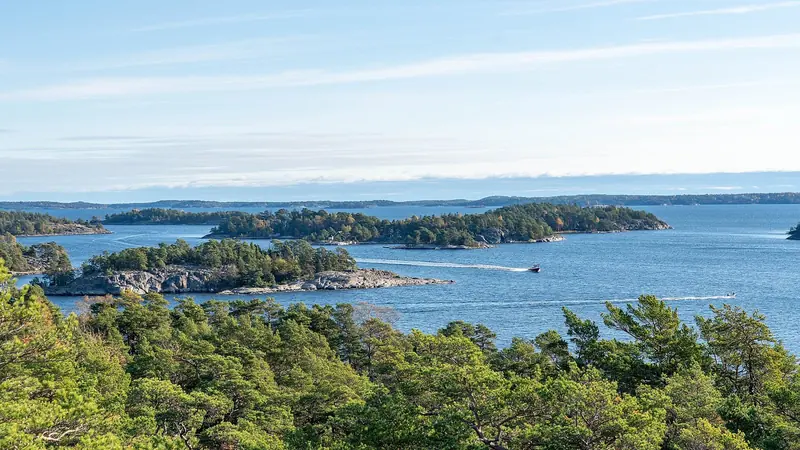
| Region | about 30,000 islands, islets and skerries running roughly 80 km east from Stockholm and 150 km north to south |
|---|---|
| Stockholm to Sandhamn, the centre of Swedish yachting, is about 25 nautical miles entirely in sheltered water | |
| There is effectively no tide in the Baltic, only a few centimetres of wind driven variation | |
| There is no ocean swell inside the archipelago, and the water is brackish rather than salt | |
| Sea temperature reaches about 18 to 20 degrees in a good August and is colder either side of it | |
| Season | effectively mid June to late August, and the archipelago empties in the third week of August |
| Allemansratten, the right of public access, allows free mooring in nature on shores that are not private | |
| The local technique is bow to a rock with a stern anchor and a line ashore, and nature reserves have mooring rings set into the granite | |
| Anchoring is forbidden at certain locations within Sandhamn, and the harbour asks boats to contact the tender or an attendant before mooring | |
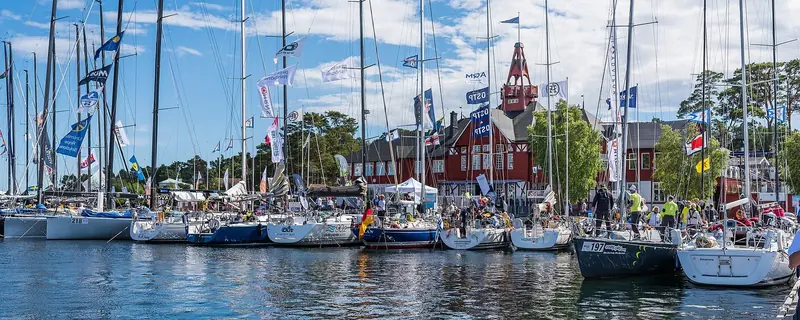
| The Royal Swedish Yacht Club runs guest marinas at Sandhamn, Lokholmen and Telegrafholmen for more than 400 boats | |
| Sandhamn itself has about 150 guest moorings, open from the last weekend in April to the last weekend in October | |
| There are around 60 guest harbours in the Stockholm area, and practically every sizeable inhabited island has one | |
| Guest harbours provide water, power, showers and usually a restaurant, and are inexpensive by the standards of this directory | |
| The islands to know | Vaxholm and its fortress, Grinda, Moja, Finnhamn, Uto in the south and Arholma at the northern end |
| Navigation is rock pilotage on marked fairways, where the charted line matters and a metre off it can be a rock | |
| Large yachts lie on the central Stockholm quays at Strandvagen and Nybroviken by arrangement with the port, in front of the Grand Hotel | |
| The Royal Swedish Yacht Club was founded in 1830 and is among the oldest yacht clubs in the world | |
| The round Gotland race runs roughly 350 nautical miles from Stockholm around the island of Gotland and back | |
| Midsummer, the weekend nearest the solstice, is the fixed point of the Swedish summer and the archipelago's busiest | |
| Stockholm is at 59 degrees north, giving about 18 hours of daylight at midsummer and a twilight rather than a night | |
| Air | Arlanda is the long haul gateway about 40 minutes north, and Bromma inside the city is the usual private aviation field |
| The Waxholmsbolaget archipelago ferries serve the islands year round, so guests can join a boat almost anywhere in the group | |
| Sweden is in the EU but not the euro. The currency is the krona and card payment is close to universal | |
| Sweden's standard VAT rate is 25 per cent, among the highest in the European Union | |
An archipelago that starts in the middle of a capital
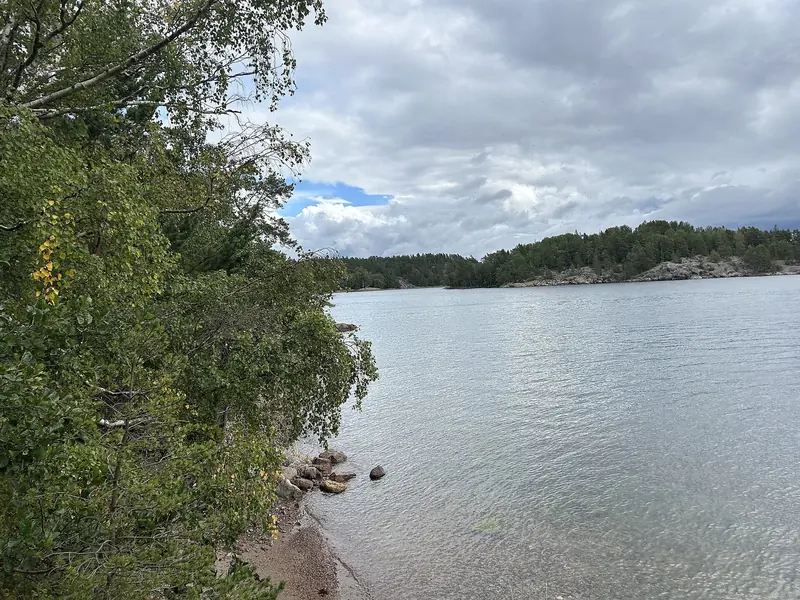
The Stockholm archipelago runs roughly 80 kilometres east from the city to the open Baltic and about 150 kilometres from north to south, and it is usually counted at around 30,000 islands, islets and skerries. It thins as it goes: wooded islands with houses and jetties on the inside, bare pink granite and juniper on the outside, and the last skerries standing alone in the Baltic. Stockholm to Sandhamn, the yachting capital of the group, is about 25 nautical miles through sheltered water the whole way.
The distinguishing feature is that the cruising begins where the city ends. A boat can lie in the middle of Stockholm one evening and be anchored off bare rock the next morning without ever leaving protected water. Very few cruising grounds put a European capital and genuine wilderness that close together, and none of the others in this directory does it without a passage in between.
No tide, no swell, and almost no salt
The Baltic behaves unlike any other cruising ground in Europe. There is effectively no tide, a few centimetres of wind driven variation rather than a range, so a boat lies to the same depth all day and a rock is where the chart says it is. There is no ocean swell inside the archipelago, because the islands break it up before it arrives. And the water is brackish rather than salt, at a salinity a fraction of the Mediterranean's, which changes what grows on the hull and what a watermaker will do with it.
The compensations come with a price. The water is cold, around 18 to 20 degrees in a good August and colder either side of it. The season is short, effectively mid June to late August with shoulders at each end, and the archipelago empties abruptly in the third week of August when Swedish schools go back. And the granite is unforgiving: this is a rock strewn ground where the marked fairways matter, where a chart plotter is a working instrument rather than a convenience, and where a metre off the line can be a metre onto a rock.
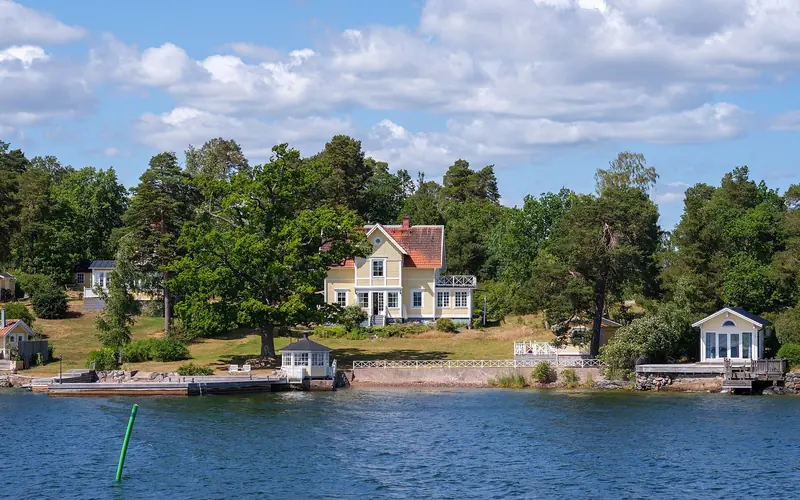
Moor to a granite rock in a nature reserve for nothing, twenty five miles from a berth in front of the Royal Palace.
The right that changes how you cruise
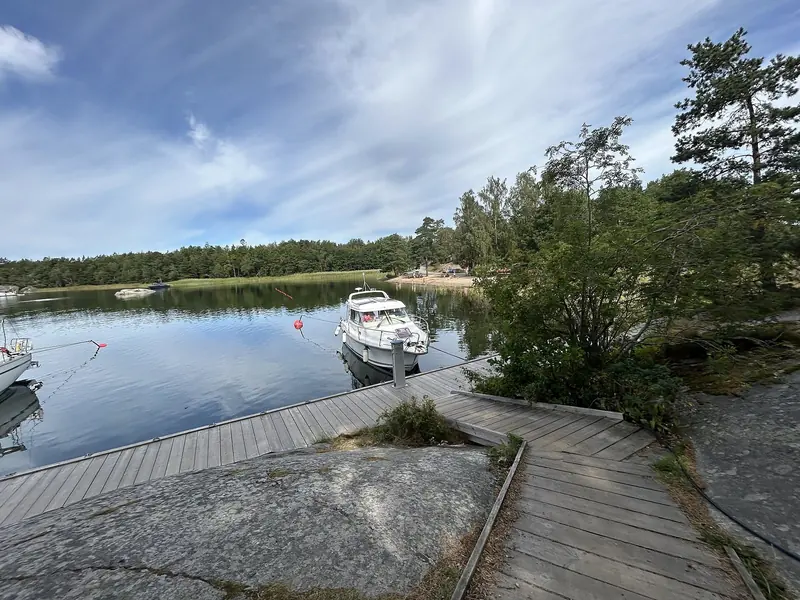
Allemansratten, the Swedish right of public access, allows a boat to moor in nature, free of charge, on shores that are not private, and it is the reason the archipelago is cruised the way it is. The local technique is to go bow to a rock face with an anchor out astern, with a line ashore to a ring or a tree, which is why so many Swedish boats carry a bow ladder and why the nature reserves have mooring rings set into the granite. Nobody charges, nobody books and there is no marina involved.
That freedom sits alongside real restrictions in the busy places. At Sandhamn, anchoring is forbidden at certain locations, and the harbour asks that a boat contacts the tender or a harbour attendant before mooring rather than helping itself. Nature reserves have bird protection areas that are closed in the nesting season. The workable summary is that the outer archipelago is genuinely free, the popular islands are managed, and the difference is signposted rather than guessed at.
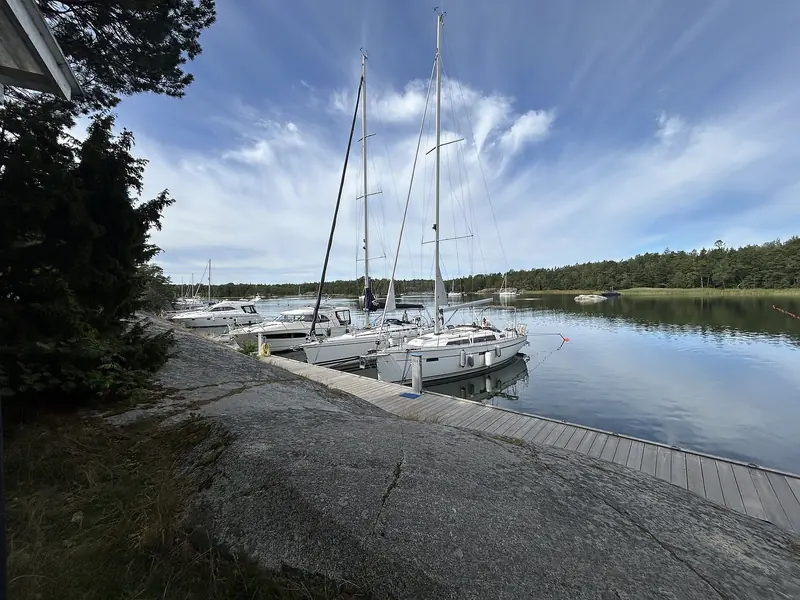
Sandhamn, and the sixty guest harbours
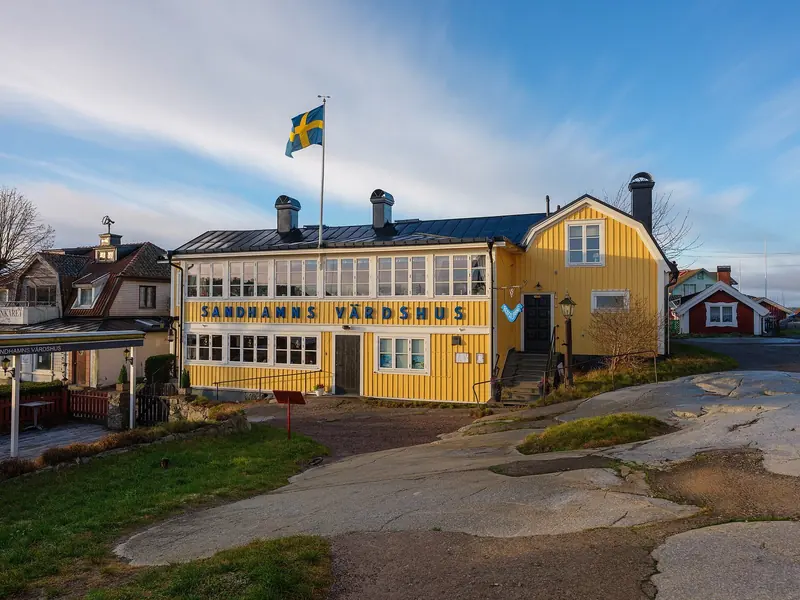
Sandhamn on Sandon is the centre of Swedish yachting and the home of the Royal Swedish Yacht Club, which runs guest marinas at Sandhamn, Lokholmen and Telegrafholmen for more than 400 boats, with about 150 guest moorings at Sandhamn itself. The marina opens from the last weekend in April to the last weekend in October. The village behind it is a pilot station turned sailing town, and in July it is the busiest small harbour in Sweden.
Around it there are some sixty guest harbours in the Stockholm area, and practically every inhabited island of any size has one. Uto in the south, Moja and Finnhamn in the middle, Grinda close in, Arholma at the northern end and Vaxholm on the way out of the city with its fortress in the channel. They provide water, power, showers and usually a restaurant, they are inexpensive by the standards of anywhere in this directory, and in the peak fortnight they fill by mid afternoon.
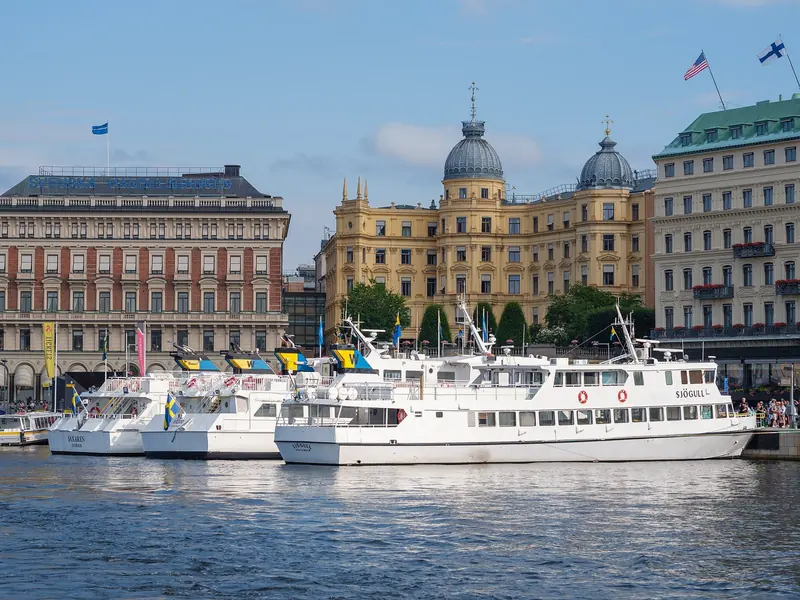
Where a large yacht actually goes
This is a ground built for boats of ten to twenty metres, and that is the honest starting point. The guest harbours are sized accordingly, the natural harbours are approached between rocks, and a deep draft closes off a great many of the best places. A yacht of 30 metres and more cruises the main fairways, anchors in the larger bays and works the archipelago by tender, which is a perfectly good way to see it but is not the way the place is designed to be used.
In the city itself, large yachts lie on the central quays by arrangement with the port, along the waterfront at Strandvagen and Nybroviken, in front of the Grand Hotel and within sight of the Royal Palace. It is one of the most spectacular city berths in Europe and it is arranged rather than booked. Checked in August 2026, no Stockholm marina publishes a superyacht rate card, and the practical route for anything of size is an agent.
The season, and the light
Stockholm sits at 59 degrees north, so midsummer gives around 18 hours of daylight and a twilight rather than a night, and the whole culture of the archipelago is built on those few weeks. Midsummer itself, the weekend nearest the solstice, is the fixed point of the Swedish calendar and the archipelago is at its fullest and its happiest. July is the holiday month. The first fortnight of August is warm and quieter, and after the third week the water empties and stays empty.
The weather is Baltic rather than Atlantic: generally settled in summer with sea breezes, but capable of a hard blow from any direction with very little warning, and thunderstorms in high summer that arrive quickly. Because everything is close, that is a nuisance rather than a hazard, and there is shelter within half an hour almost everywhere in the group. Outside the season the archipelago freezes, and icebreakers keep the commercial channels open through the winter.
The fixed week, and the racing
The Royal Swedish Yacht Club, founded in 1830, is one of the oldest yacht clubs in the world and it runs the racing calendar from Sandhamn. The offshore classic is the round Gotland race, roughly 350 nautical miles from Stockholm out into the Baltic, around the island of Gotland and back, and it is one of the largest offshore races in the world by entry. The regatta week at Sandhamn is the social fixture of the Swedish summer.
Beyond racing, the archipelago is a cruising rather than a spectating culture. There is no equivalent of Porto Cervo's Piazzetta or Cowes' waterfront, and the Swedish attitude to a large yacht is polite rather than impressed. An owner who wants to be seen is in the wrong sea. An owner who wants to swim off a granite slab at eleven at night in daylight has arrived.
Getting guests in
Stockholm Arlanda is the long haul gateway, about 40 minutes north of the city, and Bromma sits inside the city and is the usual field for private aircraft, a few minutes from the central quays. Both run full year schedules, and the Arlanda Express reaches the centre in twenty minutes. From the city, the archipelago boats of the Waxholmsbolaget serve the islands year round, which gives guests a workable way to join a yacht anywhere in the group without a helicopter.
Sweden is in the European Union but not in the euro, so the currency is the krona and card payment is close to universal, cash close to extinct. English is spoken to a standard that makes an interpreter unnecessary. Sweden's standard VAT rate is 25 per cent, among the highest in the Union, and the treatment of a charter depends on flag, place of departure and itinerary, so the structure belongs with a Swedish adviser before the boat arrives.
Ashore
Stockholm is built on fourteen islands and is one of the best looking capitals in Europe, with Gamla Stan's medieval core, the Vasa museum holding a warship raised whole from the harbour after 333 years underwater, the palace, and a restaurant scene that has been quietly excellent for two decades. The city quays put a boat inside walking distance of all of it. Guests who want a city and a wilderness in the same week can have both here more easily than anywhere else in this directory.
In the archipelago the shore side is deliberately small: a jetty, a summer restaurant, a shop, a sauna. Vaxholm has its fortress, Grinda and Finnhamn have their inns, Uto has a mine and a bakery, and Sandhamn has the yacht club and the hotel. The Swedish sauna and swim ritual is the actual entertainment, and guests either take to it immediately or spend a week explaining that they will try tomorrow.
The honest downside, and what is not published
The season is ten weeks and the water is 18 degrees in the best of them. The ground is built for boats a third the size of most in this directory, and a large yacht spends the fortnight on the main fairways with the tender working. Navigation is unforgiving rock pilotage rather than open water cruising. Sweden's standard VAT is 25 per cent. And after the third week of August the archipelago is beautiful, empty and closed.
Checked in August 2026, no Stockholm marina or guest harbour publishes a superyacht rate card, and none publishes a fuel price. The city quay berthing that large yachts use is arranged through the port and the agents rather than tariffed publicly. The guest harbour fees are published locally and vary island by island with no consolidated table. And nothing published tells an owner how many of Sandhamn's 150 guest moorings are free on a Friday in July, which is the number that decides the weekend.
À terre, accès et réservation
| Getting there | Stockholm Arlanda is the long haul gateway about 40 minutes north of the city, with the Arlanda Express reaching the centre in twenty minutes, and Bromma sits inside the city and is the usual field for private aircraft, a few minutes from the central quays. Both operate year round. The Waxholmsbolaget archipelago ferries run to the islands throughout the year, which means guests can join or leave a yacht almost anywhere in the group without a helicopter, and that is unusual in this directory. |
|---|---|
| Where the boat berths | In the city, large yachts lie on the central quays along Strandvagen and Nybroviken by arrangement with the port, in front of the Grand Hotel and within sight of the Royal Palace. In the archipelago, the Royal Swedish Yacht Club runs guest marinas at Sandhamn, Lokholmen and Telegrafholmen for more than 400 boats, with about 150 guest moorings at Sandhamn itself, open from the last weekend in April to the last weekend in October. Around 60 further guest harbours cover the rest of the group. |
| Mooring in nature | Allemansratten, the right of public access, allows a boat to moor free of charge on shores that are not private. The Swedish method is to go bow to a rock face with an anchor laid astern and a line ashore to a ring or a tree, which is why so many local boats carry a bow ladder and why nature reserves have rings set into the granite. It costs nothing and needs no booking. In the busy places the rules tighten: anchoring is prohibited at certain spots inside Sandhamn and bird protection areas close during nesting. |
| Navigating the rock | There is no tide to allow for and no swell inside the islands, which sounds easy and is not. The seabed is granite, the channels are narrow and the marked fairways exist because the alternative is rock. Swedish charting is excellent and the plotter is a working instrument here rather than a convenience. A large draft closes off many of the best natural harbours entirely, so plan the fairways for the yacht and the coves for the tender. |
| What the water and the season are like | The Baltic is brackish, at a fraction of Mediterranean salinity, which changes hull growth and what a watermaker will do with it. Sea temperature runs about 18 to 20 degrees in a good August. The season is effectively mid June to late August with usable shoulders, midsummer is the fixed point of the Swedish calendar, July is the holiday month, and the third week of August empties the archipelago completely. Outside that the water freezes and icebreakers keep the commercial channels open. |
| The fixed weeks | Midsummer weekend fills every guest harbour in the group. The Royal Swedish Yacht Club, founded in 1830 and among the oldest in the world, runs the racing from Sandhamn, and the round Gotland race, roughly 350 nautical miles from Stockholm out around the island of Gotland and back, is one of the largest offshore races anywhere by entry. The Sandhamn regatta week is the social fixture of the Swedish summer, and it is the only week here that feels like a yachting event elsewhere. |
| Money and paperwork | Sweden is in the European Union but not in the euro, so the currency is the krona, card payment is close to universal and cash is close to extinct. English is spoken everywhere to a standard that makes an interpreter unnecessary. Sweden's standard VAT rate is 25 per cent, among the highest in the Union, and the treatment of a charter turns on flag, place of departure and itinerary, so take the structure to a Swedish adviser before the boat arrives rather than afterwards. |
| Ashore | Stockholm is built on fourteen islands, with the medieval core of Gamla Stan, the Vasa museum holding a warship raised whole from the harbour after 333 years on the bottom, the Royal Palace and a long standing serious restaurant scene, all within walking distance of the city quays. In the archipelago the shore side is deliberately small: a jetty, a summer restaurant, a shop and a sauna. Vaxholm has its fortress, Uto a mine and a bakery, Grinda and Finnhamn their inns, and Sandhamn the yacht club and the hotel. |
| What is NOT published | Checked in August 2026, no Stockholm marina or archipelago guest harbour publishes a superyacht rate card, and none publishes a fuel price. The city quay berthing that large yachts use is arranged through the port and agents rather than tariffed publicly. Guest harbour fees are set island by island with no consolidated table. And nothing published shows how many of Sandhamn's 150 guest moorings are free on a Friday afternoon in July, which is the only berthing number that matters here. |
Ce que rapportent propriétaires et équipages
The free mooring right is real, and it stops at the busy islands
Swedish practice under allemansratten allows a boat to moor in nature on shores that are not private without charge, and the reserves carry mooring rings set into the granite for exactly that purpose. At Sandhamn the position is different: the Royal Swedish Yacht Club states that anchoring is forbidden at certain locations within the harbour and asks that boats contact the tender or a harbour attendant before mooring rather than choosing a spot themselves.
KSSS, the Royal Swedish Yacht ClubSandhamn carries the traffic for the whole outer archipelago
KSSS operates guest marinas at Sandhamn, Lokholmen and Telegrafholmen with capacity for more than 400 boats, of which about 150 guest moorings are at Sandhamn itself, and the marina season runs from the last weekend in April to the last weekend in October. Around sixty guest harbours serve the wider Stockholm area, with one on practically every inhabited island of any size, which is why the group can absorb a July weekend at all.
KSSS and Visit StockholmThe absence of tide is the thing visiting crews underestimate
Cruising guidance for the region is consistent that the archipelago is unaffected by tides and that the islands sit close enough together to break up any Baltic sea, which makes the sailing unusually relaxed. The corollary, less often stated, is that the seabed is granite and the marked fairways exist because of it, so the ease of the water is not an invitation to leave the charted line.
Swedish archipelago cruising guidance, including SailScanner and Visit StockholmBerths need booking in the peak even though the anchoring is free
Operators in the Stockholm region report that the guest harbours provide secure berths with sanitary facilities, fresh water, shore power and often a shop or restaurant, and that berths need advance reservation particularly in peak season. In practice the popular harbours fill by mid afternoon in July, which is why the free mooring right is not merely a saving but the practical fallback for anyone arriving late.
Stockholm region charter operators, reported by yachtcharter-dagenNothing at the large yacht end is published
Checked in August 2026, no Stockholm marina or archipelago guest harbour publishes a superyacht rate card, none publishes a fuel price, and the central city quay berthing used by large yachts is arranged through the port and agents rather than tariffed publicly. No independent published owner or captain account of superyacht service standards in the Stockholm archipelago could be found.
Yotters desk, checked August 2026
Les points forts et les points de vigilance
Points forts
- Wilderness twenty five miles from a capital city berthA boat can lie in front of the Royal Palace one evening and be moored to bare granite in a nature reserve the next morning, without leaving sheltered water.
- Mooring in nature costs nothingThe Swedish right of public access allows free mooring on non private shores, with rings set into the rock in the reserves, bow to the granite and an anchor astern.
- No tide and no swellA few centimetres of wind driven variation rather than a tidal range, and the islands break up any Baltic sea before it reaches the inner water.
- Sixty guest harbours and a yacht club from 1830More than 400 berths across the Royal Swedish Yacht Club's three marinas at Sandhamn, Lokholmen and Telegrafholmen, and a guest harbour on practically every inhabited island.
- Light that changes the cruisingAround eighteen hours of daylight at midsummer at 59 degrees north, and a twilight instead of a night, so an evening swim happens at eleven o'clock.
Points de vigilance
- Ten weeks, and then it closesEffectively mid June to late August, with the archipelago emptying in the third week of August and the water freezing in winter.
- It is built for boats a third the sizeGuest harbours, natural harbours and approaches are scaled for ten to twenty metres. A 30 metre yacht works the fairways and sees the rest from a tender.
- Rock pilotage, not open water cruisingA granite seabed and narrow marked fairways mean the charted line is the safe water and a metre outside it can be a rock, tide or no tide.
- Cold water and a high tax rateEighteen to twenty degrees in the best of August, and a standard Swedish VAT rate of 25 per cent, among the highest in the European Union.
- Nothing is publishedNo superyacht rate card, no fuel price and no tariff for the city quays, which are arranged through the port and agents rather than posted.
Pour qui: An owner who wants wilderness and a capital city in the same week, is content with a boat under about 30 metres or with running tenders from the fairways, and does not mind that the whole thing lasts ten weeks.