Al Mouj Marina (Muscat)
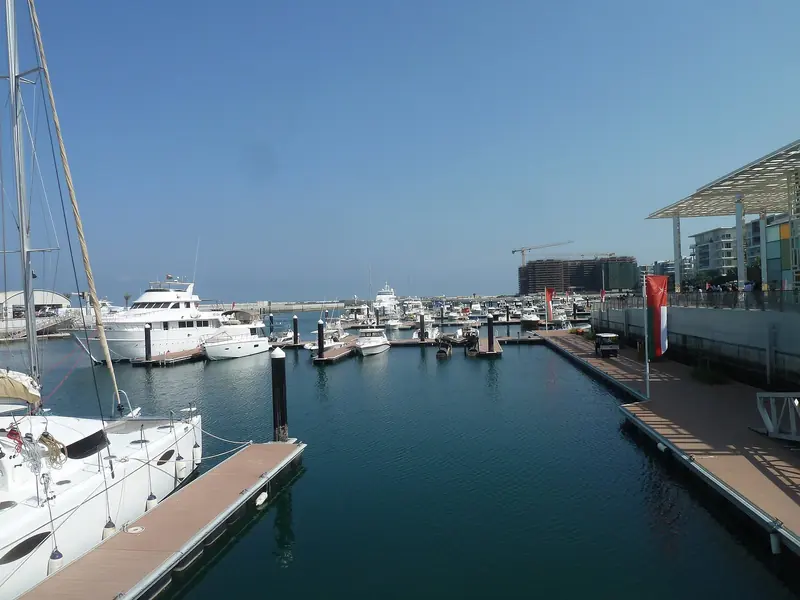
| Situation | Al Mouj Marina, Al Mouj Muscat, Seeb, Mascate, sultanat d'Oman, sur la côte du golfe d'Oman par 23 38,0 N 058 16,2 E, en dehors du détroit d'Ormuz |
|---|---|
| Exploitant et propriété | la marina est le front de mer d'Al Mouj Muscat, un Integrated Tourism Complex développé en coentreprise entre Majid Al Futtaim Properties, Oman Tourism Development Company (Omran) et Oman National Investments Development Company (Tanmia). Anciennement The Wave, Muscat, rebaptisée en 2018 |
| Places | 165 selon le site de la marina et la Leisure Marine Association. TYHA en recense 124 en service au titre d'une première phase sur 400 prévues, et PredictWind en recense 132 |
| Tailles admises | 8 à 65 m hors tout selon la marina, 10 à 40 m selon TYHA. Le tarif publié s'arrête à 40 m et marque 60 m et plus comme sur demande, sans rien de coté entre les deux |
| Profondeurs | minimum quatre mètres à l'entrée; deux à trois mètres à la basse mer moyenne à l'intérieur, avec un tirant d'eau maximal pratique d'environ trois mètres à marée basse |
| Digue | environ deux kilomètres, décrite par Al Mouj Muscat comme l'une des plus grandes du monde. Le courant de marée dans le bassin est consigné comme négligeable |
| Équipement des postes | pontons flottants avec des cheminements de six mètres de large, amarrage à couple et cul à quai, places pour catamarans disponibles, courant de quai jusqu'à 600 ampères, eau potable au poste et aspiration des eaux grises et noires. Aucun tarif unitaire n'est publié pour l'électricité ni pour l'eau |
| Carburant | ponton carburant avec essence et gazole, facturés aux tarifs nationaux omanais. Août 2026: gazole OMR 0,26 le litre, E-Plus 91 OMR 0,23, Special 95 OMR 0,24, fixés mensuellement par le ministère de l'Énergie et des Minéraux |
| VHF | canal 74 pour la marina, canal 16 pour le Port Control et pour l'appel avant arrivée |
| Douane | port d'entrée, immigration et dédouanement traités par des agents locaux agréés. La liste des ports d'entrée omanais de Noonsite n'inclut pas Al Mouj, vérifiez donc avant d'en faire votre port de dédouanement |
| Licence de navigation | depuis la décision ministérielle no 30/2026, en vigueur début février 2026, les navires et unités maritimes étrangers ne peuvent exercer aucune activité dans les eaux territoriales omanaises sans licence de navigation, demandée par un agent au moins trois jours à l'avance. Les amendes vont de OMR 500 à OMR 5 000 |
| Visas | la décision no 109/2026 de la Royal Oman Police a instauré un visa touristique gratuit de 14 jours à compter du 3 août 2026, les nationalités éligibles n'étant pas encore publiées, convertible en catégories payantes sans quitter Oman. Les visas de 30 jours et le visa d'un an à entrées multiples restent sur le système eVisa de la ROP. Aucune catégorie propre aux équipages n'est publiée |
| Accréditations | cinq Gold Anchors, seule marina d'Oman à les détenir, plus l'accréditation International Clean Marina et la désignation TYHA Superyacht Marina de septembre 2024 |
| Sortie d'eau | aucune capacité publiée à Al Mouj. Le plus fort levage de Mascate est un élévateur à bateaux de 65 tonnes avec trois cales à Marina Bandar Al Rowdha |
| Aéroport | Muscat International à environ 9 à 10 km par la route, 12 à 25 minutes, taxi annoncé entre OMR 4,5 et OMR 11 selon la source. La marina vend un accueil VIP à l'aéroport et un transfert payants |
| Devise | le rial omanais est arrimé à USD 2,6008 depuis 1986 et la Banque centrale d'Oman défend la parité, si bien que les montants en rials se convertissent à un taux stable |
Oman comme alternative au Golfe proprement dit
L'argument stratégique de Mascate, c'est la géographie. Al Mouj se trouve sur le golfe d'Oman, en dehors du détroit d'Ormuz, ce qui est une position radicalement différente de Dubaï, d'Abou Dabi ou de Doha. Un yacht basé ici n'est pas dans le golfe Persique, n'a pas à franchir Ormuz pour rejoindre la mer libre, et se trouve à une journée de route d'une zone de navigation que la majorité de la flotte régionale ne voit jamais: les îles Daymaniyat au nord-ouest et Bandar Khayran au sud-est, avec les montagnes du Hajar en arrière-plan. Le trajet vers Dubaï part dans l'autre sens, au nord-ouest le long de la côte puis autour de la péninsule du Musandam par le détroit; le chiffre à vol d'oiseau que renvoient les calculateurs de distance, environ 200 milles nautiques, ignore complètement la péninsule, prévoyez donc nettement plus d'eau que cela.
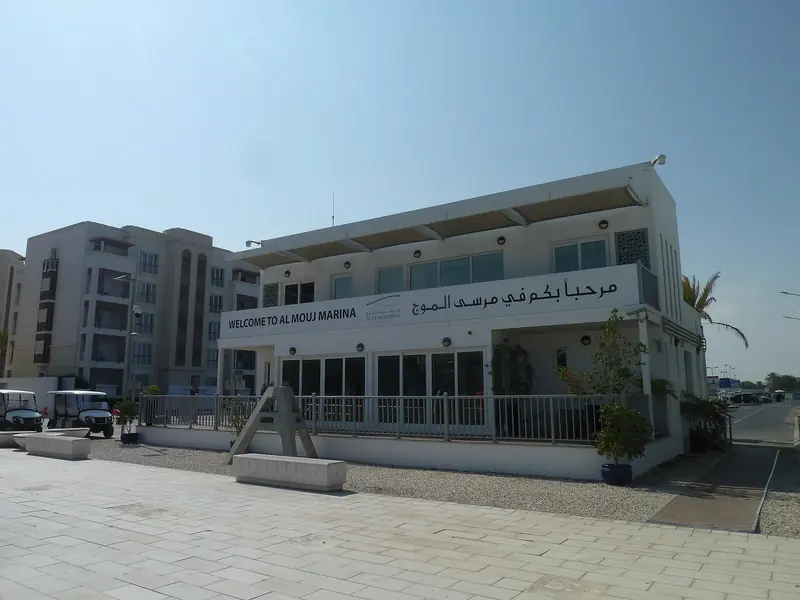
La marina constitue le front de mer d'Al Mouj Muscat, un Integrated Tourism Complex conçu comme une coentreprise public-privé entre Majid Al Futtaim Properties, des Émirats, l'Oman Tourism Development Company (Omran) et la société publique Oman National Investments Development Company (Tanmia). Le projet a ouvert sous le nom de The Wave, Muscat, et a été rebaptisé Al Mouj Muscat, l'équivalent arabe du même mot, en 2018. Cela compte pour un propriétaire parce que cela explique le caractère du lieu: un domaine résidentiel et hôtelier qui se trouve avoir une marina, plutôt qu'un port de plaisance autour duquel une ville aurait poussé. La conséquence est un très bon niveau pour tout ce qui est à terre et un niveau mince pour tout ce qui est technique, et cet arbitrage traverse toute cette page.
La marina, et les quatre décomptes de places qui circulent
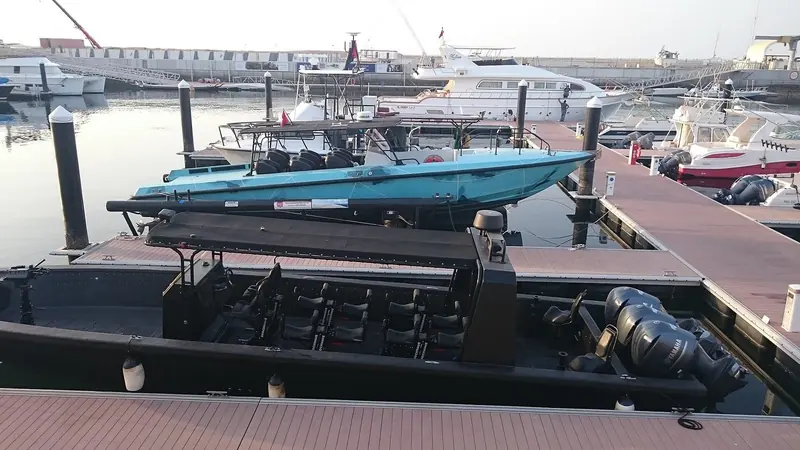
Le site d'Al Mouj Marina et la Leisure Marine Association donnent tous deux 165 places pour des yachts de 8 à 65 mètres. La fiche Global Gold Anchor de la Yacht Harbour Association donne 124 places en service au titre d'une première phase sur 400 prévues, pour des yachts de 10 à 40 mètres. La fiche de PredictWind en donne 132. La page du masterplan d'origine, du temps de The Wave, annonçait 400 places et des bateaux et yachts jusqu'à 40 mètres. Quatre chiffres, quatre sources, et la position honnête est que la marina compte aujourd'hui entre 124 et 165 places à l'eau face à un masterplan qui en a toujours visé quatre fois plus. Qui modélise un taux d'occupation ou compare la capacité à un concurrent du Golfe doit retenir les 165 de la marina et traiter les 400 comme une ambition, pas comme un actif.
Ce qui n'est pas discuté, c'est la qualité de construction. Les pontons sont flottants, avec des cheminements de six mètres de large, ce qui est d'une générosité inhabituelle et explique en partie que la marina détienne cinq Gold Anchors, la seule d'Oman, aux côtés de l'accréditation International Clean Marina et d'une désignation TYHA Superyacht Marina obtenue en septembre 2024. Les postes se prennent à couple et cul à quai, catamarans compris. Le courant de quai monte à 600 ampères, l'eau potable est au poste et il existe une aspiration des eaux grises et noires. La marina veille le canal VHF 74, tient un capitaine de port de service 24 heures sur 24 avec assistance à l'amarrage à toute heure, et exploite un service de voiturettes, un salon sur l'eau, des accès contrôlés et une vidéosurveillance. La position est 23 degrés 38,0 minutes nord, 058 degrés 16,2 minutes est.
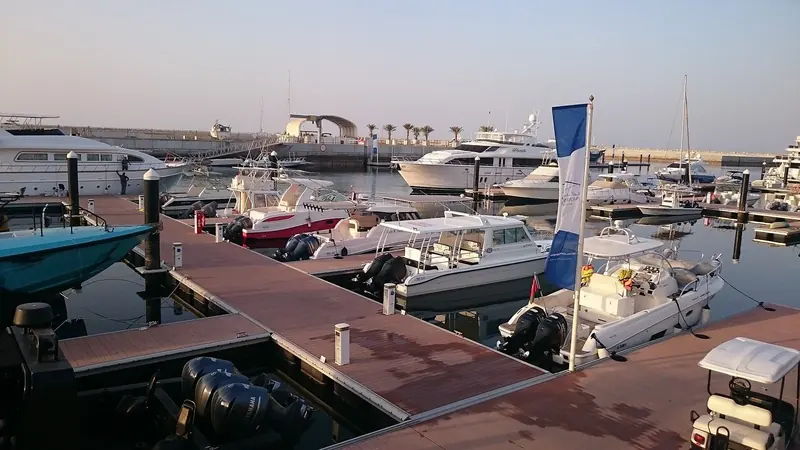
Le tarif s'arrête à 40 mètres et l'eau s'arrête à trois environ: les 65 mètres affichés sont une longueur et non une profondeur.
Profondeur, entrée et digue
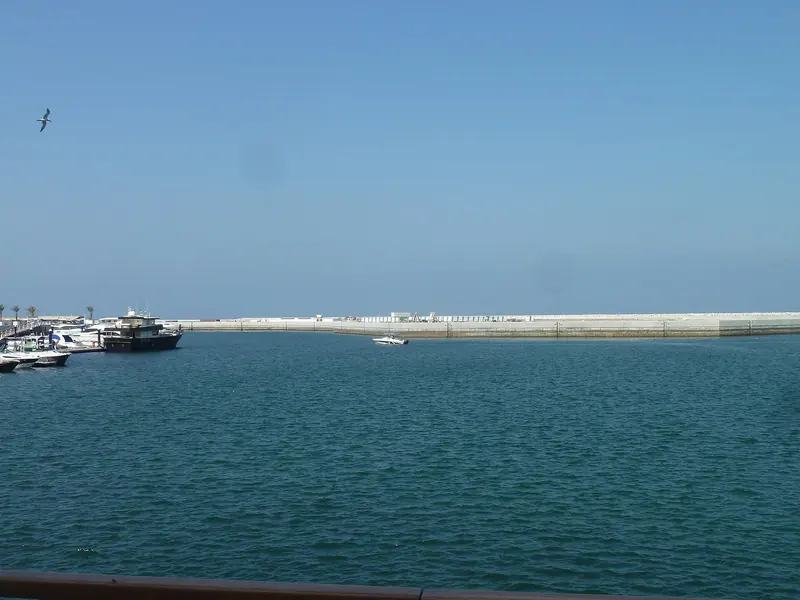
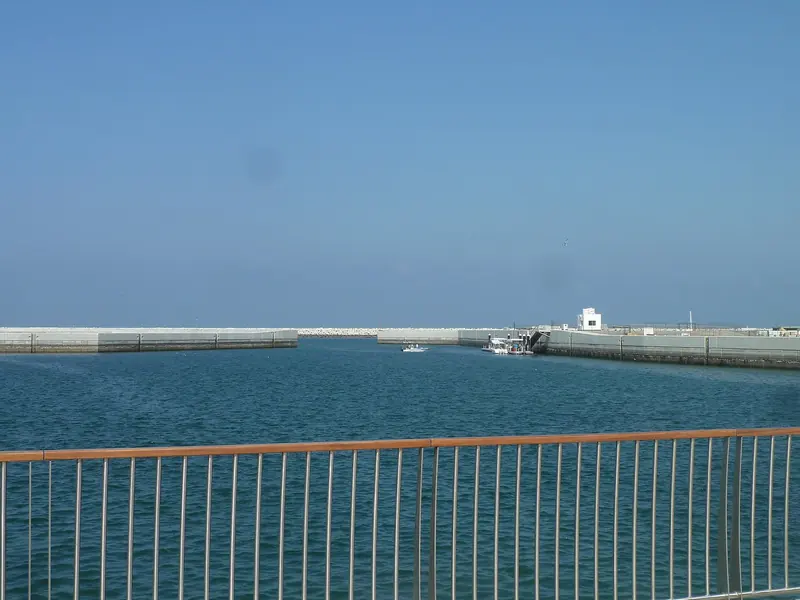
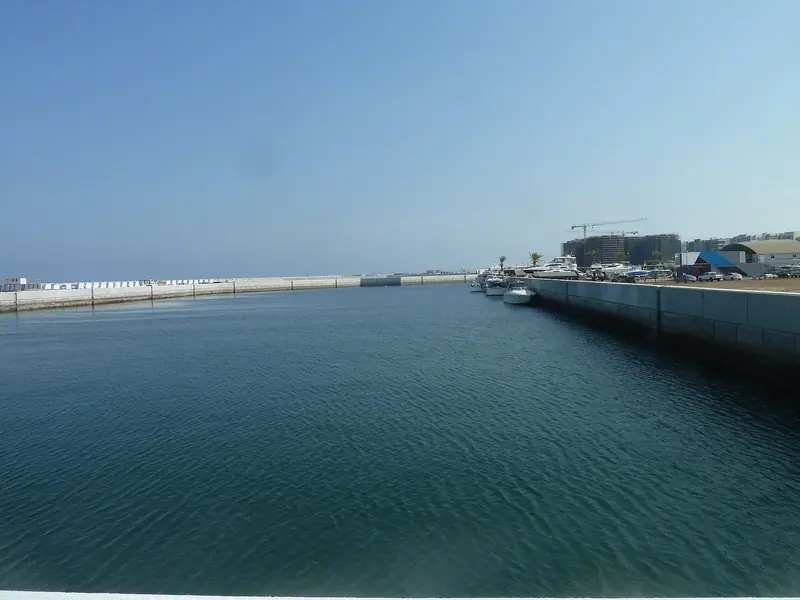
C'est la section qui décide si Al Mouj convient à un yacht donné. La digue mesure environ deux kilomètres et Al Mouj Muscat la décrit comme l'une des plus grandes du monde, protégeant le bassin du vent, de la marée et du courant. À l'intérieur, le courant de marée est consigné comme négligeable. La profondeur minimale à l'entrée est donnée à quatre mètres par la Leisure Marine Association. C'est la profondeur intérieure qui contraint: la fiche de PredictWind donne deux à trois mètres à la basse mer moyenne et juge le balisage du chenal et l'espace de manoeuvre passables plutôt que bons, et Acquera Yachting, qui place des yachts ici, indique un tirant d'eau maximal d'environ trois mètres à marée basse.
Confrontez cela à la longueur annoncée et le compte n'y est pas. Un yacht à moteur de 65 mètres cale typiquement trois mètres cinquante à quatre mètres, un 50 mètres dépasse les trois. Sur les profondeurs publiées, la plupart des yachts de plus de 40 mètres environ ne peuvent tout simplement pas séjourner dans ce bassin, quoi que dise le marketing, et le tarif de la marina l'admet lui-même en s'arrêtant à 40 mètres et en marquant tout ce qui est au-dessus comme sur demande. La lecture pratique est qu'Al Mouj est une excellente marina pour des yachts jusqu'à 35 mètres environ, jouable à 40 mètres avec une carène peu tirante et une place confirmée, et au-delà un coup de téléphone plutôt qu'une réservation. La marina propose aussi ce qu'elle appelle un mouillage abrité et desservi, ce qui est la réponse honnête pour un yacht à fort tirant d'eau qui veut être à Mascate.
Khareef et shamal, et ce qui atteint réellement Mascate
Les deux saisons nommées de la région font moins à Mascate qu'un briefing à la table à cartes ne le laisse croire, et la raison tient à la côte où l'on se trouve. Le khareef est la mousson de sud-ouest; il court sur tout l'été et, selon la description du service météorologique omanais, dure généralement jusqu'à la mi-septembre, charrie l'humidité de l'océan Indien et lève une mer réellement dangereuse. Il frappe la côte de la mer d'Arabie, c'est-à-dire le Dhofar, Salalah et le littoral au sud et à l'ouest de Ras al Hadd. Mascate n'est pas sur cette côte. Elle est sur le golfe d'Oman, de l'autre côté du coude. Le bulletin national de la Direction générale de la météorologie d'Oman, lu le 6 août 2026 en plein khareef, donnait des conditions agitées le long des zones côtières de la mer d'Arabie avec une hauteur de vague maximale de quatre à cinq mètres, et peu agitées sur le reste des côtes avec une hauteur de vague maximale de 1,25 mètre. Al Mouj relève de la seconde catégorie.
Le shamal est le vent de nord-ouest qui souffle dans le grand axe du golfe Persique, avec une saison d'hiver et une saison d'été, et la climatologie publiée indique que la saison estivale du shamal tend à s'étendre d'août à septembre. Son fetch est à l'intérieur du Golfe, de l'autre côté du détroit d'Ormuz, si bien que ce qui atteint la côte du golfe d'Oman est le vent et non la mer que ce vent construit. Le résumé honnête est que Mascate est un mouillage relativement clément dans les deux saisons et que le risque de houle y est réel mais modéré: un clapot de nord-ouest à l'approche, et non la mer d'Arabie à quatre mètres cent milles plus bas sur la côte. Yotters n'a trouvé aucune étude publiée de houle ou de surcote pour le bassin d'Al Mouj lui-même, traitez donc la digue de deux kilomètres et le courant de marée négligeable comme l'indice disponible et non comme une mesure.
Les formalités d'entrée, et la licence nouvelle cette année
Al Mouj est un port d'entrée et indique sur sa propre page de services traiter les formalités d'immigration et de douane par l'intermédiaire d'agents locaux agréés. Les guides de navigation pour Oman décrivent la procédure standard: appeler le Port Control sur le VHF 16 environ une heure avant l'arrivée, attendre l'autorisation et les instructions sur le lieu des formalités, disponibles 24 heures sur 24, s'attendre à la montée à bord de la quarantaine, de l'immigration, de la douane et des autorités portuaires, et ne débarquer personne avant que les formalités ne soient closes. La liste des ports d'entrée omanais de Noonsite cite Marina Bandar Al Rowdha, Mina al Fahal, Port Salalah et la péninsule du Musandam, et ne cite pas Al Mouj: si vous voulez une certitude pour une première arrivée, faites-vous le confirmer par écrit par la marina avant d'en faire votre port de dédouanement.
Il y a un changement bien plus important que la plupart des documents de planification de 2025 ne reprennent pas. Le 26 janvier 2026, le ministère omanais des Transports, des Communications et des Technologies de l'information a pris la décision ministérielle no 30/2026 au titre de la loi maritime du décret royal 19/2023, en vigueur depuis début février 2026. Il est interdit aux navires et aux unités maritimes étrangers d'exercer une quelconque activité dans les eaux territoriales omanaises sans licence de navigation. Les licences sont délivrées pour un voyage unique, pour des voyages multiples ou pour une croisière programmée, la catégorie croisière courant sur un an avec des dates d'entrée et de sortie précisées voyage par voyage. Un agent dépose la demande au moins trois jours avant l'entrée avec le certificat d'immatriculation, l'assurance et les documents P and I, et l'autorité dispose de trois jours pour statuer. L'agent doit inscrire le navire dans le système douanier de la Royal Oman Police, traiter les passeports et la douane, régler droits et amendes et obtenir un certificat de départ; un navire sous licence doit repartir dans les 24 heures suivant l'expiration. Les navires militaires, les navires qui n'entrent que pour charger ou décharger dans un port et les urgences réelles sont exemptés. Les amendes vont de OMR 500 à OMR 5 000, avec OMR 2 000 pour l'exploitation sans licence et jusqu'à OMR 5 000 pour fausse déclaration. Les synthèses publiées ne prévoient aucune exception pour les yachts de plaisance.
Visas pour les propriétaires et pour l'équipage
Oman vient de simplifier les choses, et largement. La Royal Oman Police a pris la décision no 109/2026 instaurant un nouveau visa touristique gratuit de 14 jours, effectif au 3 août 2026, ouvrant l'entrée touristique sans frais aux ressortissants des pays déterminés par les autorités compétentes. La liste officielle des nationalités éligibles n'était pas publiée à la rédaction de cette page. Le titulaire peut basculer vers une catégorie touristique payante sans quitter Oman, et les visas touristiques de 30 jours ainsi qu'un visa d'un an à entrées multiples restent disponibles via le système eVisa de la ROP. Séparément, et antérieurement à cela, les ressortissants de plus de cent pays étaient déjà dispensés d'obtenir un visa à l'avance pour des séjours allant jusqu'à 14 jours.
Le trou, c'est l'équipage. Yotters n'a trouvé aucune catégorie de visa omanais publiée qui soit propre aux équipages de yachts arrivant par la mer, aucun équivalent marin ou C1/D nommé dans les documents de la ROP, et aucune déclaration de la marina sur le traitement d'une liste d'équipage à l'arrivée. En pratique, un équipage qui embarque ou débarque à Mascate est traité dans le cadre général touristique et d'agence, et l'obligation faite à l'agent par la décision 30/2026 d'accomplir les formalités de passeport et de respecter la législation sur le séjour est le point où cela atterrit. Pour un yacht qui prévoit des rotations d'équipage par Mascate sur une saison, c'est la question à poser par écrit à l'agent avant la première arrivée, car c'est le seul élément de cette page qui n'est véritablement documenté nulle part publiquement.
Ce que coûte une place
Al Mouj publie un tarif annuel complet, ce qui la place devant la plupart des marinas de ce guide et devant presque toutes celles du Golfe. Les tarifs annuels standard figurant sur la page d'amarrage de la marina, consultée le 6 août 2026, en rials omanais, avec le tarif résident et fidélité entre parenthèses: 10 m à 2 465 (1 726); 12 m à 3 550 (2 485); 15 m à 5 380 (3 766); 18 m à 7 510 (5 257); 20 m à 8 970 (6 279); 25 m à 13 080 (9 156); 30 m à 17 490 (12 243); 35 m à 21 975 (15 382); et 40 m à 26 310 (18 417). Tout ce qui fait 60 m et plus est sur demande. Les résidents d'Al Mouj bénéficient de 30 pour cent de remise. Le rial omanais est arrimé à USD 2,6008 depuis 1986 et la Banque centrale d'Oman défend cette parité, si bien que les conversions sont stables: une place de 20 mètres revient à environ USD 23 300 par an et une place de 40 mètres à environ USD 68 400.
Rapporté au mètre, cela fait environ OMR 449 ou USD 1 170 le mètre et par an à 20 mètres, et OMR 658 ou USD 1 710 le mètre à 40 mètres, ce qui est compétitif face aux contrats annuels européens et bon marché face à Dubaï. Ce qui n'est pas publié, c'est tout ce qui est inférieur à l'année. Il n'y a ni tarif journalier, ni hebdomadaire, ni mensuel sur la page d'amarrage, ce qui constitue un vrai manque pour un yacht de passage plutôt que basé ici, et aucun tarif publié pour l'électricité ou l'eau malgré des alimentations de 600 ampères. Le carburant est seulement décrit comme facturé aux tarifs locaux. Le tarif s'arrête en outre net à 40 mètres, sans rien entre 40 et 60, de sorte que le propriétaire d'un yacht de 45 mètres n'a ni prix publié ni place annoncée.
Carburant, avitaillement et ce qu'il y a à terre
Les prix des carburants en Oman sont fixés mensuellement par le ministère de l'Énergie et des Minéraux, annoncés autour du premier du mois et identiques dans toutes les stations du pays. Pour août 2026, les prix publiés au litre sont de OMR 0,23 pour l'E-Plus 91, OMR 0,24 pour le Special 95 et OMR 0,26 pour le gazole. GlobalPetrolPrices a situé de manière indépendante le gazole omanais à OMR 0,26, environ USD 0,67 le litre, le 3 août 2026, et enregistre le prix comme inchangé sur les douze mois précédents selon sa propre mesure, alors que la série mensuelle publiée par Oman est passée de 208 baisas fin 2025 à 258 en mars 2026: lisez-le donc comme stable depuis le printemps plutôt que comme figé. La marina dispose d'un ponton carburant avec essence et gazole et facture à ces tarifs locaux. Aucun régime d'avitaillement sous douane ou hors taxes n'est publié pour les yachts de passage, budgétez donc le prix à la pompe.
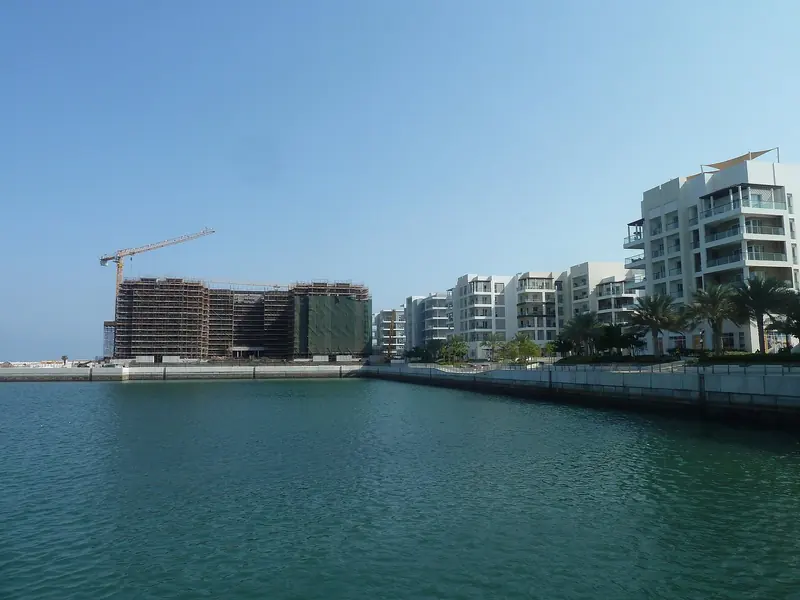
L'avitaillement et le côté terrestre sont la part d'Al Mouj qui fonctionne vraiment. Le domaine autour de la marina compte un supermarché, une banque, une blanchisserie, un centre commercial, des hôtels et des resorts, et les promenades commerçantes et gastronomiques d'Al Mouj Walk, de Marsa Plaza et de la Promenade longent l'eau; la piazza de la marina abrite elle-même des restaurants dont HuqqA pour la cuisine turque moderne et Block2 pour les burgers, en salle comme en terrasse, ce qui compte quand l'air d'août est à 41 degrés. Les titulaires d'un poste obtiennent 50 pour cent de remise sur les entrées journalières à la salle de sport et 15 pour cent sur les parcours et la restauration d'Al Mouj Golf. La destination de croisière au pas de la porte, la réserve naturelle des îles Daymaniyat, exige un permis d'entrée de l'Autorité de l'environnement d'Oman, et le débarquement comme le campement sur les îles sont totalement interdits du 1er mai au 31 octobre pour protéger la faune nicheuse, même si la plongée en apnée et en bouteille autour des îles se poursuit durant cette fenêtre. Le campement, lorsqu'il est autorisé, est plafonné à 12 personnes ou cinq tentes dans des emplacements désignés.
Le soutien technique et l'aéroport, évalués honnêtement
L'aéroport est l'argument le plus fort en faveur de Mascate et le soutien technique en est le plus faible. Muscat International est à environ neuf ou dix kilomètres de la marina, soit à peu près 12 à 25 minutes de route selon l'heure, un service de transfert annonçant OMR 4,5 à 6 pour le taxi et des résidents rapportant OMR 9 à 11 pour le même trajet: convenez du prix avant de monter. La marina vend un accueil VIP à l'aéroport et le transport en supplément payant. Dix minutes entre un aéroport international desservi en gros-porteurs et la passerelle, c'est un transfert plus court que celui de presque toutes les marinas méditerranéennes, et c'est la raison pour laquelle les propriétaires continuent de regarder Mascate.
La partie technique ne suit pas. La fiche de la Yacht Harbour Association mentionne comme disponibles à Al Mouj un élévateur et une sortie d'eau, un chantier, des métiers de la mécanique, de l'électronique de bord et un shipchandler, mais aucun chiffre de capacité n'est publié nulle part où Yotters ait pu le trouver. La vraie sortie d'eau à Mascate est à l'autre marina, Marina Bandar Al Rowdha, de l'autre côté de la ville, qui dispose de trois cales et d'un élévateur à bateaux de 65 tonnes. Il n'y a rien à Oman qui lève une coque de 40 mètres, ni aucun chantier de refit pour superyachts dans le pays, si bien que tout travail structurel implique une traversée vers les Émirats ou plus loin. Bandar Al Rowdha exploite elle-même 220 places à flot, 184 places à sec et 65 places pour jet-skis, avec environ trois mètres de tirant d'eau, et n'est donc pas non plus une solution de repli pour un grand yacht. Prévoyez Mascate comme une base d'entretien courant, pas comme un endroit où faire faire des travaux.
À terre, accès et réservation
| Getting there | Muscat International Airport is about nine to ten kilometres from the marina by road, quoted at 12 minutes on the distance services and 20 to 25 minutes by a transfer operator, which is the honest range once traffic is in it. A taxi is quoted at OMR 4.5 to 6 by one transfer service and reported by residents at OMR 9 to 11 for the same trip, so agree the fare before departure rather than after. The marina sells a VIP airport welcome and ground transport as a chargeable extra, which is worth taking for a first arrival with guests. Muscat International carries wide-body long-haul as well as regional traffic, and the ten-minute transfer is the shortest of any marina in the Gulf region covered here. |
|---|---|
| Arriving by sea and clearing in | Approach from the Gulf of Oman, outside the Strait of Hormuz, with the marina behind a breakwater of about two kilometres. Minimum depth at the entrance is four metres and the basin is two to three metres at mean low water, so confirm your draught with the dockmaster before committing. Channel marking and manoeuvring room are both rated fair rather than good on the PredictWind record, and tidal flow is negligible. Call Port Control on VHF 16 about an hour out for permission and directions to the clearance position; the marina works VHF 74. Expect boarding by quarantine, immigration, customs and port officials, and keep everyone aboard until clearance is done. Al Mouj states it handles immigration and customs clearance through licensed local agents. A 24-hour dockmaster is on duty with berthing assistance round the clock. |
| The navigation licence, which is new | Ministerial Decision No. 30/2026 was issued on 26 January 2026 by the Ministry of Transport, Communications and Information Technology under the Maritime Law of Royal Decree 19/2023 and came into force in early February 2026. Foreign ships and marine units may not conduct any activity in Omani territorial waters without a navigation licence. There are three categories: single voyage, multiple voyage and scheduled cruise, the last valid for a year with entry and exit dates given per voyage. Your agent applies at least three days before entry with the registration certificate, insurance and P and I cover, and the authority has three days to decide. The agent also has to register the vessel in the Royal Oman Police customs system, complete passport and customs procedures, settle any fees and fines and obtain a departure certificate, and the vessel must leave within 24 hours of the licence expiring. Fines run from OMR 500 to OMR 5,000, with OMR 2,000 specified for operating without a licence and up to OMR 5,000 for false information. Naval and military vessels, ships entering only to load or unload and genuine emergencies are exempt; the published summaries do not exempt pleasure yachts. |
| Reserving a berth | Contact the marina on +968 2453 4544 or [email protected], with an online reservation route on the berthing page of its site. Berths are contracted annually against the published tariff, with a 30 per cent discount for Al Mouj residents, and the marina marks 60 m and above as on application. There is no published short-stay booking product, so a yacht passing through negotiates. Given that the marina holds somewhere between 124 and 165 berths depending on which record you read, and that the number of positions able to take anything over 35 metres is not published at all, a large yacht should confirm the specific berth, its length and its charted depth in writing rather than accepting the 65-metre headline. |
| What a berth costs | The tariff published on the marina's berthing page, read 6 August 2026, in Omani rials, standard rate with the resident and loyalty rate in brackets: 10 m 2,465 (1,726); 12 m 3,550 (2,485); 15 m 5,380 (3,766); 18 m 7,510 (5,257); 20 m 8,970 (6,279); 25 m 13,080 (9,156); 30 m 17,490 (12,243); 35 m 21,975 (15,382); 40 m 26,310 (18,417); 60 m and above on application. At the Omani rial's fixed peg of USD 2.6008, in place since 1986, that is roughly USD 23,300 a year for a 20-metre berth and USD 68,400 for a 40-metre one, or about USD 1,170 and USD 1,710 a metre a year respectively. Residents of the estate take 30 per cent off. Nothing between 40 and 60 metres is priced. |
| Fuel, power and water | Oman's retail fuel prices are set monthly by the Ministry of Energy and Minerals, announced on or near the first of the month and the same at every station nationally. August 2026: E-Plus 91 at OMR 0.23 a litre, Special 95 at OMR 0.24 and diesel at OMR 0.26, the last independently confirmed at about USD 0.67 a litre on 3 August 2026 and flat for the preceding year. The marina's fuel dock carries petrol and diesel and charges at local rates. No bonded or duty-free bunkering regime for visiting yachts is published. Shore power runs to 600 amps and potable water is at the berth, with grey and black water pump-out, but no per-kilowatt-hour or per-cubic-metre tariff is published for either, so ask what is metered and at what rate before signing an annual contract. |
| Eating, provisioning and the estate | This is the marina's strongest suit. The Al Mouj estate around the basin carries a supermarket, a bank, laundry, a shopping centre and several hotels and resorts, with the Al Mouj Walk, Marsa Plaza and Promenade running the retail and dining along the water. The marina piazza itself holds indoor and al fresco restaurants including HuqqA for modern Turkish with a marina view and Block2 for burgers, and the estate is set up for year-round dining, which in a place where August afternoons reach 41 degrees means air conditioning rather than terraces. Berth holders get 50 per cent off gym day passes and 15 per cent off rounds and food and beverage at Al Mouj Golf. Muscat itself, with the Grand Mosque, Mutrah souq and the Royal Opera House, is a short drive along the coast. |
| Cruising from here, and the permit you need | The Daymaniyat Islands Nature Reserve to the north-west is the reason to keep a boat in Muscat rather than in the Gulf proper, and it is regulated. Entry needs a permit from Oman's Environment Authority, issued in paid and free categories, and tour operators will arrange one; going without means the trip is stopped and fines follow. Landing or camping on the islands is prohibited outright from 1 May to 31 October each year to protect nesting wildlife, though snorkelling and diving around them continue through that window, and when camping is permitted it is capped at 12 people or five tents in designated places. Bandar Khayran, the drowned inlet system south-east of the capital, is the other short-range destination. Longer legs are real passages: Dubai is up the coast and round the Musandam peninsula through the Strait of Hormuz, materially further than the 200 nautical miles a straight-line calculator returns. |
| What is NOT published | Any daily, weekly or monthly berthing rate. Any rate at all between 40 and 60 metres. Any per-unit price for shore power or water despite 600-amp supplies. Any haul-out capacity, travel lift tonnage or hardstanding area at Al Mouj, despite a boatyard and a hoist being listed as available. Any count of how many berths can take a yacht over 35 metres. Any maximum beam. Any wave, surge or downtime study for the basin. Any Omani visa category specific to yacht crew arriving by sea. And the total berth count is not settled: the marina says 165, TYHA says 124 of a planned 400 and PredictWind says 132. |
Ce que rapportent propriétaires et équipages
The accrediting body records a smaller and shallower marina than the marketing does
The Yacht Harbour Association's Global Gold Anchor record for Al Mouj gives 124 berths operational as phase one of a planned 400, accommodating yachts from 10 to 40 metres, on VHF channel 74, with five Gold Anchor accreditation, International Clean Marina accreditation and a Superyacht Marina designation awarded in September 2024. The marina's own material gives 165 berths and 8 to 65 metres. Both cannot be current, and the assessor's figure is the more conservative of the two.
The Yacht Harbour AssociationOman changed the rules for foreign vessels in February 2026 and most planning material has not caught up
Ministerial Decision No. 30/2026, issued on 26 January 2026, prohibits foreign ships and marine units from conducting any activity in Omani territorial waters without a navigation licence. Applications go through an agent at least three days before entry with registration, insurance and P and I documentation. Fines run OMR 500 to OMR 5,000, with OMR 2,000 for operating without a licence. Agents must obtain a departure certificate and the vessel must leave within 24 hours of expiry.
Muscat DailyEntry for owners and guests got materially cheaper three days before this page was written
The Royal Oman Police issued Decision No. 109/2026 introducing a new free 14-day tourist visa, effective 3 August 2026, granting fee-free entry to nationals of countries determined by the competent authorities. Holders can move to a paid tourist category without leaving the country. The official eligibility list had not been published at the time of writing.
Oman ObserverThe largest lift in the country is a 65-tonne hoist at the other marina
Marina Bandar Al Rowdha, on the far side of Muscat, is served by three slipways and a 65-tonne boat hoist. Its own berthing runs 220 wet berths, 184 dry berths and 65 jet-ski berths, at about three metres of draught. Nothing in Oman will lift a 40-metre hull.
Marina Bandar Al RowdhaThe cruising community's own reference does not list Al Mouj as a port of entry
Noonsite's Oman page names Marina Bandar Al Rowdha, Mina al Fahal, Port Salalah and the Musandam peninsula as ports of entry and does not name Al Mouj, while the marina states on its own services page that it is a port of entry with clearance through licensed agents. Noonsite also flags high agent and marina fees in Oman generally, and a cruiser report from Salalah recorded an agent at USD 200 to 300, compulsory third-party liability insurance with a USD 130 fine for its absence, and port fees of about USD 200. Those Salalah figures are dated and are not Muscat figures, but they set expectations about the cost of the paperwork.
NoonsiteThe khareef is on the wrong coast to matter here, and the numbers show it
Oman's Directorate General of Meteorology country outlook, read on 6 August 2026 in the middle of the khareef, gave rough seas along the coastal areas of the Arabian Sea with a maximum wave height of four to five metres, and slight along the rest of the coasts with a maximum wave height of 1.25 metres. Muscat is on the Gulf of Oman and falls in the second category. The Oman Met Office describes the south-west monsoon as running usually to mid-September and as the reason the Arabian Sea coast is dangerous through the summer.
Oman Directorate General of Meteorology
Les points forts et les points de vigilance
Points forts
- A published annual tariff, in a region where nobody publishes anythingStandard and resident rates at nine LOA bands from 10 to 40 metres, in Omani rials, against a currency pegged at USD 2.6008 since 1986. A 20-metre berth is about USD 23,300 a year and a 40-metre berth about USD 68,400.
- Ten minutes from a long-haul international airportMuscat International is nine to ten kilometres by road, 12 to 25 minutes depending on traffic, with a taxi quoted between OMR 4.5 and OMR 11 and a chargeable VIP transfer offered by the marina. No Mediterranean marina of this standard is that close to wide-body service.
- Outside the Strait of Hormuz, with real cruising ground on the doorstepThe Daymaniyat Islands Nature Reserve to the north-west and Bandar Khayran to the south-east, without a Hormuz transit and without the traffic density of the Arabian Gulf.
- Build quality and accreditation that stand upFive Gold Anchors, the only marina in Oman to hold them, plus International Clean Marina and a TYHA Superyacht Marina designation from September 2024, six-metre pontoon walkways, 600-amp shore power and a 24-hour dockmaster.
- Cheap, stable, government-set fuelDiesel at OMR 0.26 a litre in August 2026, about USD 0.67, set monthly by the Ministry of Energy and Minerals, the same at every station nationally and unchanged over the preceding year.
Points de vigilance
- Two to three metres of water rules out most yachts over 40 metresEntrance minimum four metres, basin two to three metres at mean low water, maximum draught about three metres at low tide. The 65-metre LOA headline cannot be reconciled with those depths, and the marina's own tariff stops at 40 metres.
- No haul-out or refit capacity in the country worth the nameNo lift capacity is published at Al Mouj at all. The largest hoist in Muscat is 65 tonnes, at Marina Bandar Al Rowdha. Anything structural means a passage to the UAE.
- Nothing is published short of a yearNo daily, weekly or monthly rate, no rate between 40 and 60 metres, and no per-unit tariff for the 600-amp power or the water. A yacht passing through has no published number to work from.
- Summer is genuinely punishingJuly runs around 35 degrees Celsius mean maximum with a 29-degree minimum and roughly 60 per cent humidity, and August reaches 41 degrees with humidity around 67 per cent, the highest of the year, over a sea at about 31.5 degrees. The estate is built for indoor dining for a reason.
- A long way from the fleet it would have to compete withDubai and Abu Dhabi are up the coast and round the Musandam peninsula through the Strait of Hormuz, materially further than the 200 nautical miles a straight-line calculator returns, and Muscat has none of the brokerage, charter or crew density of those ports.
- The regulatory position moved in 2026 and the crew position is undocumentedMinisterial Decision 30/2026 now requires a navigation licence for any foreign vessel activity in Omani territorial waters, with three days of lead time through an agent and fines to OMR 5,000, and no published Omani visa category exists for yacht crew arriving by sea.
Pour qui: Un propriétaire avec un yacht jusqu'à 35 mètres environ et moins de trois mètres de tirant d'eau, qui cherche une base dans la région du Golfe en dehors du détroit d'Ormuz, une vraie zone de navigation au pas de la porte et un aéroport international à vingt minutes de la passerelle, et qui n'a besoin ni d'un élévateur, ni d'un chantier de refit, ni d'une place pour quoi que ce soit approchant les 50 mètres.