Marina di Portofino
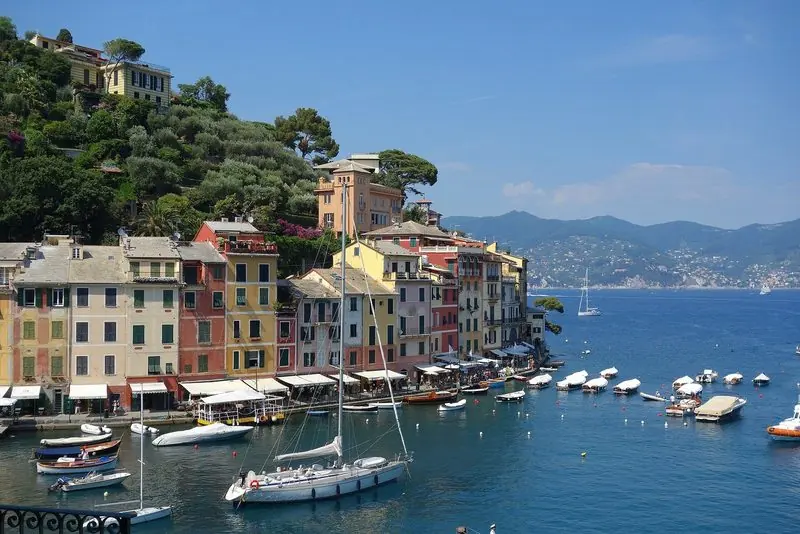
| Situation | Portofino, côte ligure, Italie |
|---|---|
| Exploitant | Portofino Yacht Marina, en gestion communale depuis 2021 |
| Quai central | quelques superyachts jusqu'à environ 64 m à quai |
| Baie voisine | un ou deux corps-morts pour des yachts jusqu'à environ 80 m |
| Plus grands yachts | au mouillage dans la baie, avec accès à terre en tender |
| Cadre | un minuscule port naturel encadré par le village |
| Haute saison | juillet et août |
| Services charge | compulsory daily services charge on top, at EUR 675 for a sailing yacht over 60 m and EUR 900 for a motor yacht |
| Carbon neutrality contribution | charged daily by length, EUR 3.51 under 12 m up to EUR 121.53 over 64 m, plus VAT |
| ISPS | EUR 650 plus VAT for commercial yachts over 500 GT, valid for periods of three days |
| Timing | berth day runs 14:00 to 12:00, exit strictly by midday, lunch stops requested by 11:00 and charged at 50 per cent of the rate |
| Marine protected area | anchoring prohibited from the Cenobio dei Dogi to the Tonnarella of Camogli and within 100 m of the Chiesa di Portofino dive site, with a booked buoy system at San Fruttuoso and Punta Chiappa from 25 April 2026 |
| Berths | 16 in total. The harbour is entirely quayed apart from the two Cannone Bay moorings |
| Lateral quay | 8 moorings, 6 on buoys and 2 on chains, for boats to 18 m LOA, with no anchor required |
| Central Quay | 6 moorings for units to 64 m LOA, five taken with an anchor down and one on a mooring block |
| Cannone Bay | 2 moorings for yachts to 80 m LOA, laid with stern buoys and an anchor |
| Depths | 1.4 m to 4 m alongside the quay, 1 m to 1.7 m at the buoys, 0.5 m to 16 m across the harbour. Bottom is mud with good holding |
| Hazards | two shoals with rocks awash, one at the surface off the Local Maritime Office building and one at 0.5 m to starboard of the fuel berth |
| Winds as named by the operator | prevailing libeccio and scirocco, traversia from the grecale, shelter from the maestrale |
| Approach | wait at the harbour mouth, call the port service on VHF 12, keep below 3 knots and give way to outbound vessels |
| Lights | white flashing 5 s, 15 M range on Punta di Portofino. Green flashing 3 s, 7 M on the inner corner of the Maritime Authority building. Red flashing 3 s, 7 M on Punta del Coppo |
| Lifting gear | a slewing crane on the quay. No capacity is published for it and there is no yard |
| Shore power | voltage, amperage and frequency are published nowhere. Italy runs at 230 and 400 V, 50 Hz and no 60 Hz supply is advertised |
| A mobile pontoon inside the harbour near the Isolotto receives cruise ship tenders | |
| Position | 44 18.18 N, 009 12.83 E |
Le plus célèbre des petits ports de la côte
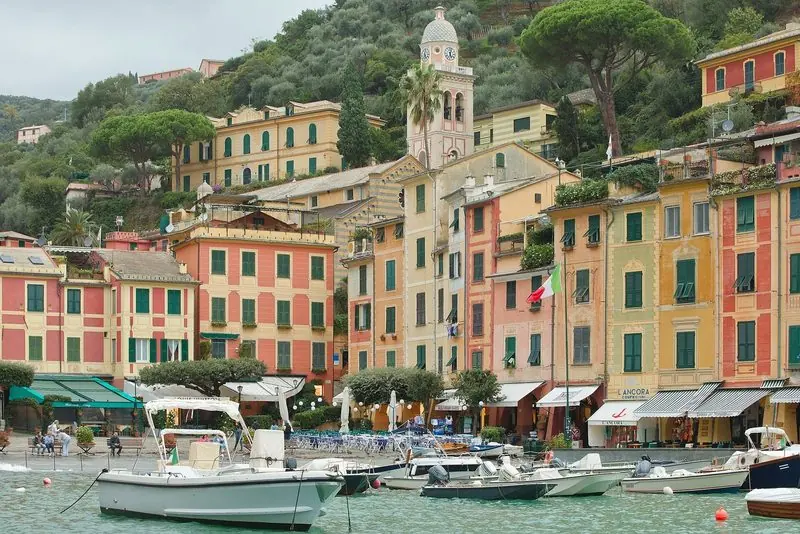
Portofino occupe une crique abritée de la côte ligure, à l'est de Gênes, un village de maisons pastel enroulé autour d'un minuscule port naturel. La baie attire artistes et voyageurs depuis plus d'un siècle, et son image compte parmi les plus reconnaissables d'Italie. Le port est petit, coincé entre les collines et le village, avec peu de place pour s'étendre. Cette contrainte est toute l'histoire du lieu.
La marina est gérée par la commune sous le nom de Portofino Yacht Marina, passée en gestion directe en 2021. Il n'y a pas ici de système tentaculaire de pontons, seulement une courte longueur de quai et quelques corps-morts. Cette échelle garde le port intime et la concurrence pour la place féroce. Portofino vit de sa rareté et non de sa capacité. Le village tient l'essentiel des voitures hors de son centre, si bien que le port et la piazzetta forment un seul espace piéton au bord de l'eau.
Une poignée de places et le mouillage
Le port n'offre qu'un petit nombre de places, le quai central pouvant recevoir quelques superyachts jusqu'à environ 64 mètres à quai. Un ou deux corps-morts distincts dans la baie voisine peuvent tenir des yachts jusqu'à environ 80 mètres. Les bateaux plus petits occupent les corps-morts restants, plus près du village. Les chiffres sont minuscules au regard des marinas plus loin sur la côte. Une place au quai central s'obtient par la capitainerie et se libère rarement au dernier moment au coeur de l'été.
Parce que le port lui-même est si limité, beaucoup de grands yachts mouillent dans la baie et rejoignent la terre en tender. Le fond tombe rapidement au large du village, ce qui donne une bonne tenue aux yachts au mouillage. Une place au quai met un propriétaire en plein coeur de Portofino, ce qui explique que les rares positions soient si recherchées. L'espace se compte ici en yachts, pas en centaines.
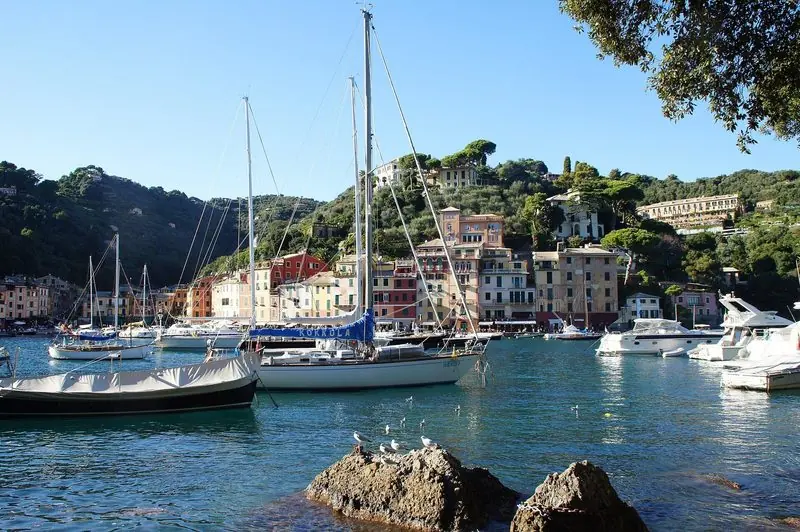
De la place pour une poignée de yachts seulement, et c'est précisément l'intérêt.
Des services dans un cadre de village
Portofino est d'abord un village et ensuite une marina, si bien que ses services sont modestes comparés à ceux des grands ports à superyachts. Le carburant et l'eau peuvent s'organiser, mais un propriétaire qui prévoit de gros travaux se tournera vers Gênes ou les chantiers de la côte ligure. La capitainerie coordonne les arrivées et le peu d'amarrages disponibles. L'avitaillement vient du village et des villes voisines. Les tenders font la navette en permanence entre les yachts au mouillage et les marches du quai, et c'est la façon normale de venir à terre ici.
Ce que le lieu offre à la place, c'est un cadre et une exclusivité. Les restaurants et les cafés de la piazzetta sont à quelques pas du quai, et les boutiques du village portent les noms qu'un propriétaire attend. L'attrait tient au fait d'être à Portofino plutôt qu'à l'offre technique. Pour le service sérieux, les yachts basés ici s'appuient sur l'ensemble de la côte ligure.
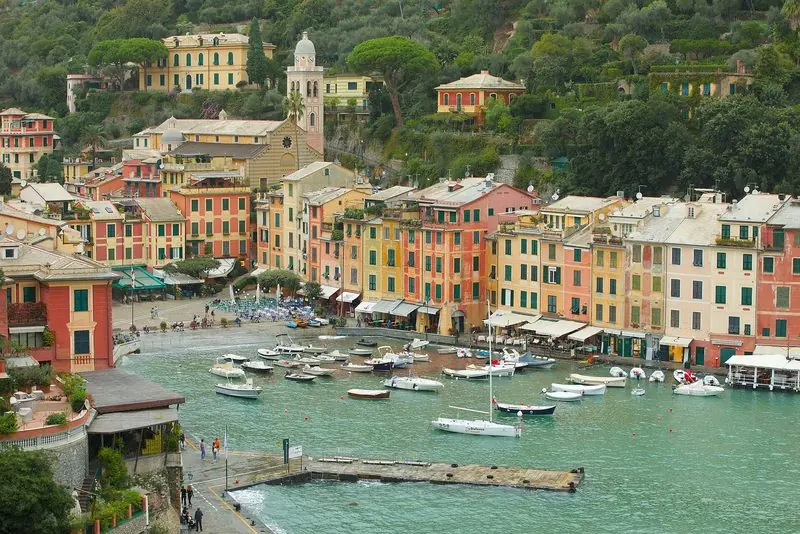
L'été ligure
Portofino tourne à plein régime tout l'été, quand le village et son port se remplissent de visiteurs à la journée et de yachts. Juillet et août sont le pic, et la petite baie peut paraître encombrée au plus fort de la saison. La côte alentour, de Santa Margherita aux Cinque Terre, ajoute à l'attrait. Le cadre est aussi célèbre que n'importe lequel en Méditerranée. Les bateaux à la journée et les ferries encombrent le plan d'eau en milieu de journée, puis s'éclaircissent une fois les visiteurs repartis le soir.
La côte ligure et tyrrhénienne s'ouvre depuis Portofino pour ceux qui naviguent sur la Riviera italienne. Gênes est à courte distance vers l'ouest, et la descente vers la Toscane et ses îles reste facilement accessible. La scène est glamour mais enracinée dans un vieux village plutôt que dans une station construite. Cette authenticité fait une large part de l'attrait.
Sa place dans le programme d'un propriétaire
Portofino est une destination que l'on visite plutôt qu'un port d'attache pratique. Il convient au propriétaire qui navigue sur la Riviera italienne et veut passer du temps dans l'un des plus beaux ports de la côte. La plupart des yachts y font escale dans le cadre d'une croisière d'été plus large plutôt que de s'y baser pour la saison. Le manque de capacité en fait une escale plutôt qu'une base. Une nuit au quai ou au mouillage suffit souvent à faire infléchir un programme d'été vers ce bout de côte.
Pour ceux qui obtiennent l'une des rares places à quai, il n'y a rien de comparable au fait d'être amarré au milieu de Portofino. La rareté qui limite le port est aussi ce qui le rend particulier. Les propriétaires associent en général une visite à Portofino à une base dans un port plus grand tout près, en utilisant le village pour son seul cadre. C'est un lieu que l'on apprécie pour ce qu'il est, non pour ce qu'il peut servir.
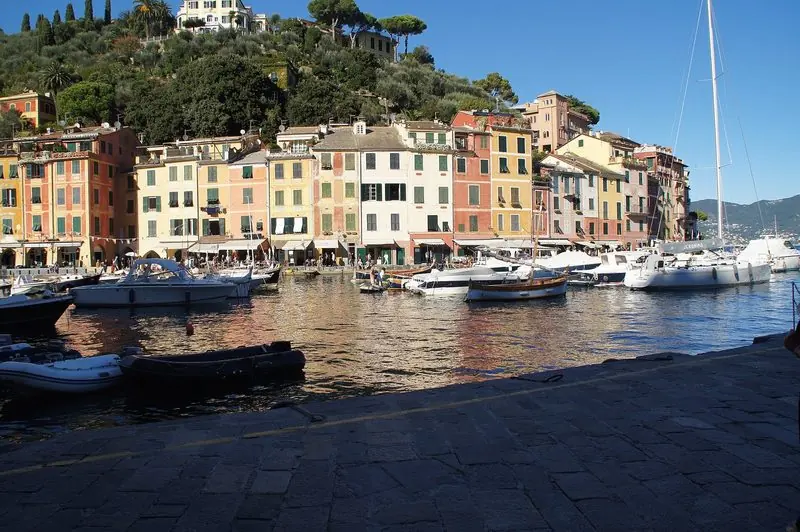
The fees on top of the fee
The headline rate is not the invoice. A compulsory daily services charge applies on top, and it differs by hull type, with a yacht over 60 metres paying EUR 675 a day if she is a sailing yacht and EUR 900 if she is a motor yacht, before VAT. In the roadstead there is a garbage service charged at a single rate of EUR 120 a day, while the Cannone Bay garbage rate is zero.
Portofino has also introduced a carbon neutrality contribution, charged daily and scaled by length, running from EUR 3.51 for a boat under 12 metres up to EUR 121.53 for anything over 64 metres, with VAT added. Commercial yachts over 500 GT at anchor or moored in Cannone Bay or on the Central Quay pay an ISPS fee of EUR 650 plus VAT for periods of three days. There is a further overnight departure charge in peak season for movements between 23:00 and 08:30.
Services, and the absence of them
Portofino is a village first, and the published service list is correspondingly short: fuel, a diver, showers and WCs, refuse, a power supply, ISPS handling, laundry, marine supplies and provisioning delivered to the boat. There is one piece of lifting gear, a slewing crane on the quay, and no capacity is published for it, which in a harbour whose deepest quay water is 4 m should be read as tender and gear handling rather than anything structural. There is no yard and no technical depth. Anything beyond a minor fix means a run down the coast to Genoa or to the Ligurian yards. On shore power the operator lists a supply and no numbers at all, with neither voltage, amperage nor frequency published. Italy runs at 230 and 400 V, 50 Hz and no 60 Hz supply is advertised anywhere, so a 60 Hz yacht converts on board.
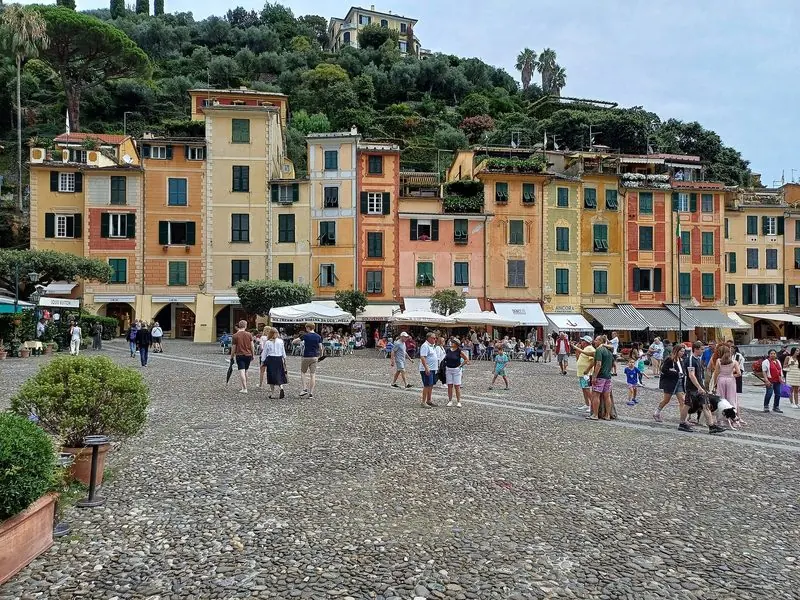
Privacy is nil and every owner who comes here knows it. The quay is a public promenade, the piazzetta terraces look straight down onto the boats from a few metres, and the harbour is the single most photographed scene on the Italian Riviera. Day boats and ferries fill the water through the middle of the day and thin out in the evening. A yacht here is on display for as long as she is alongside.
Ashore, and getting to it
The village keeps cars out of its centre, so the harbour and the piazzetta form one pedestrian space at the water's edge, with a short run of restaurants, hotels and boutiques and the walk up to the Castello Brown and the church of San Giorgio. Genoa's Cristoforo Colombo airport is the closest, roughly an hour by road, with Milan's airports two to three hours away.
For a family week the surroundings do more than the village. Santa Margherita and Rapallo sit around the headland with proper beaches and shops, San Fruttuoso abbey is reachable only by boat or on foot, and the Cinque Terre are a short cruise south-east. The promontory itself has good walking. The village alone will not hold a family for a week, and few people try.
The honest downside
There is almost no supply. The Central Quay is a handful of positions in a harbour the size of a large swimming pool, and in July and August availability is close to nil at short notice. The pricing has moved sharply, the compulsory extras are material against the headline rate, and a yacht that leaves overnight in peak season pays for the privilege. An owner planning around Portofino should treat a confirmed quay booking as the exception.
The other constraint is that this is a stop and not a base. There is no technical support, no crew infrastructure, no airport within easy reach and no capacity to hold a yacht for a season. Portofino also carries a level of day-tripper traffic that surprises people who have only seen photographs of it at eight in the morning. Owners who want the harbour usually base at a larger port nearby and bring the yacht in for a night.
The depth at the quay, and the winds the operator names
The depths are published and they are the constraint that the headline lengths hide. Alongside the quay the bottom carries 1.4 m to 4 m. At the buoys it is 1 m to 1.7 m. Across the harbour as a whole it runs from 0.5 m to 16 m. The holding is mud and good. So a 64 m yacht on the Central Quay lies stern-to with her stern in no more than 4 m of water, and the arithmetic on her stern draught wants doing at the booking and not on the approach. Two shoals with rocks awash appear in the operator's own hazard note, one at the surface in front of the Local Maritime Office building and one at 0.5 m immediately to starboard of the fuel berth.
The operator also names its winds, which most marinas do not. The prevailing winds are the libeccio from the south-west and the scirocco from the south-east. The traversia, the quarter that sends sea straight into the harbour, is the grecale from the north-east, and that is the direction that ends a stay here. Shelter is from the maestrale in the north-west. The approach procedure is to wait at the harbour mouth and call the port service on VHF 12, hold below 3 knots and give way to vessels coming out. Three lights mark it: a white flashing light of 5 second period and 15 mile range on the point of Portofino, a green flashing 3 second light of 7 mile range on the inner corner of the Maritime Authority building, and a red flashing 3 second light of 7 mile range on Punta del Coppo.
À terre, accès et réservation
| Getting there | Genoa's Cristoforo Colombo airport is the closest, roughly an hour by road around the coast. Milan's two airports run two to three hours away. There is no heliport at Portofino itself; a helicopter transfer lands at Genoa or is arranged privately further along the coast. |
|---|---|
| Arriving by sea | Call the port service on VHF channel 12 and wait at the harbour mouth. Keep below 3 knots inside and give way to vessels coming out. Three lights mark the approach: white flashing 5 seconds and 15 miles on Punta di Portofino, green flashing 3 seconds and 7 miles on the inner corner of the Maritime Authority building, red flashing 3 seconds and 7 miles on Punta del Coppo. |
| Reserving a berth | Berthing is arranged through Portofino Yacht Marina, Via Roma 35 and Piazza Liberta 13B, by phone or its booking system. There is no walk-up availability against the 6 to 8 large-yacht positions in peak season. Boat International groups Portofino with Capri and Bonifacio as a Mediterranean hotspot where a berthing agency's local relationships matter more than calling direct. |
| What a berth costs | Central Quay, 2026 card, before VAT: a yacht over 60 m pays EUR 2,100 a day low season, EUR 4,200 high season, EUR 4,700 peak. A compulsory daily services charge adds EUR 675 to EUR 900, a carbon neutrality contribution scales with length, and a garbage charge and ISPS fee apply where relevant. Cannone Bay runs EUR 1,500 to EUR 3,500 a day across the same bands. |
| The clock | The rate day runs 14:00 to 12:00 and the exit is strictly fixed at midday. A lunch-only stop between 12:00 and 15:00 can be requested by 11:00 that morning, is never guaranteed, and is billed at 50 per cent of the reference rate. In August the answer is frequently no. |
| Eating within walking distance | Ristorante Puny sits on the quay itself, run by the Miroli family for generations on Ligurian seafood and pesto. Carlo Cracco's restaurant occupies the site of the old Pitosforo, a former harbour landmark. The Hotel Splendido's cliff-top terrace looks straight down over the bay from above the village. |
| After dark | Covo di Nord Est at Paraggi beach, a short run around the headland toward Santa Margherita, is the Riviera's best-known nightclub and where the yacht crowd goes after the harbour quiets down. |
Ce que rapportent propriétaires et équipages
A booking agency, not a phone call, is how experienced captains get in
Portofino is grouped with Capri and Bonifacio as a Mediterranean hotspot where berths are scarce enough that an agency's local relationships matter; a captain calling the marina direct is competing with everyone else dialling the same number for eight positions.
Boat InternationalThe midday exit is treated as absolute, not a guideline
The operator's own rate day runs 14:00 to 12:00, the exit is described as strictly fixed at midday, and a lunch-only extension has to be requested by 11:00 that morning with no guarantee, billed at half the daily rate when granted.
Portofino Yacht Marina
Les points forts et les points de vigilance
Points forts
- One of the only marinas anywhere with an exact published tariffThe 2026 Central Quay card prices every length band by season, so an owner can cost a stop to the euro before ever calling, which almost no Mediterranean harbour of this reputation does.
- The dining matches the settingRistorante Puny on the quay, Carlo Cracco's restaurant on the old Pitosforo site and the Splendido's terrace above the bay put three serious kitchens within a two-minute walk of the boat.
- Cannone Bay takes the largest yachts the Central Quay cannotTwo stern-buoy positions are rated to 80 m LOA, six metres longer than the Central Quay's own 64 m ceiling, so the biggest boats still have a place to lie.
Points de vigilance
- Six large-yacht positions for the whole Mediterranean fleetPeak-season availability at short notice is close to nil, and Boat International names Portofino alongside Capri and Bonifacio as exactly this kind of scarce-berth hotspot.
- The headline rate is not the invoiceA compulsory services charge, a carbon neutrality contribution and an ISPS fee where it applies all stack on top, and an overnight departure in peak season carries its own surcharge.
- No technical depth and no published shore power specOne slewing crane on the quay with no stated capacity, no yard, and voltage, amperage and frequency published nowhere on the operator's own site.
- Zero privacyThe piazzetta terraces look straight down onto the boats from a few metres away, and day-tripper and cruise-tender traffic fills the water through the middle of the day.
Pour qui: Les propriétaires qui naviguent sur la Riviera italienne et veulent être amarrés dans l'un des petits ports les plus célèbres qui soient.