Puerto Banus (Marbella)
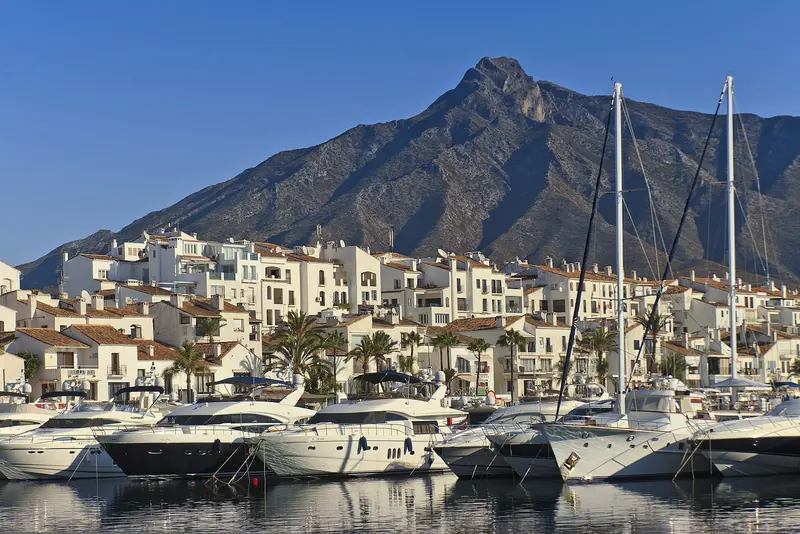
| Situation | Nueva Andalucía, Marbella, province de Málaga, Costa del Sol, par 36 28.98 N 004 57.29 W, feu vert en tête du môle extérieur |
|---|---|
| Exploitant | Puerto José Banús, S.A., sous concession administrative de la Junta de Andalucía, sous la tutelle de l'Agencia Pública de Puertos de Andalucía |
| Ouverture | mai 1970, construit par le promoteur José Banús et dessiné par Noldi Schreck avec Marcos Sainz comme un village andalou de faible hauteur autour d'une marina |
| Places | 915 sur 15 hectares et 42 165 mètres carrés de plan d'eau, pour des unités de 8 m à 50 m |
| Parc de places | 502 de 8 x 2,60 m, 233 de 12 x 3,75, 43 de 15 x 4,30, 83 de 18 x 4,80, 36 de 26 x 5,80, 6 de 30 x 6,50, 1 de 35 x 7, 10 de 50 x 8 et 1 au-delà de 50 x 9 |
| Répartition de la propriété | 194 places exploitées par le concessionnaire et 721 cédées en usage préférentiel à des titulaires privés, qui représentent 82 pour cent du plan d'eau. Aucune des places du concessionnaire n'atteint 30 m |
| Profondeurs | 3 m à 6 m dans le bassin et environ 7,5 m à l'entrée |
| Vitesse limite | 3 nœuds dans le chenal et dans le port, avec la demande de ne pas faire de vagues |
| VHF | canal 9, à appeler à moins de 5 milles nautiques ; bureau des marins de service 24 heures sur 24 |
| Électricité à quai | 16 A à 250 A, comptée de EUR 0,5133 le kWh en dessous de 500 kW par mois à EUR 0,3570 au-dessus de 5 000, plus une redevance de branchement quotidienne de EUR 1,91 à EUR 12,99 selon le type de navire |
| Eau | comptée à EUR 5,11 le mètre cube, tarif 2026, avec un minimum de service de EUR 6,44 |
| Chantier | sur place, élévateur à sangles de 50 tonnes, manutentions à EUR 16,37 le mètre linéaire jusqu'à 14 m et EUR 24,02 au-delà, séjour à terre à partir de EUR 0,57 le mètre et par jour, le tout hors TVA |
| Titre | pas de pleine propriété. Les places s'échangent comme un droit d'usage préférentiel jusqu'au terme de la concession, accordée en 1967 pour 99 ans et prorogée par résolution du 30 mai 2024, publiée au BOJA le 23 avril 2025, jusqu'au 3 octobre 2066 |
| Investissement | un programme de remplacement des pontons de EUR 7 820 000 hors TVA, de 2022 à 2025, qui a ajouté quinze places neuves, toutes de 15 x 4,30 m |
| Aéroports | Málaga Costa del Sol à environ 55 à 60 km et 40 à 55 minutes, Gibraltar à environ 67 km et 48 à 57 minutes en franchissant une frontière terrestre |
| Fréquentation | près de cinq millions de visiteurs par an selon le décompte de la municipalité de Marbella, et en 2021 les terrasses et concessions de plage ont rapporté plus que tout l'amarrage réuni |
Ce qu'est réellement Puerto Banús
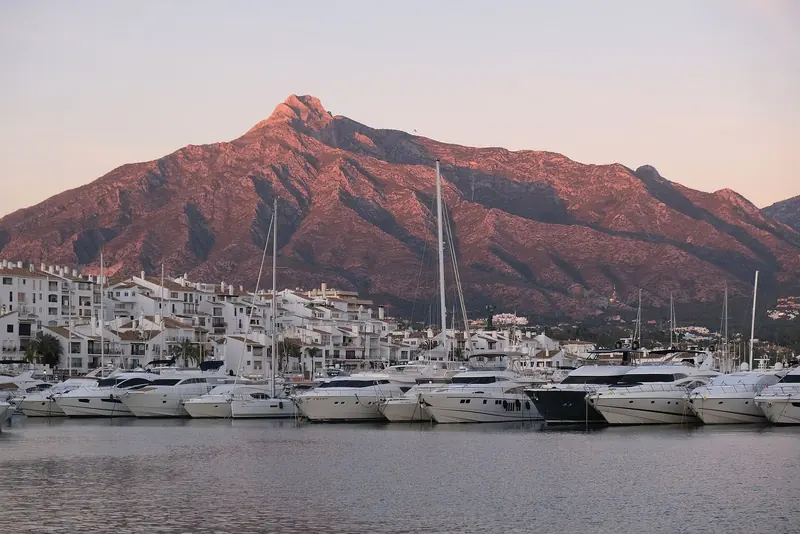
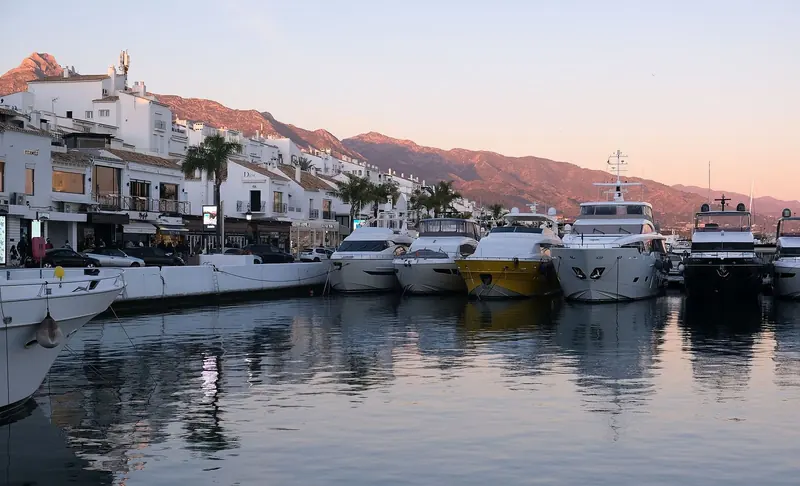
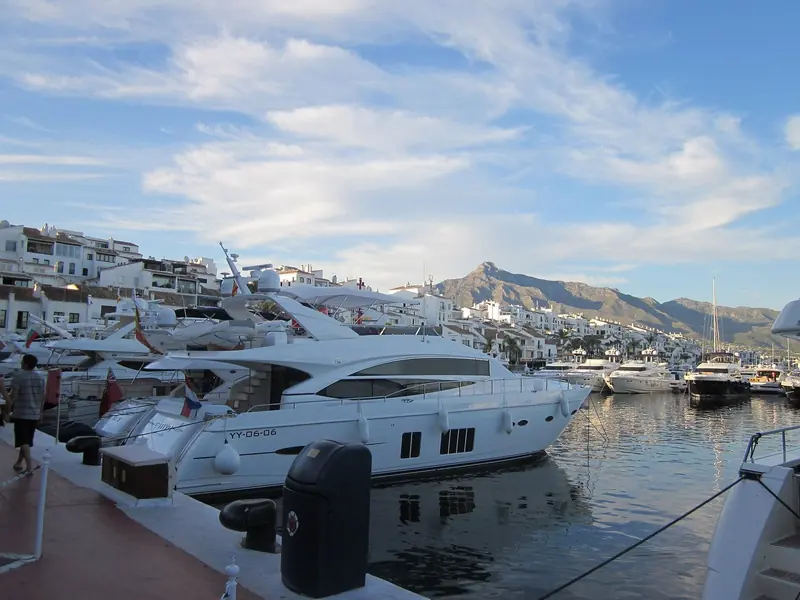
Puerto Banús a ouvert en mai 1970 à Nueva Andalucía, à environ six kilomètres à l'ouest de Marbella, sur la Costa del Sol. Il a été construit par José Banús, promoteur immobilier espagnol, et dessiné par l'architecte Noldi Schreck avec Marcos Sainz comme un village andalou de faible hauteur enroulé autour d'un bassin, et non comme un mur de tours. L'inauguration était le vrai sujet : l'Aga Khan, Roman Polanski, Hugh Hefner, le prince Rainier et la princesse Grace étaient présents, et Julio Iglesias a chanté. Cinquante-six ans plus tard, le village donne toujours sa forme au lieu, et c'est toujours la marina la plus photographiée d'Espagne.
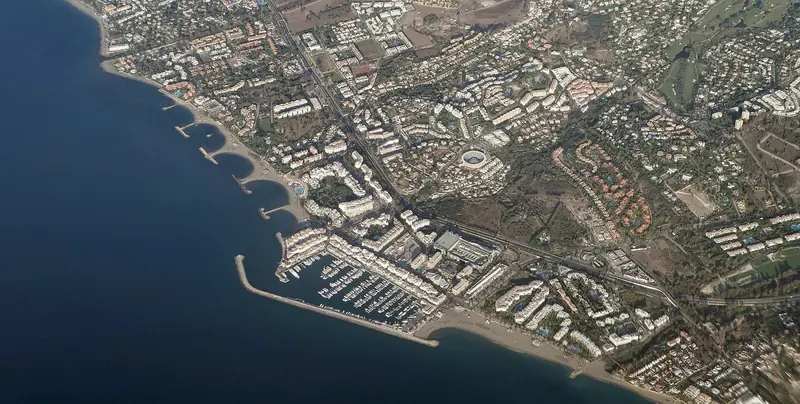
Le port occupe 15 hectares avec 915 places pour des unités de 8 à 50 mètres, des profondeurs cartographiées de 3 à 6 mètres à l'intérieur et environ 7,5 mètres à l'entrée. La municipalité de Marbella évalue la fréquentation annuelle à près de cinq millions de personnes. Il est exploité par Puerto José Banús, S.A. sous une concession administrative de la Junta de Andalucía, sous la tutelle de l'Agencia Pública de Puertos de Andalucía, et la redevance de concession versée à la région en 2021 s'est élevée à EUR 355 063. La tour de contrôle sur le môle extérieur abrite la capitainerie, le feu en tête de môle est vert, et la marina veille sur le canal VHF 9.
La question de la taille, tranchée par les chiffres de la marina
Puerto Banús paraît beaucoup plus grand qu'il ne l'est, et la correction ne relève pas de l'opinion. Dans l'étude économique que Puerto José Banús, S.A. a déposée auprès de la Junta de Andalucía en avril 2023 à l'appui de la prorogation de sa concession, la société a détaillé son parc de places ligne par ligne. On y compte 502 places de 8 sur 2,60 mètres, 233 de 12 sur 3,75, 43 de 15 sur 4,30, 83 de 18 sur 4,80, 36 de 26 sur 5,80, six de 30 sur 6,50, une de 35 sur 7, dix de 50 sur 8 et une de plus de 50 sur 9. Soit 915 au total, sur 42 165 mètres carrés de plan d'eau.
Relisez cela en acheteur. Quatre-vingts pour cent de Puerto Banús, ce sont des bateaux de 12 mètres et moins. Cinquante-quatre places dans tout le port font 26 mètres ou plus. Dix-huit font 30 mètres ou plus. Onze relèvent de la classe des 50 mètres, et exactement une position est décrite comme dépassant 50 mètres. Le tarif 2026 publié le confirme : la plus grande tranche nommée est le type I à 50 sur 9 mètres, et tout ce qui se trouve au-dessus tombe dans une seule ligne sans numéro appelée Upper length, la feuille de tarifs renvoyant au service clients pour tout dépassement de largeur ou de longueur. Si vous armez un yacht de 55 mètres, Puerto Banús n'est pas une marina autour de laquelle on organise une saison. C'est une escale de déjeuner que l'on réserve très à l'avance, si l'unique position est libre.
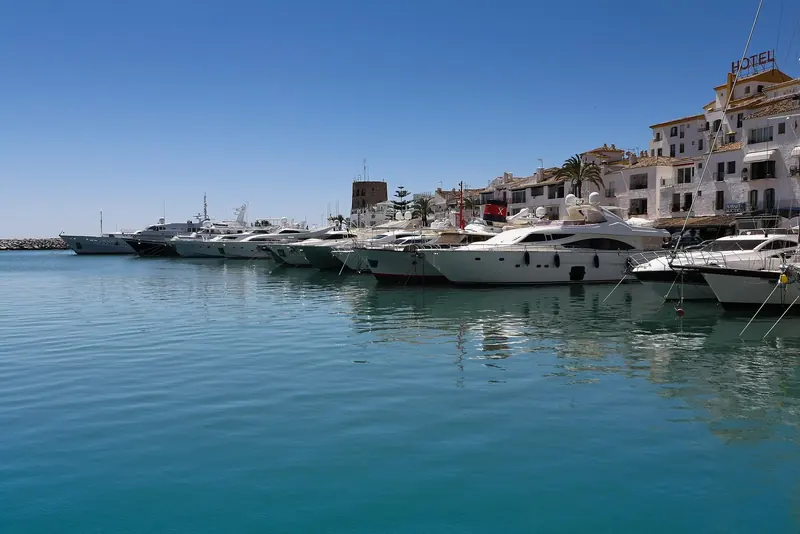
Puerto Banús compte 915 places, dix-huit d'entre elles font trente mètres ou plus, et la marina n'en détient aucune des dix-huit.
À qui appartient l'eau, et pourquoi cela change la réservation
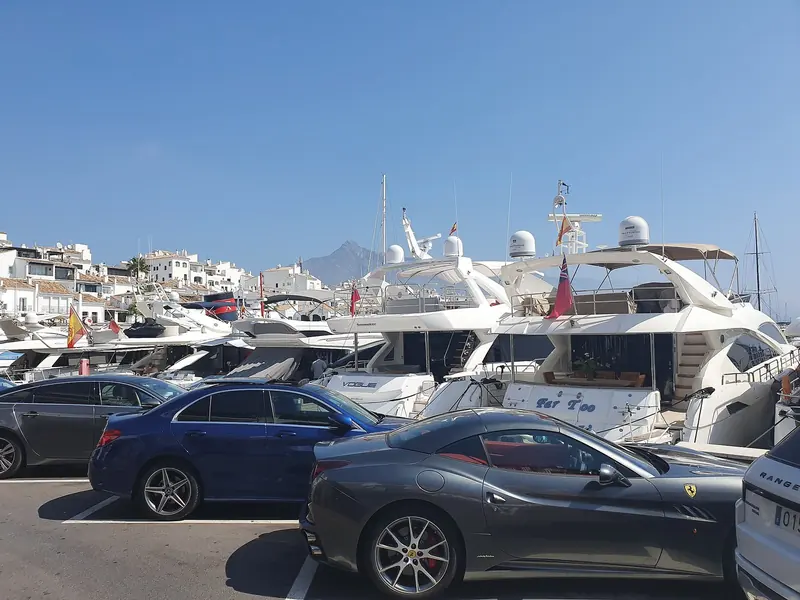
Le second fait structurel est plus étrange encore que le premier. Sur les 915 places, le concessionnaire n'en exploite que 194. Les 721 autres, soit 79 pour cent des places et 82 pour cent du plan d'eau, ont été cédées en usage préférentiel à des tiers. Ces titulaires versent des quotes-parts à une communauté des titulaires de places, la Comunidad de Titulares de Puerto Banús, qui couvre les frais d'exploitation et de conservation et a encaissé EUR 831 902 en 2021. Le concessionnaire y cotise lui aussi pour ses propres places, EUR 595 270 la même année.
Superposez maintenant le tableau des tailles à la répartition de la propriété. Sur les 194 places de la marina, 97 font huit mètres, 63 douze, 20 dix-huit, douze quinze et deux vingt-six. Elle ne détient rien à 30 mètres, rien à 35, rien à 50 et rien au-delà. Toutes les grandes places de Puerto Banús, sans exception, appartiennent à un titulaire privé. Autrement dit, un superyacht qui cherche une saison ici ne traite pas vraiment avec le port : il loue à un particulier par l'intermédiaire d'un courtier, aux conditions de ce particulier, et le rôle de la marina se réduit à facturer les fluides et à enregistrer l'arrivée. Cela explique aussi pourquoi le marché des grandes places est ici opaque là où celui des petites ne l'est pas.
Ce que coûte une place en 2026
Puerto Banús publie tout de même un tarif, ce que la plupart des marinas espagnoles de ce profil ne font pas. La feuille 2026 place la haute saison en juin, juillet, août et septembre, la moyenne saison en mai et octobre, et la basse saison de novembre à avril, les prix étant indiqués TVA comprise et hors une taxe que la feuille appelle Tax 0. Tarifs journaliers en haute saison : EUR 50 pour 8 sur 2,60 mètres, EUR 89 pour 12 sur 3,75, EUR 150 pour 15 sur 4,30, EUR 198 pour 18 sur 4,80, EUR 343 pour 26 sur 5,80, EUR 366 pour 30 sur 6,50, EUR 537 pour 35 sur 7, EUR 1 582 pour 50 sur 8, EUR 2 498 pour 50 sur 9 et EUR 5 271 pour la ligne Upper length. En basse saison, les mêmes tranches donnent EUR 17, 27, 75, 101, 174, 208, 290, 459, 711 et 1 530.
Les tarifs annuels sont le chiffre qui compte pour qui base son bateau ici : EUR 5 017 à 8 mètres, EUR 10 971 à 12, EUR 19 402 à 15, EUR 26 173 à 18, EUR 49 870 à 26, EUR 56 143 à 30, EUR 80 216 à 35, EUR 176 714 à 50 sur 8, EUR 278 184 à 50 sur 9 et EUR 536 618 pour Upper length. Notez le saut entre les deux tranches de 50 mètres : un mètre de largeur supplémentaire coûte EUR 101 470 par an, la largeur est donc facturée ici bien plus durement que la longueur. Les longs séjours sont remisés en cas de paiement anticipé, à 15 pour cent pour un mois, 20 pour trois, 25 pour six et 30 pour huit mois dans la fenêtre d'octobre à mai, et seulement 8 et 12 pour cent pour un et trois mois en haute saison. Une réservation exige le versement de 50 pour cent du devis, et la remise pour paiement anticipé du forfait annuel est annoncée jusqu'à 50 pour cent, avec une carte de parking à tarif réduit et une sortie d'eau, une remise à l'eau et sept jours au chantier compris.
Acheter une place, et la date qui figure au bout
En Espagne, on ne possède pas l'eau. Ce qui change de mains à Puerto Banús est un droit d'usage préférentiel courant jusqu'au terme de la concession administrative du port, et ce terme vient de bouger. La concession a été accordée en 1967 pour 99 ans. Le titre en vigueur allait jusqu'en 2043, et Puerto José Banús, S.A. a demandé, au titre d'une réforme de la loi portuaire andalouse de 2020, la consolidation de la durée entière de 99 ans. La Junta de Andalucía a tranché par résolution du 30 mai 2024, publiée au BOJA le 23 avril 2025, qui enregistre la modification substantielle de la concession comme une prorogation de son terme jusqu'à sa période finale, soit le 3 octobre 2066. C'est la date, au jour près. Le 2067 que l'on lit ailleurs est l'horizon du modèle de trésorerie de la société et non une durée de concession, et les annonces de courtiers vantant une concession jusqu'en 2070 ne reposent sur aucune source officielle.
La prorogation s'est payée en investissements. La société s'est engagée sur un programme de remplacement des pontons doté d'un budget de marché de EUR 7 820 000 hors TVA, EUR 9 462 200 TVA comprise, en trois phases de 2022 à 2025 : d'abord les réseaux généraux et les pontons 6 et 7, puis les pontons 3 et 4 avec la première section du ponton 2, enfin les pontons 5 et 8 avec la seconde section du 2. L'agence a fixé l'investissement éligible à EUR 7 845 354,61. Voici la partie qu'un propriétaire de grande unité devrait lire deux fois : les places nouvelles créées par l'ensemble de ce programme sont cinq de 15 sur 4,30 mètres au ponton 6 et dix autres de même taille au ponton 3. Quinze places neuves, toutes de quinze mètres, et aucune en troisième phase. Puerto Banús a dépensé près de huit millions d'euros pour se moderniser sans ajouter un seul mètre de capacité pour les grandes unités. Côté revente, le petit segment est ouvertement affiché, avec une place de 12 sur 3,75 mètres au ponton 4 proposée à EUR 96 000 en 2026, tandis que les places de 18, 26, 30 et 50 mètres sont annoncées par plusieurs courtiers sans le moindre chiffre.
Le vent, l'entrée et la question de la houle
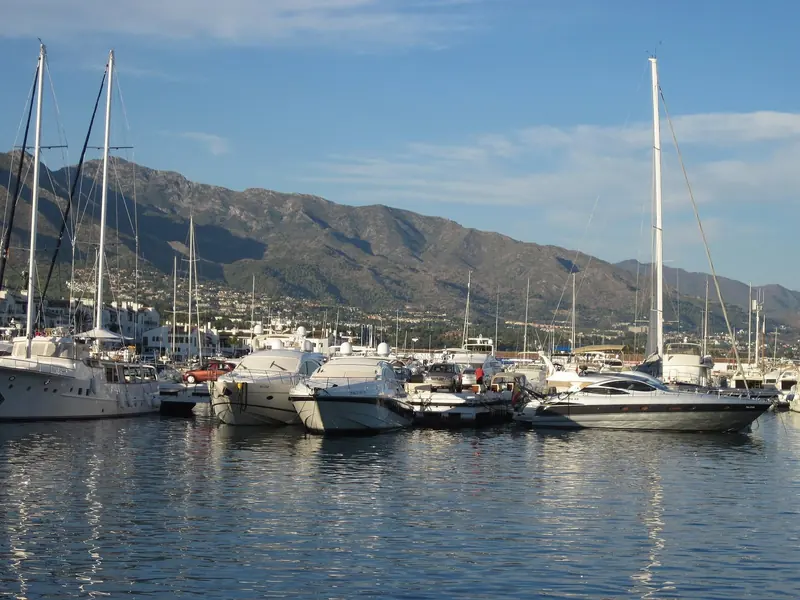
Cette côte vit au rythme de deux vents qui portent deux noms. Le levante vient de l'est, souffle en rafales de 20 à 40 nœuds, lève une mer courte et dure d'environ un à deux mètres, réduit la visibilité et s'installe généralement trois à cinq jours d'affilée, le plus souvent en été. Le poniente vient de l'ouest, de l'Atlantique, reste d'ordinaire sous 15 nœuds et laisse une eau plate, souvent d'huile, et il est plus fréquent au printemps et en automne. Les loueurs de Marbella traitent le poniente comme le vent de travail et le levante comme celui qui décide si un petit bateau sort ou non, et ils décrivent Puerto Banús lui-même comme naturellement abrité de l'est par sa position et par son dessin.
Le danger documenté ici est l'entrée, pas le bassin. Des plaisanciers rendant compte de la Costa del Sol ont décrit des tempêtes d'hiver qui poussent le sable dans les entrées de port de cette côte plus vite que les dragues ne le retirent, avec un haut-fond à Puerto Banús du côté de la digue signalé par une ligne de bouées tribord, et un avertissement explicite à ne pas entrer par houle d'est. Ce compte rendu date d'avril 2015 : il faut donc le lire comme une caractéristique permanente de la côte et non comme un relevé actuel, et se faire donner une sonde fraîche par le bureau des marins avant d'engager une carène profonde dans le chenal. Sur la question précise de la houle à l'intérieur du bassin, Yotters n'a trouvé aucun cas documenté de dommage causé par la houle à des bateaux à quai à Puerto Banús ni aucune étude publiée d'agitation, et préfère le dire plutôt que d'en inventer une. Ce qui est indéniable, c'est qu'il s'agit d'une côte ouverte exposée au sud, sans îles au large et sans baie naturelle : la protection tient entièrement aux deux môles.
La sécurité, la foule et ce que révèlent les comptes
L'affaire de sécurité est réelle et elle est récente. Le 3 octobre 2025, un homme de 25 ans a été abattu à la terrasse d'un café de Puerto Banús ; Diario Sur a rapporté le meurtre et l'arrestation d'un suspect de 38 ans le soir même, après une opération de bouclage policier, et El Mundo a rattaché la fusillade au crime organisé et aux réseaux criminels suédois installés sur la côte. La police a répondu par des patrouilles renforcées et des caméras supplémentaires dans le port. C'est un fait isolé, dont personne ne devrait tirer une tendance, mais c'est le genre de chose qu'un titulaire de place est en droit de savoir sur l'endroit où il laisse un bateau. La marina elle-même assure une sécurité 24 heures sur 24 avec vidéosurveillance et des marins présents en permanence, et elle a dépensé EUR 488 095 en sécurité en 2021 et EUR 677 620 en 2020. En 2021, la sécurité était ainsi le deuxième poste d'exploitation identifié du dossier, derrière les EUR 595 270 versés par le concessionnaire à la communauté des titulaires la même année.
La foule n'est pas accessoire à Puerto Banús, elle est le modèle économique, et les comptes le prouvent. En 2021, le concessionnaire a encaissé EUR 7,26 millions. L'amarrage, places propres et places cédées confondues, en a produit EUR 1,91 million, soit environ un quart. Les seules terrasses et concessions de plage en ont produit EUR 1,93 million, un peu plus que tout l'amarrage réuni, environ EUR 17 500 de plus sur des chiffres d'à peu près EUR 1,9 million chacun. Ajoutez le stationnement hors port à EUR 1,05 million, les fournitures hors port à EUR 0,64 million, la publicité et l'événementiel à EUR 0,31 million et un reliquat de EUR 0,27 million d'autres produits hors port, et le côté non portuaire de la maison atteint EUR 4,20 millions, 58 pour cent du total. La station de carburant, elle, a réalisé EUR 70 594. Puerto Banús est un domaine commercial, gastronomique et balnéaire qui vend accessoirement des places, et près de cinq millions de visiteurs par an marchent sur le quai où vous êtes amarré. Si vous cherchez la discrétion, c'est le mauvais port de Méditerranée, et aucun vitrage teinté n'y changera rien.
S'y rendre, et y arriver
L'aéroport, c'est Málaga Costa del Sol, à environ 55 à 60 kilomètres et 40 à 55 minutes par l'AP-7 et l'A-7 en trafic normal, les taxis et les transferts à prix fixe étant annoncés entre EUR 70 et EUR 95, le forfait courant se situant entre EUR 79 et EUR 85. C'est un véritable aéroport international avec des liaisons long-courrier, et c'est le principal avantage pratique de Puerto Banús sur les ports andalous plus petits. Gibraltar est l'autre option, à environ 67 kilomètres par la route et 48 à 57 minutes, mais le trajet comporte un passage de frontière terrestre et une piste qui ferme à la circulation routière à chaque mouvement d'avion : cela vaut pour une arrivée de Londres et rarement pour autre chose. Le concierge du port organise le transfert, la location de voiture et l'avitaillement si vous le demandez par courriel à l'avance.
Par mer, la procédure est publiée et précise. Appelez le bureau des marins sur le canal VHF 9 dès que vous êtes à moins de cinq milles nautiques et suivez les instructions données ; la vitesse maximale dans le chenal et dans le port est de 3 nœuds et il vous est demandé de ne pas faire de vagues. Les marins aident à l'amarrage et sont de service 24 heures sur 24. Vous vous enregistrez et payez ensuite au bureau du service clients, dans la tour de contrôle, ouvert de 08:30 à 18:30 du lundi au vendredi et de 08:30 à 14:00 puis de 16:00 à 18:30 le week-end ; en dehors de ces horaires, ce sont les marins qui vous enregistrent et vous attribuent une place. Munissez-vous d'une liste d'équipage et de passagers, de copies des passeports du capitaine et du propriétaire, de l'immatriculation et de l'assurance du bateau, de vos heures estimées d'arrivée et de départ, de votre dernier port et de votre destination suivante, ainsi que d'une carte de crédit valide. L'arrivée se fait à toute heure ; la place doit être libérée à 12:00 le jour du départ, faute de quoi une nuit supplémentaire est facturée. La station de carburant ouvre de 08:00 à 18:00 de novembre à avril et de 07:00 à 20:00 de mai à octobre.
Le chantier, les fluides et les lacunes assumées
Il y a sur place un chantier en activité, ce qui est rare pour une marina de ce profil, mais il est dimensionné pour la flotte que le port accueille réellement et non pour celle que sa réputation laisse imaginer. L'élévateur à sangles est donné pour 50 tonnes, et le tarif 2026 facture les manutentions à EUR 16,37 le mètre linéaire pour les bateaux jusqu'à 14 mètres et EUR 24,02 le mètre linéaire au-delà, la grue mobile étant à EUR 53,50 pour les coques jusqu'à 5,99 mètres et EUR 75,33 de 6 à 8 mètres. Le séjour à terre revient à EUR 0,57 le mètre et par jour le premier mois, EUR 0,71 le deuxième et EUR 0,88 le troisième, l'aire d'hivernage à EUR 0,82, le tout hors TVA. Toute prestation du chantier en dehors des heures ouvrables ou un jour férié porte une majoration de 100 pour cent. Les fluides sont comptés : l'eau à EUR 5,11 le mètre cube et l'électricité sur une échelle dégressive de EUR 0,5133 le kWh en dessous de 500 kW par mois jusqu'à EUR 0,3570 au-dessus de 5 000, plus une redevance de branchement quotidienne de EUR 1,91 à EUR 12,99 selon le type de navire, et des minima de service de EUR 4,91 pour le courant et EUR 6,44 pour l'eau. L'alimentation à quai est annoncée de 16 à 250 ampères.
Trois lacunes méritent d'être dites clairement. D'abord, les instructions d'arrivée du port détaillent les documents, l'amarrage, le stationnement et l'annulation et ne disent absolument rien de la douane ni de l'immigration : un yacht arrivant de l'extérieur de l'Union européenne ou de l'espace Schengen a donc intérêt à régler cela avec le port et les autorités espagnoles avant d'appareiller plutôt que sur le quai. Ensuite, aucun prix de carburant n'est publié, et aucun prix n'est publié pour une place au-dessus des tranches nommées du tarif, où la feuille se contente de renvoyer au service clients. Enfin, le stationnement est ici un vrai coût courant et non un détail : les cartes d'accès annuelles valent EUR 2 090 pour la classique, EUR 1 555 pour l'intermédiaire, EUR 760 pour la réduite et EUR 560 pour celle des prestataires, TVA comprise, et chaque client en achète une. Ajoutez la quote-part à la communauté des titulaires sur une place achetée et le tarif annuel affiché est loin d'être la facture entière.
À terre, accès et réservation
| Getting there | Malaga Costa del Sol airport is about 55 to 60 kilometres away, 40 to 55 minutes on the AP-7 and A-7 in normal traffic, and it is the reason people base boats here rather than further west. Taxis and private transfers run EUR 70 to EUR 95, with the common fixed rate quoted at EUR 79 to EUR 85 including tolls. Gibraltar is roughly 67 kilometres and 48 to 57 minutes, but the drive includes a land border crossing and Gibraltar's runway shuts to road traffic for each aircraft movement, so it suits a London arrival and little else. Marbella town is about six kilometres east. The port's concierge will arrange transfers, car hire, provisioning and bookings if you email your requirements in advance rather than turning up with them. |
|---|---|
| Arriving by sea and checking in | Call the dockhand office on VHF channel 9 when you are within five nautical miles of Puerto Banus and follow the instructions you are given. The speed limit in the channel and inside the harbour is 3 knots, and boats are asked to avoid making a wake that disturbs other craft or damages the quays. Dockhands assist with mooring and the office is open 24 hours. You must then go to Customer Service in the control tower to check in and pay: Monday to Friday 08:30 to 18:30, Saturday and Sunday 08:30 to 14:00 and 16:00 to 18:30. Outside those hours the dockhands handle it. Bring a crew and passenger list, copies of the master's and owner's passports, boat registration, boat insurance, estimated times of arrival and departure, port of origin and next destination, and a valid credit card. The port states that the information you give may be verified and that failure to provide it results in immediate suspension of services. Departure is by 12:00 or another night is charged. Access to the pontoons and to the showers is by card requested on arrival, and the wifi password comes from Customer Service and is free. |
| Reserving, and the cancellation rules | Advance booking is what the port itself recommends, and it states that it cannot guarantee a berth to anyone arriving without one. Reservations go by email to the customer service address and become effective only when 50 per cent of the quotation has been paid. Cancellation terms are set by size. For boats of 14 metres and over, high season needs seven days written notice or the 50 per cent is forfeit, and mid and low season need 72 hours. For boats under 14 metres it is 48 hours in any season. An annual contract can only be cancelled before the boat enters the port, with seven days written notice. If you want the annual prepayment discounts, the money has to be paid in advance at the time of booking, not later. |
| What a berth costs, 2026 | High season is June to September, mid season is May and October, low season is November to April. Prices are stated with VAT included and a charge the tariff calls Tax 0 excluded. High season daily: EUR 50 at 8 x 2.60 m, EUR 89 at 12 x 3.75, EUR 150 at 15 x 4.30, EUR 198 at 18 x 4.80, EUR 343 at 26 x 5.80, EUR 366 at 30 x 6.50, EUR 537 at 35 x 7, EUR 1,582 at 50 x 8, EUR 2,498 at 50 x 9 and EUR 5,271 for the Upper length row. Low season for the same bands: EUR 17, 27, 75, 101, 174, 208, 290, 459, 711 and 1,530. Annual: EUR 5,017, 10,971, 19,402, 26,173, 49,870, 56,143, 80,216, 176,714, 278,184 and 536,618. Prepayment discounts run 15 per cent for one month, 20 for three, 25 for six and 30 for eight months between October and May, and 8 and 12 per cent for one and three months in high season, with up to 50 per cent quoted on the prepaid annual package. Anything beyond the published beam or length is on application. |
| Fuel, power, water and the extras | The fuel station runs 08:00 to 18:00 from November to April and 07:00 to 20:00 from May to October, and no pump price is published. Water is EUR 5.11 per cubic metre with a EUR 6.44 minimum service charge. Electricity is banded by monthly consumption, from EUR 0.5133 per kWh up to 500 kW down through EUR 0.4652, EUR 0.4411, EUR 0.4171 and EUR 0.3809 to EUR 0.3570 above 5,000 kW, with a EUR 4.91 minimum service charge and a daily connection fee of EUR 12.99 for specialised vessels, EUR 7.93 for type I, EUR 4.57 for types II and III, EUR 2.71 for type IV and EUR 1.91 for types V to VII. Connectors are hired or bought at the dockhand office against a deposit, returned at departure. Parking is a genuine annual line item, not a courtesy: the access cards are EUR 2,090 classic, EUR 1,555 intermediate, EUR 760 reduced and EUR 560 provider, VAT included. If you own a berth rather than rent one, you also pay a quota to the berth-holders' community, which collected EUR 831,902 across the port in 2021. |
| The yard, and what it will and will not lift | There is a boatyard on the site with a 50 tonne travel lift, which places a hard practical ceiling well below the port's headline 50 metre berth length. Lift movements are charged at EUR 16.37 per linear metre for boats to 14 metres and EUR 24.02 per linear metre above that; the mobile crane is EUR 53.50 for hulls to 5.99 metres and EUR 75.33 from 6 to 8 metres, with a crane service charge of EUR 64.41. Hardstanding in the repair zone is EUR 0.57 per metre per day in the first month, EUR 0.71 in the second and EUR 0.88 from the third, and the wintering area is EUR 0.82. A pressure wash has a one hour minimum at EUR 64.41 and sandblasting is EUR 41.38 an hour, both of which must be done by a contractor authorised to work in the yard. Towing inside the port by the marina's own launch is EUR 19.21 an hour. All yard prices exclude VAT, and anything done outside business hours or on a holiday carries a 100 per cent surcharge. |
| Buying a berth, and what you are actually buying | There is no freehold. A Puerto Banus berth is a right of preferential use running to the end of the port's concession, and 721 of the 915 berths are already held that way. The concession was granted in 1967 for 99 years; the working title ran to 2043, and the Junta de Andalucia extended it by resolution of 30 May 2024, published in the BOJA on 23 April 2025, to 3 October 2066. The 2067 in circulation is the end of the company's own cash-flow model, not a concession term, and brokerage listings advertising 2070 have no official basis at all, so read the title deed and not the advertisement. At the small end the market is transparent, with a 12 by 3.75 metre berth on pontoon 4 listed at EUR 96,000 in 2026. At 18, 26, 30 and 50 metres the same brokers advertise berths with no price at all. Add the community quota and the parking card to whatever you pay, and remember that the asset has a fixed end date roughly forty years out, so it amortises rather than appreciating indefinitely. |
| Eating, drinking and the crowd you are berthed in | The Muelle Ribera frontage is the restaurant line facing the yachts and it is where most of Puerto Banus eats and is seen eating; Cipriani and Nikki Beach are the internationally known names in and beside the port, and TripAdvisor lists around 130 restaurants inside the Puerto Banus area carrying roughly 32,000 reviews between them, which is a fair measure of the density. The honest way to understand the dining here, though, is through the port's own accounts: terraces and beach concessions brought the concessionaire EUR 1.93 million in 2021, more than all berthing income put together, and non-port revenue overall was 58 per cent of the business. Close to five million visitors a year come through. That produces a dining and retail estate that out-earns the berthing business and about as little privacy as a marina can offer, and you do not get one without the other. |
| What is NOT published | No fuel price, at all. No tariff figure for anything above 50 by 9 metres beyond a single Upper length row and an instruction to consult customer service, and no published rate for excess beam. No asking prices from any broker for berths of 18 metres and above, only for the small ones. No customs or immigration procedure anywhere in the port's official arrival instructions, which cover documents, mooring, parking and cancellations in detail and are silent on clearing a yacht arriving from outside the EU or Schengen, and Yotters could not establish from any official list whether Puerto Banus is a designated Spanish port of entry. Settle that before you sail with the Policia Nacional or the Guardia Civil at Marbella, or with the maritime authorities at Malaga, rather than on the quay. No wave-agitation or basin-surge study, and no published record of swell damage to boats alongside, so the shelter claim rests on the geometry of the two moles and on operator experience rather than on measurement. No current entrance survey either: the most recent public account of shoaling on the breakwater side dates from 2015, and the controlling depth in the channel is not published anywhere, so a deep hull should take a figure from the dockhand office and check the Instituto Hidrografico de la Marina notices before committing to the entrance. And the tariff sheet itself carries the line that all prices may be modified without prior notice. |
Ce que rapportent propriétaires et équipages
The marina's own filing settles the size argument
In the economic study submitted to the regional government in April 2023 in support of its concession extension, the concessionaire listed 915 berths broken down as 502 at 8 x 2.60 m, 233 at 12 x 3.75, 43 at 15 x 4.30, 83 at 18 x 4.80, 36 at 26 x 5.80, six at 30 x 6.50, one at 35 x 7, ten at 50 x 8 and one above 50 x 9, across 42,165 square metres of water. It also gave 2021 occupancy by size: 61.9 per cent at 8 m, 78.2 at 12, 80.7 at 15, 72.2 at 18, 93.4 at 26 and 69.4 across everything 30 m and above. The 26 metre band is the tightest in the port.
Puerto Jose Banus, S.A.Four fifths of the berths are not the port's to rent you
The same filing records 194 berths operated by the concessionaire and 721 ceded in preferential use to third parties, being 82 per cent of the water surface, with the holders paying quotas into the Comunidad de Titulares de Puerto Banus that totalled EUR 831,902 in 2021. None of the 194 the marina controls is 30 metres or longer. A large yacht therefore negotiates with a private holder through a broker, not with the harbour office.
Agencia Publica de Puertos de AndaluciaThe extension was bought with pontoons, not with berths
The Junta de Andalucia published its notice on 23 April 2025 and approved the concession extension. The qualifying investment was set at EUR 7,845,354.61 and met by a pontoon replacement programme with a contract budget of EUR 7,820,000 excluding VAT across 2022 to 2025. The new berths that programme creates are five of 15 x 4.30 m on pontoon 6 and ten of the same on pontoon 3, with none in the final phase. The BOJA notice of 23 April 2025 records the extension, on a resolution of 30 May 2024, as running to 3 October 2066.
Junta de Andalucia (BOJA)Do not enter in an easterly swell
Cruisers reporting on Costa del Sol marina entrances described winter storms shovelling sand into the entrances faster than dredging cleared it, with shoaling at Puerto Banus on the breakwater side marked by a string of starboard-hand buoys, and advised against entering in an easterly swell. The same report gave La Duquesa down the coast at about 1.7 metres at chart datum. It dates from April 2015, so it describes a standing coastal characteristic rather than a current survey.
Yachting Monthly and Practical Boat Owner forumsA fatal shooting on the quayside in October 2025
On 3 October 2025 a 25-year-old man was shot dead on a cafe terrace at Puerto Banus. A 38-year-old suspect was arrested the same evening after a police cordon operation prevented his escape. Coverage tied the killing to organised crime and to Swedish criminal networks operating on the coast, and police responded with intensified patrols and additional cameras at the port. The marina itself runs 24-hour security with CCTV and spent EUR 488,095 on security in 2021, against EUR 677,620 in 2020 and EUR 595,270 paid into the berth-holders' community in 2021.
Diario Sur and El MundoWhich wind decides your day
Marbella charter operators describe the levante as an easterly gusting 20 to 40 knots that raises a short steep sea of one to two metres, cuts visibility and typically settles in for three to five days, most often in summer, and the poniente as a westerly generally under 15 knots that leaves flat and often glassy water and is more common in spring and autumn. They regard the port itself as sheltered from the easterly by its position and layout, and the poniente as the wind you want for a departure.
Marbella charter operators
Les points forts et les points de vigilance
Points forts
- A published tariff at every size, which is rare hereDaily, seasonal and annual rates for all nine berth types, plus metered fluid rates, yard rates and parking cards, all in one public 2026 document. Most Spanish marinas of this profile quote on application.
- A long-haul airport under an hour awayMalaga Costa del Sol is 55 to 60 km and 40 to 55 minutes on the motorway at a fixed transfer of about EUR 79 to EUR 85. A full long-haul airport at that distance is a real advantage over the smaller Andalusian ports, though it is a longer run than Palma is from Puerto Portals or Nice is from Cannes.
- Genuine long-stay economicsPrepayment discounts of 25 and 30 per cent for six and eight months across October to May, plus up to 50 per cent on the prepaid annual package with a parking card and a haul-out, launch and seven days ashore included.
- A working yard on the siteA 50 tonne travel lift, mobile crane, hardstanding from EUR 0.57 per metre per day and a wintering area, so a boat under about 20 metres can be maintained without leaving the port.
- A retail and dining estate that out-earns the marinaTerraces and beach concessions brought the concessionaire EUR 1.93 million in 2021 against EUR 1.91 million from all berthing, and non-port income was 58 per cent of a EUR 7.26 million business. Around 130 restaurants are listed inside the port area and close to five million visitors a year keep them open through the winter.
Points de vigilance
- It is far smaller at the top than its reputationEighteen berths of 30 metres or more in a port of 915, eleven in the 50 metre class and one position above 50 metres. Anything larger is a single unnumbered Upper length row and a phone call.
- The marina cannot sell you a large berth at any priceAll 18 berths of 30 metres and above are ceded to private holders. The concessionaire's own 194 berths top out at 26 metres, so a superyacht deals with an individual through a broker on that individual's terms.
- Beam is punished, and the eight million euro refit added nothing at the topOne extra metre of beam at 50 metres costs EUR 101,470 more a year, EUR 278,184 against EUR 176,714. And the 2022 to 2025 pontoon programme, budgeted at EUR 7.82 million, created fifteen new berths of which every one is 15 metres.
- There is no privacy and there is a security recordRoughly five million visitors a year walk the quay, and a man was shot dead on a cafe terrace in the port on 3 October 2025 in an incident linked by El Mundo to organised crime, after which police added patrols and cameras.
- You are buying a wasting asset with a date on itNo freehold exists. A berth is a right of use to the end of a concession granted in 1967 for 99 years and extended by resolution of 30 May 2024, published 23 April 2025, to 3 October 2066. Listings claiming 2070 are unsupported. Add the berth-holders' community quota and the parking card to the headline tariff.
- The entrance is the weak point of an unsheltered coastNo islands, no bay, protection is entirely the two moles. Cruisers have reported shoaling on the breakwater side marked with starboard-hand buoys and advised against entering in an easterly swell, and no current public survey of entrance depth exists.
Pour qui: Le propriétaire d'un bateau de 12 à 26 mètres qui veut une adresse à Marbella, un aéroport long-courrier à une heure et un tarif publié, et que cinq millions de personnes par an défilant devant son tableau arrière ne dérangent pas.