Williams Jet Tenders
| Catégorie | tenders de yacht à hydrojet |
|---|---|
| Fondé | début des années 2000, Royaume-Uni |
| Base | Oxfordshire, Angleterre |
| Produits phares | gammes Turbojet, Sportjet et Dieseljet |
| Première percée | petit tender à hydrojet quatre temps lancé en 2004 |
| Propulsion | hydrojet essence, diesel et électrique |
| Position | largement spécifié en série par les chantiers de production et sur mesure |
| DieselJet 415 | 4.16 m, 1.96 m beam, 828 kg dry, Yanmar 4JH of 110 hp, six seats, 68 litres, about 31 knots |
| DieselJet 625 | 6.32 m, Yanmar 4LV of 195 hp, eleven seats, about 38 knots |
| EvoJet 70 | 7.10 m, 2.65 m beam, 2,000 kg dry, Yanmar 4LV of 250 hp, thirteen seats, 200 litres, aimed at yachts of 40 m and above |
| EvoJet 70e | 58.5 kWh lithium-ion pack with control electronics from Evoa, presented by the company's commercial director as a technology demonstrator, with no catalogue listing |
| Warranty | two years from delivery, conditional on the owner returning the warranty document within ten days |
Un départ d'ingénierie britannique
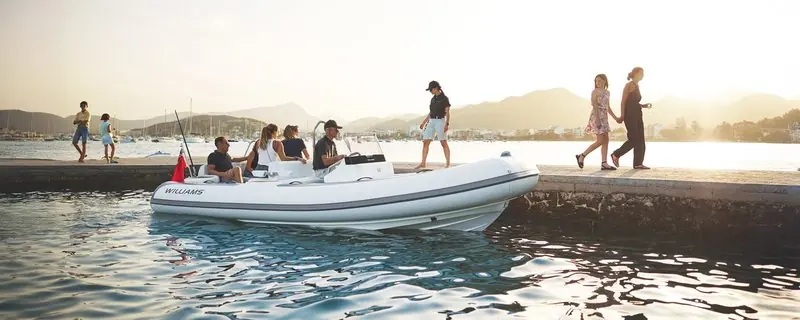
Williams Jet Tenders est né d'une activité d'ingénierie marine du sud de l'Angleterre, où les fondateurs ont passé des années à entretenir et à personnaliser des bateaux avant de construire les leurs. La société a été créée au début des années 2000 pour résoudre un problème précis : comment faire tenir un tender performant dans le garage étroit d'un yacht moderne. La percée est venue en 2004 avec un petit tender de luxe mû par un hydrojet quatre temps, un format vite devenu une référence. À partir de ce seul modèle, la maison a développé toute une famille d'unités. Elle travaille aujourd'hui depuis une grande usine conçue pour elle dans l'Oxfordshire.
Le choix de l'hydrojet était au coeur de la conception. Une turbine supprime l'hélice exposée qui rend un tender hors-bord classique délicat près des nageurs et des plages. Elle permet aussi une coque plus plate et moins profonde, qui se glisse plus facilement dans un garage. Williams a bâti sa réputation en réussissant cet ensemble sur une petite taille, là où l'ingénierie est la plus difficile. Cette concentration initiale sur les tenders compacts à hydrojet a façonné tout ce que la société a fait depuis.
La gamme, du Minijet au Dieseljet
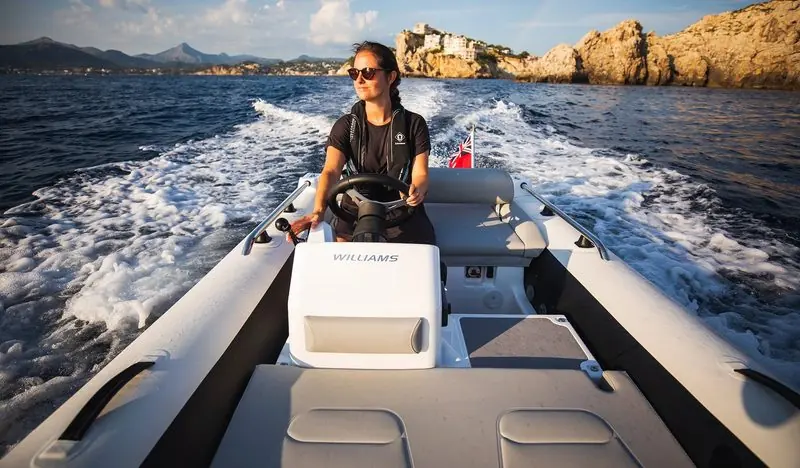
La gamme Williams est organisée par taille et par usage plutôt qu'autour d'un seul vaisseau amiral. Les modèles Turbojet étaient les tenders à hydrojet à essence d'origine et restent le coeur de la gamme, conçus pour recevoir une poignée d'invités et s'adapter à une grande variété de garages. La gamme Sportjet ajoute de la performance et de l'espace pour les propriétaires qui veulent un day boat plus rapide. Au sommet, les modèles Dieseljet transportent plus d'invités et fonctionnent au diesel, ce qui convient aux yachts qui gardent du diesel à bord et préfèrent éviter l'essence. Il existe aussi un Minijet plus petit pour les unités compactes.
À côté des gammes essence et diesel se trouve une ligne électrique qui reflète la direction du marché. Le passage à la batterie répond à une vraie demande de propriétaires qui veulent un fonctionnement silencieux et aucune manipulation de carburant sur la plateforme de bain. Chaque gamme est proposée en plusieurs longueurs pour qu'un tender puisse être accordé aux dimensions exactes d'un garage. Cette approche modulaire explique en grande partie pourquoi tant de chantiers spécifient Williams en série. Le tender est souvent choisi avant même que le yacht ne soit terminé.
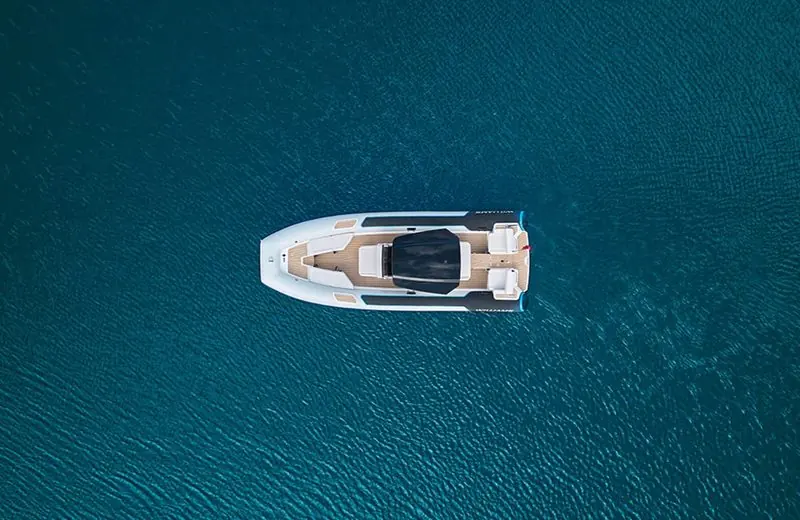
Le tender à hydrojet devenu la porte d'entrée par défaut de l'industrie vers la mer.
Construire pour le garage
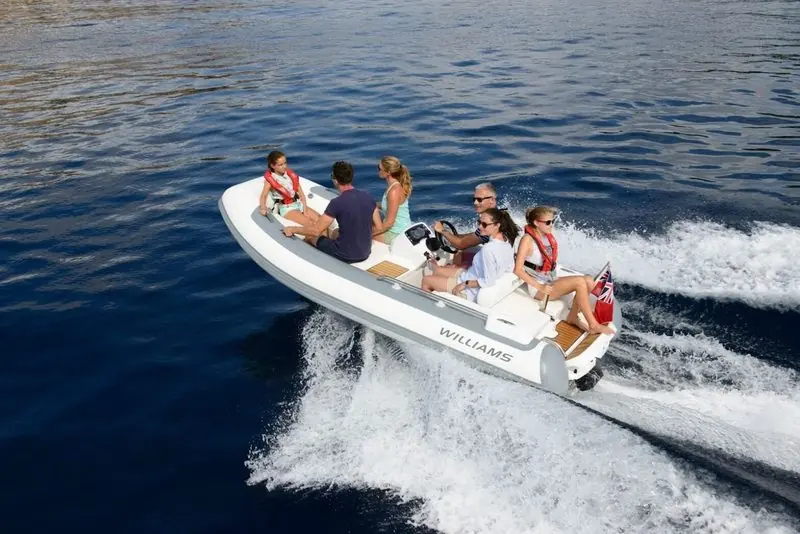
Un tender de yacht mène une vie dure et passe le plus clair de son temps rangé dans un espace confiné. Williams conçoit ses unités pour être mises à l'eau et récupérées vite, souvent par un seul membre d'équipage avec les moyens du yacht. La turbine se loge proprement et laisse des oeuvres vives nettes qui ne prendront pas de bouts et ne mettront pas les nageurs en danger. L'ajustement et la finition comptent, parce que le tender est jugé à côté du navire mère. La société construit à un niveau qui ne fera pas honte à un yacht coûtant bien des fois plus cher.
Le défi technique est de loger de la performance dans une coque petite et légère. Un tender doit déjauger vite avec un plein chargement d'invités tout en pesant assez peu pour la grue du yacht. Williams a passé deux décennies à affiner cet équilibre sur toutes ses gammes. Le résultat est un bateau qui paraît stable et prévisible même pour des invités qui pilotent rarement. C'est cette fiabilité qui garde les commandants fidèles à la marque.
La vie à bord du tender
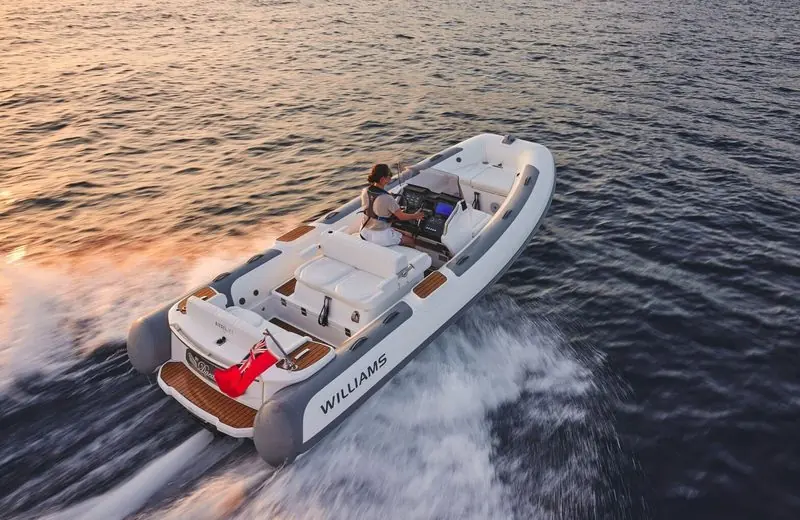
Pour les invités, le tender est la porte d'entrée du yacht. C'est ainsi qu'ils rejoignent le beach club, la terre, un restaurant ou une crique tranquille pour se baigner. Un bon tender rend ces transferts faciles et secs, un mauvais en fait une corvée. Les unités Williams sont réglées exactement pour ce service quotidien, avec des assises et des plans axés sur le confort plus que sur le seul sport. Les modèles plus grands ajoutent des bains de soleil et du rangement pour une journée entière loin du yacht.
Le format hydrojet convient aussi à la façon dont on utilise les tenders près des nageurs et des plages. Sans hélice exposée, le bateau peut approcher un banc de sable ou évoluer au ralenti parmi des gens à l'eau avec moins de risque. Cela en fait un choix naturel pour les familles et pour les invités de charter qui passent leurs journées dans la mer et hors de l'eau. Le tender devient une petite extension de la vie sociale du yacht. Cet argument pratique de sécurité a aidé les tenders à hydrojet à prendre une grande part du marché.
Un équipement par défaut pour les chantiers
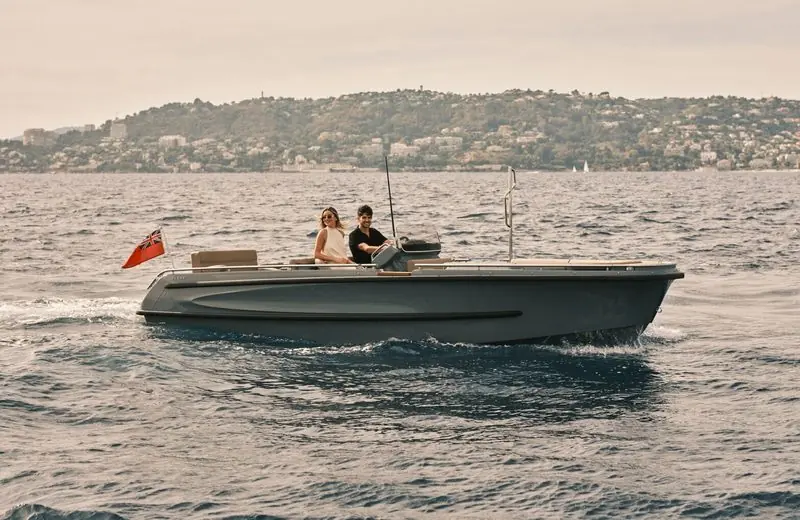
Williams se situe du côté du volume dans le monde du tender de luxe, et sa force est l'étendue plutôt que l'exclusivité de la pièce unique. Beaucoup de chantiers de série et semi-custom spécifient un tender Williams comme équipement standard de leurs garages. Cette portée a fait de la marque l'un des noms les plus reconnus du secteur. Un propriétaire qui achète un yacht neuf trouvera souvent un Williams déjà dimensionné et chiffré dans l'offre. La société a transformé une niche en quasi-standard.
Le rang de la marque tient à la constance plus qu'au spectacle. Un tender Williams est une valeur connue que les commandants savent entretenir et faire tourner saison après saison. Pour les propriétaires qui veulent une unité éprouvée et pratique plutôt qu'une déclaration sur mesure, c'est un choix sûr et populaire. Le passage à la propulsion électrique garde la gamme actuelle à mesure que le marché bouge. Williams est resté devant en affinant une formule qu'il a largement créée.
Fuel, charging and the electric question
Petrol on a large yacht is a stowage and insurance problem, and the DieselJet range solves it by drinking what the yacht already carries. On smaller boats the calculation flips, because a 90 hp petrol Rotax is far lighter than any diesel of equivalent output and the weight matters more than the fuel type. Choosing between a TurboJet and a DieselJet is really choosing between crane capacity and fuel logistics.
Williams has shown the EvoJet 70e, an all-electric version running a 58.5 kWh lithium-ion pack through control electronics from the American firm Evoa, with the same thirteen seats and the same published top speed. The company's commercial director called it a technology demonstrator built to prove what could be achieved. Williams publishes no range figure, no charge time and no price. Treat the missing range number as the whole question, because a tender that needs shore power for hours between beach trips changes a day at anchor.
What it costs to buy and to keep
Williams publishes no list prices, and the dealer network quotes against the specification. Motor Boat and Yachting listed the SportJet 520 from GBP 47,178 including VAT in its 2025 coverage. A UK tender guide consulted in July 2026 put TurboJet and SportJet boats at roughly GBP 30,000 to GBP 90,000, DieselJets at roughly GBP 100,000 to GBP 250,000 and the EvoJet 70 from roughly GBP 300,000, and described those as guidance bands with no quote behind them.
The running cost is not the fuel. It is the annual service, the impeller and wear ring that erode on any waterjet, the anodes, the tubes on the inflatable models and the hours the crew spend flushing and cleaning. Tubes are a consumable in Mediterranean sun, and a reasonable owner should budget to retube once in a long ownership. The tender also takes far more cosmetic abuse than the yacht, because it is the thing that touches docks.
Warranty, parts and a breakdown in August
Williams warrants its boats free of material defect for two years from delivery, conditional on the owner returning the completed warranty document within ten days. That clause is the sort of administrative trap that costs owners real money, and it is worth confirming with the yard's project manager that it was actually done at handover. The company runs an owners centre with manuals and parts catalogues, and sells parts through the dealers.
Coverage follows the volume. Factory-trained dealers sit across Europe, the Middle East and North America, so the Riviera, the Balearics, Italy, the Solent and Florida are well served. Caribbean cover is thinner, and a boat wintering in the islands should carry a spare impeller and a service kit. In August on the Cote d'Azur every dealer in the region is at capacity, and a failure in the first fortnight of the month is realistically a failure for the week.
Where it wins, and who should buy elsewhere
Against the custom yards, Williams competes on availability and price and loses on fit. Pascoe International and Compass Tenders design a hull around one specific garage and one owner's arrival ritual, and they will build an enclosed air-conditioned limousine that no Williams matches. Castoldi and Novurania sit between the two. What Williams offers is a boat the yard has already fitted a hundred times, delivered on schedule, with a parts network behind it.
The owner who should buy a Williams has a production or semi-custom yacht up to about 45 m, wants the tender to be a solved problem, and cares that guests can drive it safely off a beach. The owner who should look elsewhere is building full custom with the garage drawn around the tender, wants guests delivered dry and enclosed in a passing squall, or needs to move more than thirteen people in one trip.
Informations pratiques
| Price | no list prices published; Motor Boat and Yachting quoted the SportJet 520 from GBP 47,178 including VAT in 2025, and a July 2026 tender guide put TurboJet and SportJet boats at roughly GBP 30,000 to 90,000, DieselJets at roughly GBP 100,000 to 250,000, and the EvoJet 70 from roughly GBP 300,000 |
|---|---|
| Running cost | annual service, the impeller and wear ring that erode on any waterjet, anodes, and tube retubing on the inflatable models, budgeted roughly once in a long ownership |
| Fit before you order | garage door opening sets the beam limit, the cradle sets the length, and the transom crane's rated lift sets the weight; get the dry weight for the exact build, with options fitted, in writing from the dealer |
| Warranty | two years from delivery, conditional on the owner returning the completed warranty document within ten days of handover |
| Service network | factory-trained dealers are dense across the Riviera, the Balearics, Italy, the Solent and Florida; Caribbean cover is thinner, so a boat wintering there should carry a spare impeller and service kit |
| What is not published | no list prices anywhere in the range, and no range, charge time or price for the electric EvoJet 70e demonstrator |
Demander un devis pour Williams Jet Tenders.
Indiquez-nous le modèle et sa destination. La rédaction obtient une offre écrite du fabricant ou d'un revendeur agréé, la confronte aux prix publiés sur cette page et vous répond par email. Sans engagement, sans frais.
- 01Une offre écriteDans votre devise, TVA, livraison et délai précisés, pas un chiffre de brochure.
- 02Livré là où se trouve le yachtÀ la marina, au chantier ou à votre adresse, avec les documents qu'exigent une batterie lithium ou un levage à la grue.
- 03IndépendantYotters n'est lié à aucun revendeur : l'offre est comparée avant de vous parvenir.
Ce que rapportent propriétaires et équipages
No independently attributable owner or captain testimony found
trade coverage and dealer pages describe Williams as the tender most new yacht specifications already assume, but this research did not find a named owner or captain willing to be quoted on the record about handling, reliability or after-sales service for a specific model
Yotters research desk
Les points forts et les points de vigilance
Points forts
- A solved problem, off the shelfat roughly 1,200 boats a year Williams is the highest-volume boatbuilder in Britain by unit count, so the yard has usually sized and quoted the boat before the owner has shown anyone the garage
- No exposed propellerthe jet drive is the safer choice around swimmers and beaches, and the shallow draft lets the boat nose onto sand that would ground a propeller-driven tender
- The widest size and fuel spread in one cataloguepetrol, diesel and an electric demonstrator run from the 227 kg MiniJet 280 to the 2,000 kg EvoJet 70, a factor of nine, covering yachts from about 12 m to 40 m and above
Points de vigilance
- No published prices anywhere in the rangeevery figure comes from a dealer quote against the owner's own specification, and Williams has form on a weight figure that did not match the eventual spec sheet: the MiniJet was announced at under 200 kg and the current sheet gives 227 kg dry
- A jet drive costs efficiency and ease of dockinga waterjet burns more than an equivalent outboard at displacement speed, astern handling takes practice guests do not have, and the intake grate fouls on weed, rope and plastic
- Service cover thins out where owners actually cruisethe Caribbean has fewer factory-trained dealers than Europe, and every dealer on the Cote d'Azur is at capacity in August, so a breakdown in high season is realistically a week's wait
- The EvoJet 70e is not yet a real optionWilliams calls it a technology demonstrator and publishes no range, no charge time and no price, so an owner who wants the diesel garage solved electrically cannot yet buy one
Pour qui: Les propriétaires et les chantiers qui veulent un tender à hydrojet éprouvé et adapté au garage plutôt qu'une construction sur mesure unique.