Muelle Deportivo Las Palmas (Gran Canaria)
| Location | Muelle Deportivo, inside the Puerto de La Luz y Las Palmas, Las Palmas de Gran Canaria, Canary Islands, Spain |
|---|---|
| Position | 28 07 N, 015 25 W, per the World Cruising Club's 2026 ARC Rally Handbook |
| Operator | Autoridad Portuaria de Las Palmas, one of the 28 state Port Authorities under Puertos del Estado, not a private marina company |
| Berths | disputed across sources from 1,134 to 1,500; Practical Boat Owner's 2025 reporting on the marina gives 1,400 |
| Vessel range | 2 m to 50 m LOA under the marina's 2024 port ordinance; some pontoons are capped at 16 m or 45 m |
| Maximum draught | not published by the operator; third-party figures range from 4.5 m to 7 m depending on the source |
| VHF | marina office works channel 11, 07:00 to 22:00, per the 2026 rally handbook; older directories give channel 9; Port Control (harbourmaster) works 12 and 16, monitored 24 hours |
| Fuel | CEPSA fuel dock in the marina, Mon-Sat 08:00 to 18:00, Sun 08:00 to 14:00 |
| Open | marina office Mon-Fri 09:00-14:00 and 16:00-19:00, Sat-Sun 09:00-14:00; showers and toilets 24 hours by access card |
| Refit | Rolnautic Varadero runs travelifts in the marina and the wider port, with figures in its own 2026 literature running from 70 to 850 tonnes |
| Airport | Gran Canaria Airport, about 25 km and 30 to 40 minutes south by road |
| Next door | Puerto de La Luz, one of Spain's largest container and bunkering ports, plus a Spanish Navy base |
| ARC 2026 starts 22 November; ARC+ 2026, via Cape Verde, starts 8 November | |
| 2025 fleet | ARC carried 145 boats and about 820 crew, its 40th edition; ARC+ carried 86 boats and around 400 sailors |
| Tax status | the Canary Islands sit outside the EU VAT area; IGIC applies at 7 per cent instead of Spain's 21 per cent IVA |
| 2025 dispute | a new port order led the marina to give an estimated 450 liveaboard families 10 days to leave or face a 60,000 euro fine |
Where the marina actually sits, and what surrounds it
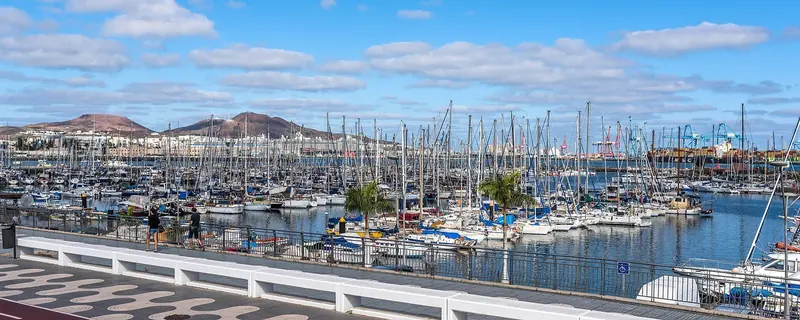
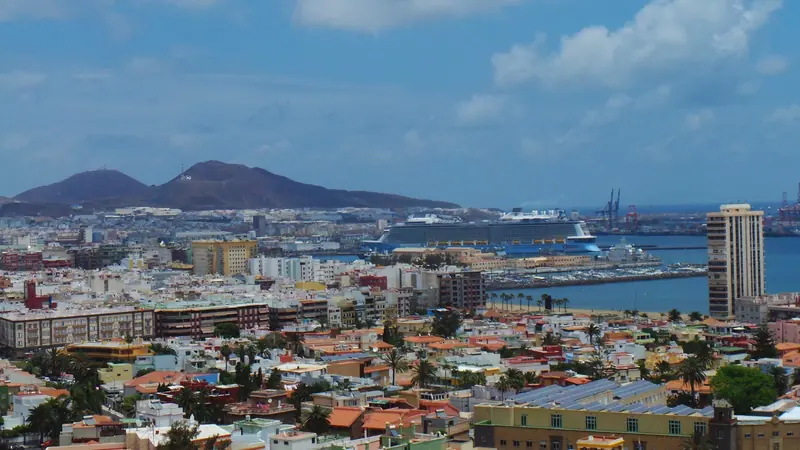
Muelle Deportivo Las Palmas, known to everyone who actually berths there as Marina Las Palmas, occupies the south-western corner of the Puerto de La Luz y Las Palmas, the working port that gives Las Palmas de Gran Canaria its economy. The World Cruising Club's 2026 rally handbook gives the position as 28 degrees 07 minutes north, 015 degrees 25 minutes west. Inside its own breakwaters the marina is laid out as a series of named piers and pontoons, from the long Dique Este wall, where the largest monohulls berth stern-to, through pontoons lettered K, L, Q, R, S and T, to the Vela Latina basin at the southern end where the multihull fleet gathers. A grocery store, chandlery and boatyard, restaurants and the rally's own information centre line its western promenade, which is what most sources mean when they call it a city marina rather than a resort one.
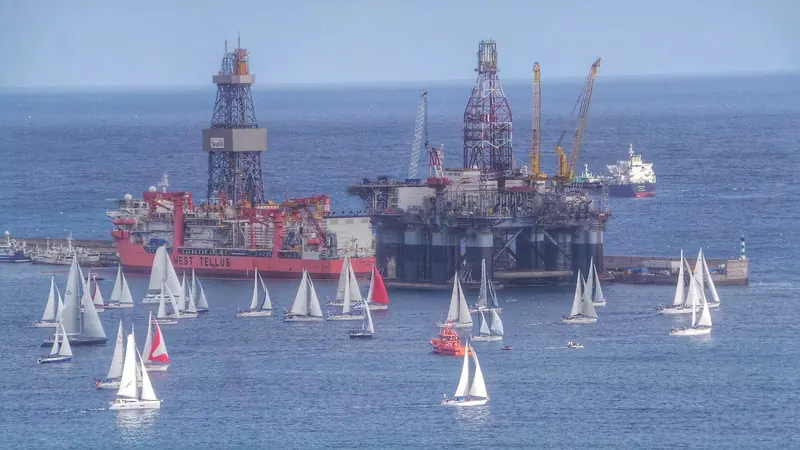
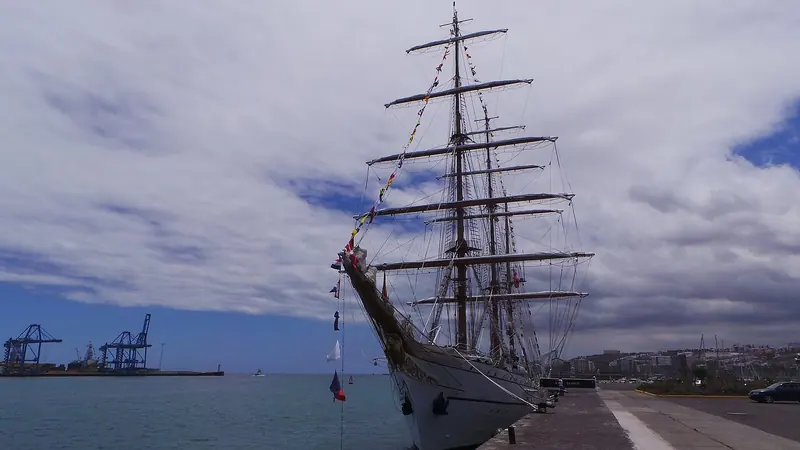
The other half of the picture is industrial. Puerto de La Luz is one of Spain's largest container and bunkering ports, with gantry cranes visible from almost every berth in the marina, and it shares its waters with a Spanish Navy base whose patrol vessels tie up a short walk from the yacht pontoons. Large ferries and fast catamarans move through the interior port constantly, and the marina's own approach notes warn yachts to be aware of commercial traffic and high-speed ferries on the final approach. This is not a quiet cove: it is a working Atlantic port that happens to have 1,000-plus recreational berths built into one corner of it, and the container cranes behind the masts are as much a part of every photograph of the place as the boats themselves.
Who actually runs it, and the rulebook that changed in 2025
The marina is run by the Autoridad Portuaria de Las Palmas, one of Spain's 28 state Port Authorities under Puertos del Estado, the national ports body, not by a private marina operator or a concessionaire. That structure explains why, unlike most superyacht-facing marinas, it publishes an actual tariff, calculated by formula rather than quoted on request, and why its rules arrive as a formal port ordinance in Spain's Boletin Oficial del Estado rather than as marina small print. The current ordinance for the small-craft dock was resolved on 19 December 2024 and took effect on 23 January 2025, replacing one dating to 2019. It sets berth authorisations as personal and non-transferable, caps vessels between 2 and 50 m, splits contracts into transient (up to 6 months) and base (6 to 12 months) categories, and states plainly that using a berth as a permanent residence or a holiday rental is strictly forbidden.
That last clause is not boilerplate. The marina had already discovered, and reported to local media, families running as many as five boats under different names as Airbnb-style rentals, and it had banned living aboard as a sole residence since 2019. What changed in 2025 was enforcement: Practical Boat Owner reported that the marina issued 22 letters covering an estimated 450 liveaboard families, giving them 10 days to leave or face a 60,000 euro fine, forced relocation, or having their boat hauled. Owners organised and hired lawyers to challenge the order. The marina's own position, as reported, is that this targets long-term residents rather than visiting cruisers or the ARC fleet, who remain explicitly welcome, but a prospective long-term or wintering-over owner should treat the underlying dispute as unresolved rather than settled.
In June 2025 the marina gave an estimated 450 liveaboard families ten days to leave or face a 60,000 euro fine. The ARC fleet's welcome was untouched. Everyone else's was not.
Hailing the marina and getting a berth assigned
Yachts must raise Las Palmas Port Control on VHF channel 16 or 12 at least one hour before arrival, both monitored around the clock, well before they reach the marina itself. The port entrance lies about 2 nautical miles due south of Las Isleta, the peninsula that is the first land to come into view approaching from the north, protected by a breakwater running over 4 km that stays hard to pick out until the boat is close in; the rule is to pass south of the green navigation mark 500 m beyond its end and stay alert for large vessels at anchor or manoeuvring nearby. Once inside, the marina itself sits behind its own breakwaters on the port's south-western side, and its entrance, too, is described by the rally handbook as surprisingly difficult to identify until quite close.
Call the marina on VHF channel 11 before entering; the 2026 rally handbook gives its listening hours as 07:00 to 22:00, though older marina directories and the Gran Canaria tourism board instead list channel 9, a discrepancy this page could not resolve from the sources available. If nobody answers, the standard instruction is to proceed directly to the arrivals pontoon or the fuel dock, both on the port side just inside the entrance, and stop there to check in. A boat arriving outside office hours ties up alongside the reception pontoon, rafting if another boat is already there, or anchors in the water just north of the entrance to wait for morning; this is the same spot cruisers report having to use in October and November when the marina is simply full ahead of the rally.
What it actually costs to berth here
As a public marina, Las Palmas prices by a formula rather than a quote, and the figures the World Cruising Club's 2026 handbook carries, current as of February 2025 and apparently unrevised since, are unusually transparent for what they are. Berth tax and navigation aids tax are charged on the boat's footprint in square metres, length multiplied by beam, by the day rather than the night, which means a single overnight stop can be billed as two days if it straddles a calendar boundary. The rate is EUR 0.17 per square metre per day for a stern-to berth, or EUR 0.418 for alongside, a more than doubled rate that rewards the space-efficient mooring the marina prefers. Water and electricity are metered and billed separately by length band, plus 7 per cent IGIC, running from EUR 1.55 a day for a 10 to 15 m boat up to EUR 3.08 for 20 to 25 m, or EUR 15.42 to EUR 30.83 a month over the same bands; boats over roughly 65 ft on the Dique Este wall are metered directly instead, at EUR 4.62 per cubic metre of water and EUR 0.18 per kWh.
The handbook's own worked example makes the formula concrete: a 14 m monohull with a 3.5 m beam, 49 square metres, berthed stern-to for two weeks, owes EUR 116.62 in berth and navigation tax and EUR 23.22 in water and electricity, EUR 139.48 in total. On top of that, every visitor needs a pontoon access card for the gates, showers and toilets, EUR 5 for a stay under a month or EUR 10 a month for anything longer. What none of this tells a buyer is what the same 14 m boat would pay across a full six-month or annual base-vessel contract under the new 2025 ordinance, since neither the ordinance nor the tariff sheet available to this page prints an annual figure the way, for instance, a comparable ACI marina in Croatia does; that comparison has to be requested directly from the office.
Fuel, power and the real reason boats top up here
A CEPSA fuel dock sits inside the marina near the reception pontoon, open Monday to Saturday from 08:00 to 18:00 and Sunday 08:00 to 14:00, and the rally's own arrival checklist tells crews plainly not to leave refuelling until the morning of the start. No per-litre price is published for the dock itself, which this page counts as a genuine gap rather than an oversight, since fuel cost is one of the largest variable expenses on an Atlantic crossing. What is documented is the underlying reason Las Palmas has a reputation as a cheap place to fill up at all: the Canary Islands sit outside the EU VAT area and apply IGIC, a local tax of 7 per cent, instead of mainland Spain's 21 per cent IVA, alongside a reduced fuel duty rate. Road diesel on Gran Canaria was running close to EUR 1.60 a litre through September 2026, itself among the cheaper prices inside the EU, and the same tax structure applies to marine fuel.
Shore power is banded by which pontoon a boat lands on rather than by a single marina-wide rate. The Dique Este wall, where the largest boats berth, carries a metered supply at 320V or 220V, 64A or 32A, alongside an unmetered 220V/32A option; the east side of T pontoon carries 220V/32A; and pontoons K, L, Q, R, S and the west side of T are wired for 220V/16A only, a real constraint for a 60-plus foot boat trying to run air conditioning or a full electrical system from a smaller pontoon. Waste and water are not itemised on the same public tariff sheet as power, and this page could not find a published per-visit charge for either; both appear to be handled through the general berth fee and the metered water rate above rather than billed separately.
The refit and provisioning trade an Atlantic crossing actually needs
This is the real reason an owner picks Las Palmas over a quieter, cheaper marina further down the Canarian coast. Rolnautic Varadero, the marina's resident chandlery and yard, describes itself as the leading chandlery in the Canary Islands and is the only authorised Yanmar dealer in the city, offering ARC and ARC+ boats a 10 per cent discount card at check-in and stocking everything from lifebuoys and EPIRBs to Furlex furling gear. The World Cruising Club's own handbook credits Rolnautic Varadero with a 70-tonne travelift for boats up to about 25 m inside the marina itself, plus a further lift in the wider commercial port for anything bigger. Rolnautic's own 2026 promotional material printed two pages later in the very same handbook instead advertises three separate travelifts under its Varadero brand, at 70, 110 and 850 tonnes, rated respectively to about 24 m, 30 m and large yachts or commercial vessels, a materially bigger and more specific claim that this page cannot reconcile with the handbook's own descriptive text; which number actually applies to a boat over 25 m looking to haul out is not settled in print anywhere checked.
Beyond the yard, Alisios Sailing Center, opposite the old Club Varadero building, is the official dealer for Beneteau, B&G, Simrad, North Sails, Selden and Harken, runs rig checks and a rigging seminar through the two-week build-up to the start, and covers sail making, repair and onboard electronics. A long directory of smaller specialists, welders, engine agents, refrigeration technicians, satellite communications and electronics shops fills out the rest of the trade, maintained and updated year to year from past participants' own recommendations rather than paid listings. Provisioning runs through three fresh markets, Mercado Central, Mercado de Las Palmas and Mercado del Puerto, and every major supermarket chain on the island, including El Corte Ingles and Carrefour, delivers free to the marina gate, which is a genuinely unusual convenience for a boat trying to load six months of stores in the final week before an ocean crossing.
Eating, and what happens after the sun goes down
The marina's own restaurant strip runs along its western promenade, opposite the rally's information centre and the chandlery. Pier 19 is generally reckoned the most stylish spot in the marina, open from 08:30 with food served until late and coffee good enough to be mentioned by name in the rally's own literature. Sailor's Bay, immediately opposite the information centre, is described as participants' most popular bar, offering value food, decent Italian coffee and free WiFi to paying customers, while Restaurant Embarcadero and Barracuda, the latter known specifically for seafood rice dishes and paella, round out the walkable options without leaving the gate. Ten minutes on foot north of the marina, the Real Club Nautico, Gran Canaria's Royal Yacht Club, opens its own restaurant to rally crews for the fortnight before the start, though it asks for smart dress, no shorts or sandals on men after dark, and does not allow children or pets at dinner.
Outside the gate, eating in Las Palmas is genuinely good value by comparison with most Atlantic-facing ports, and the bulk of it clusters in two places: around Playa de Las Canteras to the north-west, and in the old Vegueta quarter to the south, both areas that stay busy, well-lit and reported as safe well into the evening. The one specific area flagged for extra care after dark is the pair of streets just behind the cruise terminal, Calle Albareda and Calle Ripoche, where rough sleeping and occasional bag-snatching have been reported; it sits close enough to the marina's northern exit that a crew walking back late from Las Canteras should simply know to route around it rather than through it.
The dates that actually fill the place, and the paperwork around them
Everything about this marina's calendar bends around one event. ARC 2026 departs Las Palmas on 22 November, and ARC+, which routes via an 850-mile leg to Mindelo in Cape Verde before the long Atlantic crossing, departs two weeks earlier on 8 November. The 2025 editions give a sense of scale: the ARC fleet, marking its 40th running since Jimmy Cornell's original 1986 race, carried 145 boats and roughly 820 crew from 34 to 81 feet, while ARC+ added another 86 boats and about 400 sailors across 26 nations. Around the sailing itself sits a genuine two-week programme, an opening ceremony with a costumed procession around the marina behind local brass and samba bands, safety demonstrations in the Club Varadero pool, and a full schedule of provisioning, rigging and weather seminars for crews who have never made an ocean passage before.
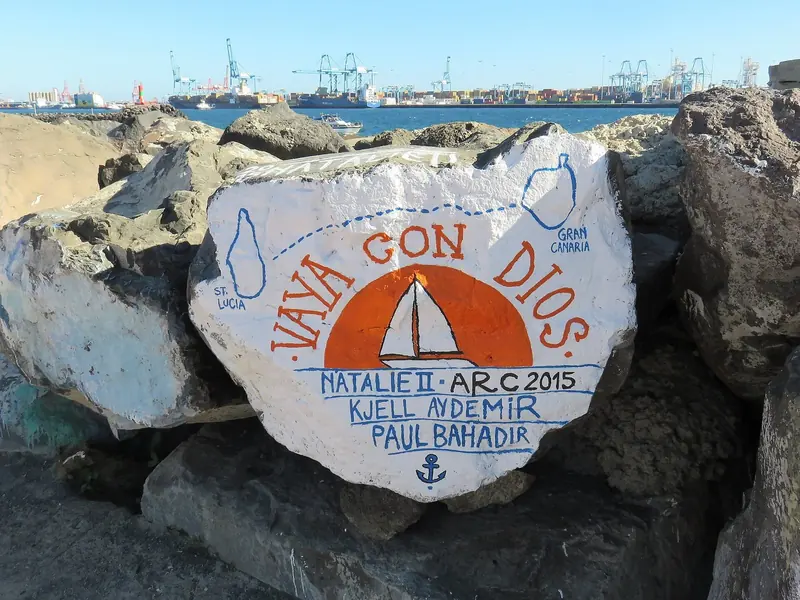
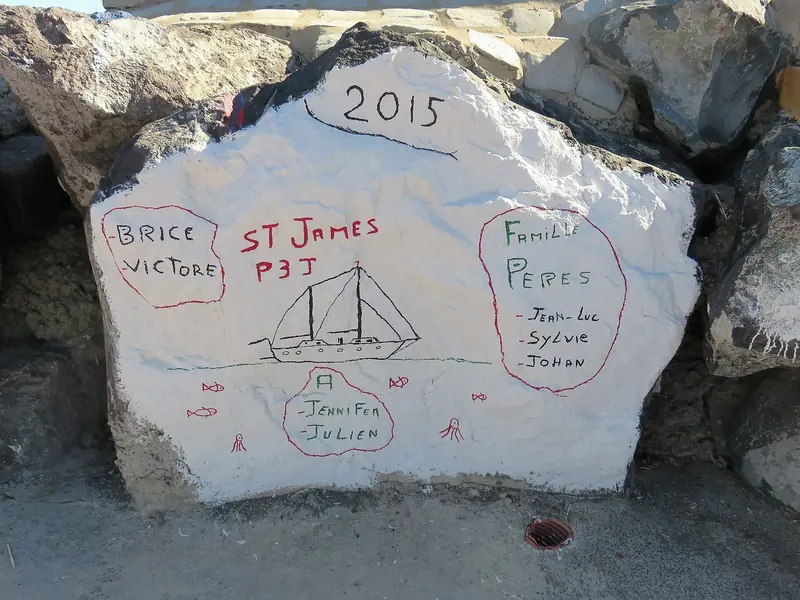
None of that is compulsory, and one small tradition outside the official programme says more about the place than the programme itself: for at least a decade, departing crews have painted a rock on the marina's own breakwater with their boat's name, their crew and the year, a custom this page could trace in photographs back to 2015 and which the 2026 rally handbook still lists, unofficially, among the things a departing crew does in the final week. Since 2010, rally sailors have also planted almost 3,000 native trees in the mountains above the city through a local charity called Foresta, restoring a stretch of cloud forest as a kind of collective, cumulative signature the ARC has left on the island well beyond the marina gate.
Clearing a non-EU yacht into the Canaries, and the traps in doing it
Because the Canary Islands are Spanish and therefore Schengen territory, standard EU immigration rules apply and the marina office handles the paperwork on arrival rather than a separate customs shed. Crew holding non-Schengen passports, Irish citizens excepted, usually need to visit the Border Police to be formally stamped out before departure, and during the rally build-up officers are arranged to attend the marina itself at set times rather than making every crew travel into the city. Where the islands genuinely differ from mainland Spain is on goods rather than people: they sit outside the EU VAT area entirely, so IGIC, a local indirect tax of 7 per cent, applies instead of the 21 per cent IVA charged on the mainland, and a separate import levy, AIEM, can apply to certain goods brought in from outside the islands. Because of that isolated tax position, Canarian port authorities tend to treat every arriving yacht as though it had come from outside the EU regardless of its actual flag or last port, meaning full ship's papers, crew passports and proof of insurance go to the marina office on every arrival, EU-flagged or not.
Two further traps are worth knowing before committing to a long stay. Spending more than 183 days ashore in Spain in a single calendar year, Canaries included, risks the owner being treated as fiscally resident, which in turn can trigger Spain's matriculation tax at 12 per cent of the boat's value for any vessel over 8 m, a cost that dwarfs a season of berth fees. And any pet aboard needs the standard EU pet passport, microchip and rabies documentation to enter, but also a separate, locally issued export health certificate from the Oficina de Sanidad Animal near the marina before it can legally continue on to St Lucia or Grenada with the fleet, a step easy to miss if an owner has only researched the EU entry side of the pet travel scheme.
A terra, accessi e prenotazioni
| Getting there | Gran Canaria Airport (LPA) is about 25 km south of the marina, 30 to 40 minutes by road depending on traffic, and is the island's only airport, with frequent connections to mainland Spain and a wide winter charter network from northern Europe. There is no dedicated marina shuttle from the airport. Buses and taxis run the route, and El Corte Ingles, 15 minutes on foot from the marina's northern exit, anchors the main shopping street, Avenida Mesa y Lopez, for anything not sold within the gates. |
|---|---|
| Arriving by sea | Call Las Palmas Port Control on VHF channel 16 or 12 at least one hour before arrival; both are monitored 24 hours. The port entrance lies about 2 nautical miles due south of Las Isleta, the first land to come into view from the north, protected by a breakwater over 4 km long that only becomes clearly visible on close approach; pass south of the green navigation mark 500 m off its end. Inside, the marina sits on the port's south-western side behind its own breakwaters. Call the marina itself on VHF 11 before entering; if there is no answer, proceed to the arrivals pontoon or the fuel dock, both immediately to port as you enter, and stop to check in at reception. Night arrivals tie up alongside the reception pontoon, possibly rafted, or anchor in the water just north of the entrance until morning. |
| How you actually reserve a berth | Outside the rally, advance booking is not really possible: notify the marina office of your ETA by email to [email protected] and a port official assigns your berth on arrival, by size and by date. For the ARC and ARC+, email the same address with your boat's LOA and beam, copying [email protected], any time after 1 July; skippers upload a passport, boat registration and insurance certificate to the rally's members area by 30 June, and the marina berths the fleet from those documents. Berths run 20 m and over stern-to on the Dique Este wall, the rest of the fleet spread through the marina, and multihulls into the Vela Latina basin at the southern end. If you withdraw from the rally after arriving, you are required to vacate the marina, since the berth is rally-allocated and not available to non-rally boats. |
| What a berth costs | The marina's own rates, current as of February 2025 and unchanged in the 2026 rally handbook, are charged on the boat's footprint in square metres (length by beam) by the day, not the night, so a single overnight stay can be billed as two days. Berth tax plus navigation aids tax runs EUR 0.17 per day per square metre stern-to, or EUR 0.418 alongside. Water and electricity are metered separately by length band and billed on top, plus 7 per cent IGIC: daily rates run from EUR 1.55 for 10-15 m boats to EUR 3.08 for 20-25 m, and monthly rates from EUR 15.42 to EUR 30.83 over the same bands. A worked example in the handbook: a 14 m monohull with a 3.5 m beam, 49 sq m, berthed stern-to for two weeks, pays EUR 116.62 in berth and navigation tax plus EUR 23.22 in water and electricity, EUR 139.48 total. Boats over about 65 ft on the Dique Este wall are metered instead, at EUR 4.62 per cubic metre of water and EUR 0.18 per kWh plus 3 per cent IGIC. A pontoon access card, needed for the gates, showers and toilets, costs EUR 5 for stays under a month or EUR 10 a month for longer stays. |
| Fuel, power, water and what is extra | The CEPSA fuel dock sits inside the marina, near the reception pontoon, open Monday to Saturday 08:00 to 18:00 and Sunday 08:00 to 14:00; the rally handbook's own advice is not to leave refuelling to the morning of the start. No price is published for fuel at the dock itself, but road diesel on Gran Canaria has run close to EUR 1.60 a litre through September 2026, and the Canary Islands' lower fuel duty and IGIC in place of mainland VAT keep it consistently cheaper than most of the rest of the EU, which is part of why so many Atlantic-bound boats top up here rather than earlier in the Med or mainland Spain. Shore power is banded by pontoon: metered 220V/32A to 320V/64A on the Dique Este wall, 220V/32A on the east side of T pontoon, and 220V/16A on K, L, Q, R, S and the west side of T. |
| Refit, chandlery and haul-out before an ocean crossing | This is the reason most owners are here at all rather than a cheaper Canarian marina further south. Rolnautic Varadero holds a 70-tonne travelift for boats to about 25 m inside the marina itself and a further lift in the wider commercial port; Rolnautic's own 2026 promotional material for the same yard instead lists three travelifts, at 70, 110 and 850 tonnes, for boats up to roughly 30 m and beyond, a materially larger claim than the rally handbook's own text printed two pages earlier, and it is not resolved which figure a boat over 25 m should plan around. Alisios Sailing Center covers rigging, sails and electronics; specialist welders, engine agents and electronics shops fill the rest of the trade directory the World Cruising Club maintains and updates from rally participants' own recommendations each year. |
| Where to eat, and after dark | The marina's own bars and restaurants sit along its western side: Pier 19 is the most stylish, open from 08:30 with food until late and good coffee; Sailor's Bay, opposite the rally's Information Centre, is the participants' most popular spot, with value food and free WiFi for customers; Restaurant Embarcadero and Barracuda, the latter known for seafood rices and paella, round out the strip. Ten minutes' walk north, the Real Club Nautico opens its restaurant to rally crews for the two weeks before the start, smart dress required and no shorts after dark. Beyond the gate, most of the city's restaurants cluster around Playa de Las Canteras and in the old Vegueta quarter, both well-lit and busy into the evening; the exception, worth extra care after 22:00, is the streets just behind the cruise terminal, Calle Albareda and Calle Ripoche, where rough sleeping and occasional bag-snatching are reported. |
| The fixed dates that fill it | ARC 2026 starts from Las Palmas on 22 November, and ARC+, which routes via Mindelo in Cape Verde, starts two weeks earlier on 8 November. The 2025 fleet, the ARC's 40th edition since Jimmy Cornell's original 1986 race, carried 145 boats and about 820 crew across; ARC+ added another 86 boats and roughly 400 sailors. Around the sailing, the rally runs a two-week programme of seminars, an opening ceremony with a parade around the marina, and an informal tradition, not part of the official programme, of crews painting a rock on the marina's breakwater with their boat's name before they leave, a custom documented back to at least 2015 and still going in 2026. |
| Canary Islands clearance for a non-EU or non-Schengen yacht | Standard EU and Schengen immigration rules apply, since the Canary Islands are Spanish territory, and the marina office handles the paperwork on arrival. Non-Schengen crew, other than Irish citizens, usually need to visit the Border Police to be stamped out before leaving, and the rally arranges for officers to attend the marina at set times during the build-up. Customs is a different story: the islands sit outside the EU VAT area and charge IGIC, 7 per cent, instead of Spain's 21 per cent IVA, and Canarian authorities tend to treat every arriving yacht as though it came from outside the EU regardless of its actual flag, so full papers, insurance and passports go to the office every time. An owner planning to leave a boat here over winter should also know that more than 183 days ashore in Spain in a calendar year risks being treated as fiscally resident, which triggers a 12 per cent matriculation tax on the boat's value; and a pet needs an EU pet passport and microchip on arrival, plus a separate export health certificate from the local Oficina de Sanidad Animal before it can continue on to St Lucia or Grenada. |
| What is NOT published | The operator publishes no maximum draught anywhere Yotters could find, and third-party figures for it, and for the total berth count, disagree by wide margins across every directory checked. Fuel has no posted per-litre price at the dock. Most significantly, the outcome of the 2025 eviction dispute, whether the challenged liveaboard families won any concession, and whether the ordinance's 6 to 12 month base-vessel category still functions as written, is not published anywhere public; an owner planning a season or a winter-over should ask the marina office directly, in writing, before committing. |
Cosa riferiscono armatori ed equipaggi
The marina cannot agree with itself, or with anyone else, on its own numbers
Marina directories give a berth count anywhere from 1,134 (masmar's own pier-by-pier breakdown) to 1,500 (GotoSailing), with SuperyachtServicesGuide at 1,363 and Practical Boat Owner's 2025 reporting at 1,400. Maximum draught runs from 4.5 m to 7 m across the same set of sources. Even the marina's own hailing channel is disputed: the 2026 World Cruising Club rally handbook gives VHF 11, while masmar and the Gran Canaria tourism board give channel 9.
masmar, GotoSailing, SuperyachtServicesGuide and Practical Boat OwnerA 2025 port order set the marina against hundreds of its own long-term berth holders
In June 2025 the marina issued 22 letters covering an estimated 450 liveaboard families, ordering them out within 10 days under a new port ordinance or facing a 60,000 euro fine, forced relocation or hauling. Living aboard as a sole residence and Airbnb-style rental of a berth had been prohibited since 2019, but this was the first time it was enforced with eviction notices, and affected owners hired lawyers to challenge it. The marina's position, reported by the same article, is that visiting cruisers and the ARC fleet are unaffected.
Practical Boat OwnerLocal users describe an office that is slow, bureaucratic and sometimes unfriendly
Forum posts describe the port as the most disorganised the writer has used, staff who became offended when a pricing complaint followed a mechanical problem, and month-long advance planning needed to be confident of a spot. The World Cruising Club's own rally handbook is blunter about the knock-on effect: repair services in Las Palmas are, in its words, under a great deal of pressure during the rally and slow to respond once the marina fills with boats.
Cruisers Forum and World Cruising ClubThe refit trade around it is real and it is what the marina is actually known for
Rolnautic Varadero, the on-site chandlery and yard, calls itself the leading chandlery in the Canary Islands and is the only authorised Yanmar dealer in Las Palmas, offering ARC+ boats a 10 per cent discount card. Alisios Sailing Center, opposite the old Club Varadero building, is the official Beneteau, B&G, North Sails and Harken dealer and runs a rig-check and rigging seminar programme through the rally build-up. Astican, which only takes vessels over 60 tonnes, is described by past users as excellent though more expensive.
World Cruising Club and RolnauticOutside the rally, a random arrival can find nothing free at all
Cruisers arriving in October or November without a rally berth report finding the marina full, with no space available until the ARC fleet has left, and being told to anchor in the area just north of the entrance and wait. The same anchorage is where the rally's own handbook tells late or overnight arrivals to wait if the reception pontoon is already rafted.
YBW Forum
Cosa convince e cosa va valutato
Punti di forza
- It is the genuine article for an Atlantic departureThis is not a marina that merely markets an ARC connection: the rally has launched from here since 1986, and the seminars, safety demonstrations, chandlery discounts and even the informal rock-painting tradition on the breakwater have built up around it over four decades, most recently a 145-boat, 820-crew ARC fleet in 2025.
- Real haul-out and rigging capacity, not just a fuel dock and a pontoonRolnautic Varadero fields travelifts described at up to 110 or even 850 tonnes in its own literature, and Alisios Sailing Center covers rigging, sails and electronics as official dealer for half a dozen major brands, a genuine pre-crossing refit hub rather than a marina that merely has a chandlery sign on the gate.
- A city-centre location with everything that impliesThe marina sits inside Las Palmas itself, with three fresh markets, every major Canarian supermarket chain delivering free to the pontoon, and Vegueta and Las Canteras both a walk away, none of which is true of most refit stops on an Atlantic route.
- A published, calculable tariff from a public operatorBecause a state Port Authority runs it rather than a private company, the berth rate is a public formula, area times day times a published coefficient, not a quote you have to request, and the handbook's own worked example lets a buyer check the arithmetic before arriving.
- Genuinely cheap fuel and power by EU standardsThe Canary Islands' position outside the EU VAT area and their lower fuel duty keep diesel consistently cheaper here than in most of the EU, one concrete reason the fleet fuels up here rather than earlier in the passage south.
Da valutare
- The basic facts about the place do not agree with each otherBerth counts across sources run from 1,134 to 1,500, maximum draught from 4.5 m to 7 m, and even the marina's own VHF hailing channel is given as both 9 and 11 depending on which guide you read; a buyer cannot take any single number here on faith.
- It spent 2025 in open conflict with its own long-term customersA new 2025 port order led to eviction letters for an estimated 450 liveaboard families, a 60,000 euro fine threat, and a legal challenge from affected owners, and the outcome of that dispute is not public; an owner considering a 6 to 12 month base-vessel contract is buying into an unresolved situation.
- The office is reported as slow and occasionally difficultForum reports describe a disorganised office and unhelpful staff, and the rally's own handbook admits repair services in the city are under heavy pressure and slow to respond once the marina fills for the season.
- No berth at all for a random arrival in October or NovemberOutside the rally's own booking process, cruisers report the marina simply full ahead of the ARC, with nothing available until the fleet departs and an instruction to anchor outside and wait.
- Real costs are left for the owner to discover on arrivalFuel carries no posted per-litre price, no annual base-vessel rate is published anywhere this page could find despite the new ordinance defining that contract category, and waste handling charges are not itemised separately from the general berth fee.
A chi si rivolge: A cruiser provisioning, rigging and clearing out for an Atlantic crossing with the ARC or ARC+, or anyone who wants genuine haul-out muscle and a city on the doorstep and can live with a bureaucratic public marina, rather than an owner wanting a quiet, predictably priced season berth or planning to live aboard long-term while the 2025 liveaboard dispute remains unresolved.