Port Ghalib Marina (Marsa Alam, Egypt)
| Location | Red Sea coast, Egypt, 75 km south of Quseir and 65 km north of Marsa Alam town, fairway buoy at approximately 25 32N, 34 38E |
|---|---|
| Egypt's first private seaport, opened in 2002 (one directory gives 2007, against three independent sources agreeing on 2002) | |
| Developed by Kuwait's Mohamed Abdulmohsin Al-Kharafi and Sons under a 1997 build-operate-transfer concession; masterplanned by France's Francois Spoerry with US and UK architecture firms | |
| One of Egypt's designated Red Sea ports of entry, alongside El Gouna, Hurghada, Safaga, Sharm el Sheikh, Suez Canal and Taba Heights | |
| Berth capacity disputed | marketing material says up to 1,000 yachts; the Egyptian Maritime Transport and Logistics Sector's own port record says Phase 1 holds about 225 yachts to 60 m, with 825 the eventual target only once an undesigned Phase 2 is built |
| Maximum LOA | 60 m per the government port record; other sources cite 50-51 m as the more commonly quoted practical and fuel-dock limit |
| VHF | listening Channel 16, working Channel 10; call port control about 2 hours before arrival (the marina's own guidance) or up to 24 hours ahead by email (Noonsite's recommendation) |
| Entrance channel runs 800 m by 99 m through the fringing reef, lit and buoyed; vessels may be held at Marsa Umbark, 2 nautical miles south, until cleared in | |
| The port closes to new arrivals at 16:00 daily, and the Coast Guard bans all boat movement inside the harbour, dinghies included, between 18:00 and 08:00 | |
| 2024 marina tariff, foreign-registered vessels, price per metre: annual USD 387-1,347, monthly USD 51-172, weekly USD 15-52, daily USD 3-13, plus a USD 300 Immigration Dock fee each way | |
| Every foreign yacht must clear in through one of only two Egyptian-licensed agents at Port Ghalib; a 2022 cruiser account reports the check-in itself running six or more hours dockside and the exit permit, issued out of Cairo, taking five to seven days | |
| No chandlery and no diesel shop in Port Ghalib itself; parts and technicians come from Quseir or Hurghada, up to three hours away by road | |
| Diesel available at a dedicated fuel berth (reported at USD 1.18/litre in February 2022); the fuel dock will not fill jerry cans, only integrated tanks | |
| Marsa Alam International Airport is about 4-5 km from the marina, served mainly by seasonal European charter routes; Hurghada, a 3-hour drive, carries the broader scheduled network | |
| Diving grounds within reach include Elphinstone Reef (about 30 km) and Daedalus Reef (a roughly 9-hour overnight sail, inside a national marine park) | |
Two very different numbers for the same marina
That is a wide enough gap that this desk is not going to average it or quietly pick the rounder number. The 1,000-yacht figure is repeated almost everywhere - Port Ghalib's own site, Noonsite, regional tourism guides, even trade directories like Dockwalk - which suggests it originated as a masterplan or design capacity rather than a built count, and has simply been carried forward uncorrected for two decades. The government's own port authority, by contrast, has every regulatory reason to report the actual built number, and its figure is far more specific: a named legal decree (Republican Decree No. 141 of 2003), an exact site area, and a stated maximum LOA of 60 metres for what exists today.
For a buyer, the practical read is simple: treat 225 built berths to 60 metres as the reliable current figure, and treat 1,000 as an aspirational number for a second phase that has no design, no funding announcement and no completion date attached to it in any source this desk could find. A yacht above 60 metres should not assume Port Ghalib can take it at all.
Clearing into Egypt is the real subject of this entry
The sequence, per that account: an agent is contacted roughly a week ahead with the registration certificate, crew list, last port clearance and the last ten ports of call; no visa is needed in advance, since Egypt issues one on arrival, but since the pandemic every foreign yacht must clear in even if it is only stopping for fuel, which used to be an exception. On arrival, the vessel goes to a dedicated Customs Dock and is boarded in sequence by quarantine, immigration and customs, a process the same cruisers describe as usually taking most of the day. Weapons, including spearguns, and drones must be surrendered to Customs on arrival and are returned only at checkout.
The real bottleneck is the exit, not the entry: because the Coast Guard issues departure clearance from Cairo, the local agent has no control over the timeline, and the same cruisers had to apply twice, losing a weather window the first time and needing a costly side trip to Hurghada for a visa extension while they waited. Egypt's Maritime Transport Sector states it launched a digital 'Yachts' Single Window' pre-clearance system in September 2022 aimed at exactly this kind of delay, but no cruiser or press account found in this research confirms whether it has actually shortened the wait in practice.
One cruising couple who checked in here in 2022 called the wait for their exit permit being a prisoner in the marina, paying daily berth rates, until the Coast Guard decided to let them go.
What a berth costs, and what clearing in costs on top of it
Utilities are priced separately on the same tariff sheet: fresh water at USD 5 to 6 per cubic metre, shore power at USD 0.30 per kWh, and a refuelling service fee of USD 5 to 40 per vessel. The Immigration Dock fee - used for the sea arrival and again for departure - runs USD 300 each way regardless of vessel size, which is a meaningfully larger fixed cost on a short stay than on a long one.
The 2022 cruiser account gives a real, itemised example rather than a theoretical one: agent fee USD 150, immigration USD 150, visas USD 25 per person, quarantine USD 40, customs USD 30, and a government marina tax of USD 30 to 50 a month depending on length, with berthing itself quoted separately by the agent. Those figures predate the marina's 2024 published tariff by two years and are not directly comparable line for line, but together they make the point this entry keeps returning to: the all-in cost of a Port Ghalib stop is the clearance process as much as it is the dockage rate.
No chandlery, no fuel for cans, and a fuel dock with its own rules
Provisioning follows the same pattern: the marina's own services page offers food and beverage delivery with two days' notice, but the cruisers who actually shopped locally describe three small grocery stores in the resort's staff village, restocked only once a week from Quseir or Hurghada, with vegetables that did not keep long. A crew planning a real provisioning run, rather than a top-up, should plan the drive rather than expect it dockside.
Dive tanks are trucked nightly to Quseir for filling and returned the next morning, and LPG is available only as a full exchange tank rather than a refill - both details that matter more to a live-aboard crew planning weeks at the marina than to a yacht passing through for a single clearance stop. Against that, the marina does provide round-the-clock security, sewage pump-out, laundry, WiFi, mail handling and airport transfers, which covers the basics of a stay even where deeper technical support does not exist on site.
The marina promenade, and the four-kilometre walk after dark
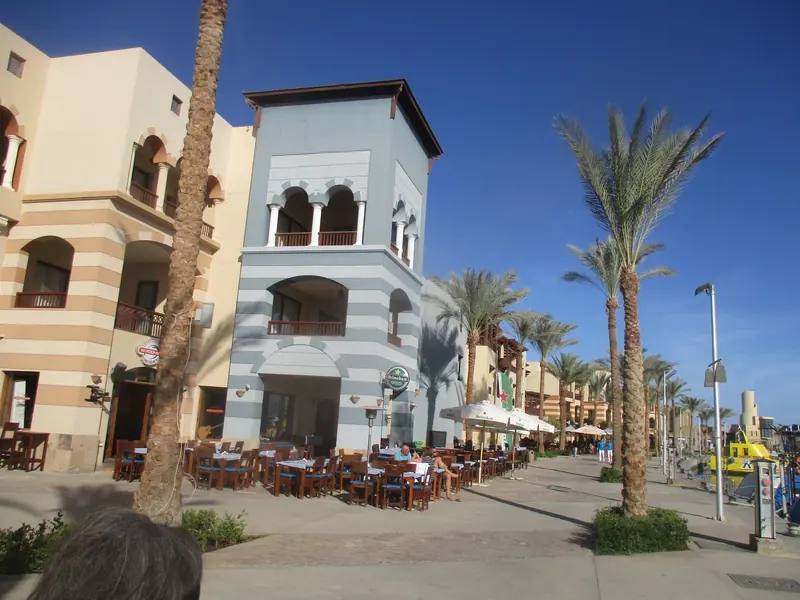
That gap between the marketing image and the on-the-water reality is worth stating plainly. The promenade itself is real and well reviewed - one visitor review calls it a highly sanitised souk with prices to match - and the resort carries several hotels with their own restaurants, including the Radisson-managed Marina Resort's five venues. The same cruiser account is blunter about the wider town: like a ghost town built by Disney World, with the whole of what there is to see covered in about two days.
None of that makes Port Ghalib a bad stop; it makes it a specific one. An owner who wants a lively, walkable marina town after dark should weigh the south-side berthing and the overnight movement ban before assuming the promenade is a short stroll from every pontoon.
Diving is the real reason most yachts come here
Emperor Divers, based at the marina jetty, runs both day boats to Elphinstone for oceanic whitetip and hammerhead encounters and multi-night liveaboard itineraries pairing Elphinstone with Daedalus and Fury Shoal. The desk could not source a single, dated, maritime-authority wind and season table specific to the Port Ghalib approach - the closest available guidance, from general Egypt climate sources rather than a marine pilot book, points to October through April as the more comfortable sailing window and April through October as the stronger diving season, an overlap that is only partial and worth planning around rather than assuming away.
Khamsin winds - hot, dry, dust-carrying southerlies - are a named seasonal hazard mainly across March to May, per general Egyptian climate sources rather than a yacht-specific pilot chart, and can reduce visibility with airborne dust for several days at a stretch when they blow. Fury Shoal, a third stop commonly paired with Elphinstone and Daedalus on multi-night liveaboard itineraries out of Port Ghalib, did not have an independently sourced distance figure from the marina in this research and should be confirmed with an operator directly. A captain planning a season that leans on both diving and comfortable passage-making should treat the two calendars as genuinely in tension rather than assuming one visit can optimise for both.
Getting there, and the airport nobody outside Egypt has heard of
The airlines actually serving Marsa Alam - Air Cairo, Corendon, EasyJet, Edelweiss, EGYPTAIR, Eurowings, Lufthansa, TUI's various national carriers and Wizz Air among them - read as a European winter-sun leisure network rather than a business-aviation gateway, which is consistent with the airport's short distance from the resort and its origin as part of the same concession that built the marina.
Hurghada's broader, more frequent connections make it the practical fallback for an owner on a tighter schedule, but it comes at the cost of the same three-hour drive that cruisers already use for chandlery runs and visa extensions - so a trip built around Hurghada effectively doubles as a logistics run rather than a pure transfer.
A terra, accessi e prenotazioni
| Getting there | Marsa Alam International Airport is 4-5 km away, served mainly by seasonal European charter routes. Hurghada, with broader scheduled service, is about a 3-hour drive north. |
|---|---|
| Arriving by sea | VHF: listening Channel 16, working Channel 10. Call port control about 2 hours ahead (marina guidance) or up to 24 hours by email (Noonsite). Port closes to new arrivals at 16:00; no boat movement in harbour 18:00-08:00. |
| Clearing in | Compulsory through one of two Egyptian-licensed agents. A 2022 account: six-plus hours dockside for quarantine, immigration and customs; exit permits issued from Cairo took 5-7 days. |
| What a berth costs, foreign-flagged | 2024 tariff: USD 387-1,347/m annually, USD 3-13/m daily, plus a USD 300 Immigration Dock fee each way. Add agent, visa, quarantine, customs and marina-tax fees on top. |
| Metered fluids | Fresh water USD 5-6/cubic metre; shore power USD 0.30/kWh; refuelling service fee USD 5-40/vessel. |
| Services on the quay | 24-hour security, sewage pump-out, laundry, WiFi, mail handling, airport transfers. No chandlery, no diesel shop; fuel dock will not fill jerry cans. |
| Where to eat within walking distance | The marina promenade's roughly 120 shops and restaurants including Divino, Soho Bar Tapas and Grill and Wunder-Bar; foreign yachts berth on the harbour's south side, a longer walk around after dark. |
| The fixed dates | No single authoritative wind table was found; general sources put October-April as the calmer sailing window and April-October as the stronger diving season, only partly overlapping. |
| What is not published | True berth capacity (225 built vs 1,000 marketed), a reconciled entrance/berth draft figure, any negotiated superyacht (60 m+) rate, and haul-out or travel-lift capacity beyond a generic slipway mention. |
Cosa riferiscono armatori ed equipaggi
The exit permit, not the entry, is what actually costs the days
Cruisers aboard SV Mai Tai describe applying twice for their Cairo-issued exit clearance, losing a weather window the first time, and needing a costly Hurghada visa-extension trip while they waited - summarising the experience as being a prisoner in the marina, paying daily berth rates, until the Coast Guard decided to let them go.
Lane and Kay Finley, SV Mai Tai, via NoonsiteThere is genuinely nowhere to buy marine parts in Port Ghalib itself
The same account states plainly that there are no diesel shops or chandlers in Port Ghalib, and that a needed refrigeration repair had to wait several days for a technician who happened to already be travelling from Quseir for another job.
Lane and Kay Finley, SV Mai Tai, via NoonsiteThe resort town itself reads as manufactured rather than lived-in
The same cruisers describe Port Ghalib as like a ghost town built by Disney World, with all of what there is to see coverable in about two days - a sharply different picture from the marina's own promotional material.
Lane and Kay Finley, SV Mai Tai, via NoonsiteThe marina's own capacity claim is far larger than its regulator's
Port Ghalib's marketing and most secondary coverage state a capacity of up to 1,000 yachts; the Egyptian Maritime Transport and Logistics Sector's own port record states Phase 1 holds about 225 to 60 metres, with 825 as an unbuilt future target.
Egyptian Maritime Transport and Logistics Sector, cross-referenced against Port Ghalib's own site
Cosa convince e cosa va valutato
Punti di forza
- A genuine, official port of entry with real diving on the doorstepOne of only a handful of Red Sea clearance points, with Elphinstone and Daedalus reefs within reach of the marina jetty.
- A published tariff, not a call-for-quote at every lengthThe 2024 sheet prices annual, monthly, weekly and daily dockage plus utilities by the metre for both local and foreign vessels.
- Real technical shelter and services for the basicsSecurity, pump-out, power, water and provisioning delivery all exist, even where deeper repair capacity does not.
Da valutare
- Clearance is a multi-day, sometimes week-long processA documented 2022 case took five to seven days to secure an exit permit, entirely outside the marina's or the local agent's control.
- No chandlery, no diesel shop, and fuel by tank onlyParts and technicians come from Quseir or Hurghada, up to three hours by road; the fuel dock will not fill jerry cans.
- The marina's own capacity claim is roughly four times its regulator's built figure225 yachts built to 60 metres against a marketed 1,000, with the difference resting on an undesigned second phase.
- An overnight movement ban can strand a crew a long walk from dinnerForeign yachts berth on the harbour's south side, and the 18:00-08:00 no-movement rule can mean a four-kilometre round walk rather than a short dinghy ride.
A chi si rivolge: An owner routing a yacht between the Mediterranean and the Indian Ocean who wants the Red Sea's diving on the doorstep, and a captain willing to budget real days, not hours, for Egyptian clearance