Flexiteek
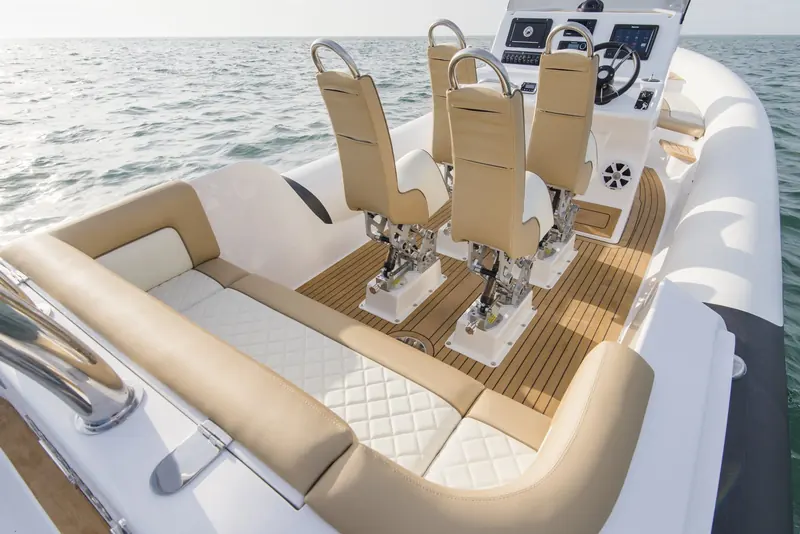
| Category | synthetic teak decking, an extruded PVC compound bonded to a boat's cockpit sole, side decks, swim platform or foredeck |
|---|---|
| Founded | 2000 in Norway by shipping entrepreneur Anders Wilhelmsen through the Watrium group; first production started at Fagersta, Sweden in 2002 |
| Ownership | Flexiteek International AS, the Norwegian holding company, owns the group's patents and trademarks; manufacturing runs through Flexiteek International AB in Fagersta, rebuilt into a new 1,400 sq m solar-powered plant in 2024 |
| Group companies | Flexiteek International Ltd (UK, formerly Wilks Rubber Plastics, acquired 2019), Flexiteek Marine Products (Poland, opened 2021), Flexiteek USA (Lake Park, Florida, opened 2025), Flexiteek Denmark |
| Range | Flexiteek 1G (2000), Flexiteek 2G (2014), Flexiteek 3 (current generation), plus the multi-tone Tritone range; up to 15 base colours and 3 caulking colours, more than 40 combinations |
| Scale | fitted by over 200 boat builders and shipyards as original equipment; the company produces about 80,000 sq m of decking a year with demand growing roughly 20 percent annually as of 2026 |
| Weight | 4.484 kg/sq m as independently measured in a 2024 comparative test, against roughly 6.5 kg/sq m for 10mm real teak rising to about 9 kg/sq m at 14mm |
| Thickness and format | 5mm standard thickness, plank widths from about 45mm to 200mm, panels CNC-cut to a deck template rather than hand-trimmed |
| Price | materials alone published at roughly EUR 150 to 1,000 per sq m depending on colour and panel complexity; one North American yard quoted an installed job at about USD 161 a sq ft (about USD 1,730/sq m) for Flexiteek against USD 286 a sq ft (about USD 3,080/sq m) for real teak on the same boat |
| Warranty | 5 years against manufacturing defects; certain acid-based cleaning chemicals are explicitly excluded and can void it |
Twenty-Five Years of Replacing a Deck Plank at a Time
Anders Wilhelmsen, a Norwegian with a background in shipping, set out in 2000 to extrude PVC into a plank that could replace teak on a boat deck, working through his Watrium group. Production started at a workshop in Fagersta, Sweden in 2002, and the plant there is still the company's main manufacturing site, rebuilt into a 1,400 square metre solar-powered facility in 2024. Flexiteek International AS, the Norwegian holding company, still owns the patents and trademarks the whole group trades on.
The group added scale by acquisition rather than staying a single Swedish operation. It bought the UK's Wilks Rubber Plastics in 2019, now trading as Flexiteek International Ltd, opened a Polish fabrication hub, Flexiteek Marine Products, in 2021, and opened Flexiteek USA in Lake Park, Florida in early 2025 to serve the American boatbuilding belt directly. The result is a company that now supplies more than 200 boat builders and shipyards as original equipment, making roughly 80,000 square metres of decking a year, with demand growing at about 20 percent annually as of 2026.
A Welded PVC Plank, Not a Painted Mat
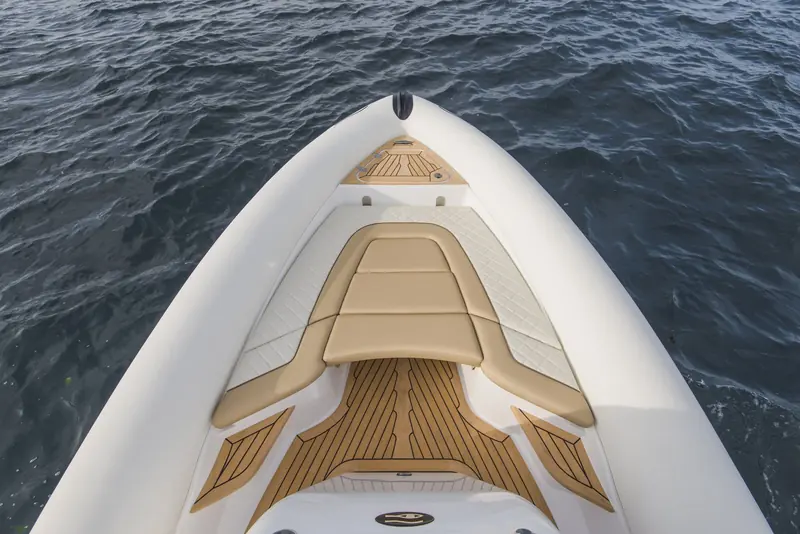
Each plank is extruded from a PVC compound rather than cast from cork or rubber, which is the point of difference Practical Sailor draws against cork-based rivals such as Marinedeck. The current Flexiteek 3 generation and its 2014-launched 2G predecessor use a microballoon filler in the compound instead of the chalk filler used in the original 2000-era product, which is what cools the surface and cuts its weight. The planks run 5mm thick in widths from about 45mm to 200mm, roughly the 1 to 4 inch range a real teak deck is laid in, offered in up to 15 base colours and 3 caulking colours, more than 40 combinations once the Tritone multi-tone range is counted.
A yard or the boat builder takes a template of the deck, and the panels are CNC-cut to that pattern rather than trimmed by hand on board, which is why the seams line up as cleanly as they do in Flexiteek's own gallery photography. The finished panel is bonded to the substrate with a two-part adhesive, never screwed or caulked in the traditional sense, and Practical Sailor notes Flexiteek heat-welds the plank-to-caulking seam rather than gluing a caulk bead into a routed groove, the detail that is meant to keep the black, grey or white line from lifting the way an old caulked teak seam does.
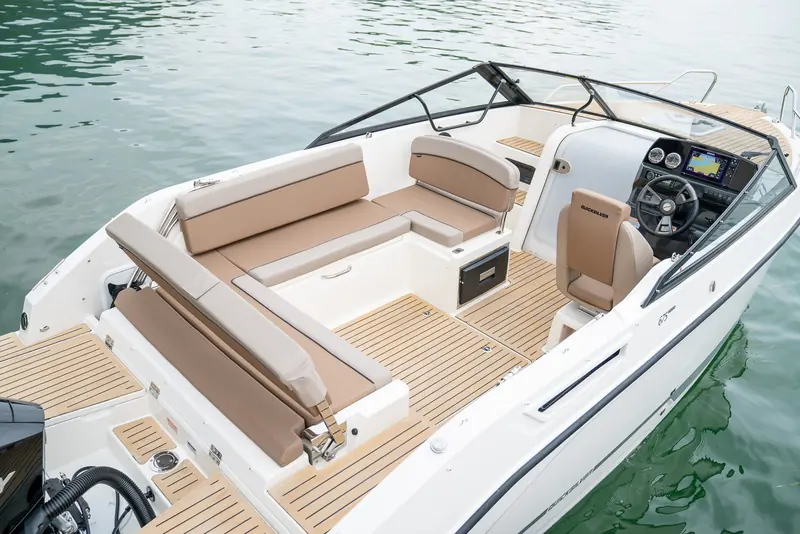
A Flexiteek deck undercuts real teak by half to two thirds installed, and almost the entire saving is in labour hours never spent oiling or scrubbing.
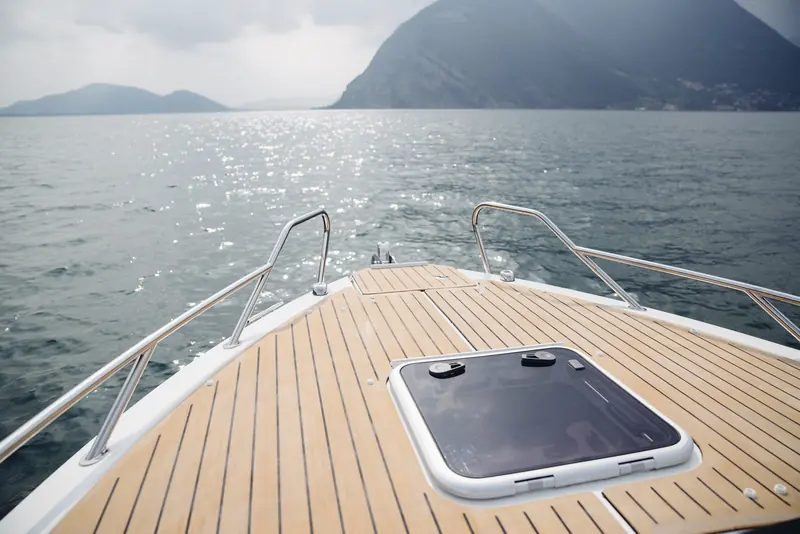
What the Deck Costs, and Why the Quote Is Mostly Labour
Flexiteek does not publish a flat per-square-metre price on its own site. Yachting World, which did get a figure out of the company, puts materials at EUR 150 to 1,000 per square metre depending on the design and size of each panel, a wide range because a plain single-colour sole costs far less to produce than a multi-tone Tritone deck with inlaid names or compass roses. That figure is materials only. A comparable rival brand, Permateek, was quoted to a YBW Forum owner at GBP 500 per square metre fully fitted, which is a more honest number for what a finished deck actually costs once a fitter is paid.
The clearest real comparison comes from a Trawler Forum thread on a Grand Banks refit, where the same yard quoted both jobs on the identical hull: about USD 161 a square foot installed for Flexiteek against USD 286 a square foot installed for real teak, excluding removal of the old deck in both cases. A UK owner separately reported a Flexiteek quote of about GBP 4,000 for a full cockpit re-deck where he supplied his own fitting labour, against a like-for-like real teak re-lay that UK yards typically quote at GBP 20,000 to 25,000 once fitting time is included. The pattern holds wherever it has been tested: Flexiteek undercuts real teak by roughly half to two thirds installed, and almost the entire gap is in labour hours, not the price of the material itself.
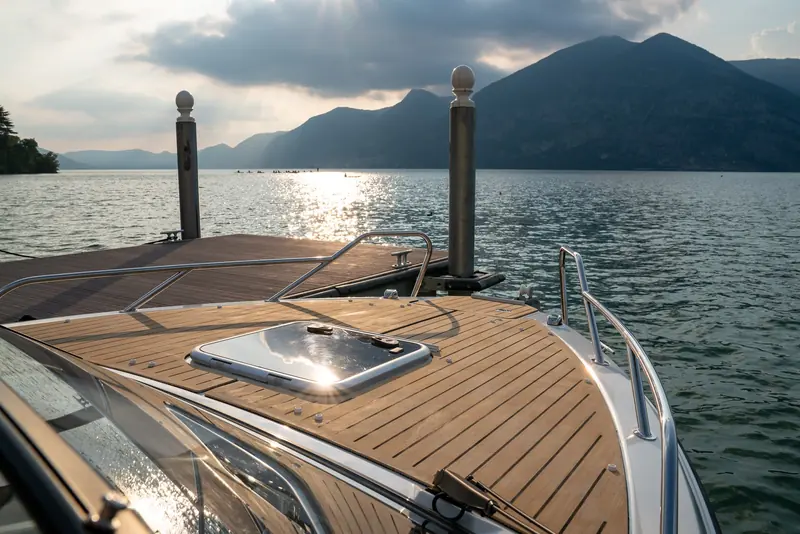
Lighter Underfoot, and No More Twice-a-Year Oiling
Independent test weighing in Yachting News's 2024 comparative test put Flexiteek at 4.484 kg per square metre, the lightest of the three synthetic products tested and, against the wider trade figures gathered for this entry, lighter than real teak's roughly 6.5 kg per square metre at 10mm rising to about 9 kg at 14mm. On a 13 metre sailboat with 30 square metres of deck, that test converted the difference into 134.5 kg for Flexiteek against a real teak deck of the same area that would likely run well over 200 kg once fasteners and bedding compound are added, weight that comes off the highest, most stability-sensitive part of the boat.
Maintenance is the other real change. Real teak wants oiling or at minimum a scrub every few months to hold its colour and grip, and owners on forums describe the work as unending. Flexiteek's own care guide and a one-year owner report published by Clevermariner both describe soap and water or a low-pressure wash as the whole routine, with one deck power-washed back to like-new condition after a month sitting dirty in a boatyard. The same owner report is honest that the deck runs hotter than the teak it replaced in full tropical sun, and that a splash of water is the fix, a trade many owners will take over oiling a deck every spring. It is not maintenance-free in every respect: a Boat Design Net poster with an actual installation reported that the surface does stain and is quite sensitive to grit and dirt rubbed in with use, with heavy-traffic areas darkening noticeably over time, and a YBW Forum owner separately noted algae growth over winter that needed a proper clean to shift. Grip underfoot is consistently rated well, including wet, which is the one area nobody in the research for this entry complained about.
Where Flexiteek Still Loses to the Real Thing
Heat has improved across generations, from the original chalk-filled compound to a microballoon-filled 2G and 3G compound that Flexiteek says cools up to 30 percent faster than rival composites, but it has not been solved. Yachting News's own heat test measured a peak surface temperature of 57.3 degrees Celsius on Flexiteek in direct sun, cooler than Permateek's 60.8 degrees but still hot enough that owners describe needing to hose the deck down before walking on it barefoot, and one YBW forum poster who otherwise likes the product says plainly that in strong sun it does get quite hot. Real teak, lighter in colour and a genuine wood, generally runs cooler underfoot in the same conditions, the one physical property synthetic decking has never fully matched.
Repair is the second gap. A damaged real teak plank can be lifted and a single new plank scarfed in, colour-matched and refastened, without touching the rest of the deck. A bonded Flexiteek panel does not fail that way: a scratch or a light burn can be sanded out, but a lifted seam or a failed adhesive bond usually means replacing the whole panel, and one owner on a Boat Design Net thread reported that patches applied with the manufacturer-recommended epoxy method came loose within a year, only holding once he switched to 3M 5200 polyurethane adhesive. On resale, forum opinion runs fairly consistent rather than split: posters on a YBW thread on the value impact of Flexiteek versus real teak argued that natural teak still signals a well-kept boat to a buyer, and that mixing real teak in the cockpit with synthetic on a swim platform reads as the worst of both rather than a compromise. None of this is disqualifying, but a buyer planning to sell in a market that still prizes real teak should weigh it in before ordering.
How Flexiteek Stacks Up Against Esthec, PlasDeck and Permateek
Yachting News tested Flexiteek against Plasdeck and Permateek on identical criteria in June 2024: surface temperature, weight, grip and tactile feel. Flexiteek came out lightest at 4.484 kg per square metre against Permateek's 5.367 kg and Plasdeck's 5.895 kg, ranked first for look and touch, and tied with Plasdeck for the coolest surface in direct sun at 57.3 degrees Celsius against Permateek's 60.8. All three reached a comparable grip angle of about 36 degrees before a test foot slipped, and the reverse-side panel construction was judged easiest to fit on Flexiteek.
Practical Sailor's own long-running synthetic teak test line, run separately in the US market, does not crown a single winner. It places Flexiteek in its Recommended tier alongside Esthec and PlasDeck, describing it as one of the most widely available products in North America and a longtime player in the field rather than the best performer on every measure; Esthec's seamless bonded finish and PlasDeck's non-migratory plasticiser formulation are each called out for their own strengths in the same review line. The honest reading of both tests together is that Flexiteek is a strong, credible choice among four or five serious synthetic teak brands rather than a category of one, and a buyer comparing quotes should ask an installer to price Flexiteek, Esthec and PlasDeck on the same job before choosing.
Informazioni pratiche
| Material price, published | Flexiteek does not put a price on its own site. Yachting World reports the company's own figure of EUR 150 to 1,000 per square metre for materials alone, depending on colour and panel complexity; a plain single-colour sole sits at the low end, a multi-tone Tritone deck with inlays at the high end. |
|---|---|
| Installed cost, from a real yard quote | A Trawler Forum thread on a Grand Banks refit records the same yard quoting both jobs on the identical hull: about USD 161 a square foot (roughly USD 1,730/sq m) installed for Flexiteek against USD 286 a square foot (roughly USD 3,080/sq m) for real teak, both figures excluding removal of the old deck. |
| A smaller, owner-fitted job | A UK owner on the YBW Forum reported a Flexiteek quote of about GBP 4,000 for a full cockpit re-deck with the owner supplying his own fitting labour, against real teak re-lays UK yards typically quote at GBP 20,000 to 25,000 fully fitted. |
| Weight versus real teak | Independently weighed at 4.484 kg per square metre in Yachting News's 2024 test, against roughly 6.5 kg/sq m for 10mm real teak rising to about 9 kg/sq m at 14mm. On a 30 sq m deck that is about 135 kg for Flexiteek against 200kg or more for real teak once fasteners and bedding compound are counted. |
| Maintenance regime | Soap and water or an occasional low-pressure wash, per Flexiteek's own care guide and a one-year owner report. Real teak wants oiling or at minimum a scrub every few months to hold its colour and grip, which owners on forums describe as a recurring, unending job. |
| Heat underfoot | Measured at 57.3 degrees Celsius peak surface temperature in direct July sun in Yachting News's test, cooler than Permateek's 60.8 degrees but hotter than Plasdeck's 53.5. Owners report needing to hose the deck down before walking on it barefoot in strong sun; real teak generally runs cooler in the same conditions. |
| Warranty and what voids it | 5 years against manufacturing defects. Flexiteek's own care documentation names acid-based cleaners, including oxalic, phosphoric, sulphuric, hydrochloric, acetic and citric acid, as chemicals that can damage the material and are excluded from cover. |
| Expected lifespan | Flexiteek cites PVC industry experts suggesting the surface may start to crack after 25 to 30 years, with no problems yet observed on its own oldest, roughly 20-year-old decks. UV darkening is described as reversible by light sanding rather than requiring replacement. |
| Resale and survey perception | Owner opinion on YBW Forum's thread on the value impact of Flexiteek versus real teak runs toward natural teak still signalling a better-kept boat to a buyer, with mixed real-and-synthetic decking on the same vessel seen as the worst of both rather than a compromise. |
| What is NOT published | No flat per-square-metre installed price and no official cost calculator on Flexiteek's own site. Large custom superyacht deck jobs, handled through the Flexiteek Superyacht division, are quoted per project only, and no independent long-term study beyond the company's own anecdotal 20-year decks exists for UV and wear over time. |
Cosa riferiscono armatori ed equipaggi
A year of heavy use, and heat is the one complaint that stuck
An owner's published one-year report describes kayaks dragged across the deck, saltwater exposure and a month of dirt and oil in a boatyard, with a power wash restoring the deck to like-new condition. The same report says the deck runs hotter than the real teak it replaced in tropical sun, and that a splash of water cools it down quickly.
ClevermarinerA bad installation, not necessarily a bad product, still cost one owner a full deck
A widely read thread titled the Flexiteek debacle describes excess adhesive squeezed out at the edges, unsealed edges letting water in underneath, and sections that pulled up easily once wet, with the original installer unresponsive to warranty complaints. The poster reported spending about an hour hand-scraping just 2 square feet of failed material during removal.
The Hull Truth (owner forum)The recommended adhesive is not always the one that works
An owner who patched a Flexiteek deck himself reported that patches bonded with the manufacturer-recommended epoxy method came loose within a year, and that switching to 3M 5200 polyurethane adhesive, applied with careful masking and weighted pressure, held with no further lifting.
Boat Design Net (forum)Resale opinion still favours real teak
In a thread specifically about the value impact of Flexiteek versus real teak, forum members argued that natural teak is bound to be more attractive to a future buyer because it suggests the owner cared about the boat, and that a mix of real and synthetic teak on the same boat creates a visual mismatch as the decks age at different rates.
YBW ForumInstallation quality, not the material, is what usually fails
A forum participant without ownership bias argued the install is the weak point rather than the product itself, citing 10-year-old Flexiteek decks still looking good, while a marine installer's own view was that the current Flexiteek 2G generation is an excellent product to fit.
Trawler Forum
Cosa convince e cosa va valutato
Punti di forza
- A real, verified installed-cost savingThe one real side-by-side yard quote found for this entry put Flexiteek at about USD 161 a square foot installed against USD 286 a square foot for real teak on the same boat, roughly half to two thirds the cost, and every other real quote gathered points the same direction.
- Genuinely lighter than the wood it replacesIndependently weighed at 4.484 kg per square metre, the lightest of the three synthetic decks in a 2024 comparative test and lighter than real teak's roughly 6.5 to 9 kg per square metre, a real weight saving off the highest part of the boat.
- Maintenance drops to almost nothingSoap and water or a low-pressure wash replaces the oiling and scrubbing schedule real teak demands every few months, confirmed by both the company's own care guide and an independent one-year owner report.
- Colour-stable, and any UV darkening is reversibleFlexiteek is designed to be UV-resistant and any darkening over years in the sun is described as correctable with a light sanding rather than a strip and re-oil, unlike untreated real teak.
- A genuine manufacturing track recordTwenty-five years in business, over 200 boat builders and shipyards fitting it as original equipment, and its own factory running in Fagersta, Sweden since 2002, scale that smaller synthetic-teak brands cannot match.
Da valutare
- Still runs hot in direct sunMeasured at 57.3 degrees Celsius peak surface temperature in a July heat test, and more than one owner reports needing to hose the deck down before walking on it barefoot in strong sun. Real teak generally stays cooler in the same conditions.
- A bonded panel is harder to repair invisibly than a teak plankA single damaged real teak plank can be lifted, colour-matched and replaced without touching the rest of the deck. A failed Flexiteek seam or adhesive bond usually means replacing the whole panel, and one owner reported epoxy-bonded patches coming loose within a year before switching adhesives.
- Real teak still commands more trust at resaleOwners discussing the value impact on YBW Forum lean toward natural teak signalling a better-kept boat to a buyer, and mixing real teak with synthetic on the same vessel is seen as reading worse than either material alone.
- No flat published installed priceEvery hard installed-cost figure in this entry came from a forum thread or a single yard quote, never from Flexiteek itself, so a buyer cannot budget accurately without getting a quote first.
- Long-run surface life is still mostly anecdotalThe 25 to 30 year crack estimate is Flexiteek's own citation of unnamed PVC industry experts, not an independent accelerated-ageing study, and the factory warranty covers only 5 years against manufacturing defects.
A chi si rivolge: Owners and buyers weighing a teak deck replacement or a new-build spec who want the look and grip of teak without the twice-yearly oiling, and who can accept that it still runs hot in direct sun and that a teak-loyal buyer may value the boat less at resale.