Sea-Fire Marine
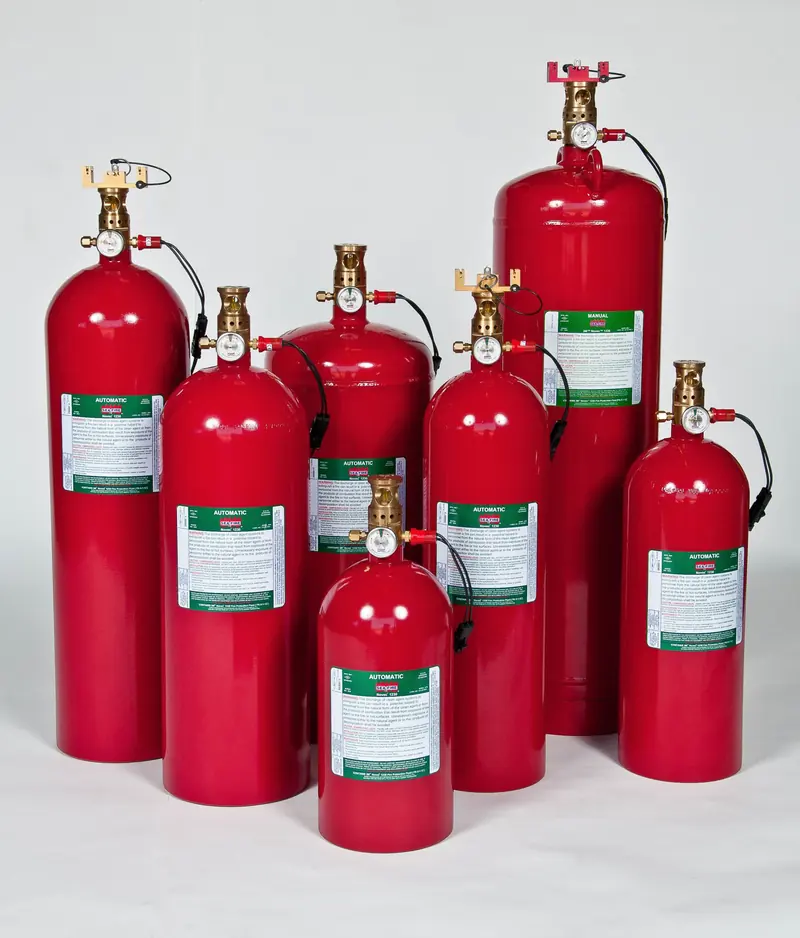
| Category | fixed and portable fire detection and suppression systems for marine engine rooms and enclosed compartments |
|---|---|
| Company | Sea-Fire Marine, a division of Metalcraft Inc, states more than 40 years of experience in fire suppression technology |
| Leadership | Ernie Ellis, president; Steve Ellis Jr., marketing director |
| Headquarters | 9351-G Philadelphia Road, Baltimore, Maryland, a 30,000 sq ft facility the company moved into in December 2017, with manufacturing in the USA and the UK |
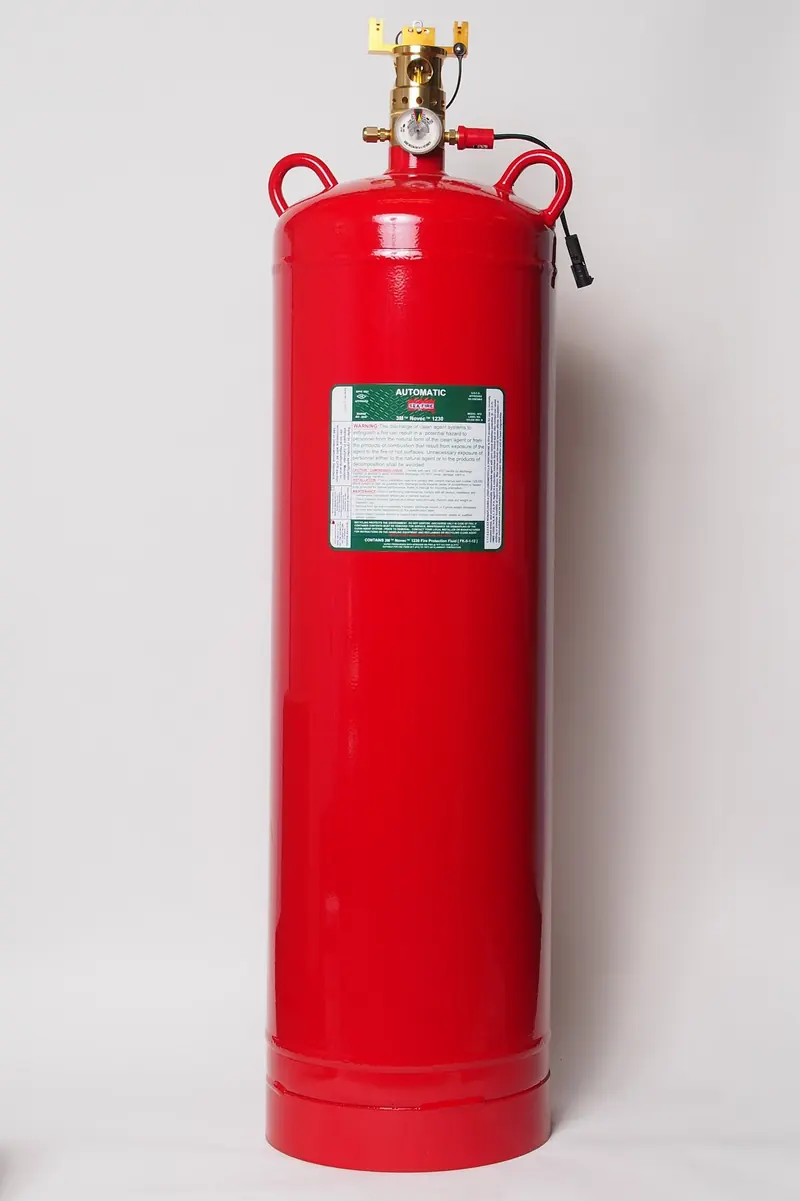
| Pre-engineered range | FD/FG series on HFC-227ea (FM-200) agent and NFD/NFG series on FK-5-1-12 (3M Novec 1230) agent, sized in 25 cubic foot increments from 25 up to 1,800 cubic feet in the maker's own catalogue |
| Engineered range | custom systems from 1,500 up to 17,500 cubic feet for large yachts, workboats and marine vessels, tested to IMO/SOLAS and approved by USCG, RINA, DNV, Lloyds/MCA, GL and Transport Canada among others |
| Entry price | a 150 cubic foot automatic FD system lists at USD 800.00 through Go2marine, a US marine retailer, read September 2026 |
| Smallest pre-engineered option | the NFG system (25 to 200 cubic feet coverage) starts at USD 320.00 through the same retailer |
| Portable extinguishers | the C-series runs USD 404.23 for the C 20 up to USD 866.20 for the C 100 |
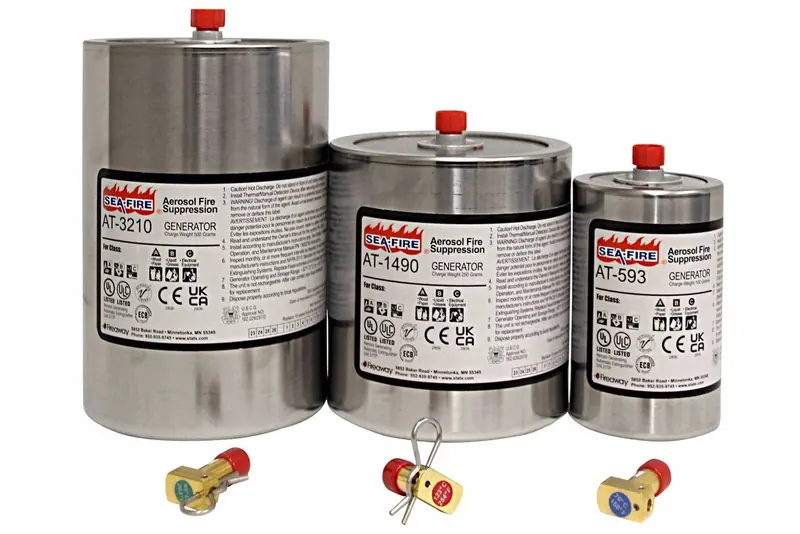
| AT-series aerosol generators | three charge weights read directly off the canisters, AT-593 at 100 grams, AT-1490 at 250 grams and AT-3210 at 500 grams, U.S.C.G. approved and built for compact spaces including lithium-ion battery compartments |
| LiCELL | a lithium-battery-specific portable extinguisher line Sea-Fire markets alongside its core range, in four graduated stainless steel sizes |
| Extinguishing concentration | Sea-Fire's own FD-series specification calls for a minimum 8.7 percent atmospheric concentration within the protected compartment, reached in 10 seconds or less |
| Warranty | two years on the FG, FD, NFG and NFD pre-engineered systems; one year on the H, N and M series, cable assemblies and electronic accessories |
| US Coast Guard guidance, per a 2026 forum discussion of the rule: a recreational vessel's fixed extinguisher needs only annual owner verification, not professional inspection, and must be replaced within 12 years | |
Forty Years of the Bottle Nobody Thinks About Until It Fires
Sea-Fire's own account of itself is short on specific founding dates but long on scale: the company describes itself as a global leader in the design and manufacture of fire suppression and detection systems for the marine and pleasure craft industry, with more than 40 years behind it. Ernie Ellis serves as president and Steve Ellis Jr. as marketing director, and the business relocated its North American headquarters to a purpose-built 30,000 sq ft facility at 9351-G Philadelphia Road in Baltimore in December 2017, with manufacturing split between the United States and the United Kingdom.
The company markets itself as the first fire extinguisher manufacturer to use DuPont's FM-200 agent for marine applications, a claim that is its own rather than independently verified, but the certifications behind the current range are real and extensive: CE, DNV, FM, GL, the Hong Kong Fire Services Department, Maritime New Zealand, RINA, SAMSA, Transport Canada and the US Coast Guard all appear on the FD and FG series datasheets.
Two Agents, and Why the Choice Actually Matters
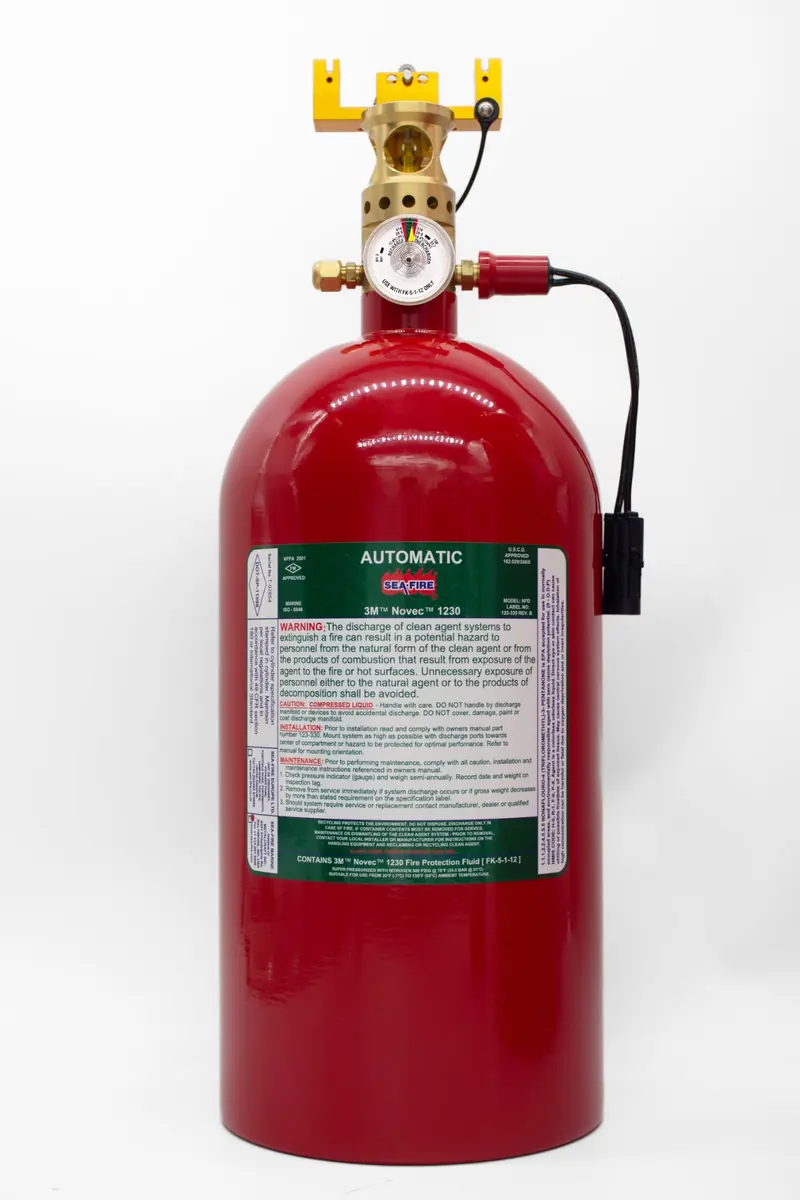
Both agents are clean agents: they leave no residue, are electrically non-conductive and are safe to discharge into a space where people might be present, which matters on a boat because nobody can guarantee an engine room is empty when a fire starts. FM-200 reaches extinguishing concentration in 10 seconds or less and takes up to seven times less storage space than an equivalent CO2 or inert gas system, according to the manufacturer, and it is accepted under the US EPA's Significant New Alternatives Policy as a replacement for agents banned under the Montreal Protocol.
Novec 1230, the agent behind the newer NFD and NFG lines, carries what one boating publication describes as almost no global warming potential against FM-200's more middling figure, and it costs slightly more as a result. Sea-Fire's own FD-series specification calls for a minimum 8.7 percent atmospheric concentration inside the protected compartment, reached in 10 seconds or less, which is the number an installer is actually sizing the bottle against rather than the cubic footage alone.
An engine that keeps running after the bottle fires does not survive the fire. It just breathes the extinguishing agent straight back out again.
The Pre-Engineered Range, and What It Costs
The pre-engineered FD, FG, NFD and NFG systems are sold in 25 cubic foot increments and cover most recreational and light commercial engine rooms, from 25 cubic feet up to 1,800 cubic feet in Sea-Fire's own catalogue. Real retail prices through Go2marine, a US marine retailer, start at USD 320.00 for the smallest NFG bottle and USD 800.00 for a 150 cubic foot automatic FD system, rising to USD 885.45 and up for the Novec-based NFD range. None of these figures include installation, engine shutdown wiring or the manual discharge cable a manual-capable model requires.
Southern Boating, a US boating publication, puts a complete fitted system at roughly USD 1,500 for a 300 square foot engine room and about USD 2,900 for a 750 square foot space, with a full system on a 50 foot boat running USD 2,500 to USD 3,000 all in. Owner reports on European forums run higher: a Sealine S37 owner was quoted GBP 2,000 including installation for an NFD-250M Novec system to replace a 20 year old FM-200 unit, and posters on the same thread cited fitted prices from EUR 1,400 to EUR 2,000 depending on the yard and whether an inspection was included.
Above 1,500 Cubic Feet: the Engineered Systems
A large expedition yacht's machinery space, or a workboat's engine room, routinely exceeds what a catalogue bottle can protect, and that is where Sea-Fire's engineered systems take over: custom-designed installations from 1,500 up to 17,500 cubic feet, tested to IMO/SOLAS and carrying approvals from USCG, RINA, DNV, Lloyds/MCA, GL, Transport Canada and the Australian and New Zealand maritime authorities. Release options span manual, automatic, manual with a time delay, or electrical release, chosen to match how the vessel's class society and flag state expect the system to behave.
Sea-Fire's own marketing director, Steve Ellis Jr., describes the sizing process itself as simple: specifying a fixed system can be as straightforward as taking a few measurements of the space. What is not simple is everything downstream of that measurement, which is why the company's own installation and design service, offered directly through at least one of its California dealers, is limited to consultation, design, installation and commissioning within that state, with equipment-only sales and third-party fitting the option everywhere else.
The Detail That Actually Decides Whether It Works
Chris Washburn, president of Washburn's Boat Yard in Solomons, Maryland and the American Boat and Yacht Council technical board member responsible for Standard A4 on fire-fighting equipment, makes the point plainly: if the engines keep running after the bottle discharges, they ingest and exhaust the suppressant along with everything else moving through the compartment, which defeats the whole system. Automatic engine shutdown becomes essential wherever the air change rate in the space exceeds about once a minute, which describes most engine rooms under way.
Sea-Fire sells the answer as an accessory rather than assuming it: the ESRS, or Engine Shutdown system, alongside Early Warning Heat Sensors and Manual Discharge Cable Assemblies. Washburn separately recommends a redundant manual-only backup system alongside the automatic one, at roughly USD 1,000 on top of the main installation, as insurance against an automatic system that discharges prematurely or fails to trigger. Notably, Passagemaker's own reporting flags that Sea-Fire's manual-pull systems, originally developed for racing use, are not USCG-approved for marine installation, which is a distinction worth checking model by model rather than assuming every product in the catalogue carries the same approval.
Lithium Batteries Are a Different Fire, and a Newer Product Line
A lithium-ion cell in thermal runaway generates its own oxygen internally, so a clean agent that works by starving a normal fire of oxygen is fighting a losing battle. Sea-Fire's AT-series answers this with a patented aerosol-generating mechanism that discharges automatically when ambient temperature reaches fire conditions, sold in three charge weights read directly off the canisters: the AT-593 at 100 grams, the AT-1490 at 250 grams and the AT-3210 at 500 grams, all US Coast Guard approved and manufactured in the United States.
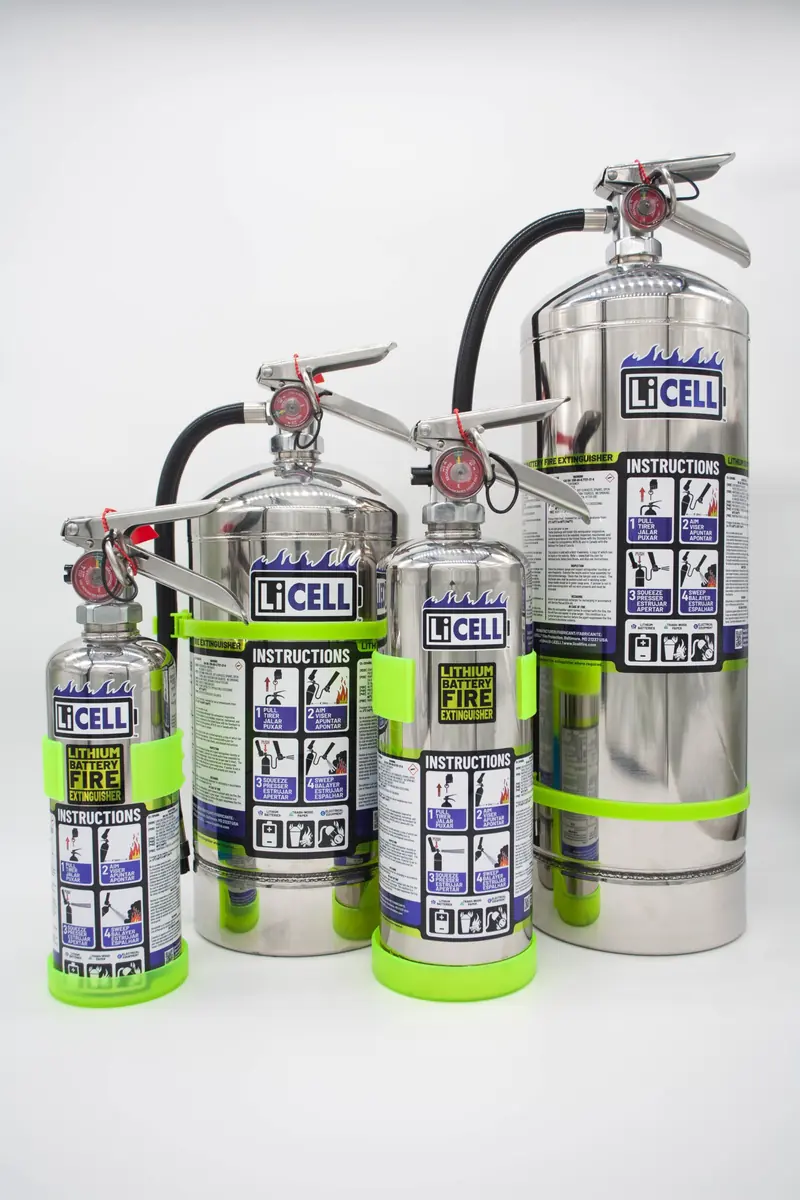
Alongside the fixed AT-series, Sea-Fire markets LiCELL, a portable extinguisher line built specifically for lithium battery fires, in four graduated stainless steel sizes from a handheld unit up to a larger cylinder with its own carry handle. Both product lines are recent additions next to the decades-old FD and FG range, which says something about how fast lithium battery banks, e-tender motors and house batteries have gone from novelty to standard equipment on the boats Sea-Fire's core customers actually own.
Servicing, Replacement and What the Label Actually Requires
The instructions printed on an NFD cylinder's own label are specific: check the pressure indicator and weigh the unit semi-annually, record the date and weight on the inspection tag, and remove the system from service immediately if it has discharged or if its weight has dropped by more than the stated allowance. Forum owners who have gone through a replacement report the regulatory side has actually loosened in recent years: a poster citing current US Coast Guard guidance says a recreational vessel's extinguisher no longer needs a professional inspection certificate, only annual verification by the owner, provided the unit is less than 12 years old.
What owners cannot avoid is the eventual bottle swap, and real prices for that vary enormously by route. One owner who replaced a 2009 FG 50A found online prices from USD 300 to USD 800 before hazmat shipping, and ended up paying Sea-Fire directly in Baltimore before a partial refund brought the net cost to about USD 247. Another reported paying just USD 100 for a Novec-agent bottle through a local fire equipment dealer in Oakland, California, and West Marine has been known to sell a Sea-Fire Novec unit for around USD 85, a reminder that the same part can cost eight times as much depending entirely on where an owner buys it.
Against Fireboy-Xintex and Kidde
Fireboy-Xintex and Sea-Fire are the two names most US boating publications reach for first, and both sell clean-agent systems on the same two chemistries, HFC-227ea and Novec 1230. Keith Larson, Fireboy-Xintex's vice president of sales, describes his company's pre-engineered systems as covering up to 4,000 cubic feet, with the broader Fireboy range running to 17,300 cubic feet before a project needs a fully engineered solution, a notably higher single-catalogue ceiling than Sea-Fire's 1,800 cubic foot pre-engineered limit before the same jump to custom engineering.
Kidde, the third name that comes up regularly, is a much broader fire-safety conglomerate with marine as one product line among many, and tends to compete on price at the small portable end rather than on engineered systems for large yachts. For an owner comparing quotes, the practical difference usually comes down to which brand the local installer already stocks and is trained on, since the underlying chemistry and the sizing logic are close to identical across all three.
Who Actually Needs to Think About This
An owner buying a boat with an existing system inherits somebody else's installation choices, and the two questions worth asking immediately are how old the bottle is and whether an engine shutdown is actually wired to it, since both determine whether the system will do anything useful in a real fire. A yard fitting a new system out should be sizing it against the compartment's real cubic footage and the specific agent's minimum concentration, not against whatever bottle happens to be on the shelf.
The newer risk is the battery bank rather than the engine, and an owner who has added lithium house batteries, an electric tender or a hybrid drive since the boat was last surveyed should ask specifically whether the existing system, sized for a fuel and electrical fire, does anything useful against a battery fire at all. In most cases it does not, which is exactly the gap the AT-series and LiCELL lines exist to close.
Informazioni pratiche
| Entry-level pre-engineered pricing, from a US retailer | Go2marine, read September 2026: NFG system (25 to 200 cubic feet) from USD 320.00; FD150A automatic (150 cubic feet) USD 800.00; NFD series from USD 885.45; FT flexible-tubing series from USD 713.38. None of these include installation. |
|---|---|
| Portable extinguishers | C-series portable units run USD 404.23 for the C 20 up to USD 611.03 for the C 50 and USD 866.20 for the C 100, per Go2marine. A basic 2.5 lb dry chemical portable is USD 60.00. |
| What a fitted system actually costs | Southern Boating puts a complete installed system at roughly USD 1,500 for a 300 sq ft engine room, USD 2,900 for a 750 sq ft space and USD 2,500 to USD 3,000 for a full system on a 50 ft boat. A UK owner was quoted GBP 2,000 installed for an NFD-250M Novec system; European forum posters reported EUR 1,400 to EUR 2,000 for comparable replacements. |
| The engine shutdown is not optional in practice | Per ABYC Standard A4 board member Chris Washburn, an engine that keeps running after the bottle discharges pulls the suppressant straight back out of the compartment. Sea-Fire sells the ESRS engine shutdown accessory separately; a redundant manual-only backup system adds roughly USD 1,000. |
| Replacement bottle prices vary enormously by source | One owner replacing a 2009 FG 50A found online prices of USD 300 to USD 800 before hazmat shipping, and paid about USD 247 net buying direct from Sea-Fire after a partial refund. Another paid just USD 100 through a local Oakland, California fire equipment dealer for a Novec-agent bottle, and West Marine has sold the same class of Sea-Fire Novec unit for around USD 85. |
| Service schedule, straight off the cylinder label | Check the pressure indicator and weigh the unit semi-annually, recording date and weight on the inspection tag. Remove from service immediately if the system has discharged or if weight has dropped below the stated allowance. |
| Current US Coast Guard rule on replacement | Per a 2026 forum discussion of the rule, a recreational vessel's fixed extinguisher needs only annual owner verification rather than a professional inspection certificate, and must be replaced within 12 years of manufacture. |
| What is NOT published | Sea-Fire lists no prices at all on its own site for any pre-engineered, engineered or portable system; every figure here comes from a dealer or an owner. The company also does not publish an independent third-party test of its own extinguishing performance beyond the certifications it holds, and its California design-and-installation service does not extend to buyers outside that state. |
Cosa riferiscono armatori ed equipaggi
Fitted prices for the same size of system vary by a factor of two or more
A Sealine S37 owner was quoted GBP 2,000 installed for an NFD-250M Novec system to replace a 20 year old FM-200 unit. Other posters on the same thread reported EUR 1,400 to EUR 2,000 for comparable replacements, and one flagged that UK-sourced units could be had for a few hundred pounds against a Mediterranean yard's unquoted-inspection price near GBP 2,000.
YBW ForumBuying direct from the manufacturer is not always the cheapest route
An owner replacing a 2009 FG 50A found online prices from USD 300 to USD 800 before hazmat shipping, and paid USD 495 buying direct from Sea-Fire in Baltimore, later receiving a USD 248 refund for a net cost of USD 247.
Sailboat Owners Forums (tfox2069)A local fire equipment dealer can beat marine-specific pricing by a wide margin
A Novec-agent FGA 123-295 50 cubic foot bottle was replaced for USD 100 through a local fire extinguisher dealer in Oakland, California in 2019, well under typical marine-retail prices for the same class of unit.
Sailboat Owners Forums (sail sfbay)The US Coast Guard's own inspection requirement has loosened
Current guidance requires only annual owner verification rather than a professional inspection certificate for a recreational vessel's fixed extinguisher, with full replacement due within 12 years of manufacture.
Sailboat Owners Forums (thinwater)Sizing a system is meant to be simple, and the maker says so itself
Specifying a fixed fire suppression system can be as simple as taking a few measurements of the protected space, though everything downstream of that measurement, including the shutdown wiring and the agent choice, is where the real decisions sit.
Southern Boating (Steve Ellis Jr., Sea-Fire Marine)
Cosa convince e cosa va valutato
Punti di forza
- The certification list is genuinely extensiveCE, DNV, FM, GL, the Hong Kong Fire Services Department, Maritime New Zealand, RINA, SAMSA, Transport Canada, USCG and US DOT all appear on the FD and FG datasheets, and the engineered systems add IMO/SOLAS testing and Lloyds/MCA approval for large yacht and commercial work.
- Two agent chemistries cover both the budget and the environmental end of the marketFM-200 on the older FD and FG range is proven, fast and inexpensive; Novec 1230 on the newer NFD and NFG range costs more but carries, per an independent boating publication, almost no global warming potential, giving a buyer a genuine choice rather than one agent forced on every size.
- The range scales from a USD 320 bottle to a 17,500 cubic foot engineered systemAlmost no other single marine fire-safety brand covers a small sailboat's 25 cubic foot lazarette and a large yacht's 17,500 cubic foot machinery space under one name and one certification set.
- Sea-Fire has moved early on the lithium battery riskThe AT-series aerosol generators and the LiCELL portable line exist specifically because a standard clean-agent bottle does not reliably extinguish a battery in thermal runaway, and both are current products rather than an afterthought bolted onto older technology.
- The service requirement printed on the label is simple and unambiguousA semi-annual pressure and weight check, recorded on the tag, is something any competent crew or yard can do without specialist tools, and current USCG guidance no longer requires a professional inspection certificate for a recreational vessel.
Da valutare
- The equipment alone is not the systemPer ABYC's own Standard A4 technical board member, a bottle without a properly wired engine shutdown is far less effective in practice, and that wiring is sold as a separate accessory rather than bundled by default with every unit.
- Sea-Fire publishes no prices anywhere on its own siteEvery figure in this entry comes from a dealer, a forum or a boating publication, and real prices for what should be an identical replacement bottle ranged from USD 85 to USD 800 across the sources checked here, which makes comparison shopping essential rather than optional.
- At least one product line carries a narrower approval than the core rangePassagemaker's own reporting notes that Sea-Fire's manual-pull systems, originally developed for racing use, are not USCG-approved for marine installation, a distinction easy to miss against the extensive certification list the rest of the catalogue carries.
- The full design and installation service is geographically limitedAt least one of Sea-Fire's own dealers offers full consultation, design, installation and commissioning only to California residents, leaving buyers elsewhere to source equipment from Sea-Fire and fitting from a separate qualified installer.
- Pre-engineered coverage tops out below a direct rival'sSea-Fire's pre-engineered catalogue runs to 1,800 cubic feet before a project needs a custom-engineered system, against Fireboy-Xintex's pre-engineered ceiling of 4,000 cubic feet, per that company's own vice president of sales.
A chi si rivolge: Owners and yards specifying or replacing engine-room fire suppression, and anyone who has added a lithium battery bank, e-tender or hybrid drive since the boat was last surveyed for fire risk.