Sealegs
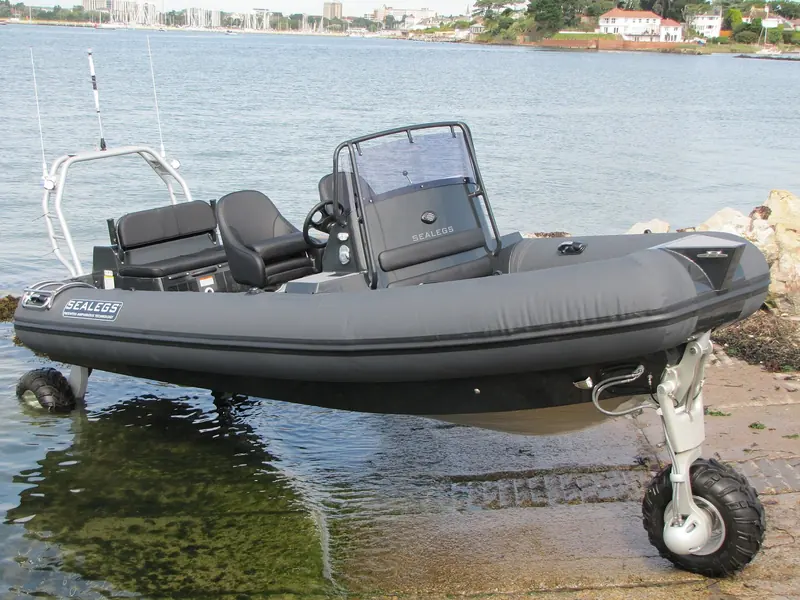
| Sealegs International, Auckland, New Zealand; invented by Maurice Bryham and developed with co-founder David McKee Wright, production from 2005 (Wikipedia; Suncruiser, 2019 puts the founding in the early 2000s) | |
| 1,000th craft shipped in September 2015 to 50 countries (Wikipedia); more than 1,200 sold by April 2019 (Suncruiser); more than 1,850 shipped by March 2025 (Boating New Zealand) | |
| Three wheels, one at the bow and two at the stern, raised, lowered and driven by hydraulics; all-wheel drive is standard (Trade-a-Boat, 2016; Power Boat Magazine, 2026) | |
| Land drive is a separate small engine, a 22 hp Honda GX690 on the 6.1 m boat, driving a hydraulic pump (Trade-a-Boat, September 2016) | |
| Land speed about 7 km/h on the 6.1 m boat (Trade-a-Boat) and up to 10 km/h on larger models (Suncruiser, 2019) | |
| Land running time rose from 10 minutes to 30 minutes with the XRT oil cooling system (Trade-a-Boat; Wikipedia) | |
| Kits for 2026 | System 20E electric, System 60 up to 2,500 kg, System 70 up to 3,500 kg, System 100 diesel up to 10,000 kg gross weight (Power Boat Magazine, 10 June 2026) |
|---|---|
| 7.1 m Sport RIB with a 150 hp Evinrude E-TEC: 44.2 mph top speed, 25 mph cruise at 5.95 gph, 177 miles of range with 10 percent reserve (Boattest, 2016) | |
| Boattest priced the 7.1 m at USD 129,000 with the 150 hp engine; Trade-a-Boat priced the 6.1 m from NZ$130,000 plus GST (2016) | |
| The parent company was NZX listed, renamed Future Mobility Solutions in 2017 and sought to delist in 2019 with a going concern warning (NZ Herald, 28 August 2019) | |
Where Sealegs comes from
Wikipedia credits Maurice Bryham with prototyping the craft and David McKee Wright with partnering him to incorporate Sealegs International. Wright was chief executive by 2013, according to Wikipedia. A 2019 Suncruiser profile says the pair launched the company in the early 2000s, and Wikipedia gives 2005 as the start of production, so the founding year depends on whether you count the prototype or the first sale. The record is kept in round numbers. The 1,000th craft shipped in September 2015 and went into 50 countries, according to Wikipedia. By April 2019 Suncruiser put the figure above 1,200, and by March 2025 Boating New Zealand said more than 1,850 had shipped. That is roughly 850 boats in a decade, or somewhere under a hundred a year, which tells you this is a specialist builder and not a volume one.
Trade-a-Boat's Peter Elliott toured the factory in Albany, on Auckland's North Shore, for a 2016 review and described a plant of about 60 staff that makes the hulls, consoles and hydraulic drive parts itself, to a stated tolerance of under 1 mm in the hull. He wrote that 70 percent of sales go offshore, with the largest share to North America, and that 20 percent go to existing customers moving up to a bigger boat. Those are the maker's figures relayed by the reviewer, not audited numbers. Power Boat Magazine's June 2026 guide places the facility in Glenfield, also on the North Shore, and calls Sealegs the best selling amphibious brand in the world. Treat that as the magazine's claim; no sales league table was found.
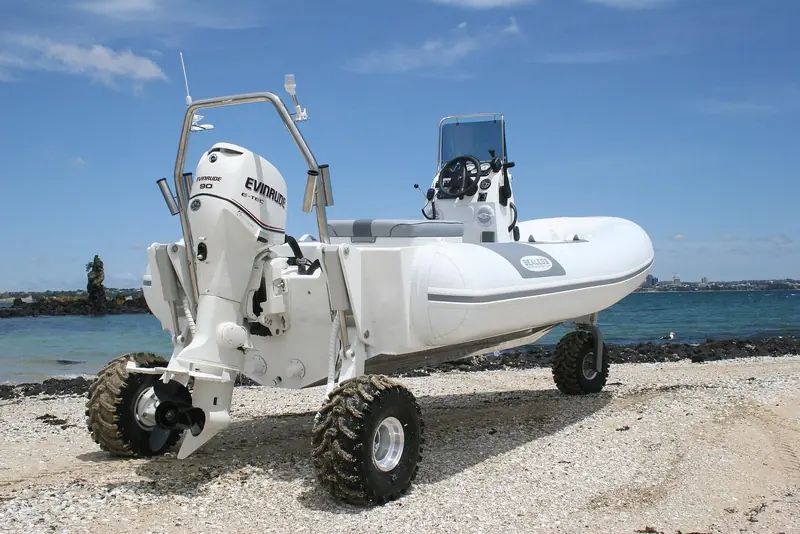
How the amphibious drive works
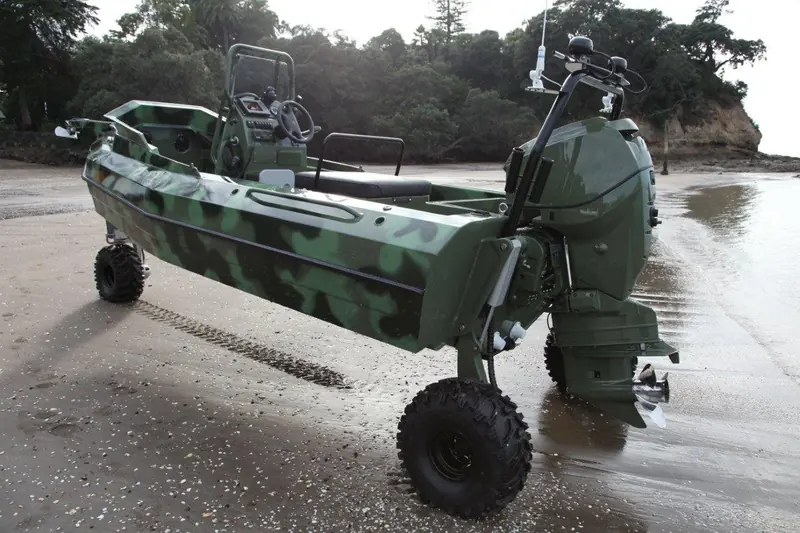
On the 6.1 metre boat Trade-a-Boat described a 22 hp Honda GX690 under an aluminium cabinet driving a hydraulic pump. The pump powers all-wheel drive and the rams that raise and lower the legs, on 25 by 12 inch all-terrain tyres. Steering is by the same wheel that steers the outboard on the water; it turns the bow wheel on land, and power steering can be switched off once you are afloat. Launching is a sequence, not a button. Drive into the water, start the outboard as soon as it is submerged, retract the wheels and stop the hydraulic engine. Coming ashore, you approach at an even pace, restart the hydraulic engine, lower the wheels, raise the outboard as the bow wheel bites and switch off as the stern wheels reach the land. Elliott called the transition smooth and seamless.
Land performance is where sources disagree, because the boats and the years differ. Trade-a-Boat gives about 7 km/h and a climb of up to 11 degrees for the 6.1 m. Suncruiser quotes up to 10 km/h on larger models, and Boattest says the 7.1 m can climb a 30 percent grade, which is about 17 degrees. Early boats could drive for only 10 minutes before the hydraulic oil overheated; with the XRT cooling system that is now 30 minutes. A 2012 forum thread quoted the maker's FAQ as needing about 50 minutes of cooling after 10 minutes of use, which is the old limit and not the current one. Brakes are automatic and fail safe: they need hydraulic pressure to release, so a dead engine or a burst hose locks the wheels. Trade-a-Boat singled this out as a feature it liked.
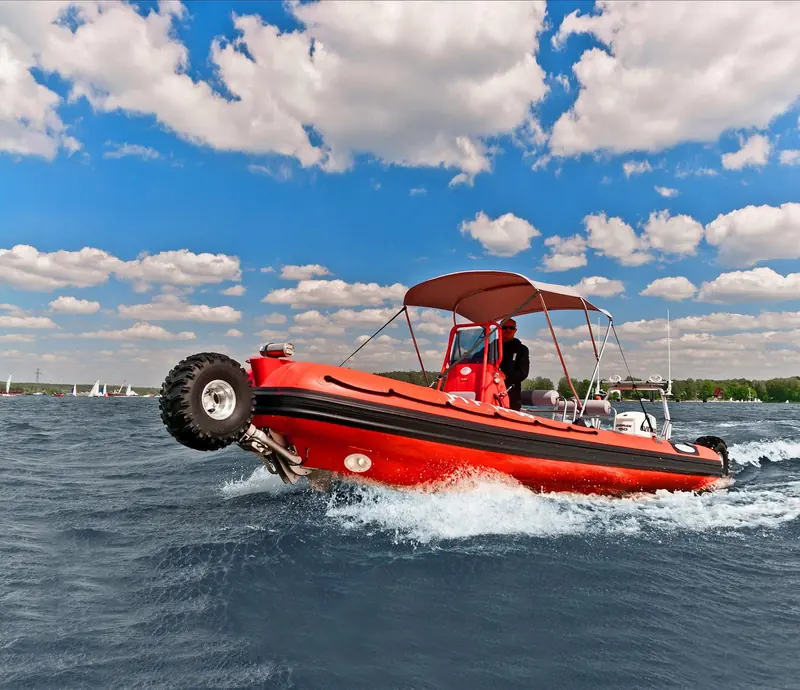
Owners use the boat far more than any they had before, because launching and storing it is easy (Trade-a-Boat, 2016).
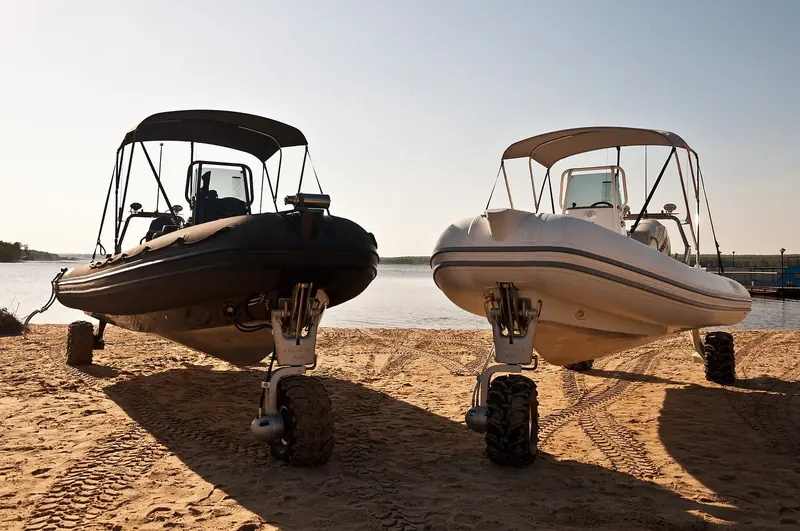
The range, from tender to cabin boat
Power Boat Magazine, in its guide of 10 June 2026, lists System 20E for the 3.8 m electric tender, System 60 for craft up to 2,500 kg gross, System 70 for up to 3,500 kg with a 28 hp Honda or 40 hp Briggs and Stratton petrol engine, and System 100 for up to 10,000 kg with a diesel inboard. Kits fit craft from 3.8 m to 12 m. At Auckland in March 2025 Boating New Zealand reported the 3.8 m Electric Hybrid Tender with a 3 kWh battery and 7.5 km/h on land, up to 60 hp on the water; a 7.5 m RIB in All-Round and Social versions with a 200 hp Yamaha and a 40 knot claim; and the 12RC. The 12RC is 12.3 m by 3.6 m with two Mercury 600 hp V12 outboards, a galley, up to four berths and a bathroom, and is the largest Sealegs. Boating New Zealand quotes 54 knots for it, Power Boat Magazine, in April 2024, gave no speed, so that figure has one source.
The model that sold the volume is the middle one. In 2019 John Dowd of Kelland Watercraft, the Canadian importer, told Suncruiser that the 7.1 m, which seats eight, was the most popular. Wikipedia also lists a Stabicraft 2100 ST built in collaboration with Stabicraft from December 2014 and an electric boat released in September 2018. Sealegs craft also serve emergency and patrol work, and Wikipedia names users in Australia, Fiji, Malaysia, New Zealand and the United States, and Elliott reported seeing a US Navy vessel with Sealegs technology at the Auckland boat show.
What it is like on the water
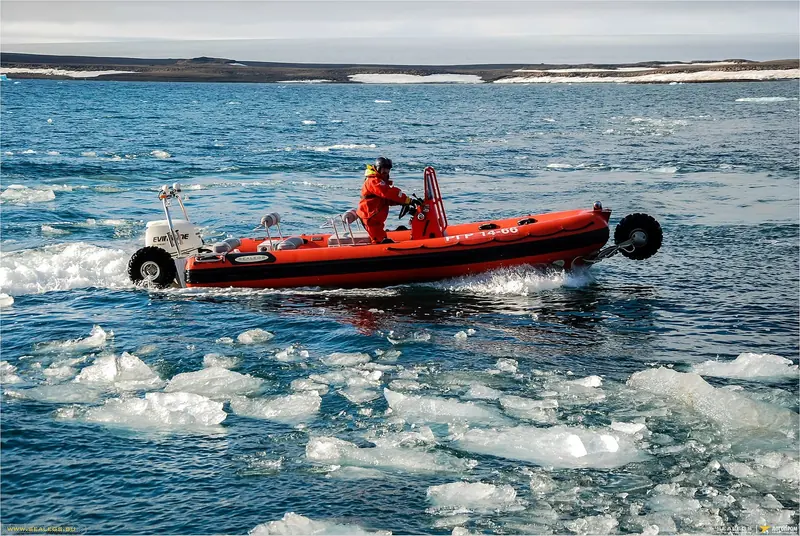
Boattest ran the 7.1 m Sport RIB with a single 150 hp Evinrude E-TEC at a tested weight of 4,044 lb against a 3,065 lb dry weight. It reached 44.2 mph at 5,500 rpm burning 15.45 gph, and cruised at 25 mph at 3,500 rpm on 5.95 gph for a stated 177 miles with a 10 percent reserve. Time to plane was 4.0 seconds, and 0 to 30 mph took 7.8 seconds. At 4,000 rpm it did 30.2 mph on 7.5 gph. The testers ran it in 2 to 4 foot seas and a 10 to 15 mph wind and said the wheels did not affect the turning. Trade-a-Boat's 6.1 m with an Evinrude 115 reached 35 knots and rode firmly with little hull noise, which Elliott put down to a four-stringer hull that doubles as the chassis for the drive.
The cost of the wheels shows up at the stern. Elliott noted that the two hydraulic mounts and wheels add drag and slow the boat out of the hole, and listed it among his cons with price. A permatrim is normally fitted to counter it, though he said the longer waterline on the 6.1 m did not need one. Everything above is a 2016 test on a 150 hp two stroke Evinrude, so a buyer today should treat the fuel numbers as a guide to shape, not a promise, and ask for a recent sea trial on the outboard actually fitted.
What it costs to buy and own
Trade-a-Boat tested the 6.1 m Sport RIB at NZ$171,000 plus GST with Fusion audio, a ski tower and the long options list, from NZ$130,000 plus GST. Boattest listed the 7.1 m at USD 129,000 with the 150 hp engine in 2016, with a bimini at USD 1,740 and a washdown pump at USD 990. In April 2019 Suncruiser quoted Kelland Watercraft that current models start at 180,000, in a currency the article does not name. For 2021 Power Boat Magazine reported a planned 3.8 m electric tender at about NZ$105,000, with refundable deposits and production dependent on 15 deposits; the desk did not confirm it went on sale at that price. Search listings seen on 18 November 2026 show a 2026 7.5 m Hydrasol asking NZ$319,990, a 2025 7.5 m in the UK at 210,000 pounds and another New Zealand 7.5 m at NZ$260,000. The desk could not open those pages, so treat them as asking prices that need checking.
Used boats help the maths. A 2011 6.1 m RIB was listed on Trade-a-Boat at NZ$74,950 in Auckland, an asking price on the page the desk read. That is roughly half the 2016 new price, so the early boats do hold value, but one listing is not a trend. Add the engine, a trailer if you want to road tow, and servicing, because Sealegs' aftersales page, as shown in search results, says each craft must be serviced to the maker's schedule to keep the warranty. The intervals and the prices of that service are not published where the desk could read them. Elliott did report that the factory holds a stock of every part and that a hydraulic hose is simple to order and fit.
Who stands behind it
The NZX listed parent was Sealegs Corporation Limited until 31 January 2017, when it became Future Mobility Solutions, according to NZX records seen in search results. The NZ Herald reported on 28 August 2019 that the company had applied to delist, that the loss for the March year was NZ$6.3 million against NZ$2.6 million the year before, and that its auditor Grant Thornton flagged material uncertainty about the group continuing as a going concern. The same story said the Court of Appeal had released an injunction Sealegs had won against Orion Marine, which had stopped Orion building amphibious boats. National Business Review headlines in the same period reported a management buyout of the Sealegs International boat business. The desk could not open that story, so it has no date, price or buyers.
None of this says the boats are unreliable. It says the maker has had a hard financial history, and that a private buyer, or a yard thinking of putting one in a tender garage, is relying on a small builder's parts supply. The 2025 and 2026 launches, the 12RC and the electric tender show the company still developing products, and Boating New Zealand's March 2025 piece gives 21 years of production. Ask for the current service agent in your country in writing before you pay a deposit.
The alternatives to a Sealegs
Power Boat Magazine's 2026 guide names Anura, a New Zealand maker since 2012 that offers petrol, diesel, hybrid, hydraulic and electric systems, with HP Series kits up to 8,000 kg gross. It also names Tectrax, which says its Generation 2 is the only fully electric amphibious system, with no hydraulics, three axial flux motors, 48 V LiFePO4 batteries with a five year warranty from early 2026, and a front wheel that turns through 110 degrees. The magazine describes both from the makers' material, with no tests, and no prices were published. Tectrax also sells a remote controlled self propelled trailer, the Boat-Launcher, at 6 to 8 km/h using 5 to 10 percent of battery per launch with a three year warranty, for owners who want ramp free launching without replacing the boat.
Against any of these, the Sealegs advantage is its age and its numbers: 1,850 craft and 20 years of hydraulic legs. Its disadvantage is the same hydraulics, which means oil, hoses and rams in a salt water environment. Elliott argued that the drive motors have no electrical parts, so long immersion is no problem. A forum poster in 2012, who owned no Sealegs, doubted that the system would hold up to salt and sand. Neither claim is a reliability record, and the desk found none.
Who should buy one
The case is use, not speed. Elliott wrote that owners tend to use the boat far more than any previous boat because launching, retrieving and storing it is so easy, and Suncruiser reported a company survey saying owners used their Sealegs four times as much as the boat before. That is the maker's survey and the desk has not seen it. Boattest noted that most buyers are waterfront homeowners. The same ease suits a superyacht tender, and Elliott called the 6.1 m party boat a fitting addition to one, though a tender has to fit the yacht's garage and crane with its legs fitted, and the 6.1 m weighs 1,150 kg with its engine.
It is weaker for someone who sails from a good ramp, or a marina, with a pickup. The extra cost buys a convenience that these owners already have. Expect to pay a premium over a conventional RIB of the same length, and no source in the desk's reading gives a like for like premium. Try one on your own beach, ask for a recent sea trial and for the service agent's name, then decide.
Informazioni pratiche
| Price | 6.1 m Sport RIB from NZ$130,000 plus GST, NZ$171,000 as tested (Trade-a-Boat, 2016). 7.1 m USD 129,000 with a 150 hp engine (Boattest, 2016). Listings seen in search results ask NZ$260,000 to NZ$319,990 for 7.5 m boats; ask a dealer for a current quote |
|---|---|
| Used | A 2011 6.1 m RIB asked NZ$74,950 on Trade-a-Boat in Auckland (asking price, one listing) |
| Drive kits | System 20E electric; System 60 to 2,500 kg; System 70 to 3,500 kg; System 100 diesel to 10,000 kg (Power Boat Magazine, June 2026) |
| On land | Three wheels, all-wheel drive, about 7 to 10 km/h, 30 minutes of running with XRT, automatic fail safe brakes; not for public roads, use a trailer |
| Performance | 7.1 m with 150 hp: 44.2 mph, 25 mph cruise at 5.95 gph, 177 miles with 10 percent reserve (Boattest, 2016) |
| Compare | Anura hydraulic, hybrid and electric kits; Tectrax fully electric drive; a Tectrax Boat-Launcher trailer at 6 to 8 km/h; or a conventional RIB with a ramp or davit |
| Servicing | Sealegs' aftersales page says each craft must be serviced to its schedule to keep the warranty; the factory is reported to stock every part (Trade-a-Boat, 2016) |
| Check before buying | Who your service agent is; hours on the hydraulic engine; hose, ram and leg pivot condition; the tyres; how it launches at your own site |
| What is not published | A current price list; service intervals and prices; any owner survey or failure data; independent test of the 2025 and 2026 boats; the terms of the buyout |
Cosa riferiscono armatori ed equipaggi
Owners use it far more than past boats
The reviewer reported owner anecdotes that, because it is so easy to launch, retrieve and store, they use it far more than any boat they had before; he found it believable
Peter Elliott, Trade-a-Boat, 1 September 2016Stern weight slows the start
On the 6.1 m with an Evinrude 115 the hydraulic mounts and wheels at the stern added drag out of the hole, though the boat reached 35 knots
Peter Elliott, Trade-a-Boat, 1 September 2016Wheels did not spoil the handling in a chop
Testers ran the 7.1 m in 2 to 4 foot seas and a 10 to 15 mph wind and said the wheels did not affect turning
Boattest, 2016 (author not named)Dealer says the 7.1 m is the favourite
The 7.1 m, which seats eight, is the most popular model, in the words of the Canadian importer
John Dowd, Kelland Watercraft, in Suncruiser, 5 April 2019Forum doubts on salt, sand and cost (not owners)
In a March 2012 thread, posters who said they owned none questioned the durability in salt and sand and the cost; the thread also mixes in the pontoon boat leg product that shares the name
iBoats forum, thread More Sealegs Questions, March 2012No owner reliability survey exists in the desk's reading
The desk found no owner association, forum report or survey on hydraulic leg failures, service intervals or cost, so reliability is untested here
Yotters desk
Cosa convince e cosa va valutato
Punti di forza
- The most proven amphibious RIBMore than 1,850 craft shipped and 20 years of production, with users from NZ coastguard work to the US
- Drives itself on and off a beachAll-wheel drive, 30 minutes of land running with XRT, and brakes that lock on any loss of hydraulic pressure
- Good numbers on the water44.2 mph and 177 miles of range at 25 mph for the 7.1 m in Boattest's 2016 test, with a stable ride in 2 to 4 foot seas
- A kit for every sizeFour systems, from the 3.8 m electric tender to a diesel System 100 for 12 m boats up to 10,000 kg
Da valutare
- The priceNZ$171,000 plus GST tested in 2016 for a 6.1 m, with 7.5 m boats now asking NZ$260,000 and above in listings
- Slow out of the holeTwo wheels and legs at the stern add drag, which the Trade-a-Boat reviewer listed as a con
- Slow and short on land7 to 10 km/h and a 30 minute run limit, so it is a beach and ramp machine, not a road one
- A shaky corporate recordThe listed parent reported a NZ$6.3m loss and a going concern warning in 2019 and a management buyout was reported afterwards
- No reliability evidenceNo independent service cost or failure data was found for the hydraulic legs
A chi si rivolge: Buyers with a beach, a shallow shore or a tidal slip who would otherwise not launch, and yacht owners weighing a self-launching tender. Less useful for anyone who already has a good ramp.