Wallas

| Founded | 1972, Turku, Finland, by Jorma Wallasvaara (1929-2006); manufacturing based in Kaarina, Finland |
|---|---|
| 30GB diesel heater | 1,500-3,000W, 12V, fuel consumption 0.15-0.3 l/h, electrical draw 0.8-1.75A |
| 22GB Coastal Kit | max 2.4kW, min 1.0kW, fuel consumption 0.10-0.24 l/h (Yachting World) |
| 30DT (3kW) and 40DT (4kW) | both discontinued, replaced by the 30GB and the newer VikingAir |
| VikingAir | infinitely adjustable output, 950-3,000W |
| Price | Wallas 30GB with full install kit and control panel, USD 2,881, Scan Marine USA (official US importer) |
| Named owner accounts | Rodney (Catalina 42 Mark II), Fred Ficarra, Abe (Hunter 36), via Sailboat Owners forum |
| Maintenance | burner needs decarbonising roughly every 500 hours, per owner accounts |
| Also makes | diesel-fuelled stovetops and ovens, stated as the world's first diesel convection oven |
| Recent engineering | brushless blower motors, laminar flow burner for lower CO2/NOx, designed for blended biodiesel |
What Wallas is, and who started it
Jorma Wallasvaara, who lived from 1929 to 2006, was a sailing enthusiast first and an engineer second, and the company's own account of its founding is specific about the motive: he built the heater because nothing on the market at the time met his own standard for reliability, quiet running and clean emissions aboard his own boat. His stated philosophy at founding was blunt about the stakes: "If a company does not have sustainable products and production there is no place to enjoy nature in the future." Manufacturing and product development are still based in Kaarina, Finland, close to the company's original Turku home.
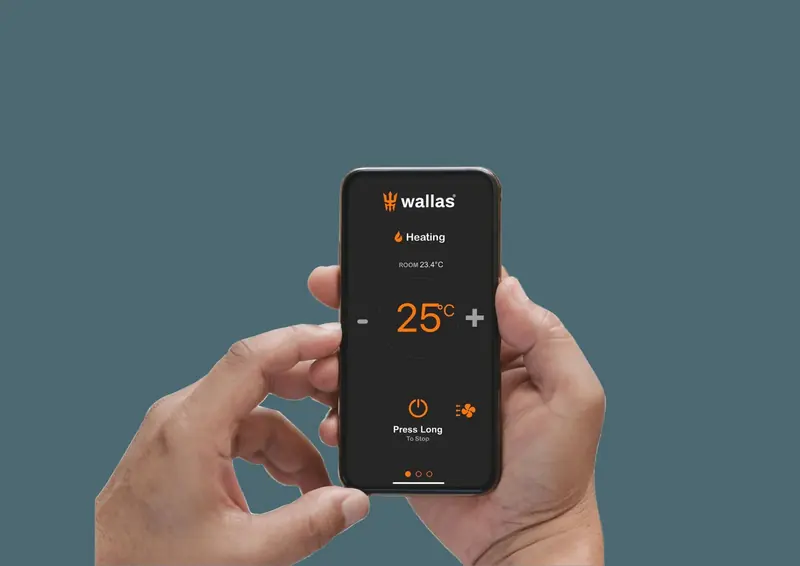
The company has stayed narrowly focused since: diesel-fuelled air heaters and cookers for marine, cabin and camper use, rather than expanding into unrelated boat systems the way some of its larger rivals have. Wallas states that every unit is hand built and hand tested, and that it developed the world's first diesel-operated convection oven, alongside what it markets as an early move into mobile app-operated remote control for a diesel heater, a feature most rivals have only added more recently.

Why a Wallas heater is engineered differently from a generic diesel heater
Yachting World's buyer's guide to diesel heaters specifically credited Wallas's updated 22GB and 30GB models, its Nautic range, with a switch to brushless blower motors, which the guide said produced more power and output capacity and let a boat heat up quickly, efficiently and quietly. The 22GB Coastal Kit specifically is rated at a maximum of 2.4kW and a minimum of 1.0kW, running on diesel at 12V DC, with fuel consumption from 0.10 to 0.24 litres an hour depending on where the output is set within that range. No separate published rating for the plain 30GB or the newer VikingAir was found stated in quite the same detail as the 22GB Coastal Kit, so a buyer comparing models against a specific cabin size should ask a dealer for the same fuel-consumption breakdown for whichever unit is actually being quoted.
The newer laminar flow burner design is stated to lower CO2 and NOx emissions compared with older combustion designs, and to run on blended biodiesel rather than requiring pure mineral diesel, which matters increasingly as marinas and cruising grounds shift toward biodiesel blends at the fuel dock. Wallas also states it uses renewable materials in the heater's construction, a claim consistent with Wallasvaara's founding statement about sustainable production, though this research did not find an independent, named third-party verification of the specific emissions or renewable-content figures beyond Wallas's own published material.

A named forum owner compared his Wallas heater directly against his neighbours' Webasto and Espar units at anchor and said the Wallas left visibly less soot on the transom, quieter running and all.
The model range: from the everyday 30GB to the newer VikingAir
The 30GB is described by multiple retailers as the most popular model in the whole Wallas range, on the strength of its low energy consumption relative to its heating power: a stated 1,500 to 3,000 watt output range on 12V, with fuel consumption of 0.15 to 0.3 litres an hour and electrical draw of 0.8 to 1.75 amps depending on where it is set. The older 30DT, a 3kW unit once recommended for sailing boats up to about 12 metres, and the 40DT, a 4kW unit, have both been discontinued, with the 30GB now positioned as the 30DT's direct replacement.
The newest model, VikingAir, moves away from the older stepped power settings toward an infinitely adjustable output from 950 to 3,000 watts, letting an owner dial in a specific cabin temperature rather than choosing between a small number of fixed heat settings. That stepless control is also what one owner specifically praised as very miserly on power consumption in a forum account cited below, since the heater does not have to cycle a large output on and off to hold a small, precise temperature the way a heater limited to two or three fixed settings does.
What a Wallas heater actually costs, installed
Scan Marine USA, which states it is the exclusive US authorised importer for Wallas heating and cooking systems, lists the 30GB diesel heater with control panel at USD 2,881, a package that includes the heater itself, mounting hardware and bracket, a 13 foot fused power harness, 13 feet of fuel line and filter, and a PI control panel with a 19 foot harness, everything needed for a self-installation except the labour and the ducting run through the boat. No separate, comparably detailed price was found for the smaller 22GB or the newer VikingAir in this research, so a buyer sizing a heater for a specific boat should confirm current pricing directly against the model actually being specified.
That single-importer structure, one official distributor per major market rather than the wide multi-retailer competition seen on a brand like Lofrans, means US pricing in particular is less exposed to comparison shopping across independent chandleries: Scan Marine USA is effectively the reference price for the American market, whereas European buyers can compare listings across SVB and other continental retailers.
What real owners actually say, by name, on their own boats
A forum poster identified as Rodney, running a Catalina 42 Mark II, said plainly "we love it" and called it "a very simple machine and beautifully built," recording fuel consumption of about 0.3 litres an hour running full blast. He specifically compared its exhaust against neighbouring boats at anchor: the Wallas was "very clean burning" next to neighbours' Webasto and Espar units, which he said left visibly more soot on their transoms, and he described the running noise as a muted rush of air with a very slight whistle rather than, in his words, sounding like a jet engine. A second poster, identified as Fred Ficarra, said he had no complaints about his own unit and separately described a prior Espar heater he had owned as "the worst product I've ever owned," a direct, named, comparative account rather than an anonymous complaint.
A third poster, identified only as Abe and running a Hunter 36, called the heater "a work of art" and praised its craftsmanship. The one specific, recurring maintenance point across these accounts was that the unit needs decarbonising, a service task that clears built-up combustion residue from the burner, at roughly every 500 hours of running time, which is a real, concrete maintenance interval an owner should budget for rather than a vague reliability worry, and is consistent with what any diesel combustion heater needs periodically regardless of brand. None of the three posters identified themselves as a Wallas dealer or as otherwise connected to the company, and all three were writing on a public forum aimed at other boat owners rather than in a context written for publicity.
Beyond heating: the diesel stove and oven side of the business
A diesel stove and oven draw fuel from the same tank as the boat's main engine, which removes the separate gas locker, gas detection system and bottle-swapping logistics that a propane galley needs, and avoids the fire risk profile that comes with storing pressurised gas aboard. This matters most on a boat that already carries a diesel-fuelled Wallas heater, since one fuel system then serves heating and cooking together rather than running two separate fuel types for two related jobs.
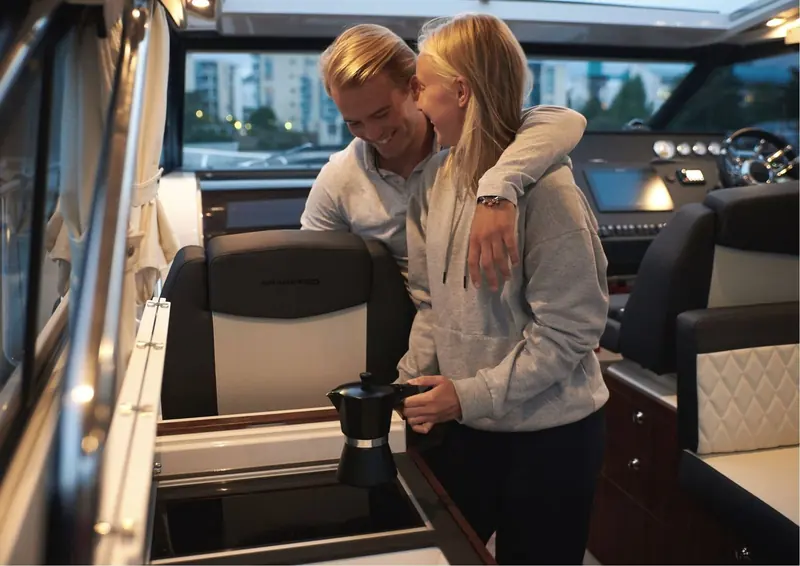
In practice this shows up as an ordinary looking stovetop, a kettle or a stovetop moka pot sitting on the hob exactly as it would on a gas cooker, and the difference is entirely in what feeds the burner beneath it rather than in how the galley is actually used day to day. That is a genuine trade-off rather than a pure upgrade: a diesel burner generally takes longer to reach full heat than a gas ring, so an owner used to instant gas heat should expect a different rhythm at the stove rather than an identical one running on a different fuel.
Informazioni pratiche
| Price, 30GB with install kit | USD 2,881, Scan Marine USA (official US importer), includes control panel, mounting hardware, 13 ft power harness, 13 ft fuel line and filter |
|---|---|
| Power range | 22GB: 1.0-2.4kW; 30GB: 1.5-3.0kW; VikingAir: infinitely adjustable 0.95-3.0kW |
| Running cost | fuel consumption from about 0.10 l/h at low output to 0.3 l/h at full output depending on model and setting |
| Maintenance | decarbonise the burner at roughly every 500 hours of running time, per independent owner accounts |
| Fit before ordering | confirm cabin volume and insulation against the heater's rated output range, and check duct routing before assuming a given model will heat the whole boat |
| What is not published | no detailed current retail price was found for the 22GB or VikingAir models specifically, and no independent third-party emissions test of the laminar flow burner's CO2 or NOx figures was found beyond Wallas's own claims |
Cosa riferiscono armatori ed equipaggi
A direct, named comparison against neighbouring Webasto and Espar heaters at anchor
Rodney, sailing a Catalina 42 Mark II, reported his Wallas ran visibly cleaner than his neighbours' Webasto and Espar heaters, with less soot on the transom, plus quieter running and about 0.3 litres an hour fuel consumption at full output
Rodney, Catalina 42 Mark II owner, Sailboat Owners forumA named owner's direct comparison against a prior Espar heater
Fred Ficarra reported no complaints with his Wallas unit, and separately described a previous Espar heater he had owned as the worst product he had ever owned, a specific comparative account rather than an anonymous rating
Fred Ficarra, Sailboat Owners forumA recurring, specific maintenance interval named across multiple owner accounts
Several owners independently mentioned that the burner needs decarbonising at roughly every 500 hours of running time, a real, budgetable maintenance task rather than a vague complaint
Rodney, Sailboat Owners forum
Cosa convince e cosa va valutato
Punti di forza
- Named owners independently confirm quieter, cleaner running than named rivalsReal, named forum posters compared their own Wallas heaters directly against Webasto and Espar units on neighbouring boats and reported cleaner exhaust and quieter operation, which is stronger evidence than a manufacturer's own emissions claim
- One fuel system for heating and cooking togetherA diesel stove, oven and heater all draw from the boat's main diesel tank, removing the separate gas locker, gas detection system and bottle logistics a propane galley needs, and the fire-risk profile that comes with pressurised gas storage aboard
- A founder's stated philosophy that the current engineering still matchesJorma Wallasvaara founded the company specifically to solve reliability, noise and emissions problems he found personally on his own boat, and the brushless motors and laminar flow burner in the current range are a direct continuation of that same stated goal rather than an unrelated feature added later
Da valutare
- A recurring maintenance task every 500 hoursOwner accounts independently confirm the burner needs decarbonising at roughly that interval, a real service cost and inconvenience an owner should plan for rather than assume the unit is maintenance-free
- Single-importer pricing in at least the US marketScan Marine USA is the sole stated official US importer, which means less price competition than a multi-retailer brand like Lofrans offers, and a buyer cannot easily shop the exact installed price across several independent US chandleries
- A diesel burner is slower to reach heat than a gas ringBoth the heater and the stovetop trade the instant response of gas or electric heat for the fuel-system simplicity of running off diesel, which is a genuine adjustment for anyone used to a gas galley rather than a straightforward upgrade in every respect
A chi si rivolge: An owner who wants cabin heat and galley cooking run off the same diesel tank as the engine, without a separate propane gas locker aboard, and who is prepared to budget for a roughly 500 hour decarbonising service interval on the burner.