St Kitts and Nevis
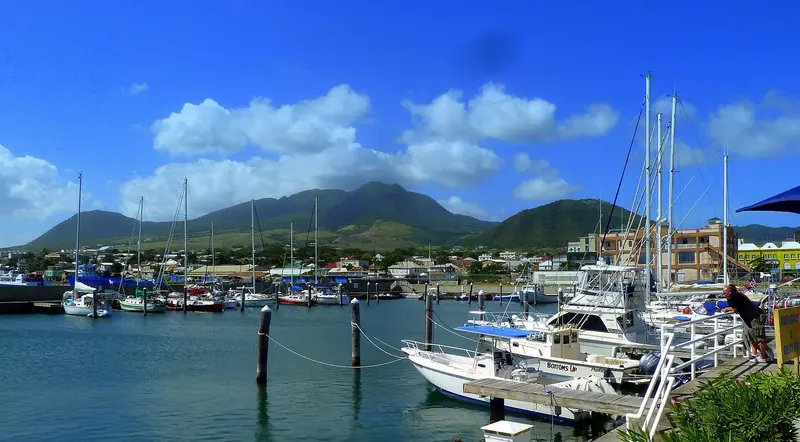
| Christophe Harbour Marina opened in February 2015 with 24 alongside berths sized for yachts of 150 to 220 feet (CharterWorld). | |
| Safe Harbor Marinas bought Christophe Harbour Marina's assets and operations on 23 May 2025 and announced plans to expand it for yachts up to 350 feet (PR Newswire, Cruising World). | |
| The Narrows separating St Kitts and Nevis is about 3 kilometres wide at its narrowest point (Wikipedia; Department of Marine Resources, Nevis). | |
| St Kitts Marine Works in Sandy Point runs two 150 ton travelifts and can haul yachts up to 120 feet long and 35 feet wide (Superyacht Services Guide; All At Sea). | |
| Brimstone Hill Fortress National Park, close to the Marine Works yard, was named a UNESCO World Heritage Site in 1999 (UNESCO World Heritage Centre). | |
| Nevis Peak rises 985 metres (3,232 feet) above Charlestown (Wikipedia). | |
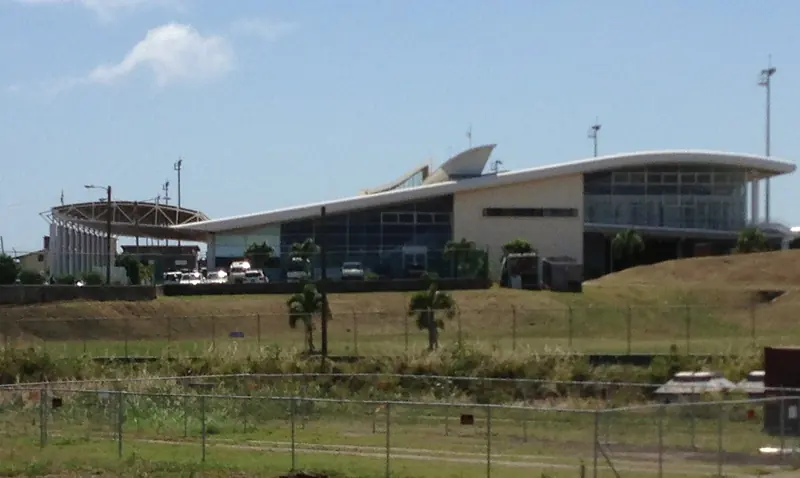
| American Airlines flies into Robert L Bradshaw International Airport from Miami and Charlotte, with JetBlue adding a seasonal winter link from New York JFK (American Airlines; JetBlue). | |
| The Booby Island Regatta has run every year since 2008 on the first weekend of May, at the midpoint of the Narrows (Wanderlusters; Nevis Aquatic and Sailing Center). |
A Winter Circuit Stop Still Finding Its Feet
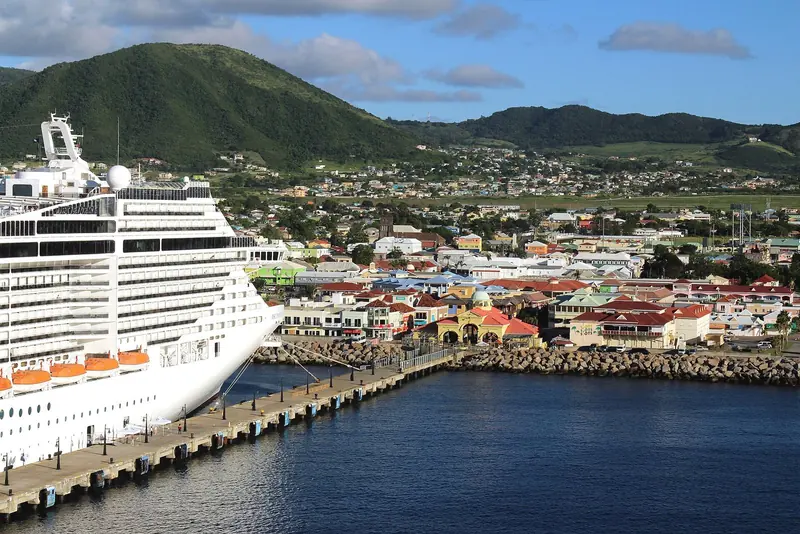
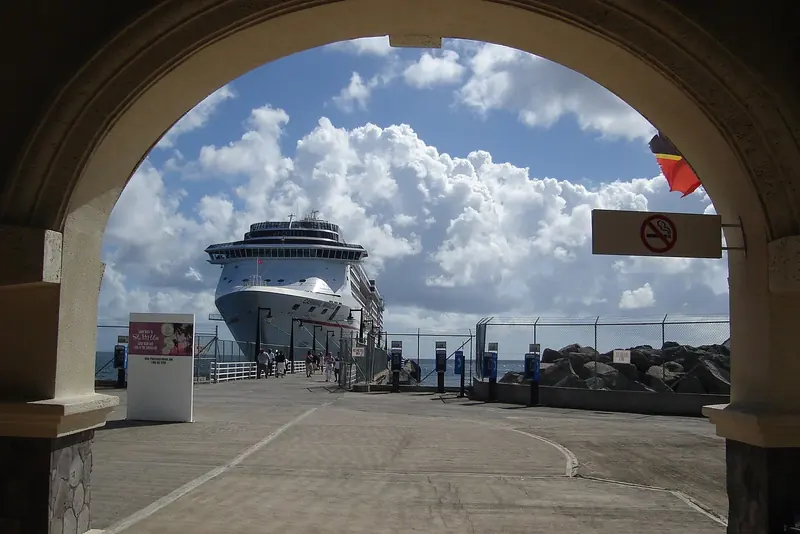
St Kitts and Nevis is a twin-island stop on the Eastern Caribbean winter circuit built around one purpose-built superyacht marina on St Kitts, with far less crowding at anchor than St Barths or Antigua see over the same weeks. The marina, Christophe Harbour, sits on the Southeast Peninsula next to the Kittitian Hill resort development, a Bill Bensley designed community built around golf and a Park Hyatt. Basseterre, the capital and the other main port of entry, is an old sugar-trade town with a working cruise pier that shares its water with visiting yachts.
Nevis, the smaller of the two islands, has no marina of its own, only the Charlestown anchorage and a handful of free mooring balls. That asymmetry, one developed superyacht base on St Kitts and one undeveloped anchorage on Nevis, is the single fact that shapes every practical decision covered below, from where you clear in to where you actually spend the night.
Getting There Starts at One Small Airport
Crew and owners fly into Robert L Bradshaw International Airport (SKB) on St Kitts, served directly by American Airlines from Miami and Charlotte and by a seasonal JetBlue link from New York JFK, with no direct European service (American Airlines, JetBlue). Anyone flying from Europe connects through Miami, San Juan or Antigua. Nevis has its own strip, Vance W Amory International, with a runway of 1,220 metres, but it takes only small regional carriers such as Cape Air, Winair and St Barth Commuter, so it works for island-hopping crew changes rather than a first arrival with heavy luggage or provisions.
For an owner joining a yacht already in Christophe Harbour, the practical routing is a scheduled flight into SKB followed by a short transfer to the Southeast Peninsula, or a private charter direct to either strip. Neither airport currently takes wide-body traffic, which keeps the islands genuinely quiet but also means anything larger than provisioning for a week is easier to stage through San Juan or Antigua first.
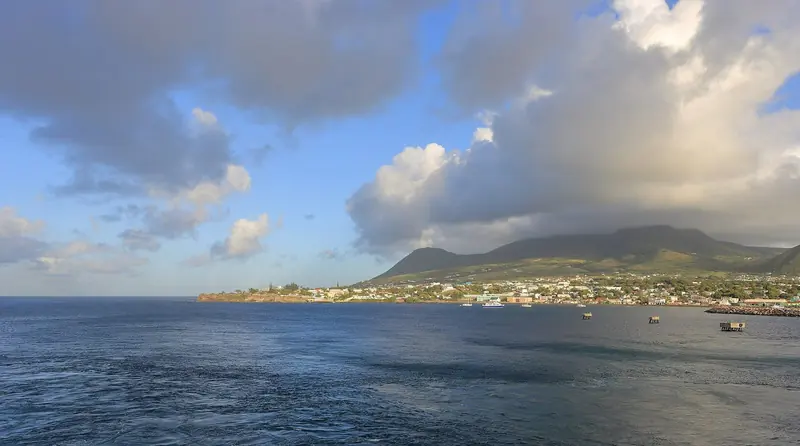
The Narrows between St Kitts and Nevis is barely 3 kilometres wide at its narrowest, yet sailors reliably pick up 3 to 5 extra knots of wind crossing it, according to the marina's own passage guide.
Where It Sits on the St Barths-Antigua Circuit
St Kitts and Nevis works as a two to three day link in a wider Leeward Islands itinerary, typically strung between Antigua and Barbuda on one side and St Barths and St Martin on the other (Worth Avenue Yachts). Brokers building a seven day charter around St Barths and Antigua commonly slot St Kitts and Nevis in the middle precisely because it is calmer, letting guests decompress between two much busier scenes.
On a longer voyage, some brokers extend the same idea into an eight to ten day run covering St Kitts, Nevis, the neighbouring island of Statia, then Antigua and Barbuda, four nations and two UNESCO sites on one loop. None of these legs are long: St Kitts to Statia is a straightforward day sail, and St Barths is within a half day's run in normal trade wind conditions.
The Narrows Is a Short Crossing With a Sting in the Wind
The Narrows, the strait between the two islands, is a crossing of roughly 6 to 12 nautical miles depending on departure point, taking one to three hours under typical 15 to 20 knot trade winds (Port Zante Marina). At its narrowest, between St Kitts's Southeast Peninsula and Nevis, the channel is about 3 kilometres wide, with Booby Island sitting almost exactly at its midpoint and the Cow and Calf Rocks off Nevis's northwest corner as the main charted hazard.
The channel behaves like a funnel: wind speed typically climbs 3 to 5 knots inside it compared with the sheltered water on either side, and the sea turns confused and choppy whenever the wind runs against the tidal flow. Both the marina's own passage guide and cruisers on the water agree on the fix, which is simply to plan the crossing in daylight and reef early rather than mid-channel.
Clearing In Depends Entirely on Which Port You Choose
St Kitts and Nevis has two ports of entry, Basseterre for St Kitts and Charlestown for Nevis, and which one you use changes how straightforward clearance actually is (Noonsite). From November to May, Christophe Harbour Marina runs its own onsite clearance, open seven days a week from 10:00 to 18:00, and is the easiest route in for a yacht heading straight for the Southeast Peninsula. Clearing through Basseterre instead means dealing with Customs at Port Zante Marina and Immigration and the Port Authority separately at the cruise ship building, a slower process with more moving parts.
Every yacht should file on SailClear and complete the Immigration and Customs ED form and CARICOM advance passenger information before entering territorial waters, fly the yellow Q flag until cleared, and send only the captain ashore with the paperwork. Noonsite's cruising desk logged Christophe Harbour Marina's admin fee, which covers both clearing in and out, at 30 US dollars as of February 2025; customs charges and harbour dues apply on both islands, but there is no separate immigration charge, and travel between St Kitts and Nevis needs no further clearance since both fall under the one federation.
Anchoring Options Split Sharply by Island
St Kitts carries the real infrastructure, Christophe Harbour Marina and the smaller Port Zante Marina at Basseterre, while Nevis offers only an open anchorage and free mooring balls at Charlestown. Christophe Harbour opened in February 2015 with an initial 24 alongside berths sized for yachts of 150 to 220 feet (CharterWorld); on 23 May 2025 Safe Harbor Marinas bought the marina's assets and operations from the Darby family and the government of St Kitts and Nevis, and announced plans to expand it to take yachts up to 350 feet (PR Newswire, Cruising World). Port Zante Marina, in the middle of Basseterre, holds around 36 smaller berths with fuel, water and power, all within walking distance of the town's shops and restaurants.
Away from the marinas, St Kitts has several usable anchorages: Basseterre itself, exposed to swell and to cruise ship traffic; Frigate Bay, better sheltered with a dinghy dock behind a rock wall; and Friar's Bay, which cruisers describe as calm and, outside cruise season, empty. On Nevis, Charlestown's roadstead offers depths of roughly 8 to 12 metres over sand, and the Nevis Port Authority lays free mooring balls there, but the island has no full-service marina at all, so anything beyond a night at anchor means crossing back to St Kitts.
Fuel and Parts Are Easy, Haul-Out Means One Yard
Fuel and day to day provisioning are straightforward, with duty-free fuel and stores at Christophe Harbour and a working fuel dock and supermarkets in Basseterre, but there is only one yard on either island that can lift a yacht out of the water. As a designated port of entry, Christophe Harbour sells fuel and provisions free of import duty and government charges, and exempts yacht and aircraft crew from local work permit fees (Christophe Harbour). In Basseterre, Port Zante's fuel dock sits a short walk from Rams, Horsfords and Best Buy supermarkets, and from public markets that run Wednesday and Saturday in Basseterre and Tuesday and Saturday mornings in Charlestown.
For anything structural, St Kitts Marine Works in Sandy Point, on the island's northwest coast under Brimstone Hill, runs two 150 ton travelifts and can haul yachts up to 120 feet long and 35 feet wide across 27 acres of secure storage (Superyacht Services Guide, All At Sea). It is one of the handful of yards in the Eastern Caribbean rated for yachts over 100 feet, but marine services on the islands otherwise stay basic: there are no dedicated Volvo or Yanmar dealers, and specialised parts generally have to be imported (Sailboat Liveaboard).
What It Actually Costs, Start to Finish
The only clearance figure anyone publishes is Christophe Harbour Marina's 30 dollar admin fee, and neither the marina's berth rate nor St Kitts Marine Works' haul-out day rate appears anywhere online, both quoted only on direct enquiry (Noonsite; Christophe Harbour; St Kitts Marine Works). Customs charges and harbour dues also apply on both islands on top of that admin fee, scaled to vessel size and length of stay, though again without a published rate card. Cruisers who anchor rather than berth still pay the same clearance and port dues as a yacht on a slip.
One cost that is published, and worth knowing before you plan a dinghy run ashore, is Christophe Harbour's landing fee for non-marina guests, which cruisers reported at 100 US dollars a day in the busy season (Blue Dot Voyages). Separately, and unusually for a Caribbean marina, buying a berth at Christophe Harbour has been marketed as a route into the country's citizenship by investment programme, since real estate purchases from 325,000 US dollars qualify; that is a property transaction for owners considering a permanent base, not a cost that applies to a yacht simply passing through for the season.
The Season Window Is Short and the Hurricane Risk Is Real
The reliable sailing window runs from mid-December to mid-April, when the northeast trades sit at a steady 12 to 20 knots and the islands see their driest weather of the year, February through April driest of all. Christophe Harbour Marina runs its onsite clearance service specifically across this same November to May yachting season, which tells its own story about when the marina expects yachts to actually be there.
Outside that window, both islands sit well inside the Atlantic hurricane belt for the full June to November season. Many yacht insurance policies draw a hurricane exclusion line at roughly 12 degrees 40 minutes north; St Kitts, at about 17.3 degrees north, and Nevis, at about 17.1 degrees north, sit well north of it, so neither island offers any automatic insurance exemption during hurricane season. Owners who leave a boat here through the summer generally do it ashore: St Kitts Marine Works can dig keel holes, tie down catamarans and arrange hurricane securing for yachts on the hard.
Ashore, the Draw Is Volcanoes, a Fortress and a Very Local Regatta
The two islands trade nightlife for volcanic scenery and history: Brimstone Hill Fortress on St Kitts is a UNESCO World Heritage Site, and Nevis Peak, at 985 metres, is a genuine rainforest hike rather than a beach walk (UNESCO World Heritage Centre; Wikipedia). Brimstone Hill, built by African slave labour to British military specification in the 17th and 18th centuries, sits near St Kitts Marine Works on the island's northwest coast, so a haul-out visit and a fortress tour naturally pair up. The St Kitts Scenic Railway, a narrow-gauge line originally built to move sugar cane, offers a slower way to see the same coast from a double-decker carriage.
On the water, the standout fixture is the Booby Island Regatta, run every year since 2008 on the first weekend of May, roughly at the midpoint of the Narrows crossing itself (Wanderlusters; Nevis Aquatic and Sailing Center). Organised through the St Kitts and Nevis Sailing Association, which formally joins the St Kitts Yacht Club, founded in 1987, with the Nevis Aquatic and Sailing Center, the regatta runs pursuit races with names like Chase the Monkey and Round the Rock, and is explicitly not trying to compete with Antigua Sailing Week or the Heineken Regatta in St Martin, just to give charter guests and local day sailors a reason to raft up near Booby Island for a weekend.
An Land, Anfahrt und Buchung
| Getting there by air | Robert L Bradshaw International Airport (SKB), St Kitts: American Airlines from Miami and Charlotte plus nonstop New York service, JetBlue seasonally from New York JFK. No direct European flights; connect via Miami, San Juan or Antigua. Nevis's Vance W Amory International (NEV) has a 1,220 metre runway but takes only small regional carriers. |
|---|---|
| Crossing the Narrows | 6 to 12 nautical miles depending on departure point, 1 to 3 hours under 15 to 20 knot trades; expect 3 to 5 extra knots of wind in the channel and confused seas when wind opposes the tide. Plan the crossing in daylight. |
| Ports of entry | Basseterre for St Kitts, Charlestown for Nevis. Christophe Harbour Marina runs its own onsite clearance November to May, daily 10:00 to 18:00; Basseterre clearance splits between Customs at Port Zante Marina and Immigration and the Port Authority at the cruise ship building. |
| Clearance fee | Christophe Harbour Marina's admin fee, covering clearing in and out, was reported at 30 US dollars as of February 2025 (Noonsite). Customs charges and harbour dues apply on both islands on top of that; no separate immigration fee. |
| Berthing on St Kitts | Christophe Harbour Marina (Safe Harbor), opened 2015 with 24 berths for 150 to 220 foot yachts, now expanding to take yachts up to 350 feet. Port Zante Marina, Basseterre, roughly 36 berths with fuel, water and power, walking distance to town. |
| Berthing and anchoring on Nevis | No full-service marina. Charlestown roadstead, roughly 8 to 12 metres over sand; free Nevis Port Authority mooring balls. |
| Haul-out and repair | St Kitts Marine Works, Sandy Point: two 150 ton travelifts, up to 120 feet LOA and 35 feet beam, 27 acres of secure storage. No dedicated Volvo or Yanmar agents on either island; specialised parts require importation. |
| Fuel and provisioning | Duty-free fuel and stores at Christophe Harbour; fuel dock at Port Zante. Supermarkets Rams, Horsfords and Best Buy in Basseterre; public markets Wednesday and Saturday in Basseterre, Tuesday and Saturday mornings in Charlestown. |
| Season | Mid-December to mid-April is the reliable sailing window, driest February to April, trades 12 to 20 knots. Hurricane season runs June to November; both islands sit north of the roughly 12 degree 40 minute insurance latitude line, so neither gets an automatic hurricane season exemption. |
| What is not published | Christophe Harbour Marina's berth day rate and St Kitts Marine Works' haul-out day rate are both quoted only on direct enquiry, not published anywhere online. |
Was Eigner und Crew berichten
The marina's own retail is still thin
Christophe Harbour has 'no shops yet' by a cruiser's account, and a non-marina guest's dinghy currently pays a 100 US dollar a day landing fee in the busy season.
Blue Dot VoyagesBasseterre's anchorage is a mixed bag, Friar's Bay is the quiet alternative
The anchorage outside Port Zante carries unpredictable swell and heavy cruise ship traffic, while Friar's Bay is large, calm and 'completely empty when there are no cruise ships'.
Blue Dot VoyagesChristophe Harbour was built to be the easy port of entry
Aeneas Hollins, the marina's director of yachting and a former superyacht captain, has pointed to its proximity to other Eastern Caribbean islands and an onsite team as reasons owners choose to homeport there.
CharterWorldParts and specialist services mean patience
There are no dedicated Volvo or Yanmar agents on St Kitts or Nevis, and specialised parts generally have to be imported rather than sourced locally.
Sailboat LiveaboardThe Narrows crossing needs respect, not just a glance at the chart
The passage guide for the crossing warns that wind speed typically climbs 3 to 5 knots inside the channel and that seas turn confused whenever wind runs against the tidal flow.
Port Zante Marina
Was gut ist und worauf zu achten ist
Stärken
- One real purpose-built marinaChristophe Harbour is a designated port of entry with onsite clearance, duty-free fuel and provisions, and crew work permit fee exemptions, backed since May 2025 by Safe Harbor's wider Caribbean network (Christophe Harbour; PR Newswire).
- Genuine haul-out capacity close bySt Kitts Marine Works' two 150 ton travelifts and 120 foot capacity put real repair infrastructure within a short hop of the anchorages, rare for an island this size (Superyacht Services Guide).
- Quieter than its winter-circuit neighboursBrokers use St Kitts and Nevis deliberately as the calm middle leg of itineraries built around the far busier St Barths and Antigua seasons (Worth Avenue Yachts).
- A short, sailable link in the wider circuitThe Narrows crossing to Nevis runs 1 to 3 hours, and St Barths and Statia are both within a day's sail, so the destination adds variety without adding a long passage (Port Zante Marina).
Worauf zu achten ist
- Nevis has no marina at allBeyond free mooring balls and an open roadstead at Charlestown, Nevis offers nothing for a yacht that needs to actually tie up, forcing a return crossing to St Kitts for anything more (Sailboat Liveaboard).
- The marina is still young and just changed handsChristophe Harbour opened in 2015, was sold by its founding family and the government to Safe Harbor Marinas in May 2025, and has no published berth rate, which together read as a facility still settling into its next phase (CharterWorld; PR Newswire).
- Marine services stay thin outside the one yardThere are no dedicated Volvo or Yanmar dealers on either island, and cruisers report specialised parts have to be imported, so anything beyond routine work means waiting (Sailboat Liveaboard).
- Basseterre's anchorage shares water with cruise shipsCruisers describe the Basseterre anchorage outside Port Zante as carrying unpredictable swell and heavy cruise ship traffic, pushing most yachts toward Frigate Bay or Friar's Bay instead (Blue Dot Voyages).
Für wen: Suits an owner or charter party wanting a quiet, uncrowded link between Antigua and St Barths on the winter circuit, with real haul-out backup close by; it does not suit anyone who wants nightlife, a deep chandlery bench, or a marina with a settled and published rate card.