The Maldives
| Region | Indischer Ozean, südwestlich von Sri Lanka |
|---|---|
| Beste Saison | November bis April (trockener Nordostmonsun) |
| Tor | Male und Velana International Airport |
| Charakteristische Stätte | Hanifaru Bay, Baa-Atoll (UNESCO-Biosphärenreservat) |
| Meeresleben | Mantarochen und Walhaie, außergewöhnliches Rifftauchen |
| Liegeplätze | fast keine Marinas, durchgehend Ankern in Lagunen |
| Zugang | Genehmigungen und örtlicher Agent erforderlich, Schutzgebiete kontrolliert |
| Zu beachten | Riffnavigation, Abgeschiedenheit und begrenzte Unterstützung |
| Hanifaru Bay | scuba diving has been banned inside the bay since 2012, snorkelling only, no anchoring in the bay |
| Manta season at Hanifaru | May to November, peaking June to October in the southwest monsoon |
| Gateway | Velana International at Male, with domestic airports and the world's largest seaplane network beyond it |
| Navigation | reef passes need high sun and good light, so passages are planned for the middle of the day |
| Green Tax | tourist vessels charge USD 12 per person per night from 1 January 2025, doubled from USD 6, under Regulation 2024/R-117 |
| Tourism GST | 17 per cent from 1 July 2025, up from 16 per cent |
| Charter | permitted for foreign-flagged yachts holding a cruising permit and a separate charter licence, with no cabotage bar on moving guests between Maldivian islands |
| Agency | only Maldivian nationals may act as agents for a foreign tourist vessel, and the agent is appointed before arrival |
| Reef damage | a yacht that grounded in Alifu Dhaalu Atoll on 28 April 2025 was fined MVR 4,889,450, about USD 311,000, under Regulation 2011/R-9 and Act 4/93 |
| Enforcement scale | an audit reported in January 2026 put over MVR 930 million of environmental fines outstanding, with MVR 228 million recovered from 37 reef-damage cases in two to three years |
| Berthing | Crossroads Maldives publishes no rate card, checked 28 July 2026, so berths are quoted against dates |
| Nearest yard | Colombo Dockyard in Sri Lanka, four dry docks of 107 to 263 m and over 1,000 m of repair berth |
Ein Staat aus Atollen
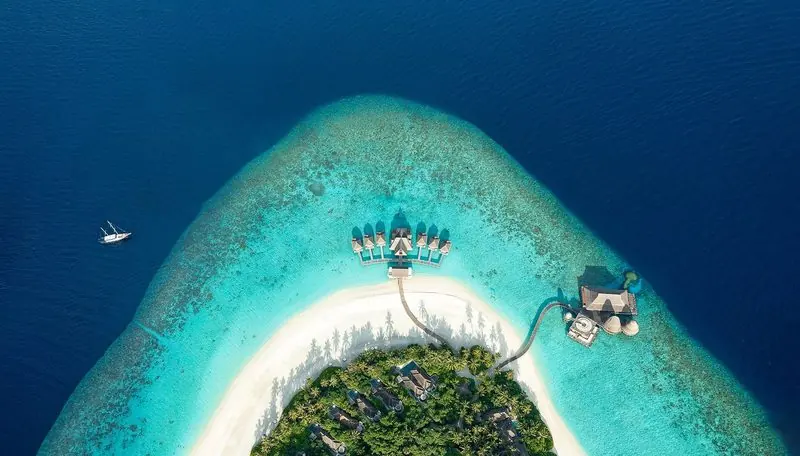
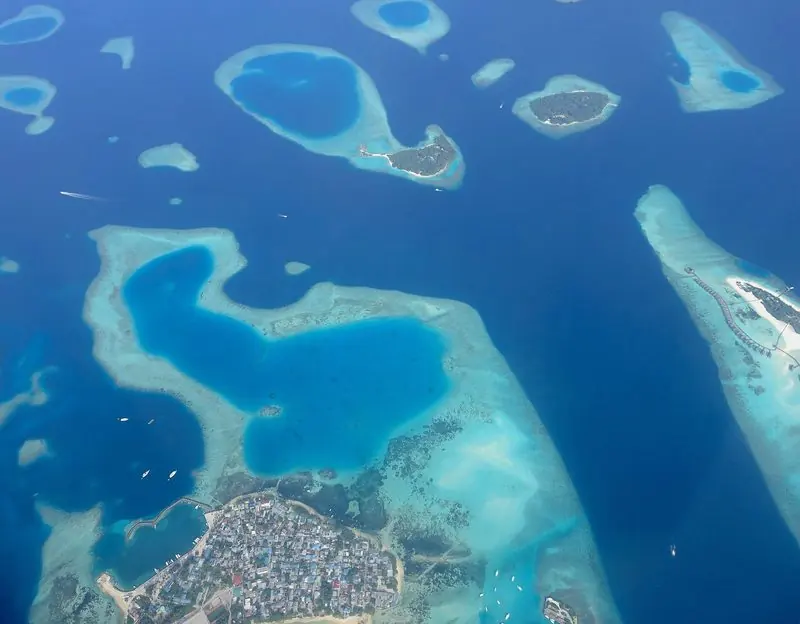
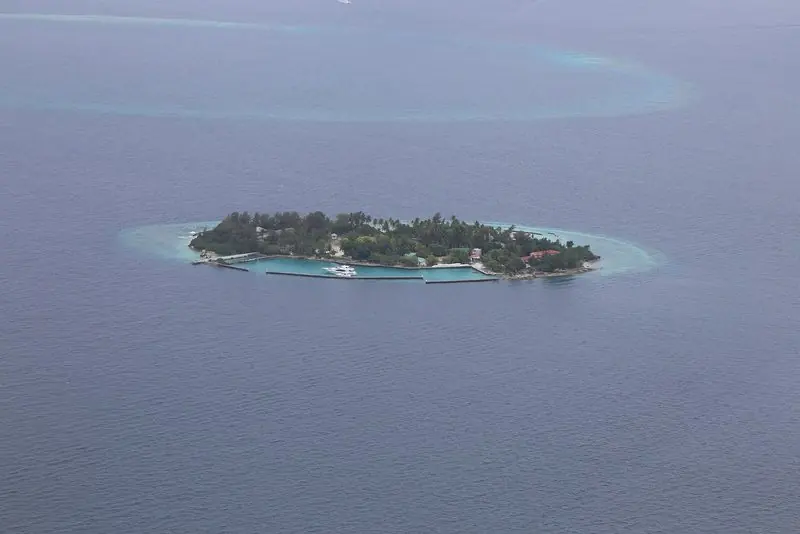
Die Malediven bestehen aus mehr als tausend niedrigen Koralleninseln, gruppiert in eine Kette von Atollen im Indischen Ozean, südwestlich von Sri Lanka. Nur wenige der Inseln erheben sich mehr als ein paar Meter über das Meer, und die meisten sind von Riff und flachen Lagunen umringt. Das Land hat sich mit seinen Resorts und seinem Tauchen einen weltweiten Ruf aufgebaut. Für das Yachting bietet es ein abgelegenes Revier in warmem Wasser aus klaren Lagunen und reichem Meeresleben. Das Gefühl der Abgeschiedenheit steht im Zentrum des Reizes.
Der Anziehungspunkt ist hier das Wasser und was darin lebt. Korallenriffe und ihr Meeresleben, von Mantarochen bis zu Walhaien, bringen Taucher und Schnorchler aus aller Welt. Das Baa-Atoll ist ein UNESCO-Biosphärenreservat, und seine Hanifaru Bay beherbergt eine der größten Ansammlungen von Mantarochen auf dem ganzen Planeten. Die Atolle bieten zahllose Riffankerplätze und Sandbänke, viele davon weit von jeder Siedlung. Eine Yacht gibt die Freiheit, Stellen zu erreichen, die den Resorts verschlossen bleiben.
Die Saison
Die Hauptsaison läuft von November bis April, dem trockenen Nordostmonsun, wenn die See am ruhigsten und das Wetter am beständigsten ist. Dezember bis März ist der Höhepunkt, mit verlässlichem Sonnenschein und der höchsten Nachfrage. Der feuchtere Südwestmonsun von Mai bis Oktober bringt mehr Regen und rauere See, nährt aber auch das Plankton, das die Mantarochen anzieht. Das Tauchen bleibt das ganze Jahr über gut für jene, die das Wetter hinnehmen.
Die Mantasaison in der Hanifaru Bay erstreckt sich über die Monate des Südwestmonsuns, wobei die stärksten Ansammlungen typischerweise um den August und September auftreten, wenn Gezeitenströmungen das Plankton in der Bucht konzentrieren. Eigner, die diesem Schauspiel nachgehen, planen gegen die allgemeine Saison für ruhiges Wetter. Die Wassertemperaturen sind das ganze Jahr über warm. Die Wahl des Monats hängt davon ab, ob beständiges Wetter oder bestimmtes Meeresleben Vorrang hat.
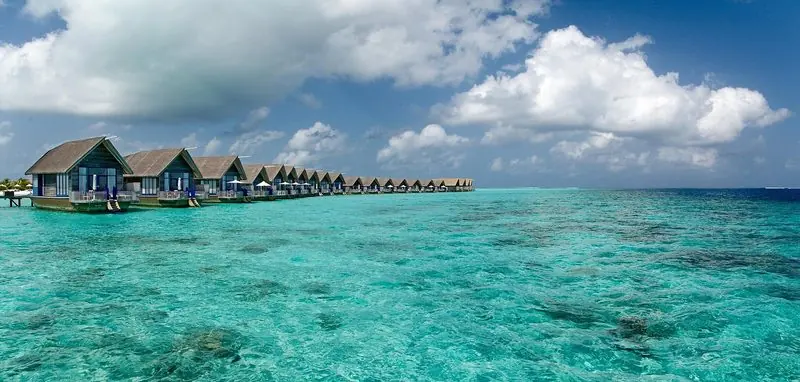
Tausend Koralleninseln, wo der Ankerplatz und nicht die Stadt das Ziel ist.
Häfen und Ankerplätze
Die Malediven haben sehr wenig an Marinas, und Yachting bedeutet hier Ankern in Lagunen statt Liegen längsseits. Die Hauptstadt Male und ihr Flughafen Velana sind das wichtigste Tor für Gäste und Vorräte. Eine Yacht fährt zwischen den Atollen und ankert dabei vor Riffen, Sandbänken und Resortinseln. Service und Proviantierung sind begrenzt und auf die Region der Hauptstadt konzentriert.
Die Ankerplätze sind der ganze Sinn. Geschützte Lagunen hinter den Riffen geben in fast jedem Atoll ruhiges, klares Wasser, von Male und Ari in der Mitte bis Baa im Norden. Sandbänke, die bei Niedrigwasser auftauchen, geben einprägsame Plätze für ein Arrangement am Strand. Der Zugang zu Schutzgebieten wie der Hanifaru Bay ist kontrolliert und wird im Voraus arrangiert. Die Navigation zwischen den Riffen verlangt gutes Licht und sorgfältige Lotsung.
An Land und auf dem Wasser
Für eine besuchende Yacht gibt es an Land wenig herkömmliches Leben jenseits der Resortinseln, von denen jede ein in sich geschlossener Rückzugsort ist. Gäste besuchen nach Absprache Resortrestaurants und Spas, und lokale Inseln bieten einen Einblick in das maledivische Leben. Die eigentliche Erfahrung liegt auf dem Wasser und unter Wasser, ein Revier für Eigner, die das Meer wollen und keine Stadt. Die Tage werden von der Tide und vom Tauchen bestimmt.
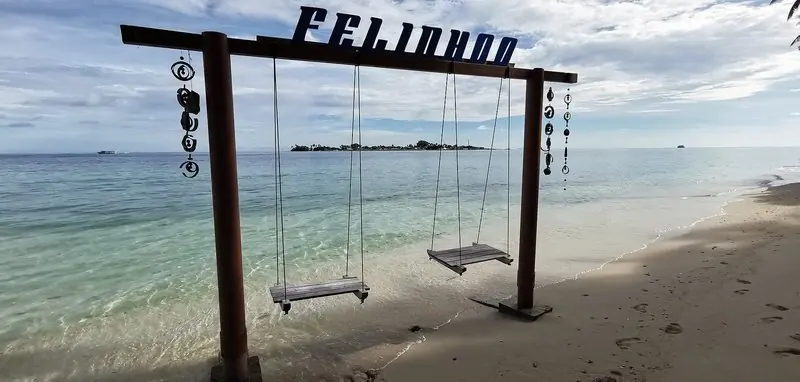
Auf dem Wasser geht es auf den Malediven um das Tauchen und das Meeresleben der Riffe. Begegnungen mit Mantarochen und Walhaien sind der charakteristische Anziehungspunkt, dazu Rifftauchgänge von außergewöhnlicher Klarheit. Surfen an den zum Ozean gerichteten Wellen ist in der Saison eine weitere Attraktion. Tender und Tauchboote übernehmen einen großen Teil der Arbeit und erreichen Riffe und Kanäle von einer Yacht vor Anker. Warmes Wasser das ganze Jahr über macht die Zeit im Meer leicht.
Praktische Hinweise
Fahrten auf den Malediven erfordern Genehmigungen und den Einsatz eines örtlichen Agenten, der Klarierung, Fahrtdokumente und den Zugang zu Schutzgebieten als Selbstverständlichkeit organisiert. Der Zugang zu empfindlichen Stätten wie der Hanifaru Bay im Baa-Atoll ist begrenzt und muss im Voraus organisiert werden. Regeln dazu, wohin Yachten fahren und was sie tun dürfen, werden ernst genommen. Eigner planen den Törn weit im Voraus mit örtlicher Unterstützung.
Die Abgeschiedenheit prägt jede praktische Entscheidung, da Treibstoff, Ersatzteile und Proviant begrenzt und auf Male konzentriert sind, sodass Yachten Vorräte für längere Zeiträume fernab jeder Unterstützung mitführen. Die Distanzen zwischen den Atollen sind real, und die Navigation zwischen Riffen verlangt Sorgfalt und gutes Licht. Charteryachten mit Basis im Land wickeln vieles davon als Routine ab. Tender- und Tauchbetrieb stehen im Mittelpunkt, wobei die Riffnavigation die wichtigste zu steuernde Gefahr bleibt.
Male, seaplanes and the daylight limit
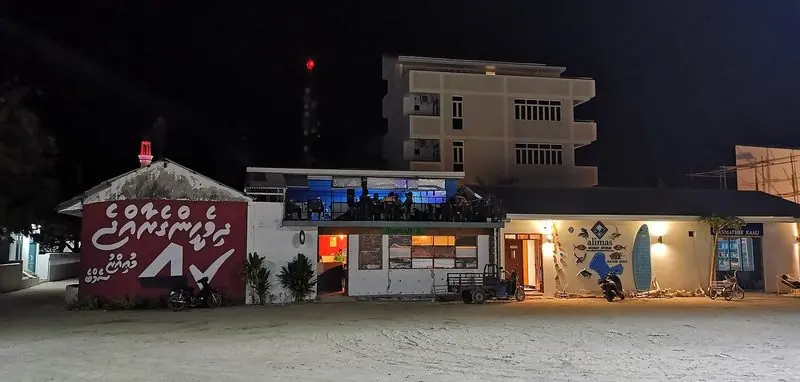
Velana International at Male has direct wide-body service from Europe, the Gulf and Asia, and full private jet handling, so guests arrive easily. What happens next is the Maldivian problem. Domestic airports at Dharavandhoo in Baa, Maamigili in Ari, Hanimaadhoo in the north and Gan in the far south cover the country, and the seaplane network out of Male is the largest in the world and reaches most of the resort islands. Both stop flying at dusk.
That daylight limit shapes everything. A guest arriving on a late evening flight into Male cannot reach a boat in Baa Atoll until the next morning, which means a night in a hotel or a yacht that repositions south to meet them. Owners who do this repeatedly base the changeover at Crossroads or at a resort near Male and accept a delivery leg. Getting the boat itself to the Maldives is the larger question, since Male is roughly 4,500 nautical miles from the Mediterranean by way of Suez, and the Red Sea leg is its own decision.
Resort islands, local islands and the rules
There is no town, no marina village and no restaurant scene, and an owner who has not internalised that will find the fortnight long. The three options ashore are resort islands, which are private and require arrangement in advance and often a day rate, local inhabited islands such as Dhigurah, Thoddoo and Maafushi, which offer a village, a beach and a genuine glimpse of Maldivian life, and Male itself, which is a dense working capital with markets and shops and is not a guest destination. None of the three is a substitute for a town.
The rules on the local islands matter and catch people out. The Maldives is a Muslim country and alcohol is not available on inhabited islands, modest dress is expected ashore, and bikinis are confined to designated beaches. None of that applies aboard the yacht or on a resort island. Guests who want a bar and a night out are choosing between a resort island by prior arrangement and the aft deck, and most weeks the answer is the aft deck.
Permits, agents and support
The cruising permit comes from the Ministry of Tourism and can be applied for before arrival or within four days of customs clearance, and a vessel over 20 metres staying more than seven days after clearance pays USD 1,000 to the Maldives Inland Revenue Authority, with a passenger licence fee of USD 5 per person on top, on the figures current in July 2026. Only Maldivian nationals may act as agents for a foreign tourist vessel, so the choice of agent is a real decision. Any commercial or private charter carrying tourists needs a separate charter licence.
Support is thin. Fuel is available at Male and at Crossroads and is expensive, spares are air freighted from Singapore, Dubai or Europe and clear customs slowly, and there is no yard capability for a large yacht in the country. Provisioning is done through the agent and the resort supply chain and the quality varies. A yacht planning a Maldives season carries a deep spares inventory and an engineer who can use it.
The honest downside
The Maldives ask a lot and give one thing back. There is no culture to see beyond the local islands, no restaurants, no nightlife, no shopping and nothing to do that is not in or on the water, so a fortnight here suits divers, surfers and families with young children and bores almost everybody else by day nine. And the resort islands, which are the only serious shore facility, are set up for their own guests and treat a visiting yacht as an exception.
The larger point is the delivery. Bringing a Mediterranean yacht to the Maldives commits it to a passage of several thousand miles each way and a season away from any support network, which is why most of the boats working these atolls are either based in the Indian Ocean or on a longer world itinerary. An owner who wants two weeks of this without that commitment is looking at a charter.
What the state takes, and what nobody publishes
The government's share is documented and it is the part an owner can actually budget. A vessel over 20 m staying more than seven days after clearance pays USD 1,000 to the Maldives Inland Revenue Authority, with a passenger licence fee of USD 5 per person on top, on the figures current in July 2026. Green Tax is the line that scales with guests. From 1 January 2025 tourist vessels charge Green Tax at USD 12 per person per night, doubled from USD 6, under Regulation 2024/R-117 made with the fourteenth amendment to the Tourism Act. Twelve guests aboard for a fortnight is USD 2,016 in Green Tax by itself. Tourism goods and services tax rose to 17 per cent on 1 July 2025 from 16, and it attaches to what a charter sells.
Everything else is a quotation. Crossroads Maldives is the only marina in the country and publishes no rate card, and none could be found on 28 July 2026, so a berth there is priced against the dates. There is no published fuel price for yachts either, and bunkering runs through the agent at Male or Crossroads. What that adds up to is a season with almost no berthing line at all, which is the opposite of the Mediterranean arithmetic: Marina di Porto Cervo's published 2026 tariff is EUR 3,698 a day in the band to 40 m from 1 to 20 August, roughly EUR 102,000 for the month, or EUR 195,819 for a 1 May to 31 October contract. The Maldives removes that number and replaces it with a delivery of several thousand miles each way and a spares bill that travels by air.
Charter, the Maldivian agent and the cost of a grounding
A foreign-flagged yacht may charter in Maldivian waters, and the condition is licensing rather than flag. The vessel takes a cruising permit from the Ministry of Tourism first, then a separate charter licence for foreign tourist vessels, and that licence is required whether the charter is commercial or private so long as tourists are carried. The agent is not optional and cannot be foreign, since the 2024 amendments to the foreign vessel regulations reserve agency for foreign tourist vessels to Maldivian nationals, and the agent is appointed before arrival. There is no cabotage bar on carrying paying guests between Maldivian islands once the licence is held, which is the material difference between this ground and Florida or Turkey. Tourism GST at 17 per cent and Green Tax at USD 12 per person per night both fall on the charter.
The penalty that owners actually meet is environmental, and it is large. Fines are set under Regulation 2011/R-9 made under the Environmental Protection and Preservation Act 4/93, and the Environmental Protection Agency issues them as a matter of routine. A yacht that grounded in Alifu Dhaalu Atoll on 28 April 2025 was fined MVR 4,889,450, about USD 311,000, for reef damage. An audit reported in January 2026 put more than MVR 930 million in environmental fines outstanding, with MVR 228 million recovered from 37 reef-damage cases over the preceding two to three years, which says both that the fines are handed out constantly and that the state is serious about collecting them. Anchoring in sand only, and not at all inside Hanifaru Bay, is not a courtesy.
The nearest yard, and where the waste goes
Nothing in the Maldives will lift a 50 m yacht and nothing is likely to soon. The nearest facility of any real capacity is Colombo Dockyard in Sri Lanka, which runs four dry docks between 107 and 263 m and more than 1,000 m of serviced repair berth, and reaching it is an ocean passage east. Everything short of that is an air-freighted specialist and a wait at anchor, which is why the boats that work these atolls carry an engineer who can use a deep spares inventory and why a Maldives season is planned around the yard period that preceded it.
Waste is the same problem in miniature. Reception facilities exist at Male and at Crossroads and effectively nowhere else, so a yacht working the outer atolls holds everything aboard for the length of the cruise and lands it on the way through. In a country whose entire economy sits on the reef, and whose fines regime prices reef damage in hundreds of thousands of dollars, a discharge decision taken casually inside a lagoon is the most expensive mistake available.
An Land, Anfahrt und Buchung
| Getting there | Velana International at Male takes direct wide-body flights from Europe, the Gulf and Asia, plus full private jet handling. Domestic airports and the world's largest seaplane network reach the outer atolls, but both stop flying at dusk. |
|---|---|
| By sea | Reef passes are read by eye, so passages run from mid morning to mid afternoon when the sun is high. Charts are not uniformly reliable and local pilotage is normal practice, not a precaution for the inexperienced. |
| Reserving a berth | Crossroads Maldives at Emboodhoo Lagoon is the only marina in the country, 30 berths to about 55 m, 15 minutes by speedboat from the airport. It publishes no rate card, so a berth is quoted against the dates, checked 28 July 2026. |
| What it costs the state | A vessel over 20 m staying more than seven days after clearance pays USD 1,000 to the Maldives Inland Revenue Authority plus a USD 5 per person passenger licence fee. Green Tax is USD 12 per person per night since 1 January 2025, and tourism GST is 17 per cent since 1 July 2025. |
| Fluids and stores | Fuel is available at Male and at Crossroads and is expensive. Spares are air freighted from Singapore, Dubai or Europe and clear customs slowly. There is no yard capability for a large yacht anywhere in the country. |
| Clearance and permits | The cruising permit comes from the Ministry of Tourism, applied for before arrival or within four days of customs clearance. Only Maldivian nationals may act as agents for a foreign tourist vessel, and the agent is appointed before arrival. |
| Where to eat | There is no restaurant scene. Resort islands require prior arrangement and often a day rate; local inhabited islands such as Dhigurah, Thoddoo and Maafushi offer a village and a beach; alcohol is not sold on inhabited islands. |
| After dark | Aboard the yacht or a pre-arranged resort island are the only options with a bar. Local islands are dry under Maldivian law, and there is no town or marina village anywhere in the country. |
| Fixed dates | Northeast monsoon, November to April, is the calm, clear dry season and peaks December to March. The Hanifaru manta aggregation runs May to November, peaking June to October, inside the wetter southwest monsoon. |
Was Eigner und Crew berichten
The marina that finally made a Maldives season practical has an environmental record of its own
Sleeper's review of Crossroads Maldives praised the resort and marina's design but recorded that the land reclamation behind the first phase was criticised by environmental observers at the time, a detail worth weighing against a country that fines yacht grounding in the millions.
Neena Dhillon, Sleeper magazineGetting the local pilotage wrong is expensive, not theoretical
The 45 m explorer yacht Big Fish grounded on the reef at Alif Dhaal Atoll on 28 April 2025 and was fined around MVR 4.8 million, roughly USD 311,000 at the time, for the resulting coral damage, a case the Maldivian authorities and the trade press both treated as routine enforcement rather than an exception.
Boat International
Was gut ist und worauf zu achten ist
Stärken
- Genuinely uncrowdedEven in the December to March peak, an owner can move for days without seeing another private yacht outside the handful of named dive and manta sites.
- World-class, little-competed-for divingSouth Ari Atoll holds whale sharks year-round, one of very few places on earth where that is true, and Hanifaru Bay gathers some of the largest manta aggregations recorded anywhere.
- No real cyclone riskThe atolls sit close enough to the equator that tropical cyclones are very rare, unlike the Caribbean, the Pacific or the Arabian Sea further north.
- One proper marina now existsCrossroads Maldives at Emboodhoo Lagoon takes yachts to about 55 m with fuel, water, power and provisioning 15 minutes from the airport, which has changed what a guest change or a stores run actually requires.
Worauf zu achten ist
- Nothing ashoreNo town, no restaurant scene, no shopping and nothing to do that is not in or on the water. A fortnight suits divers, surfers and families with young children and bores most other guests by day nine.
- The delivery is the real commitmentMale is roughly 4,500 nautical miles from the Mediterranean by way of Suez. Most boats working these atolls are based in the Indian Ocean or on a long world itinerary rather than visiting for one season.
- Grounding fines are large and enforcedThe 45 m explorer yacht Big Fish was fined roughly MVR 4.8 million, about USD 311,000, for reef damage after grounding in Alif Dhaal Atoll on 28 April 2025, reported by Boat International. An audit in January 2026 found over MVR 930 million in environmental fines outstanding across the country.
- The only marina has its own criticsSleeper magazine's review of Crossroads Maldives, while positive on the design, noted that the reclamation behind phase one of the development drew criticism on environmental grounds.
Für wen: Eigner, die einen abgelegenen Törn in warmem Wasser rund um Tauchen und Meeresleben wollen und damit zufrieden sind, durchgehend in abgelegenen Lagunen zu ankern.