SEABOB (Cayago)
| Kategorie | elektrischer persönlicher Wasserschlitten |
|---|---|
| Hersteller | Cayago, Deutschland |
| Gegründet | 2007 |
| Wichtigste Produkte | SEABOB F5 und F5 S |
| Neueste Generation | F9, gestaltet von Studio F. A. Porsche (dem Designstudio von Porsche) |
| Antrieb | wiederaufladbarer Elektrojet, ohne Abgase und ohne freiliegenden Propeller |
| Position | weithin als das Standard-Luxuswasserspielzeug angesehen |
| Superseded F5 generation | 2.5 kW to 4.5 kW and 29 kg to 35 kg, still the machine in most yacht toy lockers |
| Charging | about four to six hours on the standard charger, about one to one and a half hours on the quick charger |
| Prices from Cayago's September 2025 EMEA list: F9 at EUR 9,285 net of VAT and F9 S at EUR 12,380 net | |
| Warranty | 24 months from transfer including the battery, with an annual inspection at an authorised facility |
| Depth | Cayago's own data sheet, read July 2026, gives a depth-sensor safety cut-off at 3.0 m and an electronic control system settable to a maximum of 25 m, and publishes no top speed for the F9 or F9 S |
| Flag reach | Part A Chapter 14 of the Red Ensign Group Yacht Code covers the United Kingdom, the Cayman Islands, Gibraltar, the Isle of Man and the other British Overseas Territories and Crown Dependencies, so a Cayman-flagged yacht is inside the same chapter MGN 681 interprets |
| Cayman Islands Shipping Registry | no separate lithium battery shipping notice in its published notices as of July 2026, so REG Yacht Code Chapter 14 plus a vessel-specific risk assessment is the operative standard |
| Marshall Islands | the 2026 edition of Yacht Code MI-103, effective 1 January 2026, introduces specific rules for spaces used to store or charge lithium-ion powered toys and tenders |
| Malta | a Transport Malta Commercial Yachting Notice of 22 June 2022 and Information Notice 45 of 7 September 2022, both written as strong recommendation, with the Commercial Yacht Code 2025 Revision 1 as the surveyed document |
| IMO | no mandatory instrument covering portable lithium battery powered craft aboard yachts as of July 2026 |
| Class | DNV's Battery (Safety) notation triggers only above 50 kWh aggregate installed capacity. Lloyd's Register LR-GN-052 of 10 June 2025 is advisory guidance, not a rule |
| Certified charging locker | no marine manufacturer publishes a price. EN 14470-1 Type 90 industrial cabinets listed at EUR 3,270 net (asecos ION-CHARGE 90, July 2026) and GBP 4,571.04 net or GBP 5,485.25 gross (asecos ION-CORE-90, United Kingdom, July 2026) |
| The SEABOB battery is integrated and does not come out. No spare pack appears on Cayago's EMEA list of September 2025 or on the Maltese dealer list of May 2026, and no replacement price is published | |
| MCA Safety Bulletin 35, updated 15 November 2024: a container marketed as fully MGN 681 compliant was found not able to comply fully, and the MCA noted that no international standard governs these products | |
Der deutsche Hersteller Cayago
Der SEABOB wird von Cayago gebaut, einem deutschen Unternehmen, das 2007 gegründet wurde, um leistungsstarke Wasserfahrzeuge zu entwickeln. Von Beginn an konzentrierte es sich auf eine einzige Idee, nämlich einen kräftigen elektrischen Schlitten, den ein Schwimmer festhält und durch das Wasser steuert. Cayago gehörte zu den ersten Unternehmen, die den Elektroantrieb in diese Art von persönlichem Wasserspielzeug brachten. Der SEABOB wurde zum bestimmenden Produkt und verschaffte der Marke einen fast schon sinnbildlichen Status auf Yachten. Das Unternehmen hat den Entwurf über mehr als ein Jahrzehnt weiter verfeinert.
Cayago stellt den SEABOB als technisch durchentwickeltes Premiumprodukt dar und nicht als einfaches Poolspielzeug. Verarbeitung, Materialien und Elektronik richten sich an Käufer, die denselben Standard erwarten wie von den Yachten, die sie mitführen. Diese Konzentration auf die Technik hat die Marke vor billigeren Nachahmern gehalten. Der Name SEABOB wird heute fast als Kurzform für die ganze Kategorie benutzt. Die deutsche Fertigungsbasis ist Teil dieses Rufs.
Der F5 und die neuere Generation
Den Kern des Programms bilden seit Langem der F5 und der stärkere F5 S, schlanke Schlitten, die einen Fahrer auf und unter der Oberfläche tragen. Diese Modelle haben den Leistungsmaßstab der Klasse gesetzt und sind ein gewohnter Anblick vor den Badeplattformen von Yachten. Eine zugespitztere Variante F5 SR ergänzte zusätzliche Geschwindigkeit für ambitionierte Fahrer. In jüngerer Zeit hat Cayago eine neue Generation eingeführt, den F9, gestaltet mit dem Designstudio von Porsche. Das Programm deckt Fahrer vom gelegentlichen Schwimmer bis zu jenen ab, die maximale Leistung wollen.
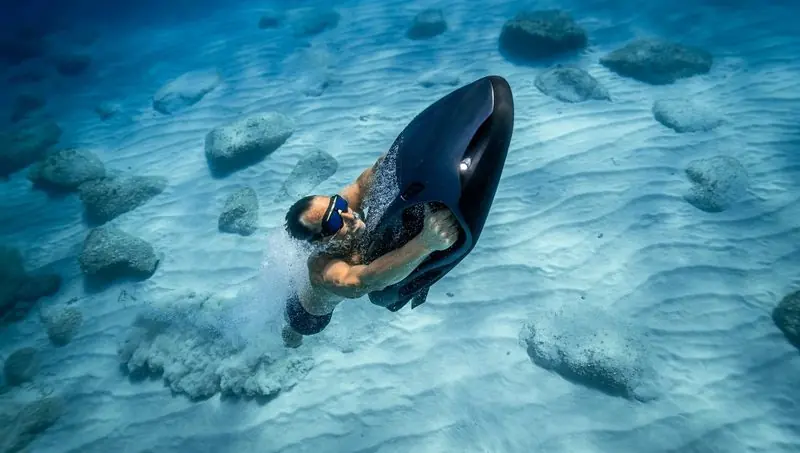
Der SEABOB arbeitet, indem er Wasser durch einen Jet zieht und den Fahrer nach vorn schiebt, gesteuert über einen einfachen Griff und eine Neigung des Körpers. Er kann wie ein Bodyboard entlang der Oberfläche laufen oder für einen Schwimmer mit Maske abtauchen. Verschiedene Modelle bieten unterschiedliche Leistung und unterschiedliches Tauchverhalten. Die neuesten Versionen bringen aktualisierte Batterien und Elektronik in ein bewährtes Format. Cayago hat außerdem Sondereditionen mit Partnern aus der Automobilwelt ausgelotet.
Der elektrische Schlitten, der zum selbstverständlichen Spielzeug an jeder Badeplattform wurde.
Elektroantrieb und kluge Steuerung
Im Herzen des SEABOB sitzt ein kräftiger elektrischer Jetantrieb, gespeist von einer wiederaufladbaren Batterie. Es gibt kein Benzin, keine Abgase und keinen Propeller, der zum Fahrer hin freiliegt. Das System regelt die Leistungsabgabe so, dass ein Anfänger gemächlich dahinziehen und ein Könner kräftig beschleunigen kann, mit derselben Maschine. Der Auftrieb ist so abgestimmt, dass der Schlitten von selbst wieder zur Oberfläche strebt, was eine Sicherheitsreserve schafft. Diese Verbindung aus Kraft und Kontrolle trennt den SEABOB von einem einfachen Tauchscooter.
All dies im Salzwasser zuverlässig zu halten, ist eine ernsthafte technische Aufgabe. Die Elektronik muss versiegelt, die Batterie überwacht und der Antrieb vor Korrosion geschützt werden. Cayagos lange Konzentration auf ein einziges Produkt hat es erlaubt, diese Einzelheiten über viele Modelljahre zu verfeinern. Das Ergebnis ist ein Spielzeug, das sich schnell und lebendig anfühlt und doch für Gäste beherrschbar bleibt, die nie eines benutzt haben. Diese Zugänglichkeit trägt einen großen Teil zum Erfolg auf Charteryachten bei.
Das Erste von der Badeplattform
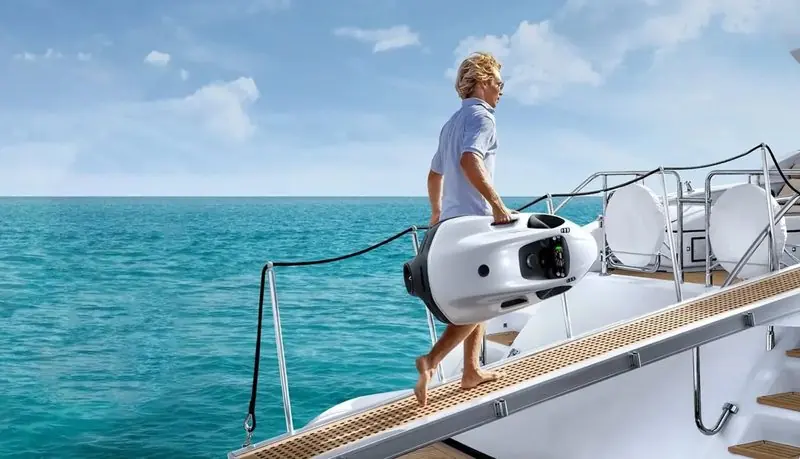
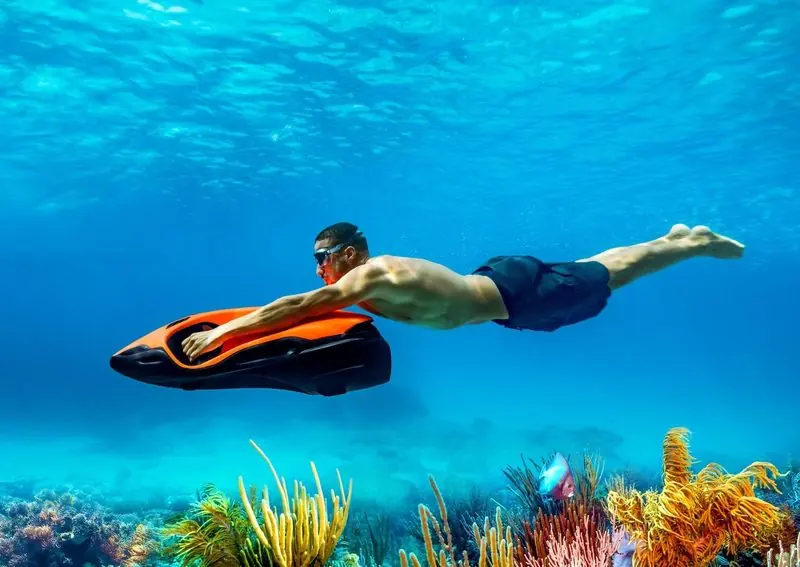
Auf einer Yacht vor Anker ist der SEABOB oft das erste Spielzeug im Wasser. Gäste nutzen ihn, um eine Bucht zu erkunden oder schneller zu schwimmen, als sie es aus eigener Kraft je könnten, und gleiten mit Maske an einem Riff entlang. Er passt zu einer breiten Spanne von Altersstufen und Fähigkeiten, was ihn für eine gemischte Gruppe an Bord ideal macht. Die Crew kann einen mit einer kurzen Einweisung übergeben und Gäste ihn sicher genießen lassen. Diese Bedienbarkeit erklärt, warum nahezu jede Yacht mindestens einen mitführt.
Der Schlitten passt sauber in den Spielzeugstauraum und lädt am Bordnetz der Yacht. Sein sauberer Elektroantrieb bedeutet, dass er nahe an Schwimmern und Stränden eingesetzt werden kann, ohne Abgase und ohne gefährlichen Propeller. Für Familien ist er ein Liebling, weil Kinder wie Erwachsene ihn fahren können. Der SEABOB ist Teil des gewohnten Bildes eines Tages vor Anker geworden. Nur wenige Wasserspielzeuge sind so eng mit dem Yachtleben verknüpft.
Das Standard-Luxuswasserspielzeug
Der SEABOB hat eine Stellung erreicht, um die ihn die meisten Hersteller nur beneiden können, nämlich die selbstverständliche Wahl in seiner Kategorie zu sein. Wenn eine Yacht ihr Spielzeug auflistet, ist ein SEABOB fast immer darunter. Die Mischung der Marke aus Leistung, Sicherheit und Verarbeitung hat sie zum Maßstab gemacht, an dem andere gemessen werden. Die Verbindung zum Porsche-Design beim neuesten Modell verstärkt dieses Premiumbild. Cayago hat aus einer Nischenerfindung einen erwarteten Bestandteil des Yachterlebnisses gemacht.
Für Eigner liegt der Reiz darin, dass der SEABOB schlicht funktioniert und dabei stimmig aussieht. Es ist ein Spielzeug, das Gäste wiedererkennen und ohne Einweisung genießen, und eines, das gut auf die Yacht zurückfällt. Der Elektroantrieb passt zudem zur Bewegung der Branche hin zu leiserer und sauberer Ausrüstung. Cayagos fortgesetzte Investition in neue Modelle hält das Programm aktuell. Der SEABOB bleibt das Wasserspielzeug, das die Kategorie bestimmt, die es geschaffen hat.
The SE63 for Lamborghini
Cayago has built a licensed special edition with Automobili Lamborghini, and it is a different machine. The SE63 runs a 6.3 kW motor at 162 TP, nearly three times the plain F9, weighs 35 kg, runs about 60 minutes and is quoted at 35 km/h, roughly 19 knots, with the optional rear-mounted Performance Board fitted. Production started in the second quarter of 2026 with deliveries from that summer.
The 63 refers to 1963, when Ferruccio Lamborghini founded the car company. A figure of 63 knots circulates on social media and on review aggregators and appears nowhere in Cayago's technical documentation. The SE63 is allocation only and priced on application, in six Lamborghini finishes not offered on the standard machines.
What it costs, and when that was quoted
Cayago's EMEA list of September 2025 puts the F9 at EUR 9,285 net of VAT and the F9 S at EUR 12,380 net. A Mediterranean dealer publishing Maltese gross figures in May 2026 showed EUR 10,956.30 for the F9 and EUR 14,608.40 for the F9 S with 18 percent VAT applied. Every regional number moves with the tax rate and the exchange rate, so the net figure is the one to compare.
The options are not trivial against the base price. The same 2026 list showed Battery Capacity Plus at about EUR 847 gross, the driving stability system at about EUR 490 on the F9, a lifting dock at about EUR 1,095, a rack at about EUR 348, a bag at about EUR 352 and a cover at about EUR 99. Add the quick charger and a spare battery and a well-equipped F9 S lands close to EUR 20,000.
Lithium aboard, and which flags it actually binds
The Maritime and Coastguard Agency issued MGN 681 (M) Amendment 1 on 19 December 2025, covering fire safety, stowage and charging of small electrically powered craft and their lithium-ion batteries aboard yachts. Under it, lithium-ion batteries may only be charged aboard inside a certified container or space, any spare or removed battery above 100 Wh must sit in a dedicated cabinet built to EN 14470, EN 16121 or EN 16122, and from 1 January 2027 those containers on UK-registered vessels must carry UK type approval from a nominated body. The reach is wider than the initials suggest, because MGN 681 sits on Part A Chapter 14 of the Red Ensign Group Yacht Code, and the Red Ensign Group is not only the United Kingdom. The Cayman Islands, Gibraltar, the Isle of Man and the other British Overseas Territories and Crown Dependencies register under the same code, so a Cayman-flagged yacht is already inside Chapter 14. The Cayman Islands Shipping Registry goes further than the Code. Guidance Note 06/2023, read July 2026, annexes the United Kingdom's MGN 681(M) on the fire safety and storage of small electric powered craft and strongly recommends it be followed on every yacht that carries them, so a surveyor works to Chapter 14, that note and a vessel-specific risk assessment together.
The two flags outside the Red Ensign Group have moved separately and unevenly. The Republic of the Marshall Islands rewrote Yacht Code MI-103 with a 2026 edition effective 1 January 2026, and that edition introduces specific rules for spaces used to store or charge lithium-ion powered toys and tenders, so an RMI yacht now has a code requirement of its own rather than a borrowed one. Malta moved earlier and more softly. Transport Malta's Merchant Shipping Directorate issued a Commercial Yachting Notice on battery charging and storage aboard commercial yachts dated 22 June 2022, and Information Notice 45 on lithium-ion battery fires dated 7 September 2022, both framed as strong recommendation, with the firm requirement being that any suspect or defective pack is landed immediately and that deviations from the Commercial Yacht Code need the administration's approval. A Maltese yacht is surveyed against the Commercial Yacht Code, at its 2025 revision, not against MGN 681. The practical answer for an owner buying three SEABOBs is that the charging arrangement should be built to the strictest of the three, because flags change hands more often than garages get rebuilt.
Warranty, service and the alternatives
Cayago gives 24 months from transfer, batteries included and without a separate cycle limit, registered to the original purchaser. The warranty requires an annual inspection at an authorised facility and excludes use outside normal use, which is the clause that matters to anyone chartering the yacht. Declare the charter profile to Cayago before delivery, because those cases are assessed individually. Opening or modifying the machine voids it outright.
The rivals are the electric surfboards and the foils, not other sea scooters, because they compete for the same platform time and the same charging locker. A SEABOB works for a guest who cannot ride anything, at any age, with five minutes of instruction, which is where Awake, Fliteboard, Lift Foils and JetSurf all lose. It also does not get anyone out of the water, and after twenty minutes some guests want to stand up.
What class and the IMO add, and what they do not
Nothing at the International Maritime Organization binds a water toy today. The IMO's work on lithium-ion batteries has run through the Maritime Safety Committee's review of alternative fuels and new technologies, where MSC 109 added swappable traction battery containers to the list under review and identified nineteen regulatory gaps, eleven of which were confirmed for further work, and MSC 110, sitting from 18 to 27 June 2025, closed the review of regulatory barriers. None of that has yet produced a mandatory instrument reaching a 1.2 kWh sled in a yacht garage, and an owner told that the IMO requires something should ask which instrument.
Class arrives at the same place from a different direction. DNV's Battery (Safety) notation becomes mandatory where installed battery capacity exceeds 50 kWh in aggregate, which is more than forty times an F9 S pack, so a locker full of toys never triggers it. What the societies have produced is advice rather than rule. Lloyd's Register published LR-GN-052, Guidance Notes on Lithium-Ion Battery Powered Crafts and Vehicles carried on Yachts, on 10 June 2025, addressed to designers, builders and operators. DNV, Lloyd's Register, RINA, Bureau Veritas and ABS formed a Yacht Safety and Environmental Consortium in 2024. The obligation a yacht is actually surveyed against still comes from the flag, not from class and not from the IMO.
What the certified charging space costs
No manufacturer of a marine lithium charging locker publishes a price. The active-suppression systems yacht suppliers sell against MGN 681, the RACLAN boxes and the modular RAMBSS, and the passive ZARGES BatterySafe cases, were all quotation only in July 2026. The published prices that do exist are for shore-side industrial cabinets built to EN 14470-1 Type 90, which is one of the standards MGN 681 names for spare-battery stowage. A German supplier listed an asecos ION-CHARGE 90 with pull-out shelves at EUR 3,270 net of VAT in July 2026, and a United Kingdom supplier listed the taller asecos ION-CORE-90 at GBP 4,571.04 net or GBP 5,485.25 gross. Those figures set the order of magnitude for a box, not the cost of a compliant installation.
The SEABOB makes the problem harder than an eFoil does, because the battery does not come out. The ION-CHARGE 90 has an internal envelope of 470 by 452 by 582 mm and shelves rated at 25 kg, which suits a removable eFoil pack and will not take a sea sled. On a SEABOB the certified space has to be a compartment designed into the yacht rather than a cabinet bought and bolted down, and that is a refit drawing and a yard bill rather than a purchase order. One warning belongs alongside any quotation. In Safety Bulletin 35, updated 15 November 2024, the MCA found that a lithium storage container marketed as fully compliant with MGN 681 was not able to comply fully, stated that no international standard governs these products, and advised that any certification a manufacturer claims should be viewed with caution.
Praktische Angaben
| New price (net) | F9 EUR 9,285 and F9 S EUR 12,380, per Cayago's EMEA list of September 2025 |
|---|---|
| Gross Mediterranean price | F9 EUR 10,956.30 and F9 S EUR 14,608.40 with 18 percent VAT, a Maltese dealer list read May 2026 |
| Main options | Battery Capacity Plus about EUR 847 gross, quick charger about EUR 1,752 gross, driving stability system about EUR 490 on the F9 |
| Running cost | the pack is integrated and does not come out, so a failure out of warranty is a specialist rebuild with no published price |
| Storage and charging | from 1 January 2027 UK-flagged yachts need a type-approved certified locker; shore-side EN 14470-1 cabinets run EUR 3,270 to about GBP 5,485 gross and are sized for a removable eFoil pack, not a SEABOB, so plan a built-in compartment |
| Warranty | 24 months from transfer including the battery, with an annual inspection required and cover void for undeclared charter use or for opening the unit |
| What is not published | no top speed for the F9 or F9 S, no spare battery on any dealer list, and no price anywhere for a certified charging locker built for the integrated pack |
Angebot anfragen für SEABOB (Cayago).
Nennen Sie uns das Modell und wohin es geliefert werden soll. Die Redaktion holt ein schriftliches Angebot beim Hersteller oder einem autorisierten Händler ein, prüft es gegen die auf dieser Seite veröffentlichten Preise und meldet sich per E-Mail. Unverbindlich und ohne Gebühr.
- 01Ein schriftliches AngebotIn Ihrer Währung, mit Mehrwertsteuer, Lieferung und Lieferzeit, kein Prospektpreis.
- 02Geliefert dorthin, wo die Yacht liegtIn die Marina, auf die Werft oder an Ihre Adresse, mit den Papieren, die ein Lithium-Akku oder ein Kranhub braucht.
- 03UnabhängigYotters ist an keinen Händler gebunden, das Angebot wird verglichen, bevor es Sie erreicht.
Was Eigner und Crew berichten
No independently attributable owner or crew testimony found
trade coverage repeatedly describes the SEABOB as the first toy named when a captain lists what is in the locker, but no publication found in this research names an owner, captain or crew member willing to be quoted on the record about the F9 specifically
Yotters research desk
Was gut ist und worauf zu achten ist
Stärken
- Any guest can ride itfive minutes of briefing suits a nervous teenager and a confident diver alike, which is where eFoils and jet boards lose most guests
- Nine kilos lighter than the F5the F9 S drops from about 35 kg to 25.9 kg, turning what used to be a two-person lift off the swim platform into a one-person job
- Positive buoyancy is a real safety marginletting go of the throttle stops the motor and floats the rider back to the surface rather than leaving him stranded below
Worauf zu achten ist
- One charge, one sessionthe integrated battery cannot be swapped, so a standard F9 gives about 40 minutes of riding and then a four to six hour wait before the next guest can use it
- No published top speedCayago confirms thrust in its own TP units but has never given a knots figure for the F9 or F9 S, so a buyer cannot compare it directly against a rival sea scooter on speed
- The certified charging locker is an unbudgeted refit itemno marine supplier publishes a price for a locker sized to a non-removable SEABOB pack, and the MCA's Safety Bulletin 35 found at least one product marketed as MGN 681 compliant was not able to comply fully
Für wen: Yachteigner und Chartergäste, die ein schnelles, sicheres elektrisches Wasserspielzeug wollen, das jeder an Bord fahren kann.