Williams Jet Tenders
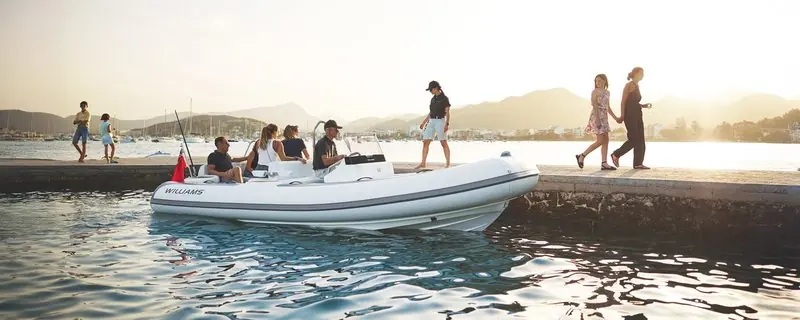
| Kategorie | jetgetriebene Yachttender |
|---|---|
| Gegründet | Anfang der 2000er Jahre, Vereinigtes Königreich |
| Sitz | Oxfordshire, England |
| Wichtigste Produkte | Baureihen Turbojet, Sportjet und Dieseljet |
| Erster Durchbruch | kleiner Viertakt-Jettender, vorgestellt 2004 |
| Antrieb | Jetantrieb mit Benzin, Diesel und Elektro |
| Position | von Serien- und Custom-Werften vielfach serienmäßig vorgesehen |
| DieselJet 415 | 4.16 m, 1.96 m beam, 828 kg dry, Yanmar 4JH of 110 hp, six seats, 68 litres, about 31 knots |
| DieselJet 625 | 6.32 m, Yanmar 4LV of 195 hp, eleven seats, about 38 knots |
| EvoJet 70 | 7.10 m, 2.65 m beam, 2,000 kg dry, Yanmar 4LV of 250 hp, thirteen seats, 200 litres, aimed at yachts of 40 m and above |
| EvoJet 70e | 58.5 kWh lithium-ion pack with control electronics from Evoa, presented by the company's commercial director as a technology demonstrator, with no catalogue listing |
| Warranty | two years from delivery, conditional on the owner returning the warranty document within ten days |
Britische Ingenieurswurzeln
Williams Jet Tenders ging aus einem Betrieb für Schiffstechnik im Süden Englands hervor, wo die Gründer jahrelang Boote gewartet und angepasst hatten, bevor sie eigene bauten. Das Unternehmen entstand Anfang der 2000er Jahre und nahm sich eines bestimmten Problems an, nämlich wie sich ein leistungsfähiger Tender in die enge Garage einer modernen Yacht einpassen lässt. Der Durchbruch kam 2004 mit einem kleinen Luxustender, angetrieben von einem Viertakt-Jetmotor, einem Format, das bald zur Referenz wurde. Aus diesem einen Modell heraus baute die Firma eine ganze Bootsfamilie auf. Heute arbeitet sie von einem großen, eigens errichteten Werk in Oxfordshire aus.
Die Entscheidung für den Jetantrieb stand im Kern der Konstruktion. Ein Jetantrieb beseitigt den freiliegenden Propeller, der einen herkömmlichen Außenbordertender im Umfeld von Schwimmern und Stränden heikel macht. Er erlaubt zudem einen flacheren Rumpf mit geringerem Tiefgang, der leichter in eine Garage gleitet. Williams hat seinen Ruf darauf gegründet, dieses Paket im kleinen Format richtig hinzubekommen, wo die Technik am schwierigsten ist. Diese frühe Konzentration auf kompakte Jettender hat alles geprägt, was das Unternehmen seither getan hat.
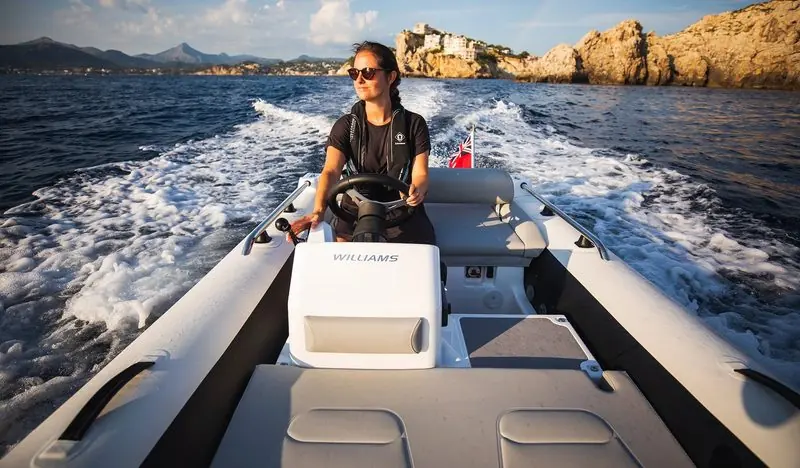
Die Baureihen von Minijet bis Dieseljet
Das Williams-Programm ist nach Größe und Verwendung geordnet und nicht um ein einzelnes Flaggschiff herum. Die Turbojet-Modelle waren die ursprünglichen Benzin-Jettender und bilden weiterhin den Kern des Programms; sie sind für eine Handvoll Gäste ausgelegt und passen in sehr unterschiedliche Yachtgaragen. Die Sportjet-Reihe ergänzt Leistung und Platz für Eigner, die ein schnelleres Tagesboot wollen. Am oberen Ende nehmen die Dieseljet-Modelle mehr Gäste auf und arbeiten mit Dieselantrieb, was Yachten entgegenkommt, die Diesel an Bord führen und Benzin lieber vermeiden. Daneben gibt es einen kleineren Minijet für kompakte Einheiten.
Neben den Benzin- und Dieselreihen steht eine Elektrolinie, die zeigt, wohin sich der breitere Markt bewegt. Der Schritt zum Batterieantrieb beantwortet eine reale Nachfrage von Eignern, die leisen Betrieb und keinen Umgang mit Kraftstoff auf der Badeplattform wollen. Jede Reihe wird in mehreren Längen angeboten, sodass sich ein Tender genau auf die Maße einer Garage abstimmen lässt. Dieser modulare Ansatz erklärt zu einem großen Teil, warum so viele Werften Williams serienmäßig vorsehen. Der Tender ist oft schon gewählt, bevor die Yacht überhaupt fertig ist.
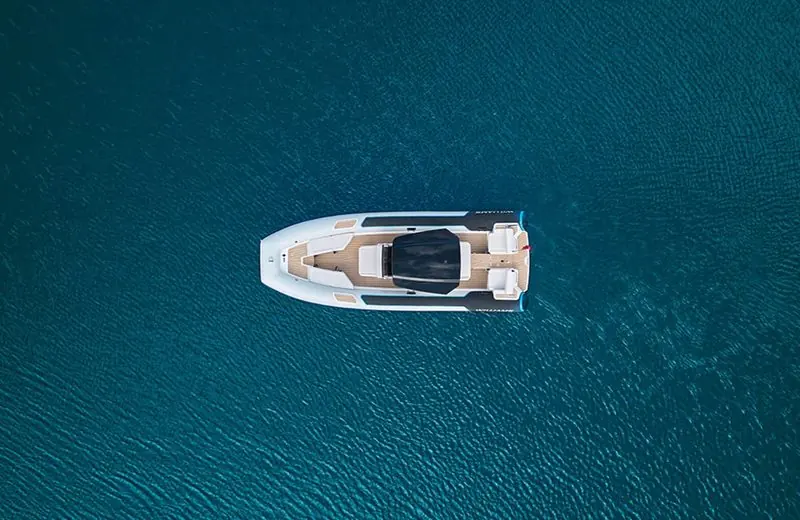
Der Jettender, der zur Standardhaustür der Branche zum Wasser wurde.
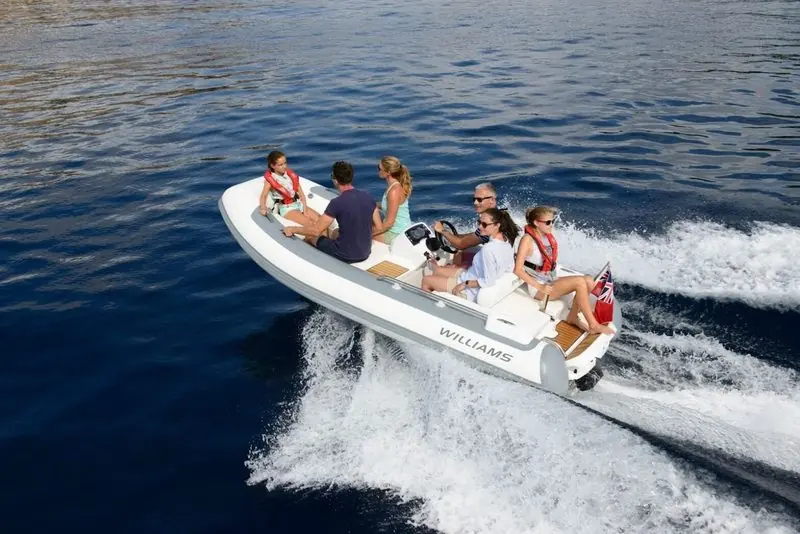
Bauen für die Garage
Ein Yachttender hat ein hartes Leben und verbringt die meiste Zeit auf engem Raum verstaut. Williams legt seine Boote so aus, dass sie sich rasch zu Wasser lassen und bergen lassen, oft von einem einzigen Crewmitglied mit den bordeigenen Systemen der Yacht. Der Jetantrieb verschwindet sauber im Rumpf und hinterlässt eine glatte Unterseite, die keine Leinen einfängt und Schwimmer nicht gefährdet. Verarbeitung und Finish zählen, weil der Tender neben dem Mutterschiff beurteilt wird. Das Unternehmen baut auf einem Niveau, das eine um ein Vielfaches teurere Yacht nicht blamiert.
Die technische Aufgabe besteht darin, Leistung in einen kleinen, leichten Rumpf zu packen. Ein Tender muss mit voller Gästeladung schnell ins Gleiten kommen und trotzdem leicht genug für den Kran der Yacht bleiben. Williams hat zwei Jahrzehnte darauf verwendet, diese Balance über alle Reihen hinweg zu verfeinern. Das Ergebnis ist ein Boot, das sich selbst für Gäste, die selten selbst fahren, stabil und berechenbar anfühlt. Diese Zuverlässigkeit hält Kapitäne bei der Marke.
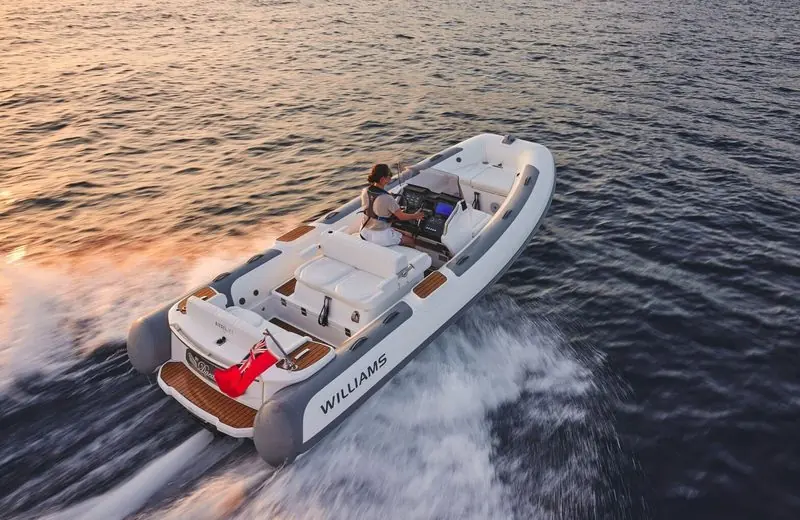
Das Leben an Bord des Tenders
Für Gäste ist der Tender die Haustür der Yacht. Über ihn erreichen sie den Beach Club, das Ufer, ein Restaurant an Land oder eine stille Bucht zum Schwimmen. Ein guter Tender lässt diese Transfers leicht und trocken wirken, ein schlechter macht daraus eine Mühsal. Williams-Boote sind genau auf diesen täglichen Dienst eingerichtet, mit Sitzanordnungen und Layouts, die auf Komfort und nicht allein auf Sportlichkeit zielen. Die größeren Modelle ergänzen Sonnenpolster und Stauraum für einen ganzen Tag abseits der Yacht.
Das Jetformat passt auch dazu, wie Tender im Umfeld von Schwimmern und Stränden benutzt werden. Ohne freiliegenden Propeller kann das Boot mit geringerem Risiko an eine Sandbank heranfahren oder zwischen Menschen im Wasser mitlaufen. Das macht es zur natürlichen Wahl für Familien und für Chartergäste, die ihre Tage im und am Wasser verbringen. Der Tender wird zu einer kleinen Erweiterung des geselligen Lebens an Bord. Dieses praktische Sicherheitsargument hat den Jettendern einen großen Marktanteil verschafft.
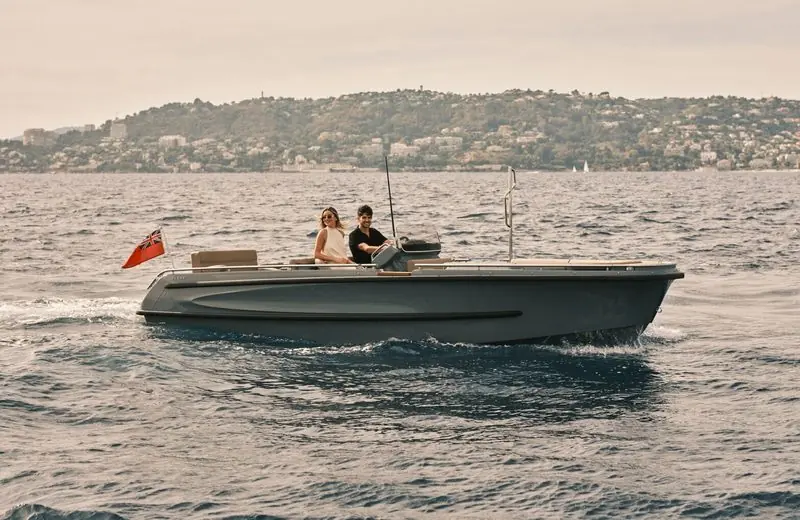
Standardausrüstung vieler Werften
Williams steht am mengenstarken Ende der Luxustenderwelt, und seine Stärke ist Breite statt einmaliger Exklusivität. Viele Serien- und Semi-Custom-Werften sehen einen Williams-Tender als Standardlösung für ihre Garagen vor. Diese Reichweite hat die Marke zu einem der bekanntesten Namen im Segment gemacht. Ein Eigner, der eine neue Yacht kauft, findet den Williams oft bereits passend dimensioniert und als Teil des Pakets kalkuliert vor. Das Unternehmen hat aus einer Nische einen Quasi-Standard gemacht.
Das Ansehen der Marke ruht mehr auf Beständigkeit als auf Spektakel. Ein Williams-Tender ist eine bekannte Größe, die Kapitäne über Saisons hinweg warten und am Laufen halten können. Für Eigner, die ein bewährtes, praktisches Boot statt einer maßgefertigten Aussage wollen, ist er eine sichere und verbreitete Wahl. Der Schritt in den Elektroantrieb hält das Programm aktuell, während sich der Markt verschiebt. Williams ist vorn geblieben, indem es eine Formel verfeinert hat, die es weitgehend selbst geschaffen hat.
Fuel, charging and the electric question
Petrol on a large yacht is a stowage and insurance problem, and the DieselJet range solves it by drinking what the yacht already carries. On smaller boats the calculation flips, because a 90 hp petrol Rotax is far lighter than any diesel of equivalent output and the weight matters more than the fuel type. Choosing between a TurboJet and a DieselJet is really choosing between crane capacity and fuel logistics.
Williams has shown the EvoJet 70e, an all-electric version running a 58.5 kWh lithium-ion pack through control electronics from the American firm Evoa, with the same thirteen seats and the same published top speed. The company's commercial director called it a technology demonstrator built to prove what could be achieved. Williams publishes no range figure, no charge time and no price. Treat the missing range number as the whole question, because a tender that needs shore power for hours between beach trips changes a day at anchor.
What it costs to buy and to keep
Williams publishes no list prices, and the dealer network quotes against the specification. Motor Boat and Yachting listed the SportJet 520 from GBP 47,178 including VAT in its 2025 coverage. A UK tender guide consulted in July 2026 put TurboJet and SportJet boats at roughly GBP 30,000 to GBP 90,000, DieselJets at roughly GBP 100,000 to GBP 250,000 and the EvoJet 70 from roughly GBP 300,000, and described those as guidance bands with no quote behind them.
The running cost is not the fuel. It is the annual service, the impeller and wear ring that erode on any waterjet, the anodes, the tubes on the inflatable models and the hours the crew spend flushing and cleaning. Tubes are a consumable in Mediterranean sun, and a reasonable owner should budget to retube once in a long ownership. The tender also takes far more cosmetic abuse than the yacht, because it is the thing that touches docks.
Warranty, parts and a breakdown in August
Williams warrants its boats free of material defect for two years from delivery, conditional on the owner returning the completed warranty document within ten days. That clause is the sort of administrative trap that costs owners real money, and it is worth confirming with the yard's project manager that it was actually done at handover. The company runs an owners centre with manuals and parts catalogues, and sells parts through the dealers.
Coverage follows the volume. Factory-trained dealers sit across Europe, the Middle East and North America, so the Riviera, the Balearics, Italy, the Solent and Florida are well served. Caribbean cover is thinner, and a boat wintering in the islands should carry a spare impeller and a service kit. In August on the Cote d'Azur every dealer in the region is at capacity, and a failure in the first fortnight of the month is realistically a failure for the week.
Where it wins, and who should buy elsewhere
Against the custom yards, Williams competes on availability and price and loses on fit. Pascoe International and Compass Tenders design a hull around one specific garage and one owner's arrival ritual, and they will build an enclosed air-conditioned limousine that no Williams matches. Castoldi and Novurania sit between the two. What Williams offers is a boat the yard has already fitted a hundred times, delivered on schedule, with a parts network behind it.
The owner who should buy a Williams has a production or semi-custom yacht up to about 45 m, wants the tender to be a solved problem, and cares that guests can drive it safely off a beach. The owner who should look elsewhere is building full custom with the garage drawn around the tender, wants guests delivered dry and enclosed in a passing squall, or needs to move more than thirteen people in one trip.
Praktische Angaben
| Price | no list prices published; Motor Boat and Yachting quoted the SportJet 520 from GBP 47,178 including VAT in 2025, and a July 2026 tender guide put TurboJet and SportJet boats at roughly GBP 30,000 to 90,000, DieselJets at roughly GBP 100,000 to 250,000, and the EvoJet 70 from roughly GBP 300,000 |
|---|---|
| Running cost | annual service, the impeller and wear ring that erode on any waterjet, anodes, and tube retubing on the inflatable models, budgeted roughly once in a long ownership |
| Fit before you order | garage door opening sets the beam limit, the cradle sets the length, and the transom crane's rated lift sets the weight; get the dry weight for the exact build, with options fitted, in writing from the dealer |
| Warranty | two years from delivery, conditional on the owner returning the completed warranty document within ten days of handover |
| Service network | factory-trained dealers are dense across the Riviera, the Balearics, Italy, the Solent and Florida; Caribbean cover is thinner, so a boat wintering there should carry a spare impeller and service kit |
| What is not published | no list prices anywhere in the range, and no range, charge time or price for the electric EvoJet 70e demonstrator |
Angebot anfragen für Williams Jet Tenders.
Nennen Sie uns das Modell und wohin es geliefert werden soll. Die Redaktion holt ein schriftliches Angebot beim Hersteller oder einem autorisierten Händler ein, prüft es gegen die auf dieser Seite veröffentlichten Preise und meldet sich per E-Mail. Unverbindlich und ohne Gebühr.
- 01Ein schriftliches AngebotIn Ihrer Währung, mit Mehrwertsteuer, Lieferung und Lieferzeit, kein Prospektpreis.
- 02Geliefert dorthin, wo die Yacht liegtIn die Marina, auf die Werft oder an Ihre Adresse, mit den Papieren, die ein Lithium-Akku oder ein Kranhub braucht.
- 03UnabhängigYotters ist an keinen Händler gebunden, das Angebot wird verglichen, bevor es Sie erreicht.
Was Eigner und Crew berichten
No independently attributable owner or captain testimony found
trade coverage and dealer pages describe Williams as the tender most new yacht specifications already assume, but this research did not find a named owner or captain willing to be quoted on the record about handling, reliability or after-sales service for a specific model
Yotters research desk
Was gut ist und worauf zu achten ist
Stärken
- A solved problem, off the shelfat roughly 1,200 boats a year Williams is the highest-volume boatbuilder in Britain by unit count, so the yard has usually sized and quoted the boat before the owner has shown anyone the garage
- No exposed propellerthe jet drive is the safer choice around swimmers and beaches, and the shallow draft lets the boat nose onto sand that would ground a propeller-driven tender
- The widest size and fuel spread in one cataloguepetrol, diesel and an electric demonstrator run from the 227 kg MiniJet 280 to the 2,000 kg EvoJet 70, a factor of nine, covering yachts from about 12 m to 40 m and above
Worauf zu achten ist
- No published prices anywhere in the rangeevery figure comes from a dealer quote against the owner's own specification, and Williams has form on a weight figure that did not match the eventual spec sheet: the MiniJet was announced at under 200 kg and the current sheet gives 227 kg dry
- A jet drive costs efficiency and ease of dockinga waterjet burns more than an equivalent outboard at displacement speed, astern handling takes practice guests do not have, and the intake grate fouls on weed, rope and plastic
- Service cover thins out where owners actually cruisethe Caribbean has fewer factory-trained dealers than Europe, and every dealer on the Cote d'Azur is at capacity in August, so a breakdown in high season is realistically a week's wait
- The EvoJet 70e is not yet a real optionWilliams calls it a technology demonstrator and publishes no range, no charge time and no price, so an owner who wants the diesel garage solved electrically cannot yet buy one
Für wen: Eigner und Werften, die einen bewährten, garagentauglichen Jettender wollen statt eines einmaligen Custom-Baus.