Amels 212
| LOA | 65,5 m (212 ft) |
|---|---|
| Manga | 12,28 m |
| Calado | 3,85 m |
| Arqueo bruto | aprox. 1.518 GT |
| Diseño exterior | Tim Heywood |
| Diseño interior | Andrew Winch |
| Invitados / tripulación | 14 en 7 camarotes, aprox. 15 tripulantes |
| Entregados | 3 cascos, desde comienzos de la década de 2010 |
El peso medio wide body
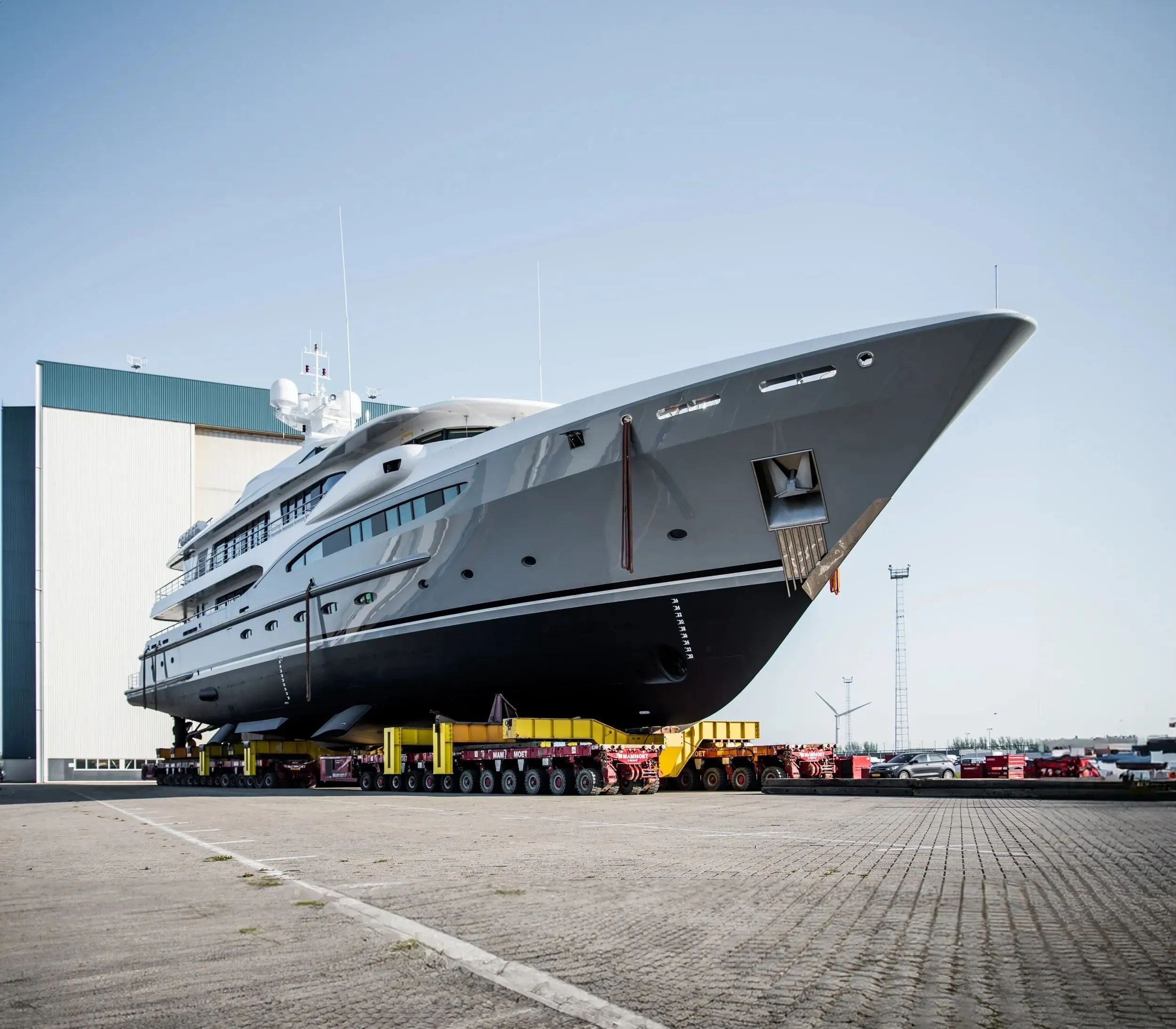
El 212 se coloca entre las plataformas menores centradas en el volumen y los clásicos buque insignia, y ofrece un salto de espacio interior sin entrar en territorio de buque insignia. Con 65,5 metros daba una cubierta puente wide body y un arqueo bruto bastante por encima de las 1.500 GT, generoso para la eslora. La promesa Limited Editions se mantuvo. Los compradores recibían una plataforma diseñada con margen para personalizar el interior. Daba a los armadores volumen de buque insignia en un casco que seguía siendo manejable de explotar.
La rareza forma parte de su carácter. Se completaron tres cascos, lo que hace del 212 una imagen poco frecuente al lado de los modelos más vendidos de la gama. Los barcos entregados incluyeron el VENTUM MARIS y el SEA RHAPSODY, junto con el yate Z, con entregas a partir de comienzos de la década de 2010. Esa escasez da al modelo un atractivo particular en el mercado de brokerage. Una escasez así tiende a mantener vivo el interés por un yate con los años.
Heywood a mayor escala
Tim Heywood llevó su lenguaje habitual al 212, con la proa larga y la superestructura baja escaladas para la eslora añadida. El resultado es un yate que se ve aplomado y sin prisa sobre el agua. La disposición wide body suma manga interior sin romper el equilibrio exterior. Es una pieza de diseño meditada más que llamativa. El 212 lleva sus metros de más con la misma calma que muestran los barcos menores.
La distribución de cubiertas aprovecha al máximo el tamaño añadido. Un sundeck amplio y generosas zonas de popa dan a los invitados sitio de sobra para repartirse, mientras la proa ofrece un refugio más tranquilo. Las proporciones cargan el volumen extra sin parecer pesadas. La contención de Heywood mantiene al 212 con aspecto actual mucho después de sus años de construcción. Esa resistencia a la moda ha sentado bien a los cascos entregados.
Solo se construyeron tres Amels 212, un 65 metros wide body que juega la carta de la rareza y de los interiores Winch.
Interiores Winch, espacio wide body
Un volumen interior de unas 1.518 GT da al 212 verdadera presencia bajo cubierta. Andrew Winch diseñó los interiores de los yates entregados, aportando una mano refinada y meditada a los espacios wide body. Las distribuciones alojan hasta 14 invitados en siete camarotes, un paso por delante de las plataformas menores. El alojamiento del armador es el que más se beneficia de la manga añadida. El planteamiento wide body convierte la manga en espacio habitable justo donde más cuenta.
La cubierta puente wide body es el elemento interior que lo define, y suma anchura útil donde los invitados pasan buena parte del tiempo. Las alturas libres y los grandes acristalamientos venían de fábrica en la plataforma, así que el interior se siente abierto y luminoso. El alojamiento de tripulación para unas 15 personas sostiene una explotación de servicio completo. El volumen coloca al 212 más cerca de los buques insignia de lo que su eslora por sí sola sugiere. Los invitados registran la anchura mucho antes de pensar en la eslora.
Rápido para su clase
El 212 es más rápido que buena parte de la gama, con una velocidad máxima anunciada en torno a 17 nudos. Monta el habitual casco de acero de desplazamiento del astillero con superestructura de aluminio. Una capacidad de combustible de unos 155.000 litros alimenta travesías largas, y la de agua se sitúa cerca de 38.000 litros. La ingeniería apunta a una navegación oceánica capaz con un punto útil de ritmo. La velocidad de más da al armador más libertad al planificar travesías largas.
A un crucero de 13 nudos la autonomía llega a unas 5.000 millas náuticas, suficiente para cruces oceánicos con margen. El calado de unos 3,85 metros mantiene abierto un terreno de navegación amplio. Como en el resto de la serie, la maquinaria favorece componentes probados y un funcionamiento silencioso. Un yate de este volumen pide una tripulación profesional completa para llevarlo bien. La capacidad generosa de tanques apunta a un barco concebido para distancias reales y no para saltos costeros.
Quién compra un 212
El 212 atrae a armadores que quieren volumen próximo al de un buque insignia en un paquete algo más compacto. La distribución wide body encaja con quienes valoran el espacio interior y recibir por encima de todo. Su ventaja de velocidad atrae a armadores a los que les gusta cubrir terreno entre fondeaderos. La rareza del modelo le da cierto caché entre los compradores de Amels. La combinación de espacio y velocidad es menos común de lo que parece a este tamaño.
En el mercado de brokerage el tamaño reducido de la flota corta por los dos lados, porque mantiene escasos los ejemplares y a la vez limita los comparables directos. Los interiores Winch y el volumen sólido ayudan a los barcos entregados a mantener su atractivo. Los armadores que suben desde un superyate de tamaño medio encuentran en el 212 un escalón natural. Sigue siendo una de las opciones más distintivas de la gama clásica. Para un comprador que valora la individualidad, la flota pequeña forma parte del atractivo.
Motores y sistemas
| Main engines | Twin Caterpillar 3516B diesels, reported at 2,000kW / 2,682hp each at 1,600-1,800rpm, confirmed across hull 1 (Ventum Maris) and hull 3 (Z) brokerage sheets and the Sea Rhapsody (hull 2) listing. One generic model-page source instead states Caterpillar 3516C units at 3,151hp each, conflicting with all three hull-specific listings and flagged as a likely outlier. |
|---|---|
| Gearboxes | Reintjes WAF 863 reduction gearboxes, shaft drive to fixed-pitch five-blade propellers. |
| Generators | 3 x Caterpillar C9 generator sets at 200 ekW each, plus a Caterpillar C4.4 emergency generator at 86 ekW; shore power capacity 250 kVA. |
| Stabilisers | Active fin stabilisers rated for 13-knot cruise, plus a zero-speed function for at-anchor use. |
| Thrusters | Voith extra-silent inline bow thruster, 180 ekW, engineered specifically for low noise. |
| Watermaker | Two reverse-osmosis watermakers plus pressure pumps. Fresh water tankage reported as 38,000 litres by most sources, though one model-page source instead gives 36,400 litres - a minor unresolved conflict. |
| Fuel tankage | 155,000 litres, consistent across every source checked. |
| Range | 5,000nm at 13-knot cruise, consistent across nearly every source - except Sea Rhapsody's own listing, which instead states 5,758nm at the same cruise speed on the same tankage. Flagged as an unresolved conflict. |
| Speed | Top speed 17 knots, cruise speed 13 knots, consistent across all sources checked. |
| Gross tonnage | 1,503 GT is the figure given by the most independent sources. Two other figures appear once each and conflict: 1,574 GT and 1,518 GT - the latter notably matching the reported GT of the larger, stretched Amels 220 derivative, raising the possibility of a data mix-up on that source. |
| Beam | 11.88m recurs across three separate hull-specific listings (Sea Rhapsody, Z, Ventum Maris), against 12.25-12.28m in two earlier or general sources - possibly an early brochure figure against the as-built number. Not resolved. |
| Crew capacity and cabins | Reported crew numbers conflict by hull: 15 crew in 8 cabins (Z) against 20 crew in 10 cabins (Ventum Maris) against a generic 16-19 range on one model page. May reflect real post-delivery cabin conversions or inconsistent broker data entry - not resolved. |
| Hull count | A widely reported fourth 212 sale in 2019 appears, per one build-story source, to actually have been built to the stretched 67.6m Amels 220 specification rather than the true 65.5m 212 platform - meaning the true 212-specific hull count may be three (Imagine/Infinite Shades/Ventum Maris, Sea Rhapsody, Z), not four. A separate sister-ship listing shows a 212 hull dated 2022, which conflicts with the stated 2011-2018 production window and was not corroborated elsewhere. |
Lo que cuentan armadores y tripulaciones
Broker view: strong satisfaction across the wider Limited Editions line
Dominic Millman of Burgess, discussing the 2023 resale listing of Infinite Shades (ex-Imagine, hull 1 of the 212), said the series has been brilliant, calling the 212 a particularly popular size range and citing Dutch engineering, a high calibre design collaboration and seven spacious guest cabins over five decks. This framing covers the wider multi-size Limited Editions range, not the 212 alone, so the scarcity and satisfaction point is series-wide, not a 212-only statistic.
Dominic Millman, Burgess, via SuperyachtNewsMarket visibility of hull 1 declined under its second name
YachtForums' news desk noted that since becoming Ventum Maris, hull 1 seems to have dropped off the radar a bit, later reporting she was listed for sale asking EUR 65 million - a figure that conflicts with the EUR 57.5 million reported elsewhere for the same yacht under her prior name Infinite Shades.
YachtForums news desk
Lo bueno y lo que conviene vigilar
Puntos fuertes
- Semi-custom speed and cost advantageAmels positions the 212 as roughly two years faster to deliver than a fully custom build of similar size, at about 30 percent lower cost than an equivalent bespoke yacht - the yard's own framing, reported by Boat International's feature on hull 1, Imagine.
- Quiet, efficient engineering for the classCabin noise under 50 dB, genset soot filtration and a low-noise Voith inline bow thruster were singled out by Boat International as unusual attention to engine-room and acoustic detail for a semi-custom hull.
- Long range and stability at anchor5,000nm range at 13-knot cruise on 155,000 litres of fuel, with active stabilisers tuned for 13-knot cruising plus a zero-speed function for at-anchor comfort, consistent across brokerage listings for hulls 1, 2 and 3.
- Thin but durable resale marketVery few 212 hulls have ever come up for resale, and the 2011-built hull 1 was still marketed in the mid EUR 50-60 million range roughly twelve years after delivery, evidence the type holds value rather than being dumped cheap.
A tener en cuenta
- At least one impractical crew cabinBoat International's own feature on hull 1 flagged that one forward crew cabin really is not practical for the two crew berthed there - a named design compromise from an independent publication, not marketing copy.
- Semi-custom platform constrains real customisationThe cost and speed advantage comes from reusing Amels' established steel hull, naval architecture and systems package across hulls, so owners get a curated menu of layout and finish options rather than a clean-sheet design.
- Early hulls carry dated machinery and pending refit costsHull 1 (2011) and hull 3 (2014) both specify Caterpillar 3516B main engines, now an older Cat generation, and both have already needed refits - Ventum Maris in 2019, Sea Rhapsody in 2020 - so a buyer of an early 212 should budget for system-refresh capital spending on top of purchase price.
- Published technical data for the class is inconsistentCore figures - gross tonnage, beam, engine output, crew and crew-cabin count - vary meaningfully between brokerage listings for the same or sister hulls, so a buyer cannot rely on aggregator specs alone and needs the builder's own spec sheet or a survey for any given hull.
Información práctica
| New-build price | Not publicly disclosed by the yard or press for any hull. Amels' own positioning is about 30 percent less than a fully custom yacht of the same gross tonnage, with a roughly two-year build slot against up to five years for full custom - no absolute figure found. |
|---|---|
| Resale asking prices (as reported) | Hull 1 (Infinite Shades, 2011) was listed by Burgess at EUR 57.5 million; a separate report on the same hull under her later name Ventum Maris cited an asking price of EUR 65 million. Not reconciled - may reflect a price change over time or a reporting difference. |
| Refit history on delivered hulls | Ventum Maris (hull 1) refit reported 2019. Sea Rhapsody (hull 2) refit reported 2020. No refit date found for Z (hull 3). The class is now at the point where owners are budgeting for significant refits roughly seven to nine years after delivery. |
| Resale liquidity | Brokers describe listings in the wider Limited Editions range as scarce because owners tend to keep them - good for sellers, but it also means a buyer has very few comparable 212 hulls to benchmark price against at any given time. |
| What is not published | Build cost by hull, annual running-cost or OPEX figures, insurance guidance, drydock or refit cost figures, and a complete confirmed roster of every 212 hull with delivery dates and current names. |
Design
| Diseño exterior | Tim Heywood |
|---|---|
| Interiorismo | Winch Design (Andrew Winch) concept. Owner-customized |
| Arquitectura naval | Amels / Damen Yachting (in-house) |
Para quién es: Armadores que quieren volumen próximo al de un buque insignia y una distribución wide body para recibir, en una Limited Edition clásica más rara y más rápida.