Menorca
| Region | western Mediterranean, easternmost of the four main Balearic Islands, Palma to Mahon about 90 nautical miles |
|---|---|
| UNESCO Biosphere Reserve since 1993 (land), extended 19 June 2019 to the surrounding sea out to 12 nautical miles, the largest marine Biosphere Reserve in the Mediterranean | |
| Season | May to October, June and September the best combination of weather and space, no late-season club calendar extending the peak the way Ibiza has |
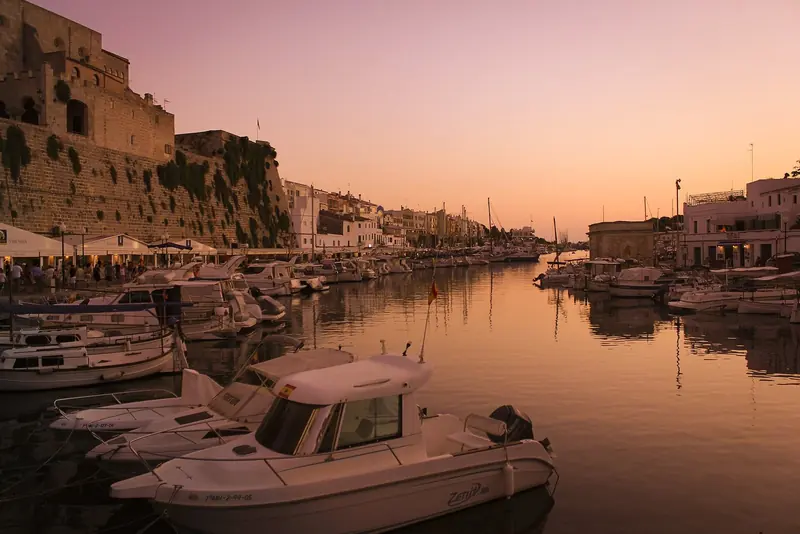
| Port de Mahon | a natural harbour running about 5 km inland, among the largest natural deepwater harbours in the world, usable in essentially any wind direction |
| Marina Port Mahon | 30 berths, 25 to 60 m LOA, no published tariff |
| Marina Menorca | 650+ berths across 4 zones (Sa Colarsega to 25 m, Cala Llonga/Ribera Norte to 21 m, floating pontoons to 15 m, Isla del Rey to 60 m) |
| One 2023 forum account | roughly EUR 575 overnight for an 18.5 m boat at Mahon - a single data point, not a rate card |
| Ciutadella | Club Nautico de Ciutadella, 180 berths, capped at 18 m / 54 ft; narrow canal entrance with a footbridge, settled-weather port only |
| Cala en Turqueta user pressure | 424.7% of carrying capacity; Cala Macarella: 203.3%; 36% of Balearic beaches over optimal capacity (Informe Mar Balear 2026) |
| 2025 Menorca beach visitor numbers described as a record by Menorca.info reporting in February 2026 | |
| Reserva Marina del Nord de Menorca | established by order dated 15 June 1999 |
| Reserva Marina de la Illa de l'Aire | created by Decreto 26/2019 of 12 April 2019; reserve is 1.5 km offshore, 719 ha, 454 ha special diving zone |
| From 5 June 2026 | jet skis banned and a 10-knot speed limit enforced across the Illa de l'Aire reserve |
| 2026 | new 21-buoy anchoring field approved for Illa de l'Aire (reduced from an original 23-buoy 2023 proposal), part of a 70-buoy Balearic-wide expansion |
| July 2026 | boaters' association ADN Mediterraneo filed a complaint against 4 named PortsIB officials alleging contract-splitting around a stalled EUR 5.8 million tender, after a EUR 314,000 emergency extension to keep 8 existing buoy fields running |
| August 2026 | GOB (environmental group) filed a separate complaint that the Illa de l'Aire speed limit and jet ski ban were being widely ignored with no effective enforcement |
| Balearic anchoring law | Decree 25/2018, Posidonia red/yellow zones, Posidonia GOIB app; 2025 enforcement: 18 patrol boats, 181,000+ inspections Balearics-wide, 6.4% of checked vessels found anchoring illegally |
| Anchoring fines | EUR 100 to EUR 450,000 under the Balearic regime, up to EUR 2 million under the national coastal regime |
| Menorca Airport (MAO) | summer 2026 schedule, about 28 airlines to 72 destinations; Palma, Barcelona and Madrid the busiest routes; heavily seasonal (flightconnections.com, Flightradar24) |
| Menorca has no refit/haul-out yard of note; the nearest comparable technical base is STP Shipyard Palma, about 90 nm away | |
| Balearic sustainable tourism tax (ITS), high season 1 May-31 Oct: EUR 4/person/night (5-star and luxury), EUR 3 (4-star/3-star superior), EUR 2 (lower categories, apartments); application to private charter yacht guests not confirmed by any source found | |
| Fornells | large, largely enclosed north-coast bay, small marina with few berths plus a buoy field and open anchorage; known locally for caldereta de langosta |
Menorca is not a smaller Mallorca
Menorca has no equivalent of Marina Ibiza or STP Shipyard Palma, no nightlife economy, and no single berth over 60 metres. What it has instead is two natural harbours at opposite ends of the island, a south coast built from narrow limestone calas rather than open beaches, and a Biosphere Reserve designation that covers the entire island and, since 2019, the sea around it out to 12 nautical miles. An owner who has already done Ibiza's clubs and Mallorca's yard comes here for the opposite of both.
The distances matter too. Palma to Mahon is about 90 nautical miles, a genuine passage rather than an afternoon hop, and Menorca is routinely the island the brochures mention and the itineraries skip because it does not sit on the direct line between Barcelona and Ibiza. That isolation is the whole appeal for the owner who wants it, and the whole objection for the one who does not.
Two harbours, and they could be two different seas
Port de Mahon on the east coast is one of the largest natural deepwater harbours in the world, running roughly five kilometres inland from a wide, sheltered mouth, lined with forts, the old naval base on Isla del Rey and a working town along its northern shore. It takes commercial shipping, cruise ships and superyachts without drama and it is usable in essentially any wind direction, which is the reason it has been a naval harbour since the eighteenth century.
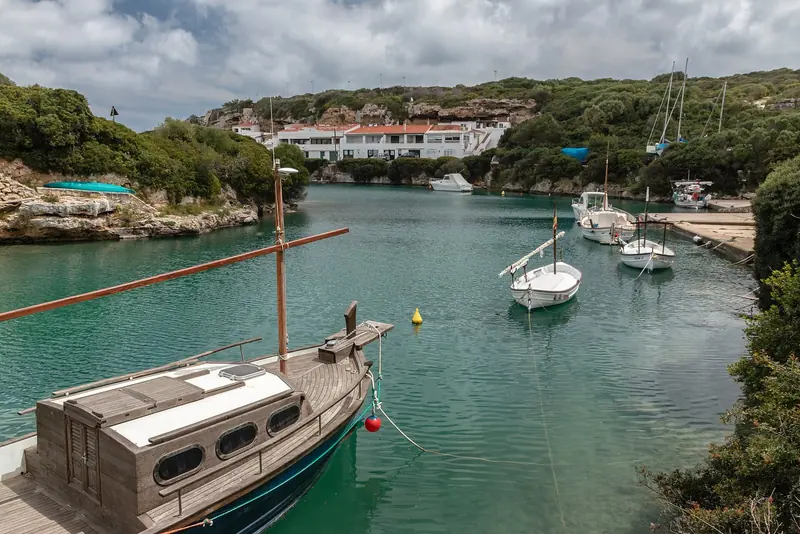
Ciutadella on the west coast is the opposite shape: a narrow canal-like inlet running into the old capital, lined with restaurant terraces and small craft rafted below the city walls, with a stone bridge and a genuinely tight entrance that a large yacht enters at low speed and only in settled weather. The two towns are about 45 kilometres apart by road and a longer way by sea around the island, so a boat based in one is not popping over to the other for the evening.
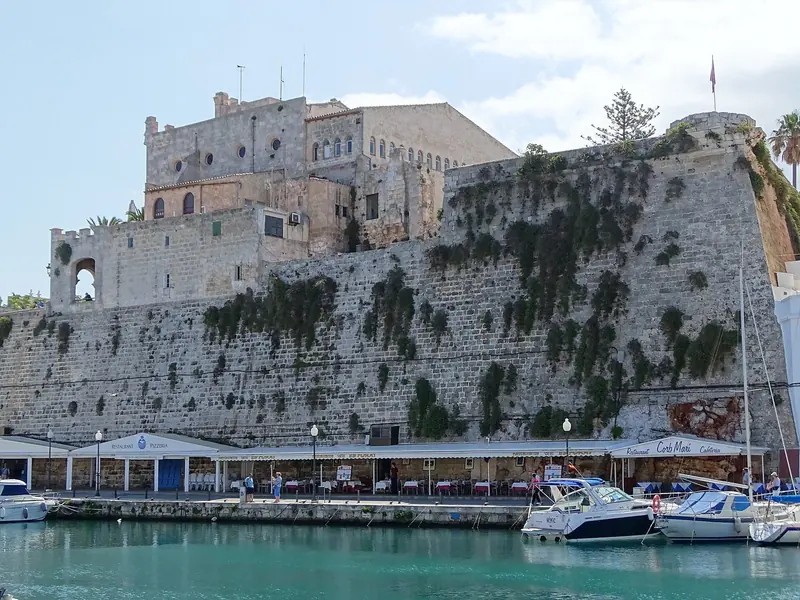
Cala en Turqueta is running at 424.7 per cent of its measured carrying capacity, and the new 21-buoy field meant to manage anchoring at Illa de l'Aire is itself the subject of a formal complaint to the state prosecutor.
Mahon: where the berths actually are
Marina Port Mahon, sited between Punta de Cala Figuera and Punta del Rellotge, runs 30 berths for yachts of 25 to 60 metres with dockhands, private security and services aimed specifically at that size of boat. Marina Menorca, the port's other concessionaire, spreads more than 650 berths across four separate mooring areas along the harbour: Sa Colarsega to 25 metres, Cala Llonga and the Ribera Norte to 21 metres, a floating pontoon area to 15 metres, and the Isla del Rey basin, which takes vessels to 60 metres.
Neither operator publishes a berthing tariff online. One 2023 forum account put an overnight rate at roughly EUR 575 for an 18.5 metre boat, which is a single data point rather than a rate card and should be read as one owner's bill, not a quotation. Es Castell and the Cales Fonts waterfront, just inside the harbour mouth, add a smaller-craft anchorage and a strip of quayside restaurants that large-yacht tenders use routinely.
Ciutadella: medieval, narrow, and not for a blow
Club Nautico de Ciutadella, the harbour's marina, runs 180 berths and caps at 18 metres, roughly 54 feet, a figure two independent listings agree on. The wider port adds around 150 to 170 further berths and visitor pontoons at similarly modest sizes. A superyacht does not berth in Ciutadella; it works Cala en Bosch, Cala Blanca or the anchorages further along the south west coast and sends the tender in for the old town, the cathedral and the harbourside restaurants under the citadel wall.
The entrance itself is the other constraint: a narrow canal with a stone footbridge across it partway in, worked at low speed, and genuinely uncomfortable in a westerly swell or the tramuntana. Cruising guides consistently flag it as a settled-weather port rather than an all-conditions harbour, which is the reverse of Mahon. Cala en Bosch, a few miles south, has its own small marina and is the practical modern alternative for a boat that wants shore power without the old-town squeeze.
The south coast calas: real anchorages, and which ones are full
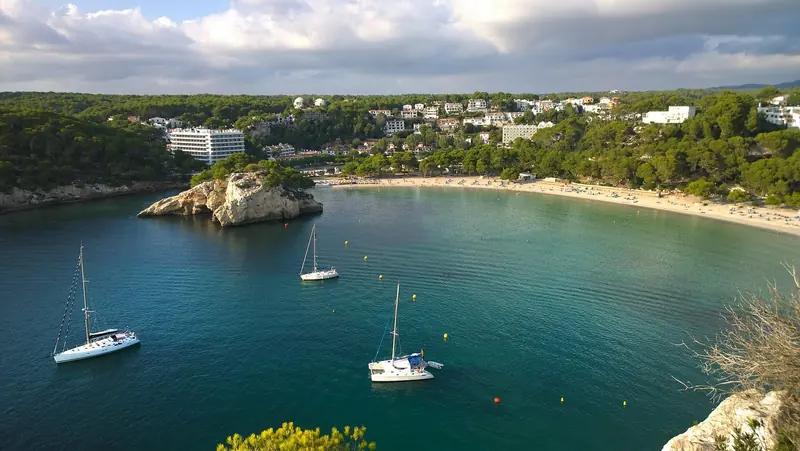
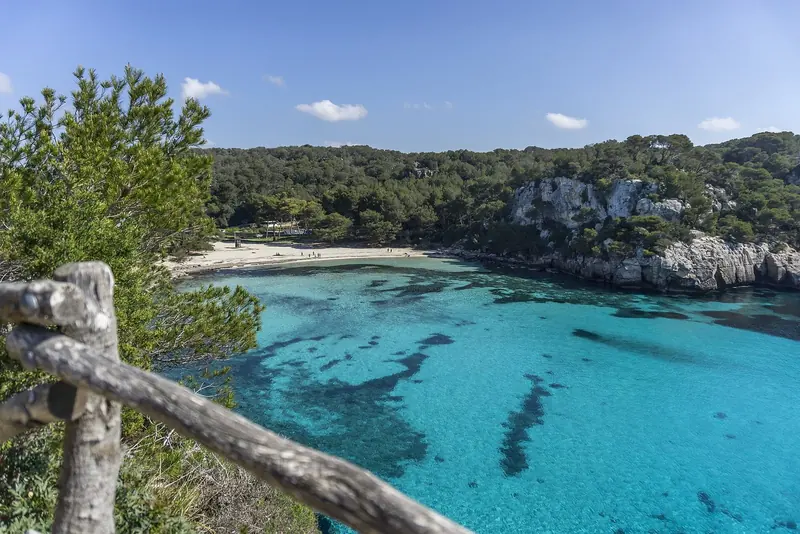
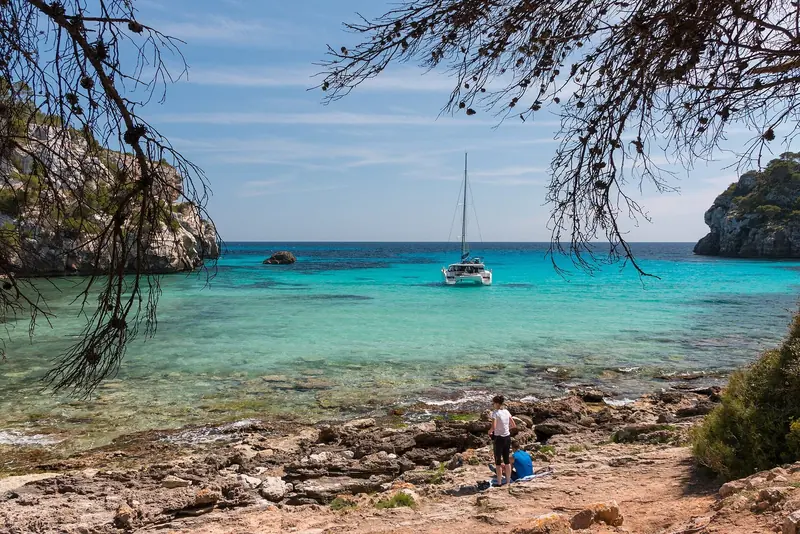
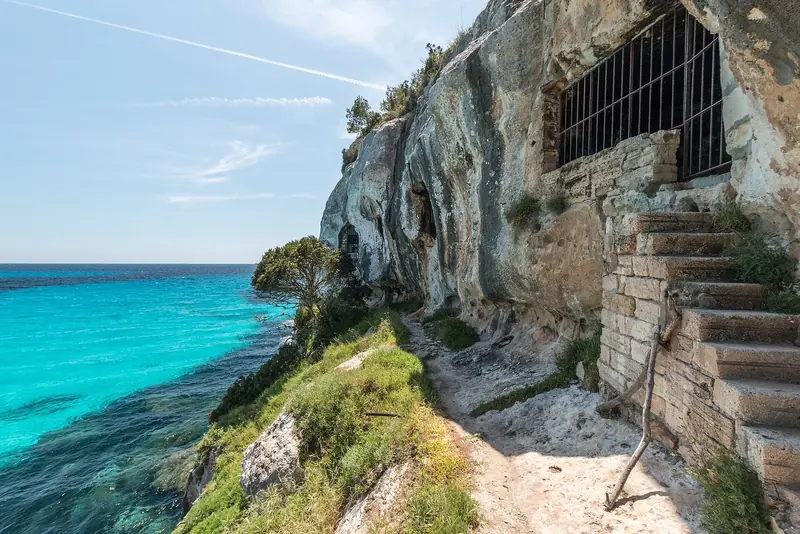
Cala Macarella and its smaller neighbour Macarelleta, Cala Turqueta, Cala Mitjana and Es Talaier are the south coast's classic stops: pale sand, cliff-framed turquoise water, reachable only by boat or on foot through pine woods, with no road access at all to several of them. Cala Galdana, a wider bay with a small resort behind it, runs a regulated buoy field rather than open anchoring and is one of the more sheltered options on this coast. Further east, Cala en Porter and the fjord-like Cales Coves cut through 40 metre limestone cliffs riddled with sea caves and, at Cales Coves, a Bronze Age necropolis of around 90 tombs cut into the rock face.
The Balearic government's Informe Mar Balear 2026, reported by both Pasion por el Mar and Ultima Hora, put Cala en Turqueta's user pressure at 424.7 per cent of its calculated carrying capacity and Macarella's at 203.3 per cent, with 36 per cent of Balearic beaches over their optimal threshold and the report noting a specific and gradual rise in anchored vessel numbers on these beaches. A separate Menorca.info report the same year described 2025 beach visitor numbers as an outright record and quoted local sources describing the pressure as putting the coves themselves at risk. An owner planning a summer week here should expect the postcard cove to be crowded exactly when the postcard says it should be empty.
UNESCO Biosphere Reserve, on land and now at sea
UNESCO named Menorca a Biosphere Reserve in 1993, the first of the Balearic Islands to receive it, in recognition of an island that kept its agricultural stone-wall landscape and low-rise building largely intact through the tourism boom that transformed Ibiza and parts of Mallorca. On 19 June 2019 UNESCO approved an extension of that reserve to the marine area surrounding the island out to 12 nautical miles, making it the largest marine Biosphere Reserve in the Mediterranean by that measure.
The practical effect for a visiting yacht is cumulative rather than a single rulebook: it is the political cover under which the island's Consell and the regional Govern have layered marine reserves, speed limits and new buoy fields since. It does not by itself prohibit anchoring anywhere, but every subsequent restriction on this page sits inside the reserve boundary, and Menorca's environmental groups invoke the designation directly when they push back on enforcement gaps.
Two marine reserves, a 2026 buoy fight, and a prosecutor's complaint
Menorca carries two formal marine reserves: the Reserva Marina del Nord de Menorca, dating to a 1999 order, and the Reserva Marina de la Illa de l'Aire, created by Decreto 26/2019 of 12 April 2019, which also tightened rules in the northern reserve. Illa de l'Aire itself sits 1.5 kilometres off the island's eastern tip, covers 719 hectares with 454 of them a special diving zone, and from 5 June 2026 carries a formal ban on jet skis and a 10 knot speed limit across the reserve.
PortsIB, the regional ports authority, approved a new 21-buoy anchoring field for Illa de l'Aire for the 2026 season, reduced from an original 23-buoy proposal first floated in 2023, part of a wider 70-buoy Balearic-wide expansion that also added fields at Cala d'Hort and Porroig in Ibiza. In July 2026 the boaters' association ADN Mediterraneo filed a formal complaint against four named PortsIB officials, alleging the buoy contracts were artificially split to avoid a stalled EUR 5.8 million public tender, after a EUR 314,000 emergency extension was approved to keep the existing eight fields running. The following month GOB, the Balearic environmental group, filed a separate complaint that boats were routinely ignoring the new jet ski ban and 10 knot limit at Illa de l'Aire through the summer, with no effective enforcement in place. An owner reading only the marketing copy would not learn that the buoy field he is asked to book is itself the subject of two live complaints.
The Balearic anchoring law applies here too, with the same fines
Decree 25/2018 maps Posidonia oceanica meadows across the Balearics into red zones, where the meadow is alive and anchoring is flatly prohibited, and yellow zones, areas allowed to recover under the same prohibition; only clean sand is legal ground for the hook. The Posidonia GOIB app lets a crew check the charted bottom before dropping anchor, and the Balearic government ran 18 patrol boats and more than 181,000 vessel inspections across the islands in 2025, with illegal anchoring recorded in 6.4 per cent of the boats checked.
The fine structure is the same one that applies in Ibiza and Mallorca: the Balearic sanctioning range runs from EUR 100 for minor breaches up to EUR 450,000 for the gravest cases, with the national coastal regime reaching EUR 2 million where it applies. Nothing in the research for this page suggests Menorca's calas are policed any less strictly than Formentera's sandbanks, and the 2026 record beach numbers reported by Menorca.info make it more likely, not less, that a captain here will be asked to move off a spot the owner can see other boats using.
Fornells and the quiet north
The Bahia de Fornells is a broad, shallow, near-landlocked bay on the north coast, sheltered from essentially every wind direction, with a small marina offering few berths but a sizeable buoy field and open anchoring space in the bay itself. The village at its head runs on lobster: caldereta de langosta, the local lobster stew, is the reason restaurants like Es Cranc and Sa Llagosta keep working lobster tanks on the waterfront, and it is one of the few places on the island where a yacht crew can walk to a genuinely well-regarded meal from the dinghy dock.
The north coast generally is rockier, windier and less visited than the south, running from Fornells past Cala Pregonda's red sandstone to Cap de Cavalleria, the island's northernmost point. It sits partly inside the Reserva Marina del Nord de Menorca, so the same Posidonia and reserve rules apply, but the crowding pressure that the 2026 Mar Balear report measured on the south coast's calas has not been reported here at anything like the same scale.
The season, the tramuntana and the embat
Menorca shares the Balearic season: warming through May and June, hot and busy in July and August, and holding its warmth with thinning crowds into September and early October. Unlike Ibiza, there is no late-season club calendar extending the peak, so the shoulder months here are genuinely quieter rather than merely less loud.
The tramuntana, the same north-westerly that batters Mallorca's Soller coast, reaches Menorca's north shore with less high ground to block it and can make Fornells, Cap de Cavalleria and the whole north coast untenable for a day or two at a time. The embat, the Balearic afternoon sea breeze, builds through the day on the south coast and is the more routine annoyance, capable of turning a flat morning anchorage at Macarella or Turqueta into an uncomfortable roll by mid-afternoon.
Getting guests in, and why it is not Palma
Menorca Airport, MAO, sits a few kilometres from Mahon town and the harbour, and in the 2026 summer schedule carries around 28 airlines to 72 destination airports, led by Ryanair, Volotea and easyJet, with Palma, Barcelona and Madrid the busiest single routes. Flight-tracking data from flightconnections.com and route listings from Flightradar24 both show the schedule concentrated almost entirely into June through September, thinning sharply either side of it.
That is a genuine airport with real capacity for a weekly guest change, but it is not Palma's scale of year-round scheduled traffic, and an owner planning a shoulder-season charter should expect thinner, less direct routing than Mallorca or Ibiza offer at the same time of year. Road transfer from the airport into Mahon town and the marinas is short, under 15 minutes in normal traffic, since the island itself is compact.
Provisioning and technical support: good, not Palma
Yacht agents including Lantimar Yachting run a Menorca office alongside their Mallorca, Ibiza and mainland operations, and both Mahon and Ciutadella support fuel, basic chandlery and food provisioning at a level the trade directory Yachting Pages describes as adequate for the island's own traffic. That is enough for weekly running and a normal guest turnaround.
What Menorca does not have is a refit yard. There is no travel lift, haul-out or technical facility on the island approaching the scale of STP Shipyard Palma's 1,000 tonne lift, and searches for Menorca-based shipyard or refit services return Mallorca and mainland Spanish yards rather than anything on the island itself. A structural fault, a major mechanical job or a haul-out still means a passage to Palma, which at roughly 90 nautical miles from Mahon is a half-day run in reasonable conditions rather than the same-afternoon fix an owner gets moored in Palma itself.
The eco-tax, and the honest downside
The Impuesto de Turismo Sostenible, the Balearic eco-tax, runs from 1 May to 31 October at EUR 4 a person per night for 5-star and luxury hotels, EUR 3 for 4-star and 3-star superior, and EUR 2 for lower categories and tourist apartments, per the tax's own portal, illessostenibles.travel, and confirmed independently by the guide site mymenorca.info. The same portal lists touristic cruise ships as a taxed category at a lower flat rate, but neither source found for this page states a rate, or even confirms an obligation, for a private charter yacht's guests staying aboard rather than in registered accommodation ashore.
Checked in August 2026, neither Marina Port Mahon nor Marina Menorca publishes a berthing tariff online, so an owner is pricing a season from a single 2023 forum data point rather than a rate card. The buoy fields at Illa de l'Aire and Fornells are themselves the subject of a live prosecutorial complaint over how their contracts were awarded, and GOB's own August 2026 complaint states plainly that the reserve's speed limit and jet ski ban are not being enforced on the water. Between the saturation numbers in the 2026 Mar Balear report and the unresolved buoy contract dispute, Menorca in 2026 is a destination whose regulatory picture is still being written in public, in real time, rather than one with a settled rulebook an owner's advisers can simply hand him.
En tierra, accesos y reservas
| Getting there | Menorca Airport (MAO) at Mahon runs a summer 2026 schedule of roughly 28 airlines to 72 destinations, led by Ryanair, Volotea and easyJet, with Palma, Barcelona and Madrid the busiest routes; the schedule thins sharply outside June-September. Road transfer into Mahon town and its marinas is under 15 minutes. |
|---|---|
| Berthing at Mahon | Marina Port Mahon runs 30 berths for 25-60 m yachts with dedicated large-yacht services; Marina Menorca spreads 650+ berths across four zones from small pontoons up to a 60 m-capable basin at Isla del Rey. Neither publishes a tariff; the one figure found, roughly EUR 575 overnight for an 18.5 m boat in 2023, is a single owner's account, not a rate card. |
| Berthing at Ciutadella | Club Nautico de Ciutadella caps at 18 m / 54 ft across 180 berths, through a narrow canal entrance with a footbridge that is a settled-weather passage only. A large yacht anchors nearby (Cala en Bosch, Cala Blanca) and tenders in rather than attempting the port itself. |
| Anchoring: what is legal and what is not | Decree 25/2018 prohibits anchoring on mapped Posidonia across the Balearics, Menorca included; the Posidonia GOIB app shows the charted bottom before the hook goes down. Fines run EUR 100 to EUR 450,000 under the Balearic regime, to EUR 2 million nationally. At Illa de l'Aire, a jet-ski ban and 10-knot limit apply from 5 June 2026, though GOB's August 2026 complaint states enforcement on the water is not effective. |
| The famous coves in season | Cala en Turqueta and Cala Macarella measured at 424.7% and 203.3% of carrying capacity respectively in the 2026 Informe Mar Balear, with 36% of Balearic beaches over their optimal threshold. Expect a crowded cove at the hours the postcards suggest it should be empty; Cala Galdana's regulated buoy field is the more orderly alternative nearby. |
| Provisioning and technical support | Mahon and Ciutadella cover fuel, chandlery and food provisioning adequately for routine running, with agents including Lantimar Yachting maintaining a Menorca office. There is no refit or haul-out yard on the island; anything structural means a roughly 90 nm passage to STP Shipyard Palma or a mainland Spanish yard. |
| What it costs, beyond the berth | The Balearic sustainable tourism tax runs EUR 2-4 per person per night in high season depending on accommodation category. No source found for this page confirms whether, or at what rate, it applies to guests aboard a private charter yacht rather than shore-based lodging. |
| What is NOT published | Checked in August 2026: neither Marina Port Mahon nor Marina Menorca publishes a berthing tariff. No confirmed ITS rate or obligation exists for private charter yacht guests. The Illa de l'Aire and Fornells buoy field contracts are the subject of a live complaint to the state prosecutor over alleged contract-splitting, filed by ADN Mediterraneo in July 2026, with no published resolution. |
Lo que cuentan armadores y tripulaciones
A single overnight bill is the only public data point for Mahon berthing
A boater's account from July 2023 recorded a charge of roughly EUR 575 for an 18.5 metre boat overnighting at Mahon, at a time when neither Marina Port Mahon nor Marina Menorca listed a published tariff. It should be read as one owner's experience, not as a current rate.
Boater review cited via harbour-guide aggregation, 2023The island's own environmental group says the new reserve rules are not being enforced
GOB documented repeated violations of the 10-knot speed limit and jet-ski ban introduced on 5 June 2026 at the Illa de l'Aire marine reserve through the summer, and formally asked the Govern to put effective monitoring in place, stating the current enforcement was not working on the water.
GOB (Grup Balear d'Ornitologia i Defensa de la Naturalesa), reported by Menorca.info, August 2026A boaters' association says the buoy fields meant to protect the seabed were contracted improperly
ADN Mediterraneo's July 2026 complaint to the state prosecutor names four PortsIB officials and alleges the Fornells and Illa d'en Colom buoy contracts were artificially split into minor contracts to bypass a stalled EUR 5.8 million public tender, while defending mariners' traditional right to anchor freely in the same sandy zones the buoy fields now occupy.
ADN Mediterraneo, reported by Menorca.info, July 2026The Balearic government's own data shows the south coast coves under real pressure
The Informe Mar Balear 2026 recorded Cala en Turqueta at 424.7% and Cala Macarella at 203.3% of calculated carrying capacity, part of a wider finding that 36% of Balearic beaches exceeded their optimal capacity threshold, with a specific note on the growing presence of anchored vessels.
Informe Mar Balear 2026, reported by Pasion por el Mar and Ultima Hora
Lo bueno y lo que conviene vigilar
Puntos fuertes
- A genuinely quieter Balearic, not just a marketing claimNo club calendar, no equivalent of the Ibiza Magna scene, and a UNESCO Biosphere Reserve designation, extended to the surrounding sea in 2019, that has kept the island's low-rise character largely intact through the boom that transformed its neighbours.
- Port Mahon is one of the largest natural harbours in the worldA 5 km, essentially all-weather deepwater harbour with two marina operators covering everything from tenders to 60 m yachts, backed by forts and a working naval history, is infrastructure Ibiza and Ciutadella both lack.
- The south coast calas are the real thingCala Macarella, Cala Turqueta and Cala Mitjana are reachable only by boat or on foot, with no road access, and Cales Coves adds a 40 m limestone fjord with a Bronze Age necropolis cut into the cliff.
- Fornells is a genuine food destination, not an afterthoughtA sheltered, near-landlocked bay with a working lobster-stew tradition at restaurants like Es Cranc and Sa Llagosta, reachable by dinghy from the anchorage.
A tener en cuenta
- The famous coves are measurably over capacityThe Balearic government's own 2026 report put Cala en Turqueta at 424.7% and Macarella at 203.3% of carrying capacity, explicitly citing rising anchored-vessel numbers as part of the pressure.
- The 2026 buoy regime is contested, not settledThe new Illa de l'Aire and Fornells buoy fields meant to manage anchoring are themselves the subject of a July 2026 complaint to the state prosecutor over contract-splitting, and GOB's August 2026 complaint says the reserve's own speed and jet-ski rules are not being enforced.
- No refit yard on the islandAnything beyond routine maintenance means a roughly 90 nm passage to Palma. Menorca has nothing approaching STP Shipyard Palma's scale, and none was found in research for this page.
- Ciutadella caps at 18 metresThe old capital's own harbour is closed to a superyacht by its narrow entrance and 180-berth marina's size limit; a large yacht sees Ciutadella from a tender, not from its own berth.
- Nothing is publishedNo Menorca marina quotes a berthing tariff online, and no source found confirms how, or whether, the Balearic eco-tax applies to a charter yacht's guests. An owner is pricing the season from fragments, not a rate card.
Para quién es: An owner who has already done Ibiza's clubs and Mallorca's yard and wants pine-fringed limestone calas, a working naval-scale harbour at Mahon, and a genuinely quieter island, and who will accept a still-unsettled 2026 regulatory picture and no on-island refit yard as the price of it.