Newport Beach & the Southern California Coast
| Location | Orange County, California, US Pacific coast, about 26 nautical miles from Catalina Island |
|---|---|
| Newport Harbor | about 880 acres, roughly 1,200 moorings across 15 numbered fields (Newport Mooring Association) |
| Slip range | Newport's own marinas run 20 to 100 feet; nothing longer gets a built dock, only a mooring or the large vessel anchorage |
| Main channel dredged to about 20 feet; depths fall to 8 to 9 feet outside the channel, notably off Lido Isle | |
| Guest mooring fee | USD 0.74 to 1.48 per foot per night; large vessel anchorage (own tackle): USD 0.55 per foot per night |
| Marina Park guest slips | USD 93 a night for 40 feet, USD 128 a night for 55 feet |
| Mooring permit rent | about USD 3.34 per linear foot a month; permit resale near USD 1,000 a foot; waitlist reported at 10 to 15 years |
| Proposed new mooring license rate | USD 15 per linear foot a month, a roughly 350 percent increase, contested with the California Coastal Commission |
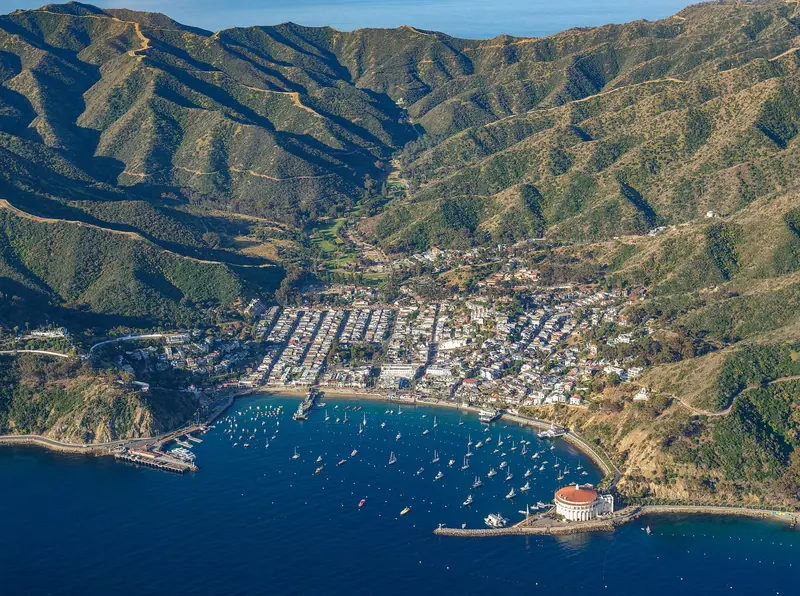
| Catalina Avalon | 360-plus moorings, first come first served via Harbor Patrol assignment, no advance booking for the general public |
| Catalina Two Harbors | 700-plus moorings across a dozen-plus coves, online booking up to 7 days out, USD 53 to 202 a night by length |
| Getting there | John Wayne Airport (SNA), nearly 500 based general aviation aircraft, two dedicated FBOs |
| No hurricane has ever made landfall in California; eastern Pacific storms rarely track north of Baja California | |
| Santa Ana winds | dry offshore gusts over 25 knots, mainly fall and winter, can clear visibility but often do not reach the inner bay |
| Newport Beach Christmas Boat Parade | 118th edition December 16 to 20, 2026, running since 1908 |
| Harbor economic footprint | about USD 1 billion a year and 8,000-plus jobs, reported by the Orange County Business Journal |
The Harbor and the Run to Catalina
The harbor itself covers about 880 acres of water behind the Wedge and the twin jetties, an amenity Harbormaster Paul Blank describes plainly: Newport Harbor is desirable because of the amenities that come with it, in a city where waterfront real estate is otherwise unreachable. Inside that acreage, the working geography is Balboa Peninsula and Lido Isle to the west, Balboa Island and its Grand Canal in the middle, and Corona del Mar at the harbor mouth, where the Balboa Yacht Club has stood since 1922. The main channel is dredged to about 20 feet, but depths fall to 8 or 9 feet outside it, especially along Lido Isle, and the Army Corps of Engineers and the city both run winter dredging campaigns to hold that line, including an eight-week Balboa Yacht Basin project scheduled for December 2025.
Catalina changes the character of a Newport trip entirely. Avalon, the island's only incorporated town, is a working harbor with over 360 moorings squeezed into Avalon Harbor, Descanso Bay and Hamilton Cove, assigned first come first served by the Harbor Patrol boat as a vessel arrives. Two Harbors, the isthmus settlement 12 miles up-island, is the other Catalina, run by the Catalina Island Company across more than 700 moorings scattered through a dozen named coves, Emerald Bay, Cherry Cove and Fourth of July Cove among them, bookable online up to a week ahead. A 20-knot cruise covers the crossing in under an hour and a half, which is the whole reason Newport owners treat Catalina as a day trip rather than an expedition.
Arriving by Sea, and Where the Mooring Reality Bites
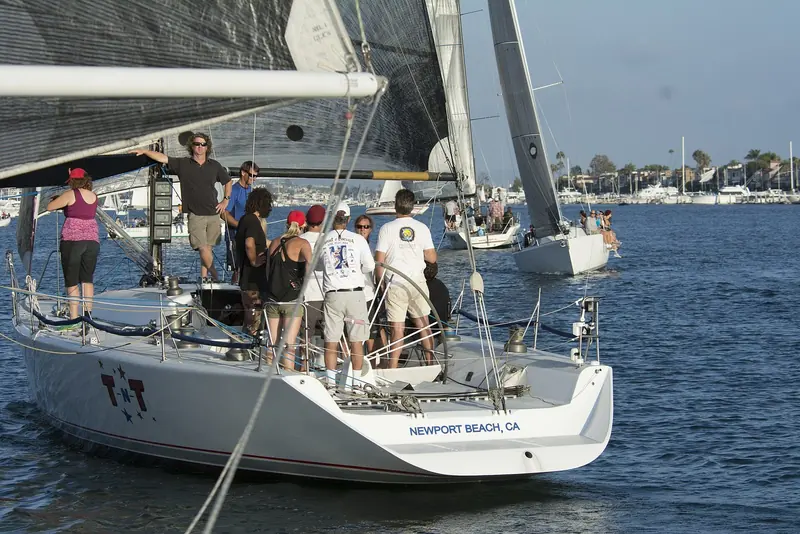
Newport Harbor's own slip inventory tops out well short of superyacht length. City figures put roughly 2,000 commercial slips and 1,000 residential piers and docks in the harbor, sized from 20 to 100 feet, and neither the Balboa Yacht Basin nor the Balboa Bay Club markets berths built for anything larger. A boat over that range works from the large vessel anchorage instead, on the city's own tackle or its own ground tackle, and the difference in the fee schedule reflects it directly. Guest moorings, the standard product, run $0.74 to $1.48 per foot per night depending on size and location, while the large vessel anchorage rate for a boat using its own tackle is $0.55 per foot per night, a lower number because it is a bare patch of water rather than a serviced mooring can.
The mooring system itself runs on a permit, not a lease, and that distinction matters to anyone trying to buy in. Existing permit holders pay the city about $3.34 per linear foot a month, roughly $133 a month for the most common 40-foot mooring, and the permit itself changes hands privately between owners at around $1,000 a foot, close to $40,000 for that same 40-foot mooring, on top of the monthly rent. Real estate and mooring brokers describing the process put the wait for a fresh permit at 10 to 15 years, which is why almost nobody enters the system by waiting for one.
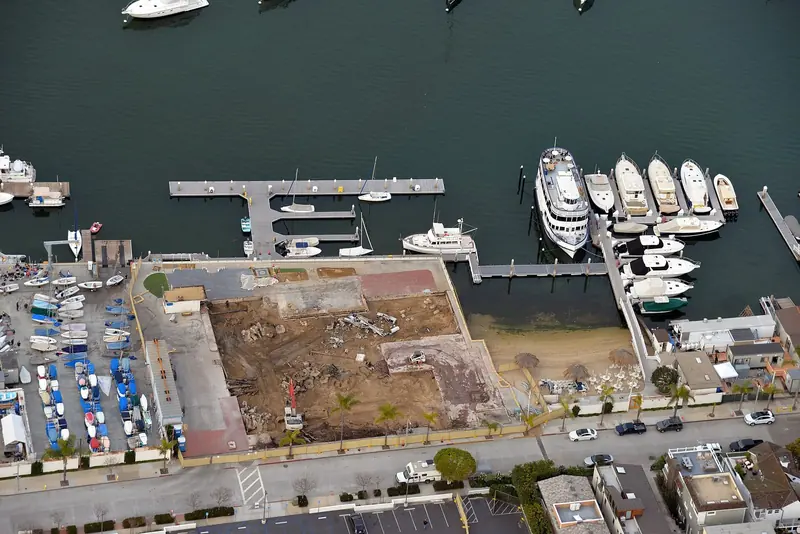
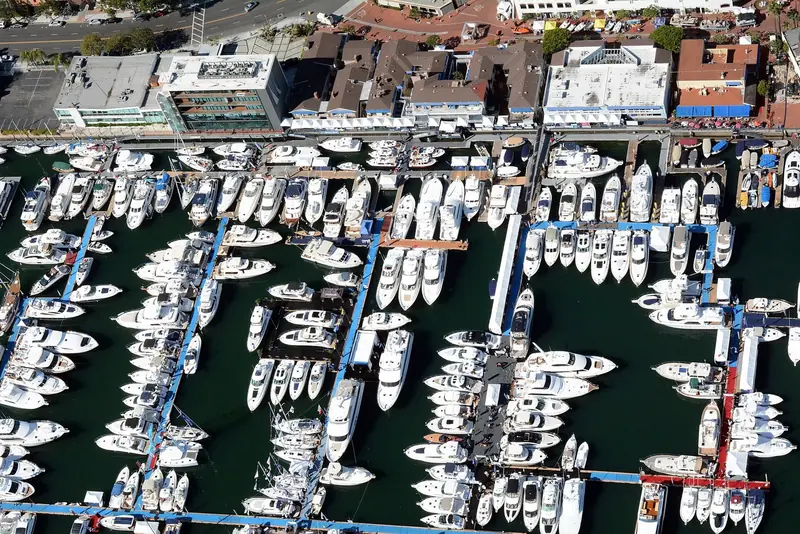
Newport Harbor has about 1,200 moorings and almost no dock built for a boat over 100 feet, so the largest yachts here anchor, they do not berth.
What It Costs, and What Needs a Permit
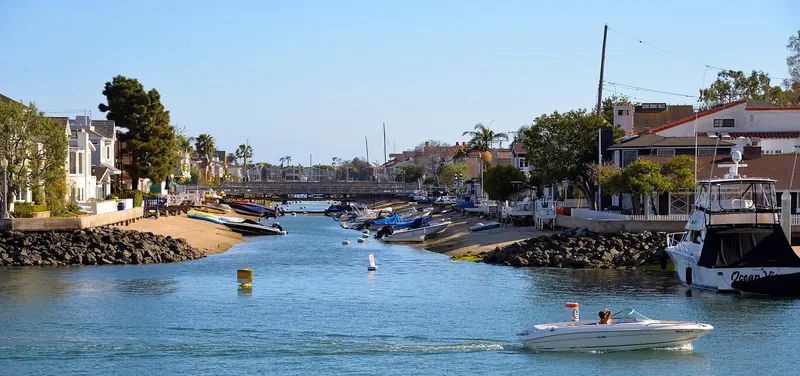
Newport's published fee tiers are straightforward once you have them. Guest moorings are $0.74 to $1.48 per foot per night, the large vessel anchorage is $0.55 per foot per night on private tackle, and Marina Park, the city's own small marina at the harbor entrance, posts flat nightly rates of $93 for a 40-foot slip and $128 for a 55-foot slip. None of those figures needs a broker to find, and none of them is the number that decides whether a big yacht can actually stop here, which is slip length, not price.
Catalina prices the same trip differently. Two Harbors, run directly by the Catalina Island Company, charges $53 a night for a boat under 29 feet up to $202 a night for one in the 90 to 100 foot band, with a $25 booking fee added on regular weekends and a 2-night minimum that becomes 3 nights on a holiday weekend. The seasonal structure rewards a longer stay heavily: pay for 6 nights and get a 7th free in summer, pay for 4 and get 3 free in spring and fall, pay for 2 and get 5 free in winter. Avalon, by contrast, publishes no comparable online rate card for its own moorings and assigns them first come first served, so a boat cannot price that stop in advance the way it can at Two Harbors. The one genuinely contested cost is the mooring rent itself. Newport Beach has proposed replacing the permit system with a licensing structure priced at $15 per linear foot a month, about $600 a month for a 40-foot mooring against the roughly $133 permit holders pay now, a change the state's own Coastal Commission has to sign off on because the mooring fields sit on state tidelands. Anne Stenton, president of the Newport Mooring Association, frames it as a fairness question rather than a subsidy: the association says it is not looking for a free ride, only parity in a harbor where everyone is on state land. Coastal Commissioner Caryl Hart called the redesign underneath the new pricing a terrible plan on navigational grounds alone, and mooring holder Sam McDonald put the suspicion plainly: the deeper you look into the plans, the clearer it gets that the point is to move people out of the mooring fields. Nothing in that fight is settled, and any number quoted today should be checked against the current city fee schedule before a boat commits to it.
The Season: Santa Ana Winds and No Hurricanes
Santa Ana winds are the defining weather event on this coast, dry northeasterly gusts that funnel down out of the Great Basin and through the coastal canyons at over 25 knots, with gusts running to double that in a strong event. They occur mostly in late fall and winter, though a weaker one can turn up any time of year, and their effect on the water is not straightforward: 10 miles inland the wind might be blowing 15 knots from the east while the bay itself sits at 0 to 5 knots from the west, because the offshore flow usually loses the fight with the onshore sea breeze before it reaches the harbor. When a strong Santa Ana does win that fight, it lays down the local swell and leaves behind the clearest visibility of the year, along with genuinely hazardous offshore wave conditions further out.
Hurricane risk, by contrast, is close to theoretical this far north. No hurricane has made direct landfall in California in recorded history, and storms that spin up in the eastern Pacific tropical season almost always track west or dissipate before they clear Baja California, with only one system on record, in 1858, reaching as far north as San Diego. What does reach Newport and Catalina from those storms is indirect: heavy swell and dangerous surf and rip currents generated by a system still several hundred miles offshore, which is a real seasonal hazard for anyone at anchor even though the storm itself never approaches landfall.
The Brokerage and Service Market
The Orange County Business Journal put a figure on what that market is worth: roughly 1 billion dollars a year in economic activity and more than 8,000 jobs tied to the harbor, against 7 million annual visitors. Yacht broker Rick Torgerson, with three decades in the business locally, describes the buying pattern at the top of that market bluntly: wealthy owners switch boats out like cars, typically running two or three vessels at once rather than one. Kevin Merrigan of Northrop & Johnson puts a number on what that ownership pattern earns back in charter: a single yacht owned by local dental-supply entrepreneur Jim Glidewell generates up to 1 million dollars a year on the charter market alone.
The show calendar and the sale data both confirm the harbor's weight in the business. The Newport Beach International Boat Show drew about 20,000 attendees and more than 200 boats on display in its most recent run, with Revel Republic co-founder Hany Ghabour, who now runs the event, saying openly that the goal is putting the show back on the map after a fallow period. On the brokerage side, individual sale prices are a matter of public record here in a way they are not everywhere: the 2026 Newport listing for the yacht Serengeti closed at 4.2 million dollars, down from an original 4.96 million dollar ask, an ordinary markdown that nonetheless shows a depth of comparable, price-discovered sales most harbors cannot offer a buyer.
What to Know Before You Go
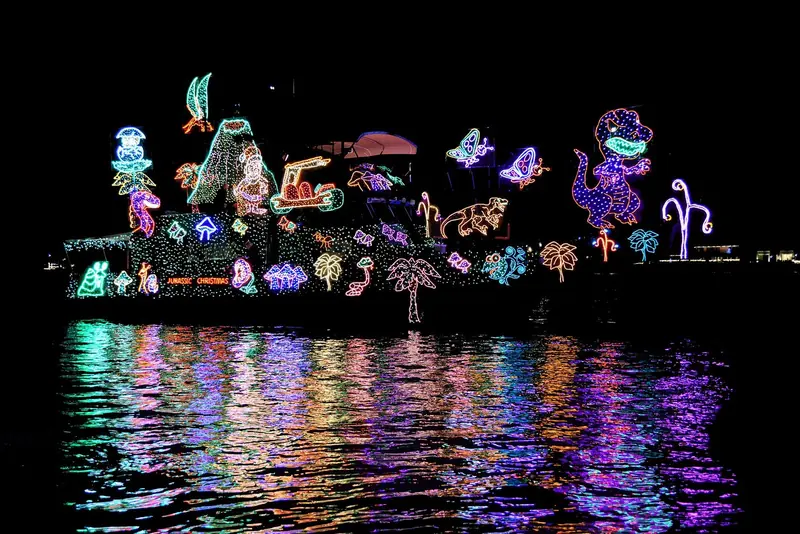
The Newport Beach Christmas Boat Parade is the harbor's signature fixture, running its 118th edition December 16 to 20, 2026, with three nightly departures at 5:30, 7:05 and 8:30 pm. It began in 1908, started by an Italian gondolier and one of Balboa Island's original developers, was shelved in 1949 over crowding concerns, and came back as the Christmas event that now draws more than 100 decorated boats along the harbor each of its five nights. The Transpacific Yacht Race, the other fixture that shapes the Southern California calendar, does not start from Newport at all: the biennial 2,225-nautical-mile run to Diamond Head, Hawaii starts off Point Fermin in San Pedro, and has done so since 1906, but it belongs to the same Southern California yachting culture that fills Newport's harbor and its brokerage offices the rest of the year.
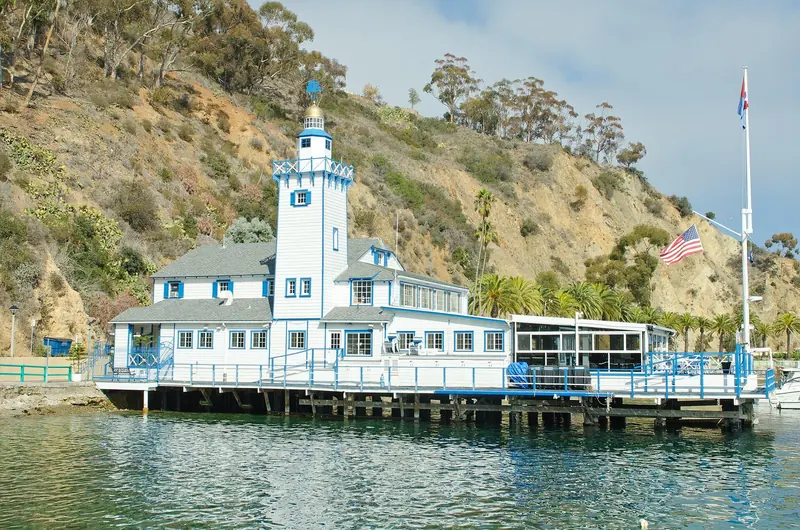
One clarification is worth making once and then dropping: this is Newport Beach, California, on the Pacific coast, distinct from Newport, Rhode Island on the US East Coast and unrelated to Newport, Wales. The confusion is common enough in search results and stock photo captions that it is worth a single sentence and no more. What a visiting owner actually needs locally is the Balboa Yacht Club at the harbor mouth in Corona del Mar, which keeps an outstation at White's Cove on Catalina for members making the crossing, and on the island itself the Catalina Island Yacht Club's clubhouse on the Avalon waterfront, built out over the water on its own pilings since the early twentieth century.
En tierra, accesos y reservas
| Getting there | John Wayne Airport (SNA) is the Orange County hub for private arrivals, with nearly 500 based general aviation aircraft accounting for 68 percent of the airport's total operations, served by FBOs including ACI Jet and Atlantic Aviation plus Clay Lacy Aviation ground handling. Long Beach Airport (LGB), about 25 miles northwest, runs four FBOs (Signature, AirFlite, Mercury Air Center and Aeroplex) and is a common substitute at similar cost. LAX handles the international and commercial traffic roughly 45 to 60 minutes north by road depending on traffic. |
|---|---|
| Arriving by sea and the mooring reality | Newport Harbor's own marinas, the city-run Balboa Yacht Basin and the private Balboa Bay Club, size their slips from 20 to 100 feet; nothing longer gets a built berth. A boat past that range takes a mooring, priced USD 0.74 to 1.48 per foot per night for a serviced guest mooring or USD 0.55 per foot per night for the large vessel anchorage on its own tackle. The main channel is dredged to about 20 feet; depths outside it, especially near Lido Isle, can run to 8 or 9 feet, and periodic Army Corps and city dredging (an 8-week Balboa Yacht Basin project was scheduled for December 2025) is part of the harbor's normal maintenance rather than an exception. |
| Catalina: two different harbors, two different systems | Avalon takes over 360 moorings on a first come first served basis, assigned by the Harbor Patrol boat as a vessel checks in outside the harbor entrance; there is no advance booking for a visiting boat, only for mooring owners and their designees. Two Harbors, 12 miles up-island and run by the Catalina Island Company, spreads over 700 moorings across a dozen-plus named coves and takes online bookings up to a week ahead, priced USD 53 (under 29 feet) to USD 202 (90 to 100 feet) a night, plus a USD 25 weekend booking fee, with steep multi-night seasonal discounts. |
| What a mooring costs to hold, not just to rent | Existing Newport mooring permit holders pay the city about USD 3.34 per linear foot a month, close to USD 133 a month for the harbor's most common 40-foot mooring, and buy into an existing permit privately at roughly USD 1,000 a foot, near USD 40,000 for that same 40-foot length. A proposed new licensing rate of USD 15 a foot a month, about USD 600 for 40 feet, is under active dispute between the city and the California Coastal Commission because the mooring fields sit on state tidelands. |
| Provisioning and fuel | Island Marine Fuel on Balboa Island runs the longest fuel dock in the harbor, at 120 feet, and can take vessels to 180 feet alongside; it sells Valvtect marine diesel and gasoline and stocks a working ship's store. Hill's Boat Service is the only fuel dock in the harbor carrying 91-octane gasoline. Neither publishes a per-gallon price online; both quote on the day. |
| Fixed dates to plan around | The Newport Beach Christmas Boat Parade runs December 16 to 20, 2026 for its 118th edition, with nightly departures at 5:30, 7:05 and 8:30 pm, drawing over 100 decorated boats. The Newport Beach International Boat Show, revived under new organizers, runs a spring weekend and drew about 20,000 attendees and 200-plus boats on display in its most recent edition. The Transpacific Yacht Race to Hawaii starts biennially, in odd years, off Point Fermin in San Pedro, not from Newport itself, but draws heavily on the same Southern California yachting community. |
| What is NOT published | Newport Beach's Harbor Department does not make its full current fee schedule and large-vessel permitting rules freely reachable outside its own site, and the harbor keeps no single published census of the roughly 9,000 vessels various sources estimate call it home, that figure comes from broker and business-press estimates, not an official city count. Avalon publishes no online mooring rate card at all, unlike Two Harbors. And the outcome of Newport's mooring-rent dispute with the California Coastal Commission was still unresolved at last check, so any rent figure quoted here should be confirmed against the current city fee schedule before it is relied on. |
Lo que cuentan armadores y tripulaciones
The harbor's own harbormaster frames the appeal as amenity access, not glamour
Paul Blank describes Newport Harbor as particularly desirable specifically because of what comes with it, in a city where the underlying waterfront real estate itself is otherwise unreachable for most boat owners.
Paul Blank, Newport Beach Harbor Master, quoted in the Orange County Business JournalWealthy local owners run a small fleet, not a single boat
After three decades brokering locally, Rick Torgerson describes the buying pattern at the top of the Newport market bluntly: owners switch boats out like cars and typically keep two to three vessels running at once.
Rick Torgerson, yacht broker, quoted in the Orange County Business JournalA mooring holder's suspicion about where the rent fight is really heading
Reacting to the city's proposed mooring license pricing, Sam McDonald said that the deeper you look into the plans, the clearer it becomes that the intent is to move people out of the mooring fields altogether, not simply to raise revenue.
Sam McDonald, Newport Harbor mooring permit holder, quoted in Voice of OCThe mooring association's own account of the dispute
Anne Stenton says the association is not asking for a free ride, only for parity, since every mooring holder in the harbor sits on the same state-owned tidelands the city wants to reprice.
Anne Stenton, president, Newport Mooring Association, quoted in Voice of OCA state coastal commissioner's on-record doubt about the harbor's own redesign
Caryl Hart called the layout underneath Newport's proposed mooring field changes a terrible plan, saying she could not see how the boats would avoid colliding with each other under it.
Caryl Hart, California Coastal Commissioner, quoted in Voice of OC
Lo bueno y lo que conviene vigilar
Puntos fuertes
- The deepest yacht brokerage bench on the US West CoastNorthrop & Johnson, IYC and several of the largest West Coast brokerage offices by volume operate out of Newport Beach, backed by an estimated USD 1 billion a year in harbor-linked economic activity, reported by the Orange County Business Journal.
- Catalina is a genuine day trip, not an expeditionAt about 26 nautical miles and under 90 minutes at a 20-knot cruise, Catalina gives Newport owners a real island escape, split between Avalon's town harbor and Two Harbors' quieter cove system, without committing to an overnight passage.
- No hurricane risk, in recorded historyNo hurricane has ever made landfall in California, and eastern Pacific tropical storms almost never track as far north as San Diego, let alone Newport, removing a planning risk that shapes cruising further south in Mexico.
- Real, comparable brokerage price dataSale prices such as the Serengeti's 2026 close at USD 4.2 million, down from a USD 4.96 million ask, are a matter of public listing record here, giving a buyer genuine comparables that many private markets do not offer.
- A serious charter yacht here can pay for itselfNorthrop & Johnson broker Kevin Merrigan cites a single Newport-based owner's charter yacht generating up to USD 1 million a year, evidence the Southern California charter market is more than a side business.
A tener en cuenta
- No dock for a genuinely large yachtNewport's own marinas run 20 to 100 feet; anything longer has no berth to plug into at all, only a mooring can or the large vessel anchorage, which is a materially different, lower-service way to stay.
- The mooring system is a decade-plus wait, or a six-figure buy-inA fresh permit is reported to carry a 10 to 15 year waitlist, while buying into an existing one runs close to USD 1,000 a foot, near USD 40,000 for the harbor's common 40-foot mooring, before any monthly rent.
- The rent itself is in open disputeNewport Beach's proposed roughly 350 percent mooring rent increase is contested with the California Coastal Commission, with mooring holders publicly suspecting the real goal is to clear the fields entirely, per reporting from Voice of OC.
- Shallow water outside the marked channelDepths fall to 8 or 9 feet outside the dredged 20-foot main channel, particularly along Lido Isle, a real constraint for anything but a shoal-draft hull, and periodic dredging is required to hold even that.
- Avalon offers no advance certaintyUnlike Two Harbors' online booking, Avalon assigns its 360-plus moorings strictly first come first served by the Harbor Patrol boat, so a visiting yacht cannot guarantee a mooring there before it arrives.
Para quién es: An owner or buyer who wants West Coast brokerage depth and a genuine island escape close by, and who accepts that anything over about 100 feet anchors here rather than plugging into a dock.