Sint Maarten & the Dutch/French Caribbean
| Region | Eastern Caribbean, Leeward Islands, one island split by a land border between Dutch Sint Maarten (south) and French Saint-Martin (north) |
|---|---|
| Scale | about 87 sq km total, Sint Maarten about 34 sq km, Saint-Martin about 53 sq km |
| Status | Sint Maarten a constituent country of the Kingdom of the Netherlands since 10 October 2010; Saint-Martin a French overseas collectivity since 15 July 2007, part of France and the EU |
| Airport | Princess Juliana International (SXM), one runway 2,300 m, about 1.8 million passengers in 2025, famous for the low final approach over Maho Beach |
| Simpson Bay Lagoon | about 1,250 hectares, maximum depth about 6 m, the Dutch/French border runs through the middle, no swell in any conditions |
| Dutch drawbridge | Simpson Bay Bridge, 17.0 m opening, 6.0 m controlling depth, seven scheduled openings a day, VHF 12 |
| French drawbridge | Sandy Ground bridge into Marigot, 10 m wide, 3.5 to 3.8 m depth, opens only at 08:30 and 17:00 |
| Marinas | IGY Simpson Bay (122 slips, 20 megayacht), IGY Isle de Sol (40 megayacht berths to 97 m), Port de Plaisance (70 to 90-plus slips, sources disagree), Bobby's Marina (to 130 ft, founded 1968), Marina Fort Louis Marigot (150 berths to 260 ft, no bridge) |
| Refit | IMM's SXM Cole Bay Shipyard runs 150 and 75 ton travelifts; Bobby's yard runs 75 and 100 ton lifts; Time Out Boat Yard (French side) is DIY dry storage |
| Hurricane Irma | category 5, 6 September 2017, about 95 percent of buildings on both sides damaged, about USD 7.15 billion in total losses, 139 wrecks removed from the lagoon |
| Season | dry, high season roughly December to April/May; hurricane season 1 June to 30 November, peak risk August to October |
| St Maarten Heineken Regatta | founded 1980, the largest regatta in the Caribbean, 46th edition 5 to 8 March 2026, 47th edition 4 to 7 March 2027 |
| Duty status | Sint Maarten sits outside the EU customs and VAT territory and runs as a duty-free port; the French side's duty status could not be confirmed to the same standard |
| Clearance | Dutch side at Simpson Bay or Great Bay/Philipsburg in person; French side online at demarche.numerique.gouv.fr, no wet stamp, EUR 5 to 15 |
The shape of a shared island
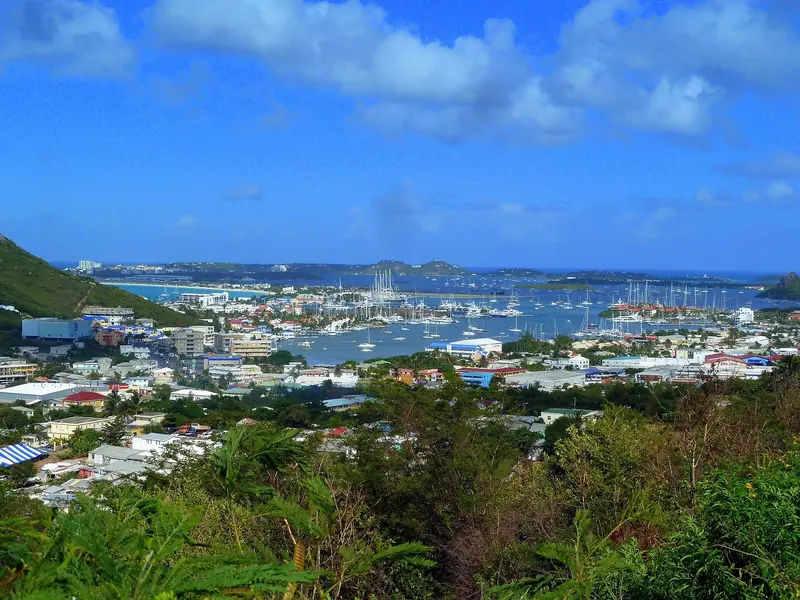
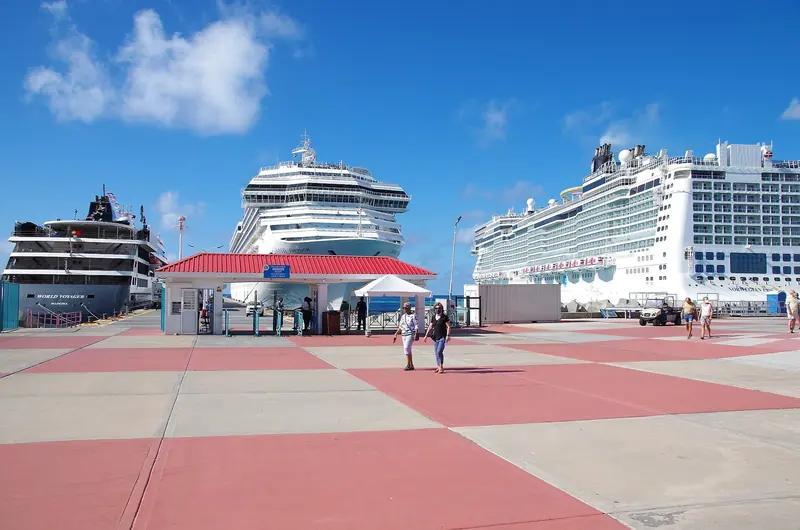
Sint Maarten and Saint-Martin are one island of roughly 87 square kilometres split by a land border rather than water, Dutch Sint Maarten holding the southern third at about 34 square kilometres and French Saint-Martin the northern two-thirds at about 53. Philipsburg on Great Bay is the Dutch capital and the cruise ship town, Marigot on the French side is the smaller and quieter seat of government, and neither is where the yachts lie. That is Simpson Bay Lagoon, the enclosed water on the island's west side that the border also crosses, so a boat at anchor can drift from one country's jurisdiction into the other's inside ten minutes.
The two sides answer to different capitals. Sint Maarten has been an autonomous constituent country of the Kingdom of the Netherlands since the Netherlands Antilles dissolved on 10 October 2010. Saint-Martin has been a French overseas collectivity in its own right, separate from Guadeloupe, since 15 July 2007, and remains part of both France and the European Union. Neither status is cosmetic. It sets which customs code applies, which side clears a commercially registered yacht, and which currency and language a crew works in a few hundred metres apart. Provisioning benefits from the split rather than suffering from it: the island is fed by two supply chains, Dutch and French, and carries a mix of American and European stock that no single-flag Caribbean island matches.
Getting there
Princess Juliana International, SXM, sits on the lagoon's south-west shore and is the reason this island works for an owner with limited patience. One runway, 2,300 metres by 45 metres, carried about 1.8 million passengers in 2025 against about 1.6 million in 2024, and the final approach is the most photographed in the Caribbean: arriving aircraft cross Maho Beach at well under 100 feet, close enough that spotters gather on the sand under the flight path every day the trade winds allow it. KLM flies Amsterdam and Air France flies Paris Charles de Gaulle year round, Air Caraibes adds Paris Orly seasonally, and American, Delta, JetBlue and United connect the US hubs, so a European guest changes only once.
Below the airline network, two ferry runs and a private aviation ramp fill in the rest. The Marigot to Anguilla crossing takes about 20 minutes and runs close to hourly through the day at roughly USD 30 one way plus a separate Anguilla arrival tax, and a Philipsburg to Gustavia service reaches St Barths in 45 minutes to an hour depending on the operator. SXM handles business jet traffic on a dedicated ramp, which is why charter guests routinely fly into St Maarten to join a yacht lying somewhere else entirely, but Yotters could not find a published annual movement count for that traffic and treats the figure as unconfirmed. On the ground, taxi fares are set by government tariff rather than metered, and no current published rate for the airport run to Simpson Bay could be confirmed, so agree the fare before the bags go in.
The bridge opens seven times a day in one direction each, and the two flags either side of it clear you differently.
Arriving by sea: the lagoon and its bridges
Simpson Bay Lagoon covers about 1,250 hectares at a maximum depth of about 6 metres, with no swell reaching the water inside it in any conditions, which is why it has been the region's working hurricane refuge for decades. Entry from the Dutch side is the Simpson Bay Bridge, run by the Simpson Bay Lagoon Authority Corporation on VHF 12, opening seven times a day in one direction per opening: 08:30 outbound, 09:30 inbound, 10:30 outbound, 11:30 inbound, 14:00 inbound, 16:00 outbound and 17:00 inbound. The gap is 17.0 metres wide with 6.0 metres of controlling depth, and because the span swings clear rather than lifting there is no air draught limit when it is open. Miss the 17:00 inbound and a yacht lies outside until the next morning. On the French side the Sandy Ground bridge into Marigot is smaller and opens only twice, at 08:30 and 17:00, just 10 metres wide with 3.5 to 3.8 metres of depth; a third crossing, the free Causeway bridge inside the lagoon, opens at 08:00, 10:00 and 16:30 both ways.
Once inside, the choice of marina is a choice of country as much as of berth. On the Dutch shore, IGY Simpson Bay Marina holds 122 slips including 20 for megayachts, to 190 feet or 57.5 metres LOA at up to 13 feet of draught, and its sister IGY Yacht Club Isle de Sol a few hundred metres away takes 40 megayacht berths from 80 to 320 feet, 97 metres, at 18 feet of draught with an in-water shipyard on site. The Yacht Club at Port de Plaisance at Cole Bay, a BluWater property rather than an IGY one, is quoted at 70 slips on its own site and at more than 90 by independent trade listings, a discrepancy Yotters could not resolve, taking vessels from 40 to somewhere between 260 and 280 feet at 16 to 17 feet of draught depending on the source. Bobby's Marina at Philipsburg's Great Bay, founded in 1968 by Robert Bobby Velasquez and the oldest yard on the island, berths to 130 feet at 12 feet of depth. On the French side, Marina Fort Louis in the heart of Marigot holds 150 berths at 3.6 metres, about 12 feet, taking yachts to 260 feet, and is the one marina on the island reached without passing a bridge at all.
The refit and service industry
This is one of the biggest yacht service clusters in the Caribbean, and the trade is concentrated around the lagoon on both flags. IMM, International Marine Management, runs its SXM Cole Bay Shipyard with 150 and 75 ton travelifts handling up to a 33 foot beam, and Bobby's own yard at Philipsburg runs 75 and 100 ton lifts alongside its marina berths, covering haul-out, mast stepping, mechanical repair, welding and coatings on site. On the French side, Time Out Boat Yard at Sandy Ground works as DIY dry storage rather than a full-service yard, which suits an owner planning his own hurricane-season lay-up. Riggers, electronics specialists, fabricators and coatings crews sit within the same few hundred metres on both shores, and yacht agents including BWA Yachting run their Caribbean headquarters from Plaza del Lago at Simpson Bay Marina, bundling clearance, berthing and bunkering into one call.
Hurricane Irma reshaped the industry as much as it damaged it. The storm crossed the island on 6 September 2017 as a category 5, and post-storm counts put roughly 95 percent of the buildings on both sides as damaged, with total losses across Sint Maarten and Saint-Martin estimated at about USD 7.15 billion. The lagoon alone held 139 wrecked vessels, all removed under an Emergency Debris Management Project that cost about USD 15 million within a USD 25 million debris programme, funded through the Sint Maarten Trust Fund and later topped up to about USD 85 million in total. The World Bank's own account, published in 2024, quotes ship inspector Paul Ellinger saying the island can now say it has an exceptionally clean lagoon. One direct legacy sits in the yard rules: Time Out now dismasts and straps down every boat, mono or multihull, for the whole of hurricane season, 1 August to 1 November, a policy adopted after 2017 and not before it.
Season and hurricane risk
The dry, high season runs roughly December to April or May, the calmest and most reliably sunny stretch and the one the charter fleet and the airlift are built around. Hurricane season is the Atlantic standard, 1 June to 30 November, with the real risk concentrated in August, September and October. The Dutch Leewards sit toward the southern edge of the main Atlantic hurricane belt, which historically has made a direct hit here less frequent than further north, and Irma is the exception that overturned that comfort rather than the rule that disproves it. A storm that reaches the lagoon finds the whole regional fleet sheltering in the same enclosed water, which is the source of the risk as much as the shelter from it.
The fixed date that defines the season is the St Maarten Heineken Regatta, which started in 1980 as a 12 boat local race, took on Heineken as title sponsor in 1983 and grew into what its own organisers and independent sailing press both call the largest regatta in the Caribbean, and very possibly the largest warm-water regatta anywhere, with a record 284 boats in 2008. The 46th edition ran 5 to 8 March 2026, and the 47th is already fixed for 4 to 7 March 2027. Robbie Ferron, the Dutch South African sailor who founded the Sint Maarten Yacht Club and has run the event for decades, has described simply getting stuck here after arriving on a boat, which is close to the regatta's own reputation: the racing is serious, the parties are not, and berths on both sides of the lagoon are booked out months ahead of race week.
Two flags, one island, two clearance systems
Sint Maarten has two ports of entry, Simpson Bay and Great Bay at Philipsburg. At Simpson Bay, Customs and Immigration share a building with walk-up windows on the first floor of the police station beside the bridge, with a current cruising guide giving Customs 08:00 to 19:00 and Immigration 07:00 to 16:00 daily, though the Marine Trade Association's own clearance page does not confirm those hours, so allow 30 to 60 minutes and treat the clock as indicative rather than guaranteed. Clearance is separate again with the Lagoon Authority collection office for the bridge fee. Bring printed papers rather than digital ones, since the Dutch side accepts paper far more reliably, and complete the online embarkation and disembarkation form now required of every arrival. Sint Maarten sits outside the European Union's customs and VAT territory and runs as a duty-free port, which is the commercial engine behind the parts and refit trade described above.
Saint-Martin clears differently again. It is done online through the French government's demarche.numerique.gouv.fr portal with no wet stamp required, is not free, and the Marine Trade Association puts the fee at EUR 5 to 15 payable on completing the declaration; Marina Fort Louis and the Marigot chandleries will process it for a small fee where the site or the connection defeats a crew. Saint-Martin remains part of France and the EU and taxes locally under its own code rather than metropolitan France's, but Yotters could not confirm from two independent sources whether that gives the French side the same blanket duty-free treatment the Dutch side enjoys, and that gap should be checked with an agent before a large order is placed on the French side rather than the Dutch one. Nobody polices the border across the water itself, but a commercially registered yacht in particular needs to know which side she is lying on before an inspector asks.
Costs and what to know before you go
Berth pricing on this island is largely a private negotiation rather than a public rate card. IGY publishes nothing for Simpson Bay Marina beyond a summer dockage special from USD 0.90 a foot a day, which describes the low season and nothing about January. Marina Fort Louis, Bobby's and Port de Plaisance publish no rates at all. The two charges that are published sit outside the berth: the Dutch bridge fee, USD 7 up to about 39 feet rising in steps to USD 500 above 118 feet, paid once against the visit rather than each way, and the French clearance fee of EUR 5 to 15. Fuel is the clearer story on paper if not in price: no supplier on either side publishes a pump rate, but Sint Maarten's duty-free status and a cluster of terminals supplying European-specification ultra-low-sulphur diesel make it one of the cheapest bunkering stops in the Eastern Caribbean by reputation, confirmed by both the island's tourism board and its own marine trade association, even though the number itself is quoted only on the day.
What is genuinely not published, and worth knowing before a booking rather than after: no marina on the island carries a public 2026 rate card, so every quote has to be requested fresh; the berth count at Port de Plaisance is disputed between the operator's own site and independent trade listings and neither Yotters nor, apparently, the trade press has resolved it; and no source gives a reliable annual figure for private jet movements through SXM despite the airport's obvious business aviation trade. Set against that, the things that are unusually well documented for a Caribbean destination are the bridge schedule, the clearance fees on both sides and the scale of the post-Irma rebuild, all independently corroborated and all worth reading before a first visit rather than learning on the water.
En tierra, accesos y reservas
| Getting there | Princess Juliana International (SXM) carried about 1.8 million passengers in 2025. KLM serves Amsterdam and Air France serves Paris Charles de Gaulle year round, with American, Delta, JetBlue and United on the US hubs. A ferry from Marigot to Anguilla runs close to hourly, about 20 minutes for roughly USD 30 one way plus a separate Anguilla arrival tax, and a Philipsburg to Gustavia service reaches St Barths in 45 minutes to an hour. SXM has a dedicated business aviation ramp; Yotters found no published annual movement figure for it. Taxi fares are government-set rather than metered and no current airport-to-Simpson-Bay rate could be confirmed, so agree the fare first. |
|---|---|
| Arriving by sea and the bridges | Call the Simpson Bay Bridge on VHF 12 and the marinas on VHF 16 or 79A. The Dutch bridge opens seven times a day, one direction per opening, 08:30 outbound through 17:00 inbound; the gap is 17.0 m wide with 6.0 m of controlling depth and no air draught limit once open. The French Sandy Ground bridge into Marigot opens only at 08:30 and 17:00, is 10 m wide at 3.5 to 3.8 m of depth, and gives access without needing the Dutch bridge at all. The free Causeway bridge inside the lagoon opens at 08:00, 10:00 and 16:30. Be on station 15 to 30 minutes before any opening; none of the three operators waits for a late boat. |
| The marina and berth reality | Five marinas serve the island across two flags. Dutch side: IGY Simpson Bay Marina, 122 slips to 190 ft at 13 ft draught; IGY Yacht Club Isle de Sol, 40 megayacht berths to 320 ft at 18 ft draught; The Yacht Club at Port de Plaisance, quoted at 70 slips by its own operator and 90-plus by independent listings, to somewhere between 260 and 280 ft; Bobby's Marina, to 130 ft at 12 ft, the island's oldest yard, founded 1968. French side: Marina Fort Louis in Marigot, 150 berths at 3.6 m, to 260 ft, reached without a bridge. None publishes a full-season rate card. |
| The refit and haul-out reality | IMM's SXM Cole Bay Shipyard runs 150 and 75 ton travelifts to a 33 ft beam. Bobby's own yard runs 75 and 100 ton lifts alongside its marina. Time Out Boat Yard at Sandy Ground on the French side is DIY dry storage rather than full service, and since Hurricane Irma every boat left there through hurricane season, 1 August to 1 November, is dismasted and strapped down regardless of hull type. Riggers, electronics and fabrication shops cluster around both shores of the lagoon; yacht agents such as BWA Yachting bundle clearance, berthing and bunkering from offices on the Simpson Bay Marina site. |
| Provisioning and fuel | Sint Maarten sits outside the EU customs and VAT territory and runs as a duty-free port, so parts and provisions land without duty or a broker's fee, and the island is fed by both a Dutch and a French supply chain, giving a mix of American and European stock unmatched elsewhere in the Eastern Caribbean. No fuel supplier on either side publishes a pump price; every bunker is quoted on the day, though the island's duty-free standing is independently confirmed by both the tourism authority and the Marine Trade Association as the reason it is regarded as a cheap stop. The French side's duty status for provisioning could not be confirmed to the same two-source standard. |
| Fixed dates to plan around | The St Maarten Heineken Regatta, the largest regatta in the Caribbean since it grew out of a 12 boat local race in 1980, runs its 46th edition 5 to 8 March 2026 and its 47th 4 to 7 March 2027, with berths on both sides of the lagoon booked out months ahead. Hurricane season runs 1 June to 30 November with peak risk August to October; dry, high season runs roughly December to April or May. A yacht wanting a quiet lagoon avoids the week either side of the regatta; a yacht wanting the industry to itself comes precisely then. |
| What is NOT published | No marina on the island, on either flag, publishes a full 2026 rate card; IGY's only public figure is a summer special from USD 0.90 a foot. No fuel supplier publishes a pump price. The berth count at Port de Plaisance is disputed between the operator's own site and independent trade listings, unresolved by Yotters or, apparently, anyone else writing about it. No reliable annual figure exists for business jet movements through SXM. And the French side's duty and tax treatment of yacht provisioning could not be confirmed against a second independent source, unlike the Dutch side's, which is well documented. |
Lo que cuentan armadores y tripulaciones
A refit-yard shopper's own account names what actually decided it
Comparing yards across the Eastern Caribbean, the author liked both Bobby's on the Dutch side and Time Out in Sandy Ground on the French side for the friendly, cordial way inquiries were handled and the overall ambiance, and praised the island's location, central to the main cruising grounds and easily reached from most major airports. What ruled Sint Maarten out for that particular boat, a brigantine, was yard management's insistence on removing the masts, met with what the author called somewhat colloquial French indifference when they explained it was unnecessary for their rig.
Caribbean CompassThe operator's own read is that the peak is fine and the shoulder is the problem
Brian Deher, head of global marina operations at IGY, has said the challenge for the island is retaining yachts through the winter and into the shoulder months rather than attracting them for the peak, crediting proximity to St Barths as the meaningful competitive advantage and naming new marina capacity elsewhere in the northeast Caribbean, St Kitts among it, as increased competition for a finite fleet.
The Daily HeraldThe lagoon's own inspector says the wrecks are gone
Ship inspector Paul Ellinger is quoted saying the island can now gladly say it has an exceptionally clean lagoon and can start to receive visitors again, after all 139 wrecks left by Hurricane Irma were removed and close to 4,000 tonnes of debris disposed of under the island's Emergency Debris Management Project.
The World BankYacht owners have complained about the water they are floating in
The St Maarten Marine Trade Association reported wastewater entering the lagoon from a building at Cole Bay in December 2025, part of a pattern of discharge incidents it traced back to 2015, and said it had received complaints directly from yacht owners about lagoon water quality.
St. Maarten Marine Trade AssociationThe regatta's own founder describes simply never leaving
Robbie Ferron, the sailor who founded the Sint Maarten Yacht Club and has run the Heineken Regatta for decades, describes arriving on a boat and getting stuck here, which is close to how the fleet itself talks about the event: serious racing by day, and a reputation for the parties that has carried the regatta from a 12 boat local race in 1980 to the largest in the Caribbean.
Canadian Geographic
Lo bueno y lo que conviene vigilar
Puntos fuertes
- The deepest parts and refit bench in the Eastern CaribbeanA duty-free port on the Dutch side, two supply chains feeding the same lagoon, and haul-out capacity to 150 tons across yards on both shores, all within the same few hundred metres of water.
- An airport minutes from the boat, with real long-haul reachSXM carried about 1.8 million passengers in 2025, with KLM and Air France flying direct to Europe and the US majors covering the American hubs, all a short tender or taxi from the lagoon marinas.
- A genuine hurricane hole, tested and rebuiltNo swell reaches the enclosed water in any conditions, and the post-Irma rebuild, wrecks removed, marinas and yards rebuilt, has left the lagoon independently described as exceptionally clean.
- The Caribbean's biggest sailing week is hereThe St Maarten Heineken Regatta, founded 1980, is the largest regatta in the Caribbean and drew a record 284 boats in 2008, with its 46th edition run in March 2026.
- St Barths and Anguilla are a short hop awayA 20 minute ferry reaches Anguilla and a 45 minute to one hour crossing reaches St Barths, so the base serves a wider cruising ground rather than one island alone.
A tener en cuenta
- One bridge, seven fixed openings, and a schedule that owns your dayThe Dutch bridge opens in one direction at a time and waits for nobody; miss the 17:00 inbound and a yacht lies outside the lagoon until the following morning.
- Two clearance systems for one waterDutch clearance is in person at a police-station window with hours that are not fully confirmed in the trade's own documentation; French clearance is online, not free, and can defeat a crew from a non-French IP address.
- Hurricane exposure is real, and the shelter concentrates the riskIrma struck as a category 5 on 6 September 2017, damaged about 95 percent of the buildings on both sides of the island and left 139 wrecks in the lagoon alone; a storm that finds the lagoon finds the whole regional fleet sheltering together.
- Almost nothing about price is publishedNo marina publishes a season rate card, no fuel supplier publishes a pump price, and even the berth count at one marina is disputed between its own operator and the trade press.
- Regatta week and the winter peak book out fastBerths on both sides of the lagoon fill months ahead of the March regatta and through the December to April season, and an owner without a held contract is working the cancellation list like everyone else.
Para quién es: An owner or captain who needs the Caribbean's deepest bench of parts, riggers and haul-out capacity within a short hop of St Barths and Anguilla, and who is willing to learn two clearance systems and one drawbridge timetable to get it.