Sri Lanka
| Location | Galle harbour, southwestern Sri Lanka, approximately 6 deg 02 min N, 80 deg 13 min E |
|---|---|
| Ports of entry | Galle, Colombo, Trincomalee; Galle remains the default for visiting yachts, a habit dating to the 1986-2009 civil war when it was the only safe option |
| Getting there | fly into Bandaranaike International (CMB) near Colombo, then about 2 to 2.5 hours / 120-150 km via the Southern Expressway to Galle; Mattala Rajapaksa (HRI) is geographically closer but carries almost no scheduled service since 2018 |
| Clearance | licensed agent mandatory, no independent arrival; daylight-only harbour entry after contacting Port Control on VHF 16; Navy boards every arrival |
| Agent fees | reported range roughly USD 200-325, most recent reports cluster USD 220-250, covering agency, harbour dues and customs/port clearance |
| Anchoring | not permitted for a cleared yacht; waiting yachts anchor outside the harbour (Watering Point/Jungle Beach) in about 10m over sand |
| Galle yacht marina | SLPA Phase I(A), completed 2015, 22 berths, boats to 15m LOA / 3m draft; cruiser reports describe a much smaller working pontoon/quay space with rafting required |
| Season | southwest monsoon roughly May-September (15-25kt winds, heavy swell, harbour surge); northeast monsoon roughly October-April is the calm window |
| Piracy status | Indian Ocean High Risk Area designation lifted 1 January 2023; Noonsite and multiple 2026 outlets (Euronews, CNBC) report a fresh resurgence off Somalia in 2026, the worst since 2013, linked to naval assets diverted to the Iran conflict |
| Shipping lane | Sri Lanka's East-West route runs about 12nm off Dondra Head, carrying 40,000+ commercial vessels a year; a proposed reroute would move it to about 25.6nm off Galle |
| Superyacht marina under construction | Port City Colombo, joint venture of Browns Investments, China Harbour Engineering Co and LOLC Holdings, groundbreaking January 2025, roughly 200-250 vessel capacity, USD 120 million, targeted 2027 completion - not at Galle |
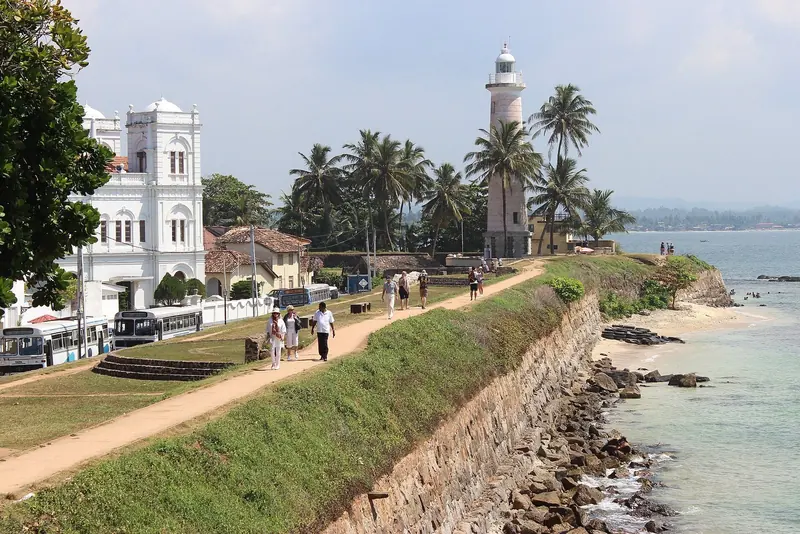
| Galle Fort | UNESCO World Heritage Site, built by the Portuguese in the early 16th century and rebuilt by the Dutch, directly adjoining the commercial harbour |
Getting to Galle
Bandaranaike (CMB) is Sri Lanka's real international gateway, served by SriLankan Airlines, Emirates, Qatar Airways, Singapore Airlines and a wide range of other carriers from the Gulf, South Asia, Southeast Asia and Europe. From the terminal a car joins the E03 Airport Expressway, the E02 Outer Circular and then the E01 Southern Expressway direct to Galle; a scheduled bus covers the roughly 147 km in about two hours fifteen minutes, and a private car runs close to that outside Friday-evening or monsoon-downpour traffic, when the drive can stretch toward three hours.
Mattala Rajapaksa International Airport, built in 2013 near Hambantota, sits only about 150 km east of Galle against Bandaranaike's 120 to 150 km, which makes it look like the shorter run on a map. In practice almost every scheduled airline pulled out by 2018 after the facility was widely reported, including by Forbes, as the world's emptiest international airport, and it now handles only a handful of domestic connections to Colombo. A crew or guest planning a Galle stop should route through Bandaranaike and treat Mattala as a curiosity, not an option.
Why Galle is the port that matters
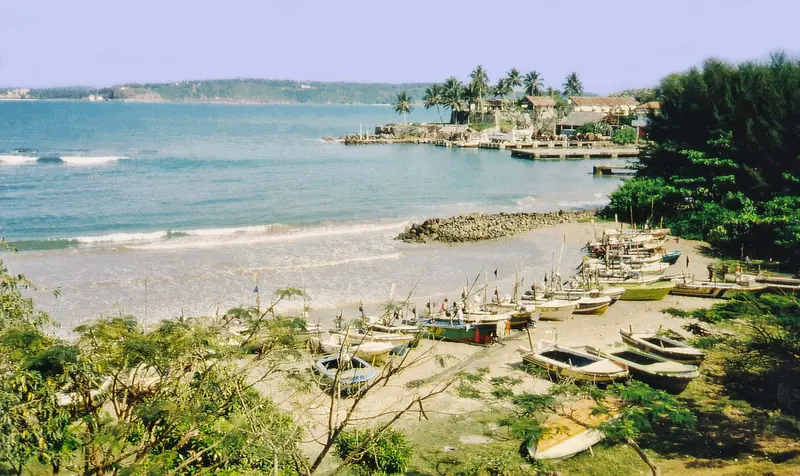
During the civil war that ran from 1986 to 2009, Galle harbour was, according to Noonsite's country guide, considered the only safe place for a visiting cruising yacht to clear into Sri Lanka; Colombo and Trincomalee have both been usable since the war ended, but Galle kept the traffic, the agents and the institutional habit that make it the default stop today. It sits on the island's southwestern tip at roughly 6 degrees 02 minutes north, 80 degrees 13 minutes east, inside a small bay dominated by the old Dutch and British fort.
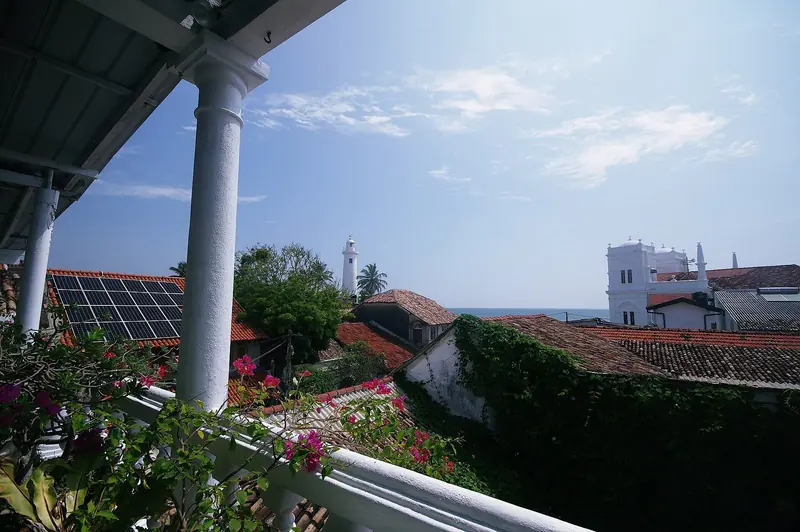
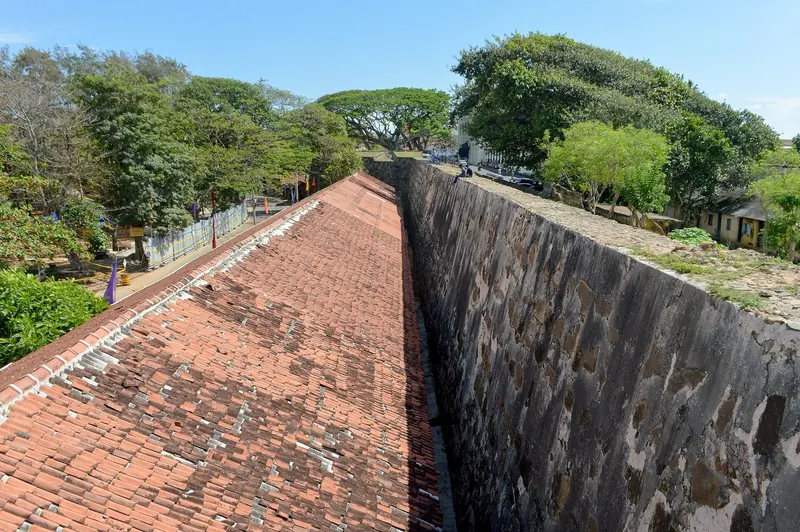
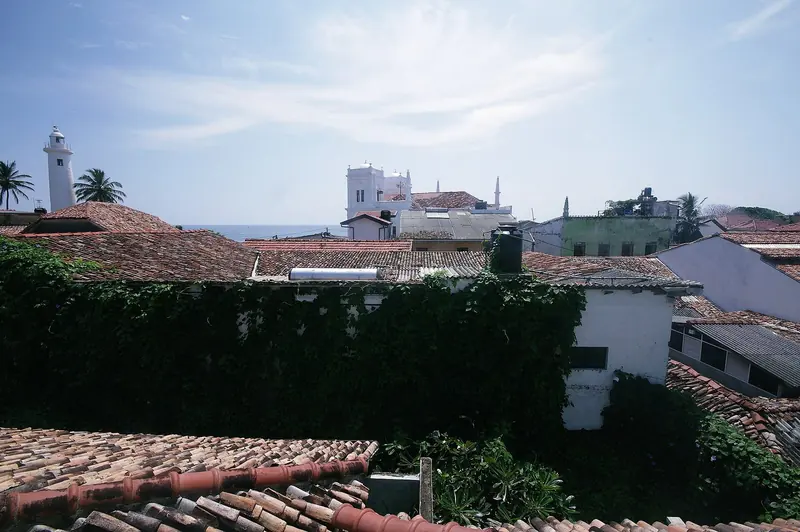
Galle Fort itself, a UNESCO World Heritage Site raised by the Portuguese in the early sixteenth century and rebuilt in stone by the Dutch, is the actual reason owners linger once the paperwork is done: a walled colonial town of ramparts, a working lighthouse and a mixed Dutch, Muslim and British quarter, walkable in an afternoon and a genuinely different stop from a resort marina. The commercial harbour a yacht clears into sits in the fort's own bay, so the two are never more than a short walk apart.
Galle is not a cruising ground, it is the last serious clearance port before the open Indian Ocean, and it has been treated that way since the civil war made it the only safe one.
Clearance: the agent is not optional
A boat approaching at night is told to anchor outside the harbour, off the buoys opposite the entrance, and wait for first light; several cruisers writing on Noonsite describe the wait for the Navy launch, once contact is made, running anywhere from ten minutes to two hours. Three Navy personnel typically board to record vessel and passport details in a ledger before the boat is escorted in, after which Customs, Immigration and Quarantine each come aboard in turn. The agent, present from the moment of arrival, handles the shore pass every crew member needs to pass the harbour gate, and a cruising permit is a separate requirement for any yacht wanting to visit a second Sri Lankan port such as Mirissa.
Reported agent fees, drawn from Noonsite's cruiser reports between 2013 and 2019, cluster between about 200 and 325 US dollars covering harbour dues, port clearance and the agency fee itself: Windsor Reef quoted 225 dollars in both 2013 and 2018, Sri Lanka Shipping 200 dollars all-in, GAC around 220 dollars, and Tango Shipping 325 dollars in 2013 though later cruisers rated Tango's service highly enough to call it worth the difference. Several reports note that quotes are genuinely negotiable and vary agent to agent, and that a check-out needs only 24 hours' notice for the agent to arrange final water and electricity readings before Immigration and a Navy inspection clear the yacht to leave.
What the harbour is actually like
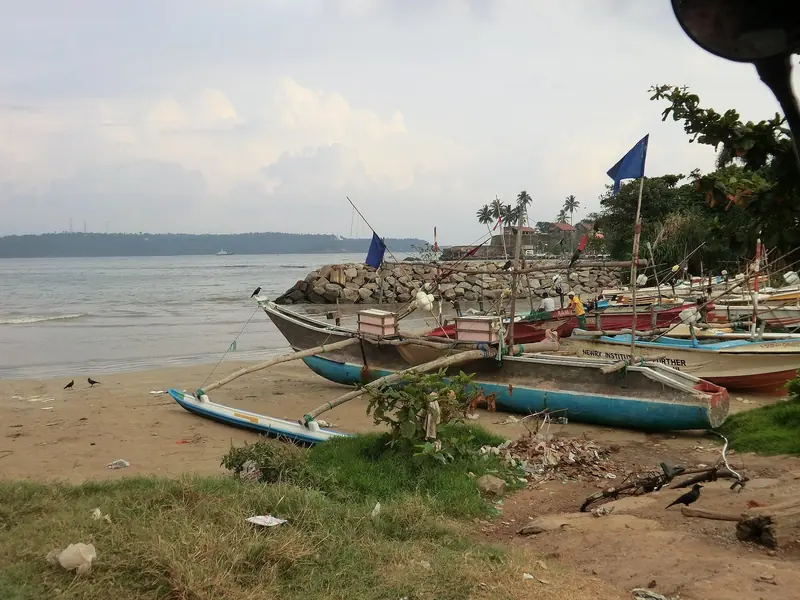
The working anchorage, used only while waiting for clearance, lies outside the harbour entrance in the bay locals call Jungle Beach or Watering Point, in about 10 metres over hard sand; once cleared, a boat moves inside to a quay in the harbour's eastern basin that cruisers nickname the 'Yacht Marina', a name that overstates what is there. Multiple firsthand reports posted to Noonsite between 2013 and 2019 describe mooring stern-to or rafted against quay walls fitted with protruding metal mooring rings that damage hulls without a fender board, in a basin with near-constant surge and cement dust blown off the harbour's own aggregate-import trade. The Sri Lanka Ports Authority's own account differs in scale: it records a Phase I(A) yacht marina development, completed in 2015 at a cost of 125 million Sri Lankan rupees, providing 22 berths for craft to 15 metres with a 3 metre draft limit and a small repair workshop.
That gap between the official 22-berth figure and cruisers' descriptions of a handful of battered pontoons and quay space for perhaps eight boats before rafting is real and worth flagging rather than resolving in either direction; a crew should assume the harbour will accommodate a boat under about 15 to 20 metres but should not expect marina-grade infrastructure. Water is delivered by hose or tanker at roughly 7 to 12 US dollars a tonne depending on the year and agent, electricity is billed by the unit and can run high, one 2017 cruiser reported a departure power bill of about 170 Australian dollars for a boat using only 12-volt fridges and LED lighting, and diesel comes by jerrycan or agent-arranged tanker rather than a fuel dock.
Season and the monsoon window
Sri Lanka runs two monsoon systems on a north-south split: the southwest monsoon (locally the Yala season) governs Colombo, Galle and the whole western and southern coast roughly from mid-May to October, while the northeast monsoon (Maha) affects the eastern and northern coasts from around November to February. For a yacht based on the south coast the practical read is simple, the October-to-April window is the one to plan a Galle stop or a Sri Lanka landfall around, and the surf season that runs November to April on the beaches either side of the fort is a rough proxy for the same calmer water offshore.
Outside that window a crew should expect a harbour entrance that is genuinely working against a moored boat, not merely uncomfortable: the southwest monsoon's swell reaches into the basin cruisers already describe as surge-prone in settled weather, and several reports specifically warn against leaving a yacht unattended at Galle through the wet season without confirming current conditions with the agent first.
The piracy years, and where the guidance stands now
At the piracy crisis's peak, rallies built around a Southeast-Asia-to-Mediterranean route through the Indian Ocean and Red Sea were disrupted directly: the Blue Water Rally, a round-the-world circuit then thirteen years old, ceased operating in April 2011 after four American sailors who had left the rally were killed by pirates near Salalah, and its remaining 20 yachts, stranded in Oman, were shipped as deck cargo to Turkey rather than risk the Gulf of Aden, as Yachting Monthly reported at the time. Cruisers of that era commonly staged through Galle, close to the Sri Lanka gap where the island's south coast pinches the Indian Ocean's east-west shipping lane, before making a fast, often convoyed crossing toward Salalah's Oasis Club muster point rather than cruising the open ocean alone. Galle itself sits near real shipping traffic today for a different reason: Sri Lanka's East-West lane runs about 12 nautical miles off Dondra Head, the island's southernmost point, carrying more than 40,000 commercial vessels a year, a proximity Colombo has periodically discussed relocating further offshore.
The shipping industry's High Risk Area designation for the Indian Ocean, maintained jointly by BIMCO, INTERTANKO, the International Chamber of Shipping and other bodies, was withdrawn effective 1 January 2023 after no major piracy attack on a merchant ship had been recorded off Somalia since 2018. That improvement has not held through 2026: Noonsite's own piracy and security resource for the Gulf of Aden, Indian Ocean and Red Sea, updated as recently as August 2026, records a fresh resurgence of piracy concerns off Somalia and renewed regional maritime security incidents across the Red Sea, Gulf of Aden, Arabian Sea and the approaches to the Strait of Hormuz, driven in large part by naval assets being pulled toward Hormuz during the Iran conflict. Separate reporting from Euronews and CNBC in August 2026, drawing on IMO data and a UKMTO advisory dated 12 May 2026, puts Somalia-linked attacks at their highest count since 2013. None of this is specific to Sri Lankan waters, Galle and the Sri Lanka gap are well south and east of the current risk area, but a crew planning on toward Oman or the Red Sea from here should register with UKMTO's Voluntary Reporting Area and MSCIO before departing rather than sail on the assumption that the 2023 all-clear still fully applies. Closer to home, Noonsite's wider Indian Ocean resources also flag a lower-grade, unrelated nuisance specific to these waters: aggressive begging and close-quarters approaches by local fishing boats to yachts on passage south of Sri Lanka, worth a mention precisely because it gets confused with the much more serious Somali-basin risk further west.
Marina development: what exists and what is coming
The Sri Lanka Ports Authority's Phase II plan for Galle, a 900-metre breakwater and a 300-metre multi-purpose berth intended to bring in cruise ships and larger leisure and commercial traffic alongside whale-watching and hospitality development, is described on the Authority's own site as awaiting UNESCO clearance before construction can begin, given the harbour's position against the fort's World Heritage boundary; no start date is published. For a yacht over about 20 metres, Galle today is a clearance port, not a marina.
The facility actually built for size is Port City Colombo's luxury marina, a joint venture of Browns Investments, China Harbour Engineering Company and LOLC Holdings that broke ground in January 2025 on a 33,776 square metre site at an announced cost of 120 million US dollars. Sources reporting on the project put its capacity at roughly 200 to 250 mid-to-large yachts, with completion targeted for 2027 and the developers positioning it as the only full-service marina between Dubai and Phuket. Asia Pacific Superyachts' Sri Lanka office, run by Priyantha Perera, already provides agency, mooring and clearance advisory services for the larger yachts that do call, citing past work for vessels including M.Y. Vava and S.Y. Hemisphere, which suggests demand is arriving faster than the infrastructure built for it.
What it costs, and what is not published
Agent fees covering customs, immigration, port clearance and harbour dues have run from about 200 to 325 US dollars across the reports gathered here, with 220 to 250 dollars the figure quoted most often in the past five years. Water is delivered at roughly 7 to 12 US dollars a tonne with a one-tonne minimum whether or not it is used, and electricity is billed by the unit at commercial rates with, by one 2017 account, a 100 percent surcharge added for pleasure craft, a combination that produced one reported power bill of about 170 Australian dollars for a boat running only basic refrigeration and lighting. Imported provisioning items are taxed heavily, with one 2024 cruiser account citing roughly 150 percent duty on imported goods and prices as high as 8 to 12 Australian dollars for a box of cereal.
What is not published anywhere found in this research: any current, agent-independent tariff for harbour dues or berthing at Galle, any berth or transit pricing for the still-unbuilt Port City Colombo marina, and any Galle-specific large-yacht rate, since the existing marina caps out at 15 metres and boats above that size are handled case by case through an agent. A crew should budget for negotiation rather than a fixed card, and, per multiple reports, should expect quotes to vary meaningfully between agents for what is nominally the same service.
En tierra, accesos y reservas
| Getting there | Fly into Bandaranaike International Airport (CMB) near Colombo. Southern Expressway (E01) to Galle: about 2 to 2.5 hours, 120-150 km depending on route and traffic. Mattala Rajapaksa (HRI), though closer on the map at about 150 km, has almost no scheduled airline service and is not a practical alternative. |
|---|---|
| Clearance | Licensed agent mandatory; no independent clearance permitted. Contact Port Control on VHF 16 before entering; daylight entry only. Navy boards on arrival, followed by Customs, Immigration and Quarantine. Separate cruising permit needed to visit a second Sri Lankan port. |
| Agent fees | Reported range roughly USD 200-325 all-in (agency, harbour dues, customs/port clearance), most recent reports cluster USD 220-250. Rates are agent-dependent and reported as negotiable. No official published tariff found. |
| Berthing | No free anchoring for a cleared yacht. Berths in the harbour's eastern basin ('Yacht Marina'), officially 22 berths to 15m LOA / 3m draft per a 2015 SLPA development; cruiser accounts describe a smaller, surge-prone quay with rafting common. Not suitable for planning around for anything over about 15-20m. |
| Season | October to April for calm conditions (northeast monsoon). Avoid May to September (southwest monsoon: 15-25kt winds, heavy swell, harbour surge). |
| Fuel, water and power | Water by hose/tanker, roughly USD 7-12/tonne, one-tonne minimum. Diesel by jerrycan or agent-arranged tanker, no fuel dock. Electricity metered at commercial rates with a reported pleasure-craft surcharge in at least one account; power bills can run higher than expected. |
| What's not published | No current public tariff for Galle harbour dues or berthing; no pricing yet for the under-construction Port City Colombo marina; no Galle-specific large-yacht rate since the harbour's own marina caps at 15m. |
| Security guidance | Indian Ocean High Risk Area designation lifted 1 January 2023, but Noonsite (updated August 2026) and multiple outlets report a 2026 piracy resurgence off Somalia, the worst since 2013, tied to the Iran conflict pulling naval escorts toward the Strait of Hormuz. Register with UKMTO's Voluntary Reporting Area and MSCIO before any onward passage toward Oman or the Red Sea. |
| Nearby marina development | Port City Colombo luxury marina (not at Galle): groundbreaking January 2025, roughly 200-250 vessel capacity, USD 120 million investment, targeted completion 2027. |
Lo que cuentan armadores y tripulaciones
The check-in is a real production, but the Navy and agents get it done
Contacting Port Control on VHF 16 and waiting for the Navy launch, boarding took two crew who stayed aboard the launch and three who came onto the yacht to record details in a ledger before escorting the boat in to meet the agent and begin Immigration, Customs and Quarantine formalities in turn.
Anthony, SV Wild FoxGalle harbour is dirty and dusty, but the town and the people are the reason to stay
Cement dust off the harbour's own aggregate trade and floating rubbish contaminate the water and coat the boat depending on wind direction, and the harbour authorities are expensive and unhelpful, but the old walled city, the fresh fruit and curries and the friendliness of the people made the stop worthwhile.
Mark Emery, SV Thinking of DaveAn unexpectedly high power bill is a real risk at departure
A parting electricity bill of roughly 170 Australian dollars for a boat running only 12-volt fridges and LED lighting, billed first at commercial rates and then with a reported 100 percent pleasure-craft surcharge added on top.
Mark Emery, SV Thinking of DaveChoosing the right agent matters more than almost anything else in Galle
Every official layer, Customs, Immigration, the Navy and the Harbour Master, can bring a stay to a standstill, and only a genuinely capable agent, cited as Isle Shipping's Upali among several options tried, can move a boat through all four smoothly.
SV Wild Fox owner writing as 'Anthony'GAC handled the paperwork but was slow and uninterested in small-boat problems
GAC took over five days to release spare parts that had already cleared Customs within 24 hours, and directed the crew to a Colombo engineering firm rather than assist locally, in contrast to more responsive independent fixers found outside the harbour gate.
Albert Cook, SY Miyagi MoonA protected mooring, but a genuinely dirty one, and worth the nine-day inland tour anyway
The Navy-assigned berth was well sheltered from adverse winds despite water fouled with floating plastic, secure enough under naval patrol to leave the boat unattended for a nine-day tour of the island, and the old walled city was just a fifteen-minute tuk-tuk ride away.
Daryl, SY Vimy
Lo bueno y lo que conviene vigilar
Puntos fuertes
- A genuinely necessary, well-positioned waypointSri Lanka sits directly on the route between Southeast Asia or the Maldives and Oman, the Red Sea or onward passages, close to the island's own East-West shipping corridor, and Galle remains the country's default, agent-experienced clearance port.
- A real historic town, not a resort stripGalle Fort is a UNESCO World Heritage Site of Portuguese and Dutch fortification directly adjoining the harbour, walkable in an afternoon and a genuine change from a marina-village stop.
- Piracy risk is well short of its 2008-2012 peakThe industry-wide High Risk Area designation was lifted 1 January 2023 after years without a major merchant-ship attack off Somalia, and Galle itself is well outside the current higher-risk zone.
A tener en cuenta
- The harbour, not the fort, is what a crew actually lives withMultiple firsthand accounts from 2013 to 2019 describe cement dust, floating rubbish, constant surge and mooring rings that damage hulls without heavy fendering; this is a working commercial port a yacht shares, not a purpose-built marina.
- Clearance is genuinely bureaucratic and inconsistentA mandatory agent, Navy boarding, and reports across several years of unpredictable extra charges and wide price variation between agents for nominally the same service.
- 2026 has brought a real piracy resurgence, even if not at Sri Lanka itselfNoonsite's August 2026 update and separate 2026 reporting describe the worst Somalia-linked piracy activity since 2013, driven by naval assets diverted to the Iran conflict; a crew continuing west should not treat the 2023 all-clear as still current without checking UKMTO and MSCIO directly.
- No real facility for a larger yachtGalle's own marina caps at 15 metres and 22 berths on paper, cruiser accounts suggest even less in practice, and the one project built for size, Port City Colombo, is 120 km away and not due before 2027.
Para quién es: An owner or delivery crew routing the long leg between Southeast Asia or the Maldives and Oman, the Red Sea or beyond, who needs a real clearance port and a genuinely interesting historic stop, not a resort marina.