St Barths & the Leeward Islands
| Región | Caribe nororiental, Islas de Sotavento |
|---|---|
| Escala | de St Barths a St Martin unas 15 millas náuticas, a Anguilla unas 30, a Antigua unas 85 |
| Temporada | de diciembre a abril, con la temporada de huracanes del 1 de junio al 30 de noviembre |
| Gustavia | unos 60 amarres de muelle hasta un máximo de unos 60 m, alrededor de 4,5 m de calado, los yates mayores fondean en la rada exterior |
| Protocolo de Gustavia | autorización del capitán de puerto antes de entrar, canal 12 de VHF, 5 nudos dentro del puerto |
| Reserva natural de St Barths | prohibida la entrada a los barcos de más de 25 m, lo que cierra Colombier y Fourchue al barco nodriza |
| Boyas de la reserva | solo en Colombier y Fourchue, cuatro días seguidos como máximo, y no deben usarse por encima de unos 55 km/h de viento |
| Laguna de Simpson Bay | el puente del lado holandés tiene 17 m de paso libre, así que la manga decide si un yate puede entrar siquiera |
| Horarios del puente | salidas a las 08:30, 10:30 y 16:00, entradas a las 09:30, 11:30, 14:00 y 17:00, sujetos a cambios |
| Antigua | Falmouth Harbour Marina admite yates de hasta unos 163 m con hasta 6 m de calado, Nelson's Dockyard unos 55 m de popa |
| Semanas fijas de 2026 | St Barths Bucket del 12 al 15 de marzo, Antigua Sailing Week del 22 al 26 de abril |
| Estatus | St Barths es país y territorio de ultramar de la UE desde el 1 de enero de 2012, fuera del área aduanera y de IVA de la Unión, con el euro como moneda |
| No VAT applies in St Barths on goods, fuel or services, against 20 per cent on the French mainland | |
| The EU 18 month temporary admission clock does not run in St Barths waters, so a Caribbean winter does not count against a Mediterranean summer | |
| Port de Gustavia published no berthing or anchoring tariff in July 2026 | |
| Reserve moorings at Colombier and Ile Fourchue are reported to be free and limited, capped at four consecutive days, and closed to vessels over 25 m | |
| From 1 September 2024 every vessel must check in and out of the waters of Martinique, Guadeloupe, Saint-Martin and Saint-Barthelemy, whatever its flag | |
| Antigua and Barbuda | a valid cruising permit is required for every vessel, issued for up to six consecutive months, with self-declared compliance with small craft regulations as a condition |
| Antigua's Port Authority collects entrance, rubbish, anchorage or dockage and cruising permit fees at the counter in US or East Caribbean dollars | |
| No published charter-licence regime for St Barths itself could be sourced in July 2026 | |
| Yard cluster | Simpson Bay lagoon at Sint Maarten and Falmouth in Antigua, with the 17 m bridge clearance deciding which of the two a wide hull can use |
Tres islas, tres trabajos
Todo en los Sotavento del norte está a una jornada de navegación. De St Barths a St Martin hay 15 millas náuticas, a Anguilla unas 30, a St Kitts unas 40. Antigua queda 85 millas al sur y es la única travesía de verdad, que se suele hacer de noche o como un largo a un descuartelar con los alisios. Barbuda está 30 millas al norte de Antigua, y Guadalupe 40 millas al sur.
Una semana son St Barths y sus vecinas. Dos noches en Gustavia, un día en Anse de Gouverneur o en Saline, un salto a Anguilla para Sandy Island y los restaurantes de playa, una noche frente a Ile Fourchue, y vuelta. Dos semanas suman la travesía al sur hasta Antigua y Barbuda, con St Kitts y Nevis de camino y Guadalupe y Les Saintes más allá. Los armadores que quieren tener el barco en un solo sitio todo el invierno suelen basarse en Sint Maarten o en Antigua y usar St Barths a ratos.
Los fondeaderos, y la trampa del tamaño
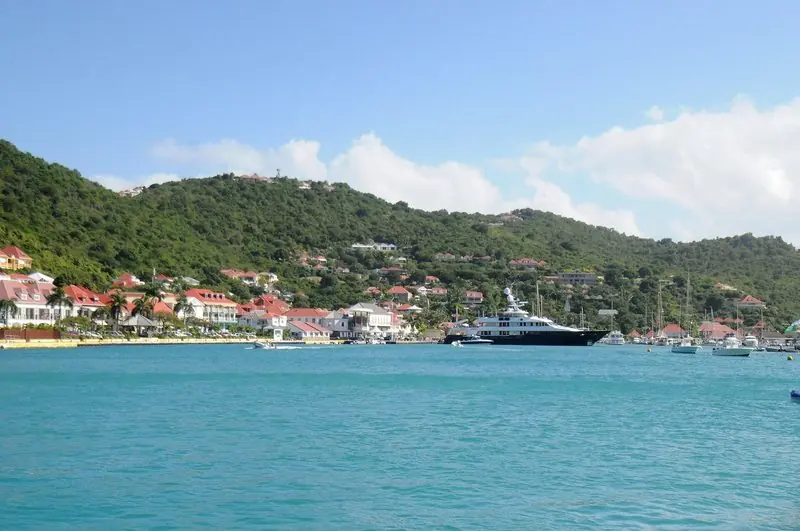
St Barths tiene dos de los mejores fondeaderos del Caribe y un yate grande no puede usar ninguno de los dos. La reserva natural prohíbe entrar en ella a los barcos de más de 25 metros, lo que cierra Colombier e Ile Fourchue a cualquier cosa de tamaño de superyate, y dentro de esas dos calas el amarre es solo a boya, con un tope de cuatro días seguidos. Los fondeaderos aprovechables para un barco grande son la rada exterior de Gustavia, Anse de Gouverneur y Grande Saline en la costa sur, y la Baie de Saint-Jean. Las tres calas de la costa sur están abiertas a la mar de fondo.
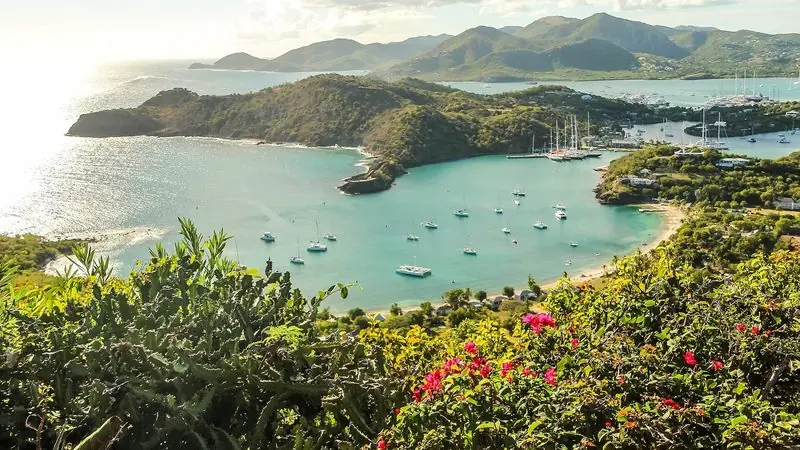
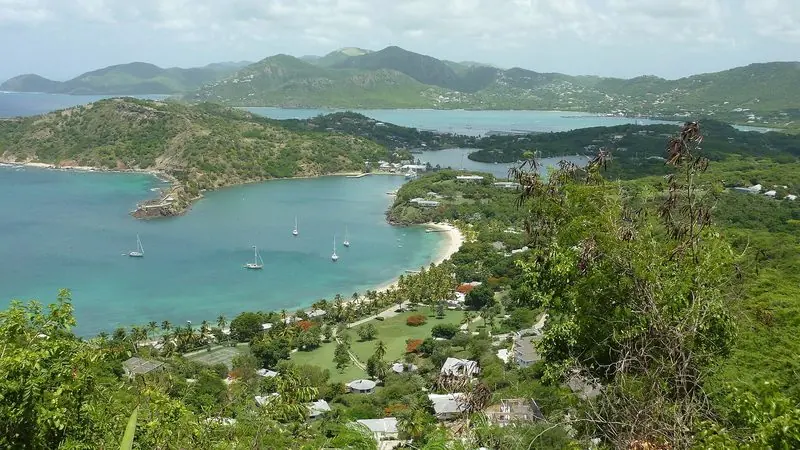
En el resto la elección es amplia. Los cayos de Anguilla tienen el agua más bonita del grupo, con Sandy Island, Prickly Pear y el tramo de Rendezvous Bay, y la isla cobra sus propias tasas de navegación y de parque marino. Alrededor de Antigua hay decenas de calas, desde Deep Bay y Jolly Harbour en el oeste hasta Green Island y Nonsuch Bay en el este, además del abrigo de English y Falmouth.
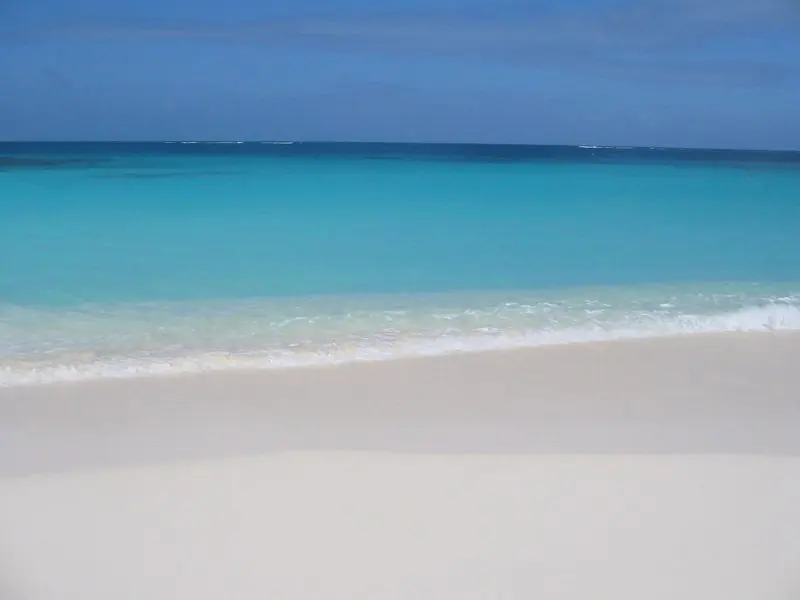
Los dos mejores fondeaderos de St Barths están cerrados a cualquier yate de más de 25 metros, y eso no es lo que sugieren las fotos.
Gustavia, el puente y Falmouth
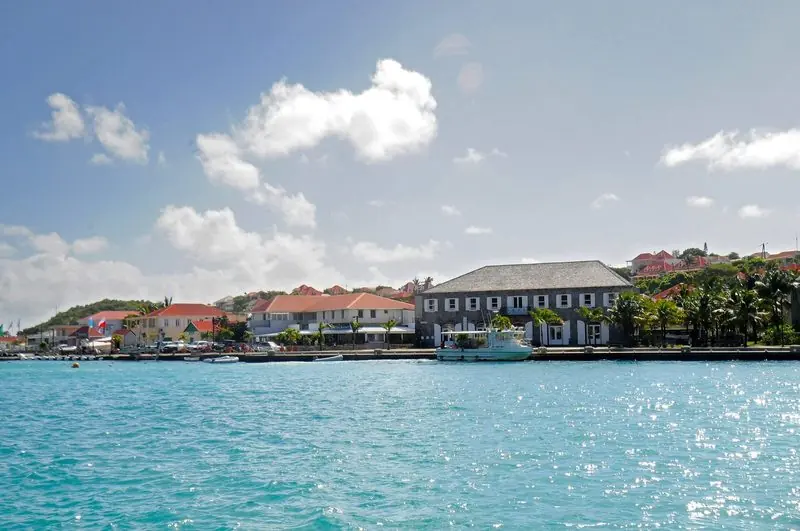
Gustavia es más pequeña que su fama. Tiene unos 60 amarres de muelle con un máximo de unos 60 metros y alrededor de 4,5 metros de calado, y los yates atracan de popa sobre su propia ancla. Todo lo mayor fondea en la rada exterior y entra en tender. Para entrar hace falta autorización de la oficina del capitán de puerto, a la que se llama por el VHF 12 antes de maniobrar, y dentro del puerto hay un límite de 5 nudos. Por Navidad y Nochevieja, el fondeadero exterior tiene cien yates y más.
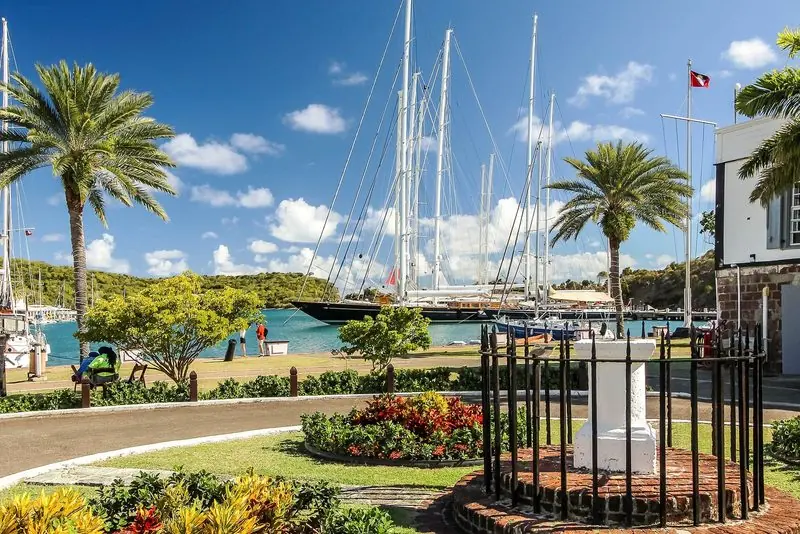
En Sint Maarten es donde más aprieta la cuestión del tamaño. La laguna de Simpson Bay concentra las marinas y la capacidad de refit de la región, y el puente del lado holandés que da acceso tiene 17 metros de paso libre, así que un yate moderno de 50 metros con manga ancha físicamente no puede entrar. Las aperturas del puente siguen un horario publicado, de salida a las 08:30, 10:30 y 16:00 y de entrada a las 09:30, 11:30, 14:00 y 17:00, y cambian, así que esto se comprueba y no se da por hecho. Antigua no tiene nada de esa dificultad, y Falmouth Harbour Marina admite yates de hasta unos 163 metros con hasta 6 metros de calado, y Nelson's Dockyard, en English Harbour, admite unos 55 metros de popa contra un muelle georgiano.
Alisios, mar de fondo y los meses
La temporada la enmarca la temporada de huracanes del Atlántico, que va oficialmente del 1 de junio al 30 de noviembre, y casi todas las pólizas exigen que el yate esté fuera de la zona acotada o en un emplazamiento aprobado en su parte central. De diciembre a abril hace un tiempo cálido, seco y estable, con temperaturas diurnas cerca de los treinta grados y un agua que no pide traje de neopreno. Los alisios soplan del noreste a 15 o 25 nudos durante semanas seguidas, y por eso la navegación a vela de aquí es la mejor del mundo y por eso los fondeaderos expuestos se mueven.
La variable que pilla desprevenida a la gente es la mar de fondo del norte en invierno. Las borrascas lejanas del Atlántico Norte mandan mar de fondo de periodo largo hacia los Sotavento de diciembre a marzo, y deja incómodas o insostenibles las calas y los puertos que miran al norte durante dos o tres días sin ningún viento local que lo explique. Los vientos de Navidad, un periodo de alisios reforzados a finales de diciembre y en enero, son la otra característica estacional. Febrero y marzo suelen ser las semanas más estables.
Nochevieja, la Bucket y la Sailing Week
La temporada caribeña tiene una semana inamovible y es la última del año. St Barths en Nochevieja es la concentración más densa de yates grandes de todo el mundo fuera del salón de Mónaco, con la rada exterior llena, el pueblo a tope y los amarres y las boyas comprometidos con muchos meses de antelación. Todo lo de esa semana cuesta más y se reserva antes de lo que un armador espera.
Después toma el mando el calendario de regatas. La St Barths Bucket se corre del 12 al 15 de marzo de 2026 y convierte Gustavia en una reunión de los mayores yates de vela a flote. Les Voiles de Saint-Barth vienen después, en abril. La Antigua Sailing Week se corre del 22 al 26 de abril de 2026 desde los puertos de Falmouth y English, precedida por la Antigua Classic Yacht Regatta. En diciembre, el Antigua Charter Yacht Show llena Falmouth con la flota de charter y con los brokers, cosa que importa a cualquier armador que explote el barco comercialmente.
Por qué los invitados vuelan a Sint Maarten
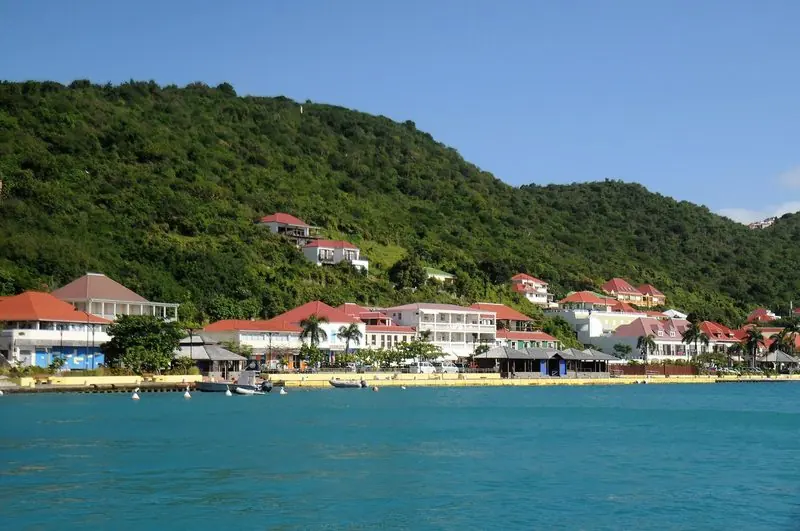
St Barths tiene aeropuerto y no va a servir de ayuda. Gustaf III, en Saint-Jean, tiene una pista muy corta con una aproximación en fuerte pendiente sobre una loma, y solo admite turbohélices pequeños y aviación ligera, así que los jets privados no pueden aterrizar allí. Los invitados vuelan a Princess Juliana, en Sint Maarten, que tiene servicio de largo radio desde Europa y Norteamérica y manejo completo de aviación de negocios, y desde allí hacen el enlace en avión ligero, en helicóptero o en el ferri de veinte minutos. El aeropuerto V C Bird de Antigua recibe largo radio directo en fuselaje ancho desde Londres y Norteamérica y es la llegada más fácil del Caribe oriental.
Ese traslado es la parte más subestimada de una semana en St Barths. El enlace añade una o dos horas por cada extremo y depende del tiempo, las últimas rotaciones de aviación ligera son a primera hora de la tarde, y en Navidad todo el sistema está saturado. Antigua se ahorra todo eso, que es una de las razones por las que hoy invernan allí muchos barcos grandes.
Cenar en St Barths, playas en Anguilla
St Barths es francesa y cara y hace una cosa extremadamente bien, que es cenar. Bonito y Le Ti Saint Barth en Gustavia, Shellona en Shell Beach, Nikki Beach en Saint-Jean y el restaurante del Eden Rock son los fijos, y la playa de Gouverneur no tiene absolutamente nada encima. El comercio es libre de impuestos y la isla no tiene IVA, lo que supone una diferencia real de precio en relojes, joyería y vino. La vida nocturna son un puñado de locales y un montón de tripulaciones de yate.
Las vecinas no son un premio de consolación. Anguilla tiene los mejores restaurantes de playa del Caribe, Blanchards y Straw Hat entre ellos, y ninguna aglomeración. El Nelson's Dockyard de Antigua es un arsenal naval georgiano restaurado y Patrimonio de la Humanidad de la UNESCO, con la barbacoa del domingo por la tarde en Shirley Heights, encima, a la que todo el mundo acaba yendo a la vez. Sint Maarten tiene los efectos navales y el supermercado y muy poco más.
Despacho, tasas y apoyo
El despacho es la faena recurrente, porque esto es una cadena de islas pequeñas bajo cuatro o cinco pabellones distintos y un yate despacha entrada y salida en cada una. St Barths y el lado francés de St Martin son franceses, el lado holandés de Sint Maarten tiene su propio régimen, y Anguilla, Antigua y St Kitts son independientes o británicas y cada una cobra permisos de navegación y tasas. St Barths es país y territorio de ultramar de la UE desde el 1 de enero de 2012, lo que la deja fuera del área aduanera y de IVA de la Unión mientras sigue usando el euro. Los agentes se ocupan de todo esto y merece la pena tenerlos.
La laguna de Sint Maarten es el centro técnico del Caribe oriental, con los astilleros, los efectos navales, el combustible y la carga, y Antigua es la segunda base, con buenos oficios náuticos alrededor de Falmouth. Entre las dos cubren casi todo lo que un yate grande necesita en una temporada. Todo lo demás es escaso, y una avería seria en Anguilla o en Barbuda significa un traslado a Sint Maarten.
El inconveniente sincero
La norma de la reserva de St Barths es lo que más les cuesta aceptar a los armadores, porque las dos mejores calas de la isla están cerradas a su yate y el barco se pasa la semana en una rada abierta frente a Gustavia o en la costa sur expuesta. Con alisios frescos y mar de fondo del norte, esa es una semana movida y los estabilizadores trabajan de firme. Los amarres de Gustavia son pocos, el recargo de Nochevieja es severo, y los precios en tierra de la isla están entre los más altos del mundo.
El apunte de fondo es que esta es una costa de huracanes con memoria. Irma, en septiembre de 2017, arrasó Sint Maarten, St Martin y partes de Anguilla y de Barbuda, y la reconstrucción ha llevado años, cosa que se nota en una infraestructura desigual y en las condiciones de seguro de los meses de verano. La temporada es además corta, más o menos de diciembre a abril, así que un yate que se quede aquí trabaja cinco meses y después se reposiciona o se desarma. Los armadores que quieren una base caribeña sin ese reloj acaban mirando más al sur.
The one real saving, and everything that is not published
St Barths is where the tax answer is the simplest on this list and the price answer is the hardest. The island has been an EU overseas country and territory since 1 January 2012, which puts it outside the EU customs and VAT area while it continues to use the euro. There is no VAT on anything bought ashore, none on fuel and none on services, which is a measurable difference against the French mainland where the same purchase carries 20 per cent, and it is the reason watches, jewellery, wine and provisioning are genuinely cheaper here rather than merely presented that way. The same status means the EU's 18 month temporary admission clock does not run in these waters at all, because the yacht is not inside the customs union, so a Caribbean winter is time that does not count against a Mediterranean summer.
Against that, almost nothing is published. Port de Gustavia posts no berthing or anchoring tariff and none was obtainable in July 2026, so no figure is offered here rather than a guess. The reserve moorings at Colombier and Ile Fourchue are reported to be free and are limited in number, capped at four consecutive days, and closed in any case to vessels over 25 m, so the mother ship is not using them and the question does not arise for her. What can be budgeted with confidence is the clearance chain rather than the berth. This is a chain of small islands under four or five flags and a yacht clears in and out of each of them, with Antigua's Port Authority collecting entrance, rubbish, anchorage or dockage and cruising permit fees at the counter in US or East Caribbean dollars. The agent's fee is the predictable line in a Leewards budget and the berth is not.
Whether a foreign flag may charter in the Leewards
There is no single answer here because there is no single jurisdiction, and that is the honest shape of the problem rather than an evasion of it. St Barths sits outside the EU customs and VAT area, so a charter here attracts no French VAT and the EU maritime cabotage regulation does not apply as it does in metropolitan France. Since 1 September 2024 every vessel, private or commercial and whatever her flag or home port, must check in and out on entering or leaving the waters of Martinique, Guadeloupe, Saint-Martin or Saint-Barthelemy, which formalised what had been a variable practice. Beyond the French islands the position changes with the flag ashore. Antigua and Barbuda requires every vessel in its waters to carry a valid cruising permit, issued by the Port Authority or the National Parks for up to a maximum of six consecutive months, and a foreign-flagged vessel operating there is treated as having self-declared compliance with the local small craft regulations as a condition of holding it.
What could not be sourced in July 2026 is a published charter-licence regime for St Barths itself, and the absence of a document should not be read as an absence of rules. The regional pattern is consistent: most Caribbean islands apply no dedicated charter tax or VAT, but they do charge cruising permits, marine park fees, clearance charges and local levies, so the cost of chartering across the Leewards is a stack of small permits assembled island by island rather than one headline rate. The practical consequence is that a week combining St Barths, Anguilla and St Kitts crosses three fee regimes and three clearances, and it is the agent's schedule rather than any tax rate that decides whether the itinerary works. Technical capability is concentrated in the Simpson Bay lagoon at Sint Maarten and around Falmouth in Antigua, so a yacht too beamy for the lagoon's 17 m bridge clearance sits outside the region's main yard cluster before her season begins, and Antigua becomes the answer by default.
En tierra, accesos y reservas
| Getting there, and why no jet lands here | Gustaf III at Saint-Jean has a single runway of 2,119 feet, about 646 metres, approached over a hillside and ending at a beach. It is too short for any jet, and the largest type ever permitted here was the DHC-7, so arrivals are STOL turboprops only. In practice most jet guests land at Princess Juliana on Sint Maarten and connect on the 15 minute hop, which is flown by Winair and by St Barth Commuter; Air Caraibes sells the route as a marketing partner but the aircraft are St Barth Commuter's Cessna 208B Grand Caravans, not its own widebodies. SXM is not the only gateway: Tradewind Aviation runs scheduled service into Gustaf III from San Juan and from Antigua, both of which take private jets. Ferries are the alternative. Plan a guest change as two legs and build the connection into the day. |
|---|---|
| Arriving by sea | Gustavia is a controlled port and the authorisation is not a formality: every yacht must obtain specific permission from the Port Captain's office before entering or manoeuvring inside the port, calling on VHF channel 12 as Port de Gustavia. On speed, note that the two territorial bodies publish different figures and you should follow the stricter: the port's own notice limits the channel to 3 knots, while the territorial environment agency states 5 knots for the channel and the port and applies the same 5 knot maximum in the anchoring zones, within 300 metres of the coast, in the bays of the reserve and within 100 metres of the islets. |
| Clearance is only half online, and the half that is not catches crews | The port takes formalities either at the port office or through its online portal, but the online step is pre-clearance and may be filed no more than 24 hours in advance. The port states plainly that the formalities are not registered until the document has been printed and signed at the port office. A captain who files online and assumes the yacht is cleared has not cleared. Immigration questions go to the gendarmerie rather than the harbour office. |
| How you actually reserve a berth | You do not, formally. The port does not take reservations. What agents and captains do instead is email the Harbour Master well in advance with the yacht's dimensions and the intended dates, which lets the office plan the quay, and then call the capitainerie on channel 12 on approach to be shown where to go. Berthing is stern-to off an anchor against the quay wall. The inner harbour's bow and stern mooring field is the more convenient and comfortable option when a slot matching your length is free. |
| The nature reserve rules, which are stricter than most owners expect | The marine park runs to five zones. In Colombier and Fourchue, two of the anchorages people specifically come for, vessels over 25 metres are not authorised at all. Any vessel anchoring there must carry insurance including a removal and destruction clause. The ecological mooring buoys take a maximum of 20 tonnes and 25 metres and may be occupied for no more than 96 hours, after which the vessel must leave the reserve and stay outside it for at least 96 hours before returning; the agency states that anchoring areas are subject to the same size and time limits. At the 23 dive sites only boats up to 10 tonnes and 15 metres may use a buoy, one boat per buoy, for a maximum of 2 hours 30 minutes, and mooring a sailing yacht there is forbidden outright. |
| The toys you cannot use | Across the reserve zones jet skis, seabobs, electric surfboards and all towed watersports are prohibited, along with excessive speed and noise. The 5 knot maximum applies in the enhanced protection zone as well as the simple one, so it is not a limit that lapses once you move outside the strictest water. This catches charter guests and brokers regularly, because the same equipment is unremarkable a few miles away. If the programme depends on the toy garage, the reserve is not where it happens. |
| Water, waste and services on the quay | Port water is metered at EUR 0.012 per litre for vessels on subscription and EUR 0.019 per litre for visitors. The WiFi code comes from the harbour master's office, waste separation into the designated containers is mandatory rather than encouraged, and the port toilets are open 07:30 to 18:00. The harbour office handles postal mail for yachts, works in close collaboration with the marine reserve, and runs its own SNSM rescue station with a crew on permanent standby. |
| Where to eat, and after dark | Bonito sits above the harbour in Gustavia and is the reliable one for a table with the fleet in view, French technique against Latin American flavours under chef-owner Laurent Cantineaux, listed as Monday to Saturday from 19:00, on 590 590 27 96 96 or [email protected]. Shellona on Shell Beach is Greek-leaning with live music and DJs. The Sand Bar at Eden Rock on Baie de Saint-Jean carries Jean-Georges Vongerichten's menu. Le Ti St Barth above Pointe Milou is cabaret rather than dinner and should be chosen knowing that. For the rest of the night, Nikki Beach, Bete a Z'Ailes on the harbour front, and in Gustavia itself L'Eclipse, Le Yacht Club St Barth and The Strand. Note that the beach club long known as La Plage, at the former Tom Beach hotel in St Jean, now trades as Pearl Beach, and older listings still carry the old name. |
| Dates to plan around | The St Barths Bucket has published its dates to the end of the decade and has returned to the second-to-last complete weekend in March: 17 to 21 March 2027, 15 to 19 March 2028, 14 to 18 March 2029 and 20 to 24 March 2030. Take those from the regatta's own site, because secondary listings are circulating a 2027 date a day out. Les Voiles de Saint-Barth follows in April. New Year is the island's peak week. Hurricane season runs June to November and the yachting calendar here is a December to May one. |
Lo que cuentan armadores y tripulaciones
Captains are directed to a berth, they do not choose one
The published procedure is to call the capitainerie on channel 12 as you near the port and be shown where to Med moor, rather than arriving to an assigned berth. Berthing is stern-to off the anchor against the quay wall, and the inner harbour's bow and stern field is described as the more convenient and comfortable option when an open slot matches the yacht's length.
Superyacht Services Guide and Southern BoatingThe overflow berths are available because nobody wants them
Side-to and stern-to dockage seaward of the mega-docks takes the boats the inner harbour cannot, and the reason it tends to be free is that winter swell makes for rolling nights aboard. It is the difference between a berth in Gustavia and a good berth in Gustavia, and it is not visible when the booking is made.
Southern BoatingThe 96 hour rule is the one that surprises returning owners
The territorial environment agency limits any stay on a reserve mooring buoy to 96 hours, after which the vessel must leave the reserve entirely and remain outside it for at least 96 hours before returning, and states that anchoring areas are subject to the same size and time limits. Combined with the 20 tonne and 25 metre buoy limits and the exclusion of vessels over 25 metres from Colombier and Fourchue, a settled week inside the reserve is not available to a large yacht.
Agence Territoriale de l'Environnement de Saint-BarthelemyThe shore programme at New Year is booked more than a year out
Villas, drivers and restaurant reservations for the New Year week are reported as needing to be secured twelve to eighteen months ahead, with New Year and the Bucket the first weeks to sell out each year. An owner deciding in the autumn that the boat should be in St Barths for New Year has already missed the shore side of it.
Haute RetreatsThe price everyone quotes is eight years old and carries no vessel size
The figure of about USD 581 a day that puts Port de Gustavia in the most-expensive-marina rankings comes from a list compiled by Motoyachting.com, published by Drivemag Boats and republished by Forbes in 2018, and it names no yacht length. No current tariff is published by the port. Anyone quoting a Gustavia berth rate today is quoting either that number or an agent's estimate, and it is worth asking which.
Motoyachting.com list, republished by Forbes, 2018
Lo bueno y lo que conviene vigilar
Puntos fuertes
- The whole island is inside a tender rideGustavia is a small harbour and the anchorages, the restaurants and the airport are all within a few minutes of it. Nothing here is a passage, and a yacht can lie off and still put guests ashore in the middle of town in minutes.
- You can plan years ahead around the BucketDates are published through 2030 and fixed to the second-to-last complete weekend in March. For an owner who wants the boat there, or specifically does not, that is four seasons of certainty, which almost no other yachting fixture offers.
- The reserve has kept the water worth visitingFive managed zones, hard limits on tonnage and length at the sensitive bays, a 96 hour cap on any mooring and a ban on jet skis and towed sports have preserved the seagrass and reef the anchorages depend on. The restrictions are the reason the place still looks the way the photographs promise.
- It is French territory with the services that impliesEU standards ashore, gendarmerie handling immigration, a port that runs its own SNSM rescue station with a crew on standby, and an online pre-clearance system. The administrative side is orderly in a way that is not universal in the Leewards.
- The concentration of good tables is unusual for the sizeBonito, Shellona, the Sand Bar at Eden Rock and Le Ti are within a short drive of one another on an island of about eight square miles, which is why the New Year fleet comes for the shore programme as much as the cruising.
A tener en cuenta
- Over 25 metres you are locked out of the best anchoragesColombier and Fourchue do not authorise vessels over 25 metres at all. For any yacht above that length, and that is the greater part of what this page is written for, it means anchoring elsewhere and sending guests in by tender to the two bays everybody photographs.
- No jet lands on the islandThe 646 metre runway takes STOL turboprops only. Most guest changes therefore run through Princess Juliana on Sint Maarten and a 15 minute commuter flight or a ferry, with the customs and schedule risk that adds at both ends. San Juan and Antigua are the alternatives, on Tradewind.
- There is no reservation to holdThe port does not take bookings. An advance email with the yacht's dimensions helps the Harbour Master plan, but the berth is assigned on approach, so a season cannot be built around a confirmed place on the quay.
- The toy garage is largely unusable in the reserveJet skis, seabobs, electric surfboards and towed watersports are prohibited across the zones, and the 5 knot limit applies in the enhanced protection zone as well as the simple one. On a charter sold partly on watersports that is a material gap between expectation and delivery.
- The outer berths rollSide-to and stern-to space seaward of the mega-docks is available when the inner harbour is full, and it is generally available precisely because winter swell makes for rolling nights aboard. The comfortable berths are the inner ones and there are not many.
- Nothing about the cost is publishedThe port publishes water at EUR 0.012 and EUR 0.019 per litre and then stops. There is no public mooring tariff, and the figure that circulates in superyacht marina rankings is from 2018 and carries no vessel length. An owner cannot cost a week in Gustavia from public information, which is unusual for a French port.
Para quién es: El armador que quiere el invierno caribeño de moda y va a basar el barco en Sint Maarten o en Antigua, usando Gustavia para las noches que importan.