Turkey & the Dodecanese
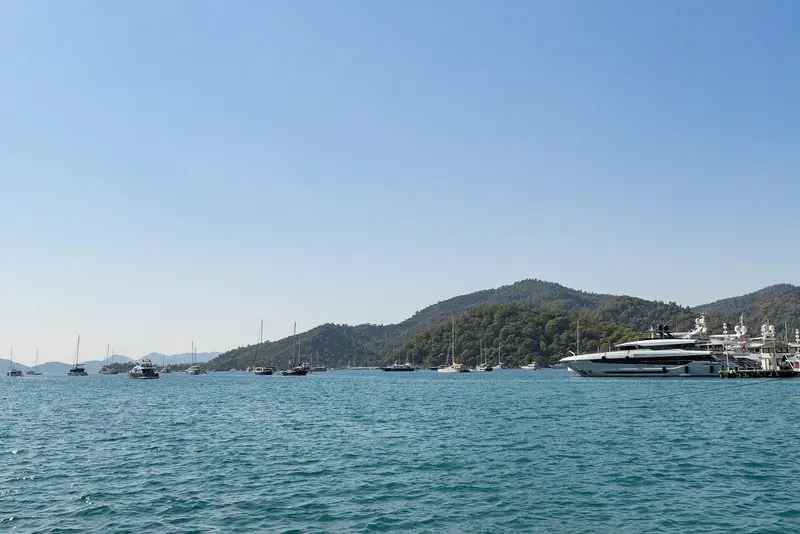
| Región | suroeste de Turquía (costas del Egeo y de Licia) más el Dodecaneso griego |
|---|---|
| Temporada | de mayo a octubre, con el pico de mediados de julio a finales de agosto |
| Viento que la define | el meltemi, del noroeste, fuerza 5 a 6 en julio y agosto y llegando a fuerza 7 a 8 |
| Puertos principales | Yalikavak, Bodrum, Gocek, Marmaris, Kos, Symi, Rodas |
| Mayor capacidad de amarre | Yalikavak Marina, unos 620 amarres, yates de hasta unos 140 metros |
| Fondeaderos emblemáticos | Skopea Limani y las islas de Gocek, Kekova, la península de Bozburun |
| Fondeo | las calas de Skopea Limani tienen de 15 a 20 metros muy cerca de la orilla, y el amarre con cabos a tierra es lo normal |
| Entrada en Turquía | e-Transitlog en el primer puerto, válido un año, más una Blue Card que registra las descargas de residuos |
| Charter | la ley turca de cabotaje restringe el charter comercial en pabellón extranjero, y hace falta una licencia turca o un permiso de navegación del ministerio |
| Combustible | repostaje libre de impuestos para yates de pabellón extranjero en marinas y astilleros turcos autorizados |
| Lado griego | tasa de navegación TEPAI, publicada en EUR 8 por metro y mes para yates de más de 12 metros en 2026 |
| Aeropuertos | Milas-Bodrum a unos 45 minutos de Yalikavak, Dalaman a unos 30 minutos de Gocek, Rodas y Kos en el lado griego |
| Charter from 19 June 2026 | a foreign-flagged commercial yacht under 39 m may not embark charter guests in Turkey and pays EUR 40 per metre of LOA at each clearance |
| Charter licence for 39 m and above | one-off and banded, EUR 74,423.36 for 39 to 59 m, EUR 108,135.03 for 60 to 79 m, EUR 168,846.72 above 80 m, valid to 31 December 2026 |
| Private yachts | a foreign-flagged private yacht may not charter in Turkey and may cruise only with the ultimate beneficial owner or a first-degree family member aboard, with no licence and no VAT |
| Licence process | notarised translations and about ten working days, with no amendments and no refunds after payment |
| Berthing | no Turkish marina publishes a superyacht tariff, checked 28 July 2026, and Netsel publishes its formula without the unit price |
| Third-party berth figure | EUR 12,000 to 25,000 a year for a 12 m yacht in the Bodrum, Marmaris and Gocek marinas on a 2026 market guide |
| Greek cost | TEPAI at EUR 8 per metre per month is EUR 400 a month for a 50 m yacht |
| Discharge | marine pollution fines under Article 20 of Environmental Law 2872 rose 25.5 per cent for 2026, and eleven vessels were fined a combined TRY 18,038,414 in the first quarter of 2026 |
| Duty-free fuel | open to foreign-flagged yachts private and commercial, ordered a working day ahead, with no published price differential |
Dos costas, una zona de navegación
La mitad turca va de la península de Bodrum hacia el sur, pasando Datca y Marmaris, hasta Gocek y Fethiye, y luego al este por la costa de Licia, por Kas, hasta Kekova. La mitad griega queda a unas millas de allí y pertenece a otro Estado por completo: Kos, Symi, Rodas, Patmos, Leros y los islotes menores entre medias. De Bodrum a Kos hay unas 12 millas náuticas. De Marmaris a Rodas, unas 35. De Datca a Symi, unas 12. Un yate puede cambiar de jurisdicción en una mañana y estar fondeado por la tarde en un sitio completamente distinto.
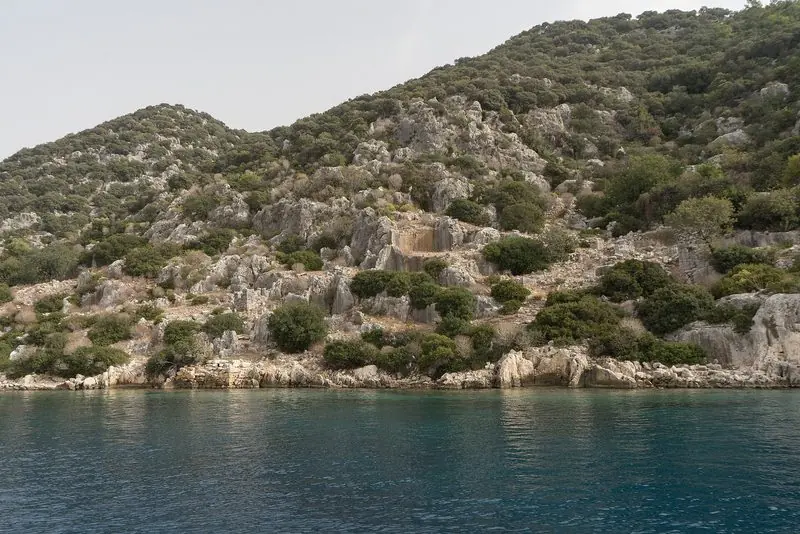
Lo que vende la costa turca es su forma. Escarpada, cubierta de pinos y muy recortada, con montañas que se levantan hacia los 2.000 metros detrás de Skopea Limani. El agua profunda llega muy cerca de tierra, así que las travesías son cortas y el abrigo es inmediato. Casi todos los días de navegación aquí son de dos a cuatro horas de máquina. Al armador que no le gustan las etapas largas y abiertas le tocan cantidades enormes de costa por muy poco tiempo en la mar.
Una semana, y dos semanas
La semana clásica empieza en Gocek. Salir a Skopea Limani para dos noches entre las islas de Gocek, cruzar el golfo de Fethiye, luego al este hasta Kalkan y Kekova para ver la ciudad licia hundida, y volver con una noche en Ekincik. Nada de esa ruta está a más de cuatro horas del fondeadero anterior. La semana alternativa es la península de Bodrum y el golfo de Gokova, más ancho, más ventoso y más abierto, con la península de Datca y Knidos en su extremo occidental.
Dos semanas permiten unir las dos mitades y añadir Grecia. De Bodrum a Gocek con Kos, Symi y Rodas en medio es la quincena honesta. La fricción es el despacho. Cada salto a través de la frontera significa un despacho completo de aduanas, inmigración y sanidad en ambos sentidos, y en un puerto con movimiento como Kos o Rodas eso son normalmente de dos a cuatro horas del día. Meta un cruce en la quincena, no cuatro.
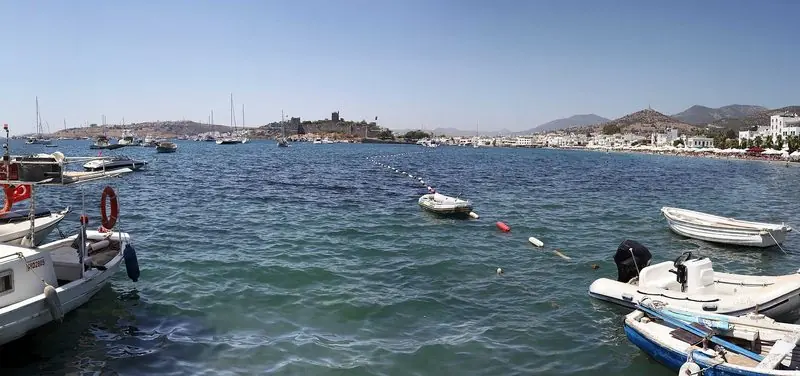
Aquí un yate puede cambiar de jurisdicción durante la comida, y lo paga con un despacho en cada extremo.
Los fondeaderos que merecen el viaje
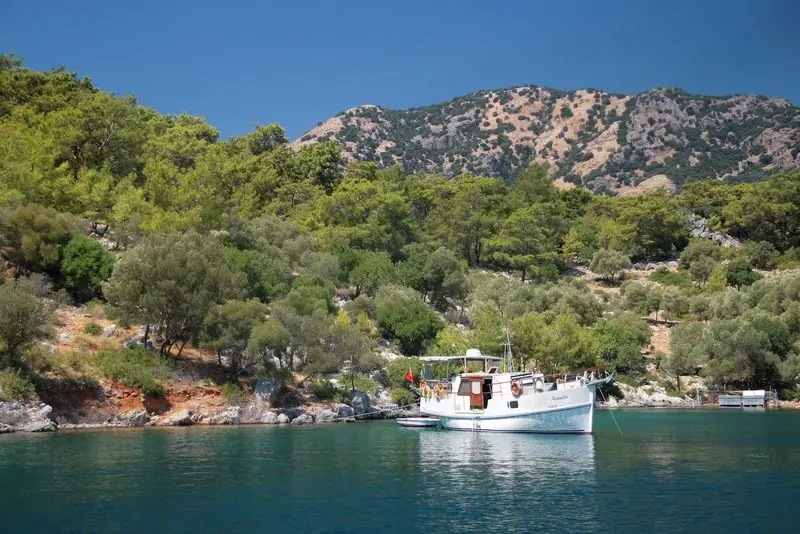
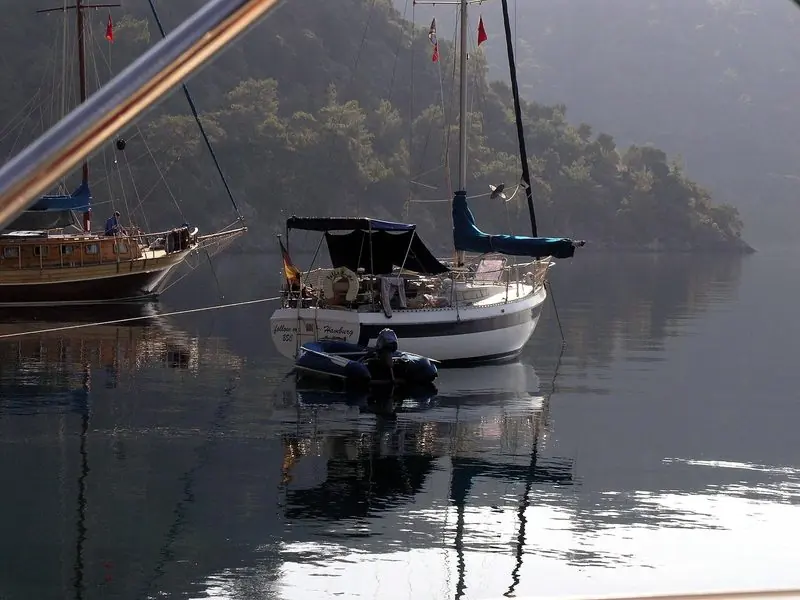
Skopea Limani, el golfo cerrado al suroeste de Gocek, tiene los mejores. La cala de Bedri Rahmi lleva el nombre del pintor turco cuyo motivo de pez sigue en la pared de roca. Tomb Bay tiene tumbas licias excavadas en el acantilado justo encima del agua. La isla de Tersane tiene un astillero en ruinas y un poblado abandonado. Varias calas tienen pantalanes de restaurante donde el personal sale a remo a coger los cabos, lo que funciona de maravilla para un barco de 25 metros y nada para uno de 50.
Al este de Fethiye el interés pasa a ser arqueológico. Kekova tiene una ciudad licia medio sumergida a lo largo de la orilla, que se ve mejor en tender y a poca velocidad, con Ucagiz y Kalekoy en cada extremo. Al oeste de Marmaris, las penínsulas de Bozburun y Datca son más tranquilas, con Knidos en la punta donde se juntan dos mares. En el lado griego, el puerto de Symi en Gialos es la llegada más fotografiada del Dodecaneso, todo fachadas neoclásicas apiladas en un cuenco de roca, y Patmos guarda el monasterio de San Juan y la cueva del Apocalipsis sobre el puerto de Skala.
Dónde cabe un barco de 50 metros y dónde no
Yalikavak Marina, en la punta noroeste de la península de Bodrum, es el ancla de toda la región, con unos 620 amarres y capacidad para yates de hasta unos 140 metros. Ha sido votada más de una vez como la mejor marina de superyates del mundo en los premios del sector. Gocek tiene varias marinas apretadas en una sola cala pequeña, de las cuales D-Marin Gocek es la mayor, con yates de hasta unos 70 metros tras un dique flotante. Netsel Marmaris y las marinas de Bodrum completan el resto. Rodas tiene un muelle de superyates en el puerto comercial, y Rhodes Marina al este de la ciudad.
Los límites aparecen al fondear. Las calas de Skopea Limani son profundas hasta muy cerca de tierra, así que la técnica estándar es fondear en 15 a 20 metros y largar cabos largos a rocas o a árboles, lo que exige sacar de 50 a 60 metros de cadena y gente en tierra. Eso es rutina para un barco de 50 metros bien tripulado e imposible en los huecos más pequeños. El muelle del pueblo de Symi es corto y está lleno. En la práctica, aquí un yate de 50 metros fondea fuera, en la parte exterior de la cala, y trabaja la costa en tender, que es como lo hace la flota residente.
El meltemi y el estado de la mar
El viento que define la zona es el meltemi, del noroeste en el Dodecaneso, en su versión más dura y más persistente en julio y agosto. Suele entrar de fuerza 5 a 6 en esos meses y puede subir a fuerza 7 u 8. El patrón diario importa más que la media: flojo hasta media mañana, más duro por la tarde, aflojando de noche. Ese ritmo previsible es la razón por la que las tripulaciones locales se mueven a la hora del desayuno. Entre las Cícladas y el Dodecaneso el viento tiene unas 100 millas náuticas de fetch libre, así que la mar se levanta en los cruces abiertos, no en la costa.
Al sur y al este de la península de Datca la costa turca está mucho más abrigada y el meltemi llega suavizado. Skopea Limani en particular es una bolsa de viento flojo. El agua está caliente desde junio y sigue siendo bañable hasta octubre. La primavera y el otoño traen la mar más tranquila y los montes más verdes, con alguna tormenta suelta en el calor de finales de agosto. De noviembre a marzo no hay temporada de navegación aquí en ningún sentido serio: húmedo, ventoso y con casi todos los restaurantes de la costa cerrados.
La temporada y las semanas ya comprometidas
La temporada útil va de mayo a octubre. De mediados de julio a finales de agosto es la península de Bodrum a todo volumen, con el tráfico vacacional turco y regional sumado a la flota internacional. Gocek en agosto está genuinamente lleno, y las buenas calas están cogidas a media tarde. Finales de mayo, principios de junio y las tres primeras semanas de septiembre son las ventanas que elige de verdad quien conoce la costa, con agua caliente, viento más suave y sitio para fondear.
Los amarres de pleno verano en Yalikavak están en la práctica comprometidos por los barcos que los mantienen con contrato anual, y la disponibilidad para el que llega sin reserva en agosto es escasa a cualquier eslora. Octubre trae la Bodrum Cup, una regata de gulets que se celebra desde 1989 en la tercera semana del mes, que llena Bodrum con 150 o más yates tradicionales de madera y cierra la temporada con una semana de fiestas. Esa semana vale la pena buscarla o evitarla, según el armador.
Llevar a los invitados a bordo
Milas-Bodrum es la puerta de entrada de la mitad norte, a unos 45 minutos por carretera de Yalikavak y menos del pueblo de Bodrum, y es el principal punto de atención a la aviación privada de la región. Dalaman sirve al sur, a unos 30 minutos de las marinas de Gocek y a menos de una hora de Fethiye. Los dos aceptan aviación de negocios y los dos tienen programación de verano desde casi toda Europa. Estambul queda a un salto doméstico corto para quien llegue en largo radio.
El lado griego lo sirven Rodas Diagoras y Kos, ambos con tráfico chárter de verano intenso y con menos atención a la aviación privada que los aeropuertos turcos. A los invitados que embarcan en Grecia y se van desde Turquía hay que avisarles de la frontera. Los requisitos de visado turco varían por nacionalidad y el sistema electrónico es sencillo, pero hay que hacerlo antes de salir. Los cambios de tripulación a través de la frontera cuestan un despacho cada vez.
En tierra, y cómo es en realidad
Bodrum tiene el castillo de los Caballeros de San Juan, que alberga el Museo de Arqueología Subacuática, y los restos del Mausoleo de Halicarnaso. El casco antiguo de Rodas es una ciudad medieval amurallada y Patrimonio Mundial, y la única escala en la que los invitados pasarán con gusto un día entero. Dalyan, al que se llega en tender remontando el río desde Ekincik, tiene las tumbas rupestres de Kaunos excavadas en la pared del acantilado.
La comida es honesta y regional. Meze, pescado a la brasa vendido al peso y restaurantes de costa que mandan una lancha a recogerle. Turkbuku, en el lado norte de la península de Bodrum, y el paseo de Yalikavak Marina llevan la escena del verano, con los nombres internacionales de la restauración y el público de después. Las islas griegas son más tranquilas, y Symi y Patmos en particular cierran pronto. Nadie viene a esta costa por la noche de la Riviera, y quien lo intenta se lleva un chasco.
Papeleo, combustible y la pega honesta
Todo yate de pabellón extranjero que entra en Turquía saca un e-Transitlog en el primer puerto, válido un año, más una Blue Card que registra las descargas de residuos. Los agentes gestionan las dos cosas de forma rutinaria y no es gravoso. La ventaja comercial es real. Los yates de pabellón extranjero repostan libres de impuestos en marinas y astilleros turcos autorizados, lo que en un barco de 50 metros es una cifra material a lo largo de una temporada. Turquía además queda fuera del territorio aduanero de la UE, que es la razón por la que tantos yates la usan para interrumpir el reloj de 18 meses de la admisión temporal de la UE, y el armador debería pedir asesoramiento propio sobre ese punto.
La pega es el régimen de charter. La ley turca de cabotaje reserva el comercio marítimo interior a los barcos de pabellón turco, y un yate comercial de pabellón extranjero no puede sencillamente subir invitados a bordo en Turquía. Las vías para rodearlo, una licencia turca de charter o un permiso de navegación por metro pagado al ministerio, han cambiado más de una vez y hay que comprobarlas en el año de uso. Más allá de eso: la aglomeración de agosto en Gocek, el meltemi en el lado de Bodrum, y una industria de refit seria cuya mayor capacidad de izado está en Tuzla, cerca de Estambul, a varios cientos de millas de las calas que se navegan de verdad.
What it costs, and where the saving actually is
Turkish marinas do not publish superyacht tariffs. Netsel Marmaris publishes the formula, LOA multiplied by beam multiplied by days multiplied by a unit price, and not the unit price. Yalikavak lists 620 berths and a 60 m maximum on the booking platforms with no rate table behind it, checked on 28 July 2026. The best-sourced third-party figures are small-boat ones: a 2026 Turkish market guide puts an annual berth for a 12 m yacht at EUR 12,000 to 25,000 in the Mugla marinas, meaning Bodrum, Marmaris and Gocek, against EUR 8,000 to 15,000 around Izmir and Didim. That is not obviously cheap. Marina di Porto Cervo's published 2026 tariff charges EUR 17,952 for a 1 May to 31 October contract in the same 12 m band and EUR 2,328 for the winter, so at small lengths the Costa Smeralda and the Turkish coast are within sight of each other. The gap opens at the top, where Porto Cervo charges EUR 3,698 a day in the band to 40 m between 1 and 20 August and EUR 5,437 in the band to 55 m, and no Turkish marina will state its equivalent in public.
The saving on this coast is fuel and customs, not berthing. Duty-free bunkering is open to foreign-flagged yachts, private and commercially registered alike, at licensed Turkish marinas and yards, with orders placed a working day ahead and 48 hours ahead over a weekend. No Turkish supplier publishes the duty-free against duty-paid differential, so the number is a quotation on the day and worth getting in writing before the boat commits to a fuelling port. The second saving is jurisdictional and costs nothing at all: Turkey sits outside the EU customs territory, which is why so many yachts use a Turkish call to interrupt the EU's 18-month temporary admission clock. On the Greek side the cost is explicit and small. TEPAI runs at EUR 8 per metre per month for yachts over 12 m in 2026, which is EUR 400 a month for a 50 m boat, and it is payable whether she moves or not.
The charter rule changed on 19 June 2026
Turkey has replaced the arrangement that most owners still believe is in force, and the new position is the plainest in the eastern Mediterranean. From 19 June 2026, a foreign-flagged commercial yacht under 39 m LOA may cruise Turkish waters with charter guests already aboard on entry and may not embark new guests in a Turkish port, and she pays a cruising permit charged at EUR 40 for each metre of LOA at every clearance, up from EUR 36. A foreign-flagged commercial yacht of 39 m and above may now embark and disembark in Turkey, but only under a Turkish charter licence obtained before arrival, with the yacht held alongside until it is approved. The fee is one-off, banded on length and valid to 31 December 2026: EUR 74,423.36 for 39 to 59 m, EUR 108,135.03 for 60 to 79 m and EUR 168,846.72 above 80 m. Papers must be translated and notarised and the process runs to about ten working days, with no amendments and no refunds once it is paid.
A foreign-flagged private yacht may not charter in Turkey at all. She may cruise, and the condition attached is that the ultimate beneficial owner or a first-degree family member is aboard, under which no licence and no VAT arise. The purpose of the whole structure is protection of the Turkish-flagged commercial fleet, which sits overwhelmingly below 39 m, and that tells an owner how it will be enforced. Cabotage remains the underlying rule: domestic maritime commerce is reserved to Turkish-flagged vessels, and a charter that embarks and lands guests in Turkey without the licence is trading illegally rather than merely misfiled. An owner who intends to earn in these waters should treat the licence fee as the price of the ground and compare it with Greece before committing, because a 45 m boat is being asked for EUR 74,423.36 before she takes a single booking.
Discharge, the Blue Card and the fines
The Blue Card is not a formality. Every foreign yacht in Turkish waters carries one and it records waste discharges to shore reception, which means the state holds a running account of what a boat has landed and can read the gaps. Discharge offences are administered under Article 20 of Environmental Law 2872, and the tariff is revalued every year. Marine pollution penalties for 2026 were raised 25.5 per cent over 2025, and in the first three months of 2026 the authorities fined eleven ships and boats a combined TRY 18,038,414. That is an average approaching TRY 1.7 million a vessel in a quarter, on a coast where the offence is usually a tank emptied in a bay that looked empty.
The practical rule is that black and grey water go ashore, at the marina or to a pump-out boat, and the Blue Card entry is made. The enclosed bays are the exposure: Skopea Limani and the Gocek gulf hold water for days in a light-air summer, which is exactly why the enforcement is concentrated there. On the Greek side the yacht is inside a MARPOL Annex V Special Area for the Mediterranean, in force since 1 May 2009, under which effectively nothing but ground food waste may go over the side and only well offshore.
En tierra, accesos y reservas
| Getting there | Milas-Bodrum is about 45 minutes to Yalikavak and is the region's main private jet handling point. Dalaman serves the south, around 30 minutes to the Gocek marinas. Rhodes and Kos serve the Greek side with heavier charter traffic and thinner private aviation handling. |
|---|---|
| By sea | Every crossing between Turkey and Greece needs a full customs, immigration and health clearance both ways, typically two to four hours at a busy port such as Kos Town or Rhodes. Build one crossing into a fortnight, not four. |
| Reserving a berth | No Turkish marina publishes a superyacht tariff. Yalikavak's prime summer berths are effectively spoken for by boats on annual contracts, and walk-up availability in August is thin at any length; book well ahead of the July to August peak. |
| What it costs | Turkish marina berthing is a quotation, not a published rate. Greece is explicit: TEPAI cruising tax runs EUR 8 per metre per month for yachts over 12 m in 2026, about EUR 400 a month for a 50 m yacht, payable whether she moves or not. |
| Charter licensing | From 19 June 2026 a foreign-flagged commercial yacht of 39 m or more needs a Turkish charter licence before embarking guests: EUR 74,423.36 for 39 to 59 m, EUR 108,135.03 for 60 to 79 m, EUR 168,846.72 above 80 m, valid to 31 December 2026. Under 39 m, guests must already be aboard on entry and each clearance costs EUR 40 per metre of LOA. |
| Fuel | Duty-free bunkering for foreign-flagged yachts, private and commercial, at licensed Turkish marinas and yards. Orders go in a working day ahead, or 48 hours over a weekend. No supplier publishes the duty-free differential; get the number in writing before committing to a fuelling port. |
| Where to eat | Turkbuku on the Bodrum peninsula and the Yalikavak Marina promenade carry the international restaurant names and the late crowd. Several Skopea Limani bays run restaurant pontoons where staff row out to take lines, which suits a 25 m boat far better than a 50. |
| After dark | Bodrum and Yalikavak have a real summer scene; the Greek islands, especially Symi and Patmos, close down early. Nobody comes to this coast for Riviera-style nightlife. |
| Fixed dates | Season runs May to October. Mid-July to late August is full volume on the Bodrum peninsula and in Gocek. The Bodrum Cup gulet regatta fills the third week of October with 150-plus traditional yachts and a week of parties. |
Lo que cuentan armadores y tripulaciones
Captains who use a Turkish agent describe the paperwork as routine rather than a real obstacle
Several captains published in 360 Yachting's own client testimonials, writing under their yacht's name rather than their own, describe repeat use of a Turkish agent across multiple seasons and say they return every time they are back in Turkish waters. It is the agency's own published feedback rather than an independent survey, so it speaks to how manageable the clearance and licensing process feels with the right agent, not to the cost of the licence itself.
Captain, M/Y I Dynasty (via 360 Yachting)
Lo bueno y lo que conviene vigilar
Puntos fuertes
- An enormous amount of coastline for very little time at seaSteep, pine-covered, deeply indented shore with deep water close in. Most cruising days are two to four hours of running, so an owner who dislikes long open legs still sees a great deal.
- A serious marina, not a makeshift oneYalikavak Marina takes yachts to roughly 140 m across around 620 berths and has been rated the best superyacht marina in the world by the Yacht Harbour Association.
- Real fuel and tax savingsDuty-free bunkering for foreign-flagged yachts at licensed Turkish marinas, plus a Turkish call that interrupts the EU's 18-month temporary admission clock, both save genuine money at no cost beyond the paperwork.
- Two countries in one cruising groundBodrum to Kos is about 12 nautical miles and Datca to Symi about the same, so an owner can add the medieval towns and monasteries of the Dodecanese to a Turkish itinerary without a long passage.
A tener en cuenta
- The charter rule changed again on 19 June 2026A 45 m commercial yacht is now asked for a one-off Turkish charter licence fee of EUR 74,423.36 before she takes a single booking, and the fee is non-refundable once paid even if the licence process, which runs about ten working days, throws up a problem.
- No marina will tell an owner what a berth actually costsNetsel Marmaris publishes its pricing formula without the unit price, and Yalikavak lists berth counts and a length ceiling with no rate table behind them, checked 28 July 2026.
- Discharge enforcement is real money, not a warningMarine pollution fines rose 25.5 per cent for 2026, and eleven vessels were fined a combined TRY 18,038,414 in the first quarter of the year alone, concentrated on enclosed bays such as Skopea Limani that hold water for days in a light-air summer.
- August crowding is genuineGocek in August is full and the good bays are taken by mid-afternoon; the refit industry's heaviest lifting capacity sits at Tuzla near Istanbul, several hundred miles from the cruising ground itself.
Para quién es: Un armador que quiere travesías cortas, calas privadas y hondas y una marina seria, y que navega en privado y no necesita que el barco gane dinero en aguas locales.