Castoldi
| Categoría | sistemas de propulsión waterjet marinos y jet tenders |
|---|---|
| Fundada | 1962 |
| Sede | Albairate, Lombardía, al oeste de Milán |
| Instalación | 18.000 metros cuadrados, con 8.000 metros cuadrados de naves de producción y oficinas, una piscina de pruebas y un helipuerto |
| Waterjets | nueve modelos Turbodrive, del Turbodrive 224 D.D. al Turbodrive 600 H.C.T. |
| Jet tenders | catorce modelos, del JT 14 al JT 34 LIMO |
| Rango de tamaños | de 14 a 34 pies, aproximadamente de 4,3 m a 10,4 m |
| Variantes de rescate | JT 14, JT 18 y JT 19 ofrecidos en versión RB/SOLAS |
| Sistema de calidad | certificado ISO 9001 |
| Aprobaciones de clase | ABS, BV, DNV, RINA, RMRS y RRR |
| Mercados | superyates, guardacostas y militar |
| Datos publicados | Castoldi no pone pesos, velocidades ni precios en las páginas públicas de sus modelos |
| Dry weight, from Castoldi's own range page, read July 2026: 790 kg for the Jet Tender 14, 1,270 kg for the 19, 1,580 kg for the 21, 2,480 kg for the 28 and 3,740 kg to 4,100 kg for the 34 LIMO | |
| SOLAS penalty | the RB/SOLAS variants weigh roughly 70 kg to 95 kg more than the equivalent guest boat, 860 kg against 790 kg on the 14 |
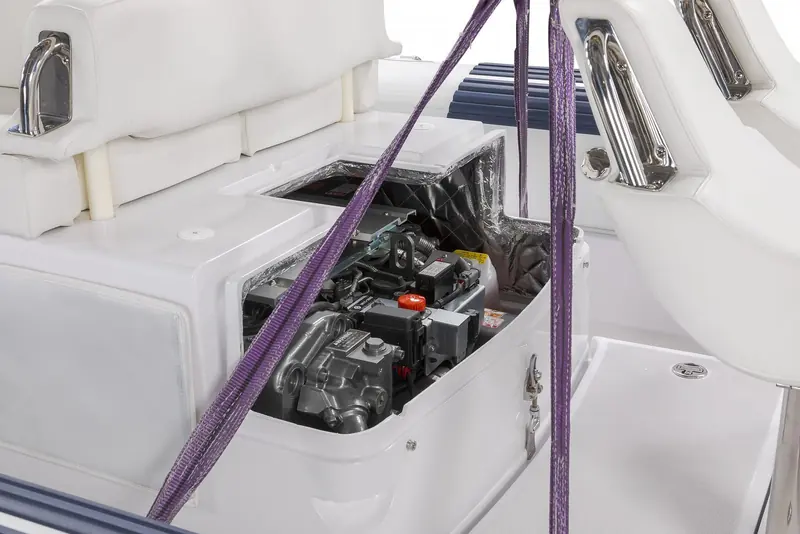
| Turbodrive 240 H.C.T., the drive in a Jet Tender 21: up to 309 kW or 420 mHP input, 238 mm impeller, 130 kg dry including gearbox, clutch, intake, duct, anodes and levers | |
| Waterjet unit dry weight ranges from 61.7 kg for the Turbodrive 224 D.D. to 1,700 kg for the 600 H.C.T. | |
| Intake protection | a movable grid at the duct water inlet, with the patented Clear-Duct system reversing the impeller and opening the grid together to back-flush the duct |
| US after-sales | Castoldi USA Inc., Seattle, announced 25 October 2022 |
| Not published | prices, lead times and any service-point directory by country |
La empresa que hizo funcionar el waterjet
Castoldi empezó a investigar la propulsión a chorro en 1962 y se describe a sí misma como la innovadora del sistema. La afirmación es defendible en el sentido de que la empresa trabajaba en chorros para embarcaciones pequeñas cuando casi nadie más lo hacía, y lleva más de sesenta años con el mismo problema. Un waterjet toma agua por debajo del casco, la acelera a través de una bomba y la expulsa hacia popa.
La ingeniería que lo hace útil en un tender es el sistema de gobierno y de inversión. Castoldi construye deflectores de empuje reversibles y un sistema capaz de mantener el empuje neutro en vertical con independencia de las vueltas de la bomba, lo que significa que el barco puede quedarse quieto con el motor en marcha y después moverse en cualquier dirección sin cambiar de marcha. Eso es lo que hace que un jet tender sea fácil de manejar de costado para un invitado.
Albairate
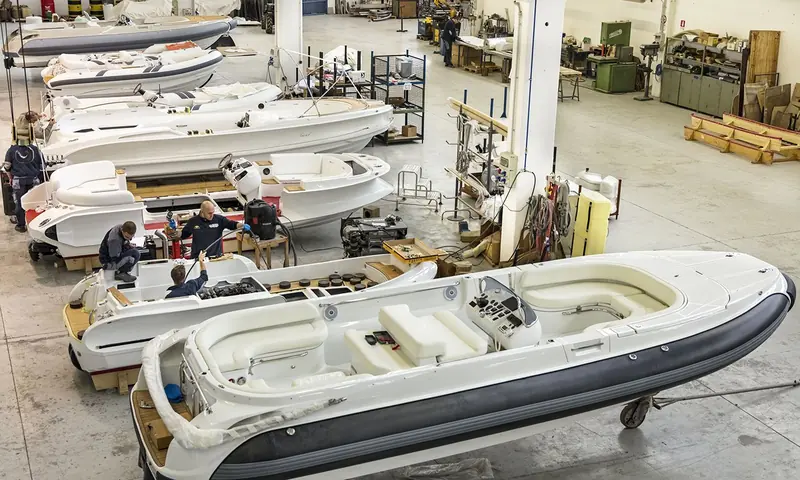
La planta está en Albairate, en Lombardía, al oeste de Milán, en un solar de 18.000 metros cuadrados con 8.000 metros cuadrados de naves de producción y oficinas. Hay una piscina de pruebas en el mismo recinto, cosa inusual y que dice algo sobre cómo desarrolla la empresa sus productos. Hay además un helipuerto, que dice algo sobre quién la visita.
La operación está certificada según ISO 9001 y tiene aprobaciones de los principales registros de clasificación, entre ellos ABS, Bureau Veritas, DNV, RINA, el Registro Marítimo Ruso y el Registro Fluvial Ruso. Esas aprobaciones existen porque los chorros van a embarcaciones comerciales y militares además de a tenders de yate, y son la razón por la que un constructor que especifica una transmisión Castoldi no tiene que justificarla ante un inspector.
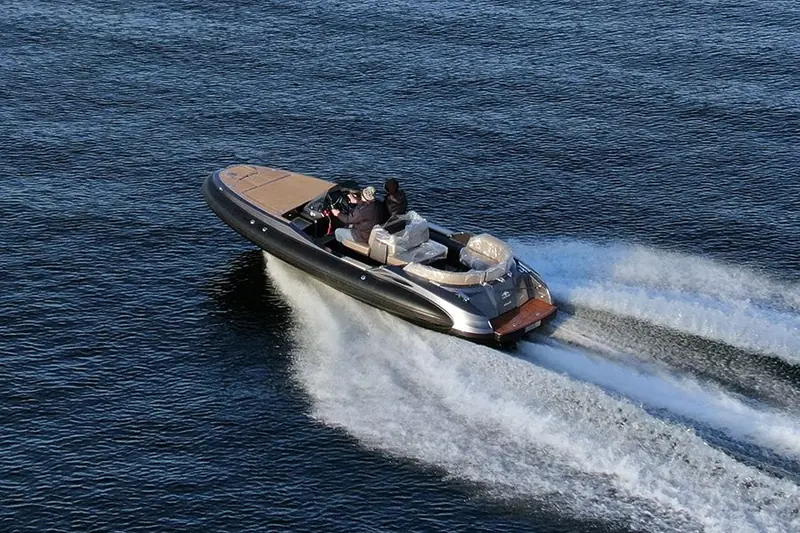
La propulsión que permite a un tender quedarse al ralentí entre bañistas, normalmente llevando el logotipo de otro.
Por qué le debería importar a un armador la propulsión a chorro
El argumento práctico son los bañistas. Un tender con hélice expuesta no puede quedarse al ralentí con seguridad entre gente en el agua, no puede acercar la proa a un banco de arena y no se le puede entregar a un invitado para que vaya a la playa sin una conversación previa. Un waterjet elimina los tres problemas, porque no hay nada girando fuera del casco. Por eso tantos tenders de superyate llevan chorro.
El segundo argumento es el calado. Un barco de chorro cala menos que uno de eje o de sterndrive del mismo tamaño y entrará en aguas someras que destrozarían una hélice. Los costes son reales. Un chorro es menos eficiente que una hélice a baja velocidad, tragará algas y bolsas de plástico por la rejilla de toma, y el rodete es un elemento de desgaste.
La gama Turbodrive
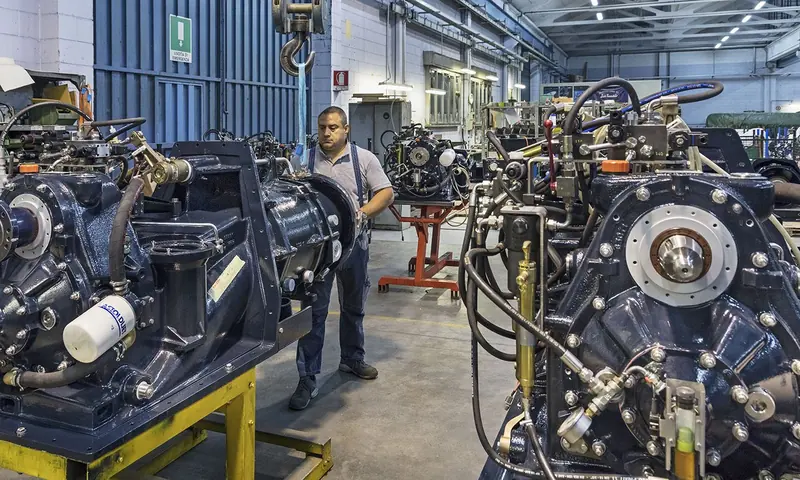
Nueve modelos Turbodrive cubren la gama, del Turbodrive 224 D.D. en el extremo pequeño, pasando por el 240 y el 284 tanto en versión H.C.T. como L.V.T., el 340 H.C., el 400 y el 490 H.C.T., hasta el 600 H.C.T. arriba del todo. Se venden a constructores de barcos, así que casi todos los armadores se encuentran una transmisión Castoldi dentro del tender de otro.
Ese es el dato comercial importante sobre la empresa. Un waterjet de Castoldi puede ir debajo de un tender construido por un astillero italiano, británico u holandés, y el logotipo del espejo de popa no es Castoldi. El armador que elija un tender debería preguntar qué transmisión lleva, porque la transmisión determina los recambios de servicio, la disponibilidad de rodetes y el manejo más que el casco.
Los jet tenders
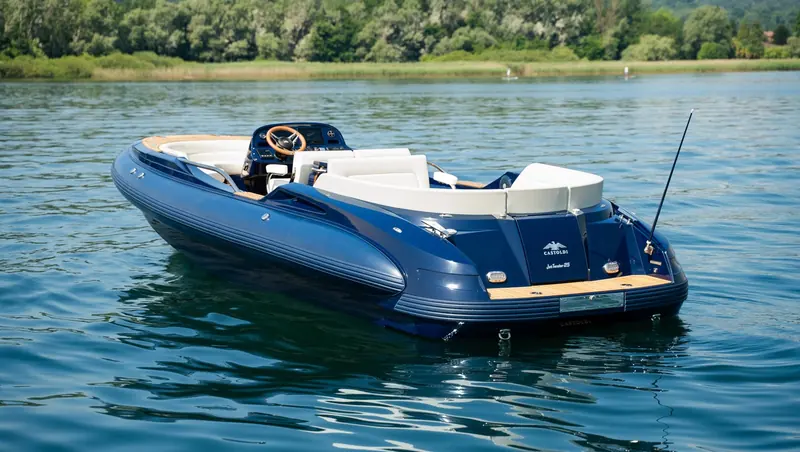
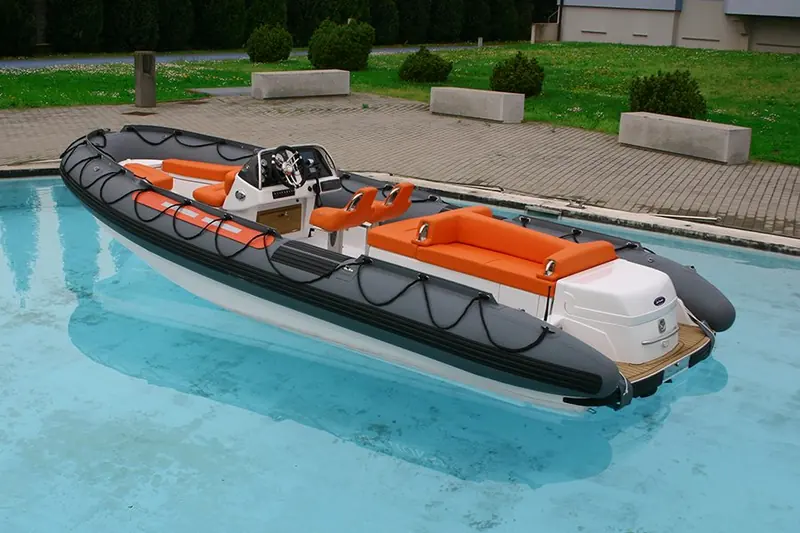
Castoldi construye también barcos completos. Catorce modelos de jet tender van del JT 14, de unos 4,3 m, al JT 34 LIMO, de unos 10,4 m, pasando por el JT 15, 16, 17, 18, 19, 21, 23, 25 y 28. Son embarcaciones semirrígidas con motores diésel y las propias transmisiones de chorro de Castoldi, una combinación inusual en un tender de yate de ese tamaño.
El diésel importa a bordo. Un yate que lleva maquinaria diésel y no quiere gasolina en la plataforma de baño puede especificar un jet tender diésel y evitarse por completo un segundo combustible. El salto de un barco de 4,3 m a una limusina de 10,4 m cubre casi todo lo que necesita de verdad un yate de 30 m para arriba, y la nomenclatura escalona los tamaños de pie en pie, lo que da idea de lo ajustados que están estos barcos a los garajes.
Las variantes de rescate SOLAS
El JT 14, el JT 18 y el JT 19 se ofrecen en versión RB/SOLAS, construidos como botes de rescate según la norma del convenio internacional. Ese es un producto distinto de un tender de invitados. Un bote de rescate SOLAS tiene que poder arriarse y recuperarse con unos estados de la mar definidos, tiene que autoadrizarse o mantenerse estable inundado, y tiene que mantenerse e inspeccionarse con un calendario.
Para un yate grande esto importa directamente, porque los barcos de registro comercial por encima de cierto tamaño están obligados a llevar un bote de rescate conforme. Poder comprar ese bote al mismo fabricante que el tender de invitados simplifica la formación, los recambios y el servicio. Es también un recordatorio de que la ingeniería de Castoldi se valida en un mercado en el que un fallo no es una molestia.
Lo que Castoldi no publica
La empresa no publica pesos, velocidades, capacidades ni precios en las páginas públicas de sus modelos. Las especificaciones se facilitan a petición a través del astillero, del distribuidor o del constructor. Es lo normal en una empresa cuyos clientes son en su mayoría otros fabricantes, y resulta incómodo para el armador que intenta comparar un tender de Castoldi con un Williams o un Novurania en una pantalla.
La consecuencia práctica es que la comparación hay que hacerla a través del capitán o del jefe de proyecto. Las cifras que deciden el resultado son el peso de izado con combustible a bordo, la eslora y la manga contra el garaje, y el número de invitados que el barco va a llevar de verdad. Quien esté haciendo una lista corta de tenders debería exigir esas tres cifras por escrito antes de decidir.
Servicio y recambios
La posición de servicio es una consecuencia de la base de clientes. Como las transmisiones de Castoldi las montan muchos constructores y muchos operadores comerciales y militares, los componentes de chorro y los rodetes se mueven por una cadena de suministro consolidada, y los mecánicos navales italianos conocen el producto. En el Mediterráneo esto es más o menos lo mejor que se puede tener con una transmisión de especialista.
El Caribe está más flojo y la respuesta práctica allí es llevar a bordo un rodete y un anillo de desgaste de repuesto. Las averías habituales de temporada en cualquier waterjet son la obstrucción de la toma y el daño al rodete por tragar restos, y las dos se resuelven en local con un buceador o con una varada. El trabajo serio de bomba vuelve a un especialista.
Frente a fueraborda, sterndrive y Williams
Para un tender pequeño la comparación es con Williams Jet Tenders, que construyó su negocio sobre tenders a chorro de gasolina dimensionados para garajes de yate y que muchos astilleros especifican de serie. Williams es la respuesta de volumen. Los tenders de Castoldi son más pesados, diésel y más cercanos a un barco de trabajo, y su alcance real está en las transmisiones montadas dentro de los cascos de otros constructores.
Frente a un fueraborda, un chorro renuncia a eficiencia y a sencillez y compra seguridad cerca de los bañistas y acceso a aguas someras. Frente a un sterndrive renuncia a empuje a baja velocidad y compra la ausencia de nada vulnerable bajo el casco. En un yate donde los invitados se bañan desde la plataforma y el tender va y viene todo el día, ese intercambio se suele resolver a favor del chorro.
Weed, sand and what the crew does about it
Every waterjet shares one failure mode. The intake is an opening in the bottom of the boat, and sooner or later it takes in weed, a plastic bag, a trailing line or a load of sand off a beach, at which point thrust falls away and the tender is unusable until it is cleared. Castoldi fits a movable grid at the duct water inlet on its drives to keep debris out in the first place.
What matters more is the drill after something gets past the grid. The Clear-Duct system reverses the impeller and opens the intake grid together, back-flushing the duct from the helm, and it is not reserved for the large commercial units: the Turbodrive 240 H.C.T. fitted to a Jet Tender 21 carries it. The consequence for a crew is that routine clearance is a lever at the console rather than somebody in the water with a knife, and only a blockage that survives a back-flush needs a diver. In a weedy anchorage that is worth more than a knot of top speed.
Price, lead time and the three numbers to get in writing
Prices and lead times are the real omission. Castoldi publishes neither, dealers quote on request, and the specialist tender brokers list every current model as built to order with no figure attached. Brokerage asking prices for used boats cover a decade of model years across a wide band and are no guide to a new hull or a refit replacement. Cost cannot be shortlisted from the websites at all, which is an argument for making the enquiry before the garage dimensions are frozen.
Three numbers decide the outcome and all three should come back in writing: lifting weight for the boat as actually fitted, length and beam against the garage opening and its door, and the guest number the boat will really carry. The published capacities are CE design category figures, 12 people on a Jet Tender 21 and 16 on a 25, which is not the number who will sit in one with towels, a cooler and a crew member driving. The drive model belongs in the same document, because it sets the spares list for the next ten years.
Información práctica
| Turbodrive unit pricing | No public list price. Distributor listings (e.g. the Turbodrive 490HC) show call-for-price / enquire-now -- this is a quote-only B2B market and Castoldi does not publish unit prices. |
|---|---|
| Jet Tender pricing (new) | No public factory price list found; Castoldi jet tenders are sold and specified through dealers, so new pricing is quote-only like the drive units themselves. |
| Jet Tender pricing (secondary market, for context only) | Used listings on DailyBoats (Europe) range from about $19,800 for the smallest models up to about $182,000; YachtWorld/Boat Trader show used Castoldi tenders from roughly $32,000-$42,000 up to $99,500-$318,000 depending on size and age. The two aggregators disagree on the top end, so treat this only as a rough band, not a reliable ceiling. |
| How a yard or owner specifies a unit | Through Castoldi's own dealer and qualified-service network rather than direct factory retail -- named distributors include Heavy Seas (UK, Castoldi Qualified Service), Golden Arrow Marine (UK), Performance Diesel and Maucour (France) and Varriale (Italy), several of which also stock Castoldi/Williams spare parts. |
| Service and parts network | Multiple independent marine distributors across Europe (UK, France, Italy, Germany via Maritimus) carry Castoldi/Williams jet-drive parts and offer qualified servicing, in addition to Castoldi's own factory support -- a broader independent-dealer network than a single-source OEM-only support model. |
| Comparable propulsion alternatives | At the small-craft end, Castoldi's largest Turbodrive (490 H.C.) tops out around 1324kW/1800hp. At the larger commercial/naval end, Kongsberg (Rolls-Royce) Kamewa waterjets scale from about 450kW to over 30,000kW with a stated average 15,000-hour interval between overhauls, and HamiltonJet focuses heavily on the passenger-ferry segment -- both operate mostly above Castoldi's leisure/patrol-boat scale rather than competing model-for-model on small tenders. No public price comparison was found between Castoldi and these alternatives, or between waterjet and propeller/sterndrive cost for an equivalent small tender; industry commentary consistently describes waterjets as carrying a higher initial and maintenance cost than propeller drives, but without a specific published figure. |
Solicitar presupuesto para Castoldi.
Dinos el modelo y adónde debe llegar. La redacción obtiene una oferta por escrito del fabricante o de un distribuidor autorizado, la contrasta con los precios publicados en esta página y te responde por email. Sin compromiso y sin coste.
- 01Una oferta por escritoEn tu moneda, con IVA, entrega y plazo indicados, no una cifra de catálogo.
- 02Entregado donde está el yateEn el puerto, el astillero o tu dirección, con la documentación que exige una batería de litio o una maniobra de grúa.
- 03IndependienteYotters no depende de ningún distribuidor, así que la oferta se compara antes de llegarte.
Lo que cuentan armadores y tripulaciones
Italian Coastguard patrol boat exceeded its design speed on a demanding delivery trip
FB Design's 16m CP335 patrol vessel, fitted with twin Castoldi Turbodrive 400 HCT waterjets, ran a winter delivery voyage from Venice to Puglia and recorded speeds up to 38 knots, higher than the designers' forecast maximum. FB Design's commercial director Ebe Buzzi credited the ease of installation and the performance of the units.
Marine Industry NewsGerman fisheries patrol authority runs twin Turbodrive 400 HCT on a North Sea patrol vessel
A 17m fisheries patrol vessel for North Sea duty in Germany was completed at Tamsen Maritim shipyard in Rostock with dual Castoldi Turbodrive 400 HCT installations, reported alongside the Italian Coastguard trial as one of two successful newbuild sea trials.
Marine Industry NewsIndependent sea-trial test of the Jet Tender 17 published real performance numbers
A road-test style write-up of the Castoldi Jet Tender 17 (170hp diesel with Castoldi waterjet drive) recorded 34 knots maximum light-ship and 32.5 knots fully loaded, describing it as a can-do RIB with the performance, reliability and safety of waterjet drive.
Yachting Magazine
Lo bueno y lo que conviene vigilar
Puntos fuertes
- No exposed propeller and near-zero draft restrictionThe waterjet has no rotating parts below the keel, so Castoldi tenders can land on beaches and cross sandbanks and are inherently safer to operate around swimmers and water-sports guests, a genuine differentiator over a shaft-and-propeller tender of the same size.
- High power density for the installed weightThe largest Turbodrive, the 490 H.C., is rated to take up to 1324kW (1800hp) of input power at a dry weight of about 890kg in an aluminum-alloy housing, giving a strong power-to-weight figure versus a comparable shaft/strut/propeller installation, corroborated by both the manufacturer's spec sheet and independent industry summaries of waterjet advantages.
- Proven at the high end of leisure/patrol speed envelopes, independently verifiedThe Turbodrive 400 HCT pushed a 16m coastguard patrol hull to 38 knots in a real winter sea trial, beating the naval architect's own forecast; this is a third-party (FB Design) verified result, not a manufacturer claim in isolation.
- Long, continuous manufacturing pedigree since 1962Castoldi states more than 40,000 units have been delivered worldwide since it began producing scaled waterjets in 1962 and mass-produced its first unit (Jet 05) in 1969; the company's waterjets also won long-distance offshore powerboat races in the 1970s-80s and powered the support boat for the 1992 transatlantic speed record attempt by Destriero, indicating decades of field-proven use rather than a recent market entrant.
A tener en cuenta
- Waterjets lose efficiency to propellers at low-to-moderate speedThe propulsive coefficient of a typical propeller at 16 knots (around 65 percent) is markedly better than a waterjet at the same speed (around 40 percent); waterjets only pull ahead of propeller efficiency at higher speeds (industry figures put the crossover in the 20-50 knot range depending on hull and load). This is a genuine physics tradeoff of the Turbodrive product line, not specific to Castoldi's execution.
- Real-world fuel consumption can run noticeably higher than an equivalent propeller boatOwner/operator discussion on jet-vs-prop performance reports comparable-power jet boats needing significantly higher engine RPM to match a propeller boat's cruise speed and burning roughly twice the fuel in some like-for-like comparisons, because pump power absorption rises with the cube of RPM. This is anecdotal rather than a controlled test, but it is a consistent, independently-reported theme.
- Debris and weed ingestion is a known failure mode that Castoldi has had to engineer aroundFloating weed, sea grass and other debris can be drawn to the intake grate and restrict flow in any waterjet; Castoldi's own Turbodrive line addresses this with a movable intake grid and a Clear-Duct unclogging system, which is itself evidence the vulnerability is real enough to need a dedicated feature, and matches the general clogging problem documented for jet propulsion craft.
- Impeller and wear-ring clearances need active maintenance; cavitation erosion is commonJet pressure and thrust depend on tight impeller-to-wear-ring clearances that open up over time, and cavitation erosion at the impeller is a recognized wear mechanism in waterjets generally; clean, well-maintained units can run for years, but this is a maintenance dependency that a fixed-pitch shaft propeller does not have to the same degree.
Para quién es: Armadores que quieren un tender diésel sin nada girando bajo el casco, y cualquiera que esté especificando un tender y deba preguntar qué waterjet lleva dentro.