Fischer Panda
| Category | sound-insulated marine diesel generators, 2.5 to 200 kW across the full product line including vehicle and special-power applications |
|---|---|
| Founded | 1977 in Paderborn, Germany as Icemaster GmbH; began sound-insulated marine generators in 1986; acquired Fischer Generators (Passau) in 1988 |
| Renamed | Fischer Panda GmbH effective 1 January 2007 |
| Ownership | Sud Beteiligungen GmbH (SudBG), a Landesbank Baden-Wurttemberg subsidiary, took an equity stake 5 February 2021 alongside founding shareholders Hans-Joachim Herbermann, Stephan Backes and Bernd-Siegfried Bagusat |
| Scale at last disclosure | about 130 employees and EUR 34 million in sales for 2020, per the company's own 2021 investment announcement |
| Manufacturing | Paderborn, Germany, plus a second plant opened in Poland in 1992 |
| US operations | bought out its formerly independent US licensee, Fischer Panda Generators LLC of Fort Lauderdale, effective 31 October 2022 |
| Range | i-Series variable-speed inverter generators, 4.0 to 48.0 kW; x-Series fixed 3000rpm generators, 3.4 to 27.0 kW; AGT-DC hybrid battery-charging units |
| Warranty | 5 years standard on marine generators, per Fischer Panda USA's own marketing |
| Pricing | no public list price anywhere; every figure available is a single dealer quote, and dealer quotes for nominally similar 8kW units have been found ranging from about USD 6,590 to USD 19,550 |
| The only independently supervised noise/fuel test located, Victron Energy's 2007 Marine Generator Test under TNO-EPS, covers Fischer Panda's older fixed-speed units, not the current i-Series | |
From an icemaker in Paderborn to a name bought from Passau
The company's own history page dates its founding to 1977 as Icemaster GmbH in Paderborn. It began developing sound-insulated generators for mobile onboard power, boats and vehicles, in 1986, and acquired the rights of Fischer Generators, a Passau company that had cooperated with BMW's Marine Division, in 1988, which is the origin of the Fischer name paired with Panda. A second manufacturing plant opened in Poland in 1992 to control production costs, and remains a manufacturing location alongside Paderborn today. Fischer Panda Inc. was established in Fort Lauderdale, Florida in 1997 as a US distribution arm, later operating as an independent licensee before the German parent bought it back on 31 October 2022, folding a 37-employee, 250-dealer US network back into the main company; the German CEO, Sven Soetebier, called it a significant step extending the company's US basis in one of its most important markets. The company formally took the name Fischer Panda GmbH effective 1 January 2007.
Ownership today sits with the founding management alongside an institutional investor. On 5 February 2021, Fischer Panda announced that Sud Beteiligungen GmbH, a Stuttgart-based mid-market equity subsidiary of Landesbank Baden-Wurttemberg, had taken a stake in the company as a long-term, financially strong equity partner, with existing shareholders Hans-Joachim Herbermann, Stephan Backes and Bernd-Siegfried Bagusat remaining as co-owners; the same release gave the only revenue figure found anywhere in this research, about 130 employees and EUR 34 million in 2020 sales, a figure that is now several years old. No published lifetime or annual unit-sales figure exists anywhere in the company's own materials or in third-party company profiles.
Variable-speed i-Series against fixed-speed x-Series
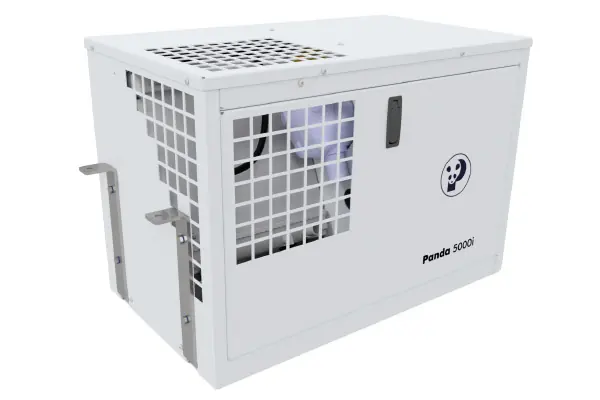
The i-Series covers 4.0 to 48.0 kW across models from the Panda 5000i and 5000i.Neo up to the 60i, using a permanent-magnet synchronous alternator whose speed varies with load, typically in a band of roughly 2,200 to 3,250 rpm, rather than the fixed 1500 or 3000 rpm most rivals run at. Fischer Panda's own marketing claims this cuts fuel consumption and emissions by up to 30 percent against fixed-speed equivalents, a manufacturer figure not independently verified by any test found in this research. The x-Series runs a fixed 3000 rpm, seawater-cooled, asynchronous or permanent-magnet alternator across 3.4 to 27.0 kW, described in company literature as carrying dual-circuit cooling with a seawater heat exchanger and wet exhaust. A representative small unit, the Panda 5000i.Neo, is rated at 4.0 kW nominal, weighs about 75 kg and is quoted at 54 dB(A) measured at 7 metres by the manufacturer's own brochure, though a second retailer datasheet for the same unit gives 64 dB(A) at 3 metres and 68 dB(A) at 1 metre, figures that are internally consistent with each other rather than contradictory once distance is accounted for.
The newer AGT-DC series, spanning 3.2 to 21.9 kW of DC output, is purpose-built for battery charging in short, targeted intervals rather than continuous AC supply, aimed at hybrid-electric propulsion systems; Fischer Panda announced a 48V serial hybrid system with drivetrain maker Molabo at METSTRADE 2025 built around this line. Across its full catalogue, including vehicle and special-power applications outside the marine range covered here, the company states its generators span 2.5 to 200 kW. Standard warranty on marine generators is 5 years with worldwide service and support, per Fischer Panda USA's own marketing copy, though the actual service network is described inconsistently across the company's own sources, one comparison citing fewer than 200 global service locations against a separate Fischer Panda release citing more than 150 dealers in the Americas alone plus distribution in over 80 countries, figures that describe different scopes rather than necessarily contradicting each other.
No price list exists anywhere. The one independent lab test that exists found the quiet generator was, at the time, one of the louder ones on the bench.
No price list anywhere, and dealer quotes that disagree by a factor of three
Fischer Panda's own FAQ system routes pricing questions to sales contacts or a dealer, and the company's dealer-facing quote process asks for vessel type, power rating, voltage, phase, largest starting load, installation dimensions and destination before any number is given, meaning every generator is effectively custom-priced per installation rather than sold off a catalogue. Individual dealer listings found in this research vary enormously for what appears to be a similar specification: an 8kW unit was found listed new at USD 19,550 by one US dealer and a nominally similar 8000i model at USD 6,590 by another online seller, a difference likely reflecting different included equipment, condition or era rather than a stable retail band. A UK retailer quotes the entry-level Panda 4000s Neo, 4kW, at circa GBP 3,900 plus VAT, the single cheapest current-era figure found in this research.
The one genuinely independent, dated price comparison available is eighteen years old: Victron Energy's 2007 Marine Generator Test recorded Fischer Panda's then-current fixed-speed units at ex-VAT list prices of EUR 7,072 for the 4000i, EUR 9,423 for the 8000 and EUR 11,523 for the 12000, against contemporaries such as Onan's 7.0 MDKBL at EUR 9,500 and Northern Lights' M773LW2 at EUR 10,010, putting Fischer Panda in the same broad band as its rivals rather than clearly cheaper or more expensive at that point in time. No manufacturer-published fuel-consumption-versus-load chart could be retrieved for any current model, and no published overhaul-hours or overhaul-cost figure exists anywhere in the company's public materials; oil and filter changes are recommended every 100 hours or once a season, with a first change earlier at 35 to 50 hours, though the company's own FAQ answers on this point are not fully consistent with each other.
The one independent test, and what it actually found
Victron Energy bought or borrowed seventeen marine generator models from Fischer Panda, Kohler, Mastervolt, Northern Lights, Onan, Paguro and Westerbeke and tested them side by side at BW Generator Techniek in the Netherlands, with the test rig supervised by TNO-EPS, described in the report itself as an independent and internationally recognised testing and certification organisation. The report's own conclusion on noise was blunt: one-cylinder 3000rpm generators in particular, and 3000rpm generators in general, produce substantially more noise than 1500rpm generators, and Fischer Panda's 3000rpm x-series units of that generation, along with the 2800rpm 4000i, landed in the noisier half of the field tested, with the two Northern Lights 1500rpm units coming out quietest overall. Fuel efficiency told a less brand-specific story: every engine tested was markedly inefficient at low load, topping out around 25 percent absolute efficiency even near full load, with specific fuel consumption around 600 g/kWh at 1 kW load dropping to about 350 g/kWh above 2.5 to 3 kW, a pattern true across every brand rather than a Fischer Panda-specific flaw.
That test is now eighteen years old and covers Fischer Panda's older fixed-speed hardware, not the current variable-speed i-Series that the brand's modern marketing rests on; no independent lab has re-tested the current range on noise or fuel consumption, which is a real and significant gap for a brand whose entire modern positioning is quietness. The one owner-reported fuel figure found for a current-era unit, a Hull Truth poster's roughly two-thirds of a US gallon per hour at full load on a Fischer Panda Mini 8 against a Westerbeke 8kW at 0.85 gph in the same thread, is a single anecdote rather than a lab measurement. On reliability and serviceability, forum consensus across multiple sources describes Northern Lights as favouring field serviceability and resale value with a simpler, slower-turning design, against Fischer Panda's own compact, lighter and quieter-in-principle but more electronically complex reputation.
A brand that splits owners sharply, and a site built to track the split
On Trawler Forum, one sailing-vessel owner called Fischer Panda units finicky and very noisy at 3600 rpm on a single cylinder, citing failed installations on a friend's boat and three Island Packet charter units of which none worked right, while separately praising his own Northern Lights 5kW unit's reliability at 1800 rpm; another poster running an FP 4200 for years reported some minor relay problems but an otherwise well-running, pretty quiet generator with responsive customer support, while acknowledging the brand as pricey. On the UK's YBW Forum, one owner reported two Fischer Panda generators that were both more trouble than they were worth, describing rectifier and inverter failures needing months-long repairs shipped back to Germany and one unit deemed obsolete despite being only a few years old; two other posters in the same thread independently identified exhaust valve seat corrosion, from exposure to hot saltwater, as a likely recurring failure mode, confirmed by a second owner's own FP 4000s needing a cylinder head removed for valve replacement.
SailNet Community threads document a Model 4000DVS owner logging not less than sixty telephone calls to the service department over four years with escalating cost and frustration, and reference a dedicated independent site, FischerPandaSucks.com, set up specifically to collect both the good and the bad on the brand, itself a notable indicator of how divisive the reputation is. A 2011 Cruisers Forum post observed that most of the negative reports circulating by that point were three to four years old, with posters suggesting the company had cleaned up its act since, a view echoed by a diesel technician quoted on a Hull Truth thread who attributed many call-outs to generators sitting unused for long stretches on part-time sportfishing boats rather than a pure design flaw, since the base diesel engine itself was independently described by multiple posters as simple and very reliable in isolation.
Información práctica
| Pricing is quote-only, and dealer figures disagree widely | No public list price in any market. Individual dealer listings for an 8kW-class unit have been found from USD 6,590 to USD 19,550. A UK retailer quotes the entry-level 4kW Panda 4000s Neo at about GBP 3,900 plus VAT, the cheapest current-era figure found. |
|---|---|
| Warranty and service | 5 years standard on marine generators, per Fischer Panda USA. Oil and filter change every 100 hours or once a season, first change earlier at 35 to 50 hours (company FAQ answers on the exact interval are not fully consistent with each other). No published overhaul-hours or overhaul-cost figure exists anywhere in the company's materials. |
| The one independent test on record | Victron Energy's 2007 Marine Generator Test, supervised by TNO-EPS, found Fischer Panda's then fixed-speed units noisier than 1500rpm rivals from Northern Lights and Onan, and every brand tested markedly inefficient at low load. The test is eighteen years old and does not cover the current i-Series. |
| Real alternatives | Northern Lights: independently measured quietest in the 2007 test, and forum consensus favours it for field serviceability and resale value. Cummins Onan and Westerbeke: priced in the same band as Fischer Panda in the 2007 comparison. Mastervolt Whisper: measured among the loudest units in the same test. |
| Known failure points to inspect | Exhaust valve seat corrosion from saltwater exposure, identified independently by multiple owners as a recurring fault requiring cylinder head removal. Rectifier and inverter electronics failures on some units, requiring factory repair in Germany. Faults concentrated on generators left unused for long stretches, per a diesel technician's own observation. |
| What is not published | No price list, no fuel-consumption-versus-load chart, no independent test of the current i-Series, no total unit-sales figure, and no reconciled figure for the size of the global service network. |
Lo que cuentan armadores y tripulaciones
Reliable in isolation, let down by electronics
An owner running an FP 4200 for years reported some minor relay problems but an otherwise well-running, pretty quiet unit, praising Fischer Panda's customer support directly while acknowledging the brand as pricey.
Trawler ForumThe specific mechanical fault two owners found independently
One poster identified exhaust valve seat corrosion, caused by exposure to hot saltwater, as a likely recurring failure mode and recommended a compression test as the first diagnostic step; a second owner's own FP 4000s confirmed the same pattern, needing a cylinder head removed for valve replacement.
YBW ForumSixty calls in four years, and why an entire complaint site exists
One documented account logged not less than sixty telephone calls to the service department over four years with escalating cost and frustration; the same broader community maintains a dedicated independent site, FischerPandaSucks.com, specifically to collect both the good and the bad on the brand.
SailNet CommunityUsage pattern, not just design, drives the fault rate
A diesel technician quoted in an owner thread said most of the problems he is called out to solve on Fischer Panda units stem from infrequent use, common on part-time sportfishing boats, rather than a flaw in the base diesel engine, which multiple posters independently called simple and very reliable in isolation.
The Hull Truth
Lo bueno y lo que conviene vigilar
Puntos fuertes
- A genuine engineering answer to generator noise and part-load wasteThe i-Series' variable-speed design, running roughly 2,200 to 3,250 rpm depending on load rather than a fixed speed, directly targets the low-load inefficiency that Victron's own independent 2007 test found universal across every brand tested, and the company's compact, water-cooled packaging (about 75 kg for the 5000i.Neo) suits tight engine rooms better than heavier fixed-speed rivals.
- A long standard warranty5 years on marine generators, per Fischer Panda USA, a genuine commitment against a category where warranty terms are otherwise inconsistently published.
- Responsive support, credited by at least one detailed owner accountOne Trawler Forum owner running an FP 4200 for years reported minor problems but praised Fischer Panda's own customer support directly, and a separate SailNet account records the service department recognising and promptly resolving a known component failure.
A tener en cuenta
- No published pricing anywhere, in any marketEvery generator is quote-only, and the dealer figures that do surface for nominally similar units disagree by a factor of nearly three, leaving a buyer with no way to sanity-check a quote against a public benchmark.
- The one independent noise test contradicts the brand's own marketingVictron Energy's TNO-EPS-supervised 2007 test found Fischer Panda's fixed-speed units noisier than 1500rpm rivals from Northern Lights and Onan, directly against the brand's Super Silent positioning, and no independent lab has re-tested the current i-Series since.
- A polarised reliability record, documented specifically rather than anecdotallyExhaust valve seat corrosion and rectifier or inverter electronics failures recur as named, specific faults across separate YBW Forum and SailNet threads, including one unit logging over sixty service calls in four years, serious enough that an entire independent site exists to track owner complaints.
- A real price premium versus named rivals, historically at leastThe one independent price comparison available, from 2007, priced Fischer Panda's units at or above contemporary Onan and Westerbeke equivalents, and at least one forum poster otherwise satisfied with the brand still called it pricey.
- No published fuel-consumption chart or overhaul costA buyer cannot check the company's own up to 30 percent fuel-saving claim against any published chart, and no source anywhere gives a major-service or overhaul cost, leaving the back half of ownership entirely unpriced.
Para quién es: Owners specifying a compact, variable-speed generator for a tight engine room on a 21 to 33 m yacht who value Fischer Panda's fuel-saving inverter technology, and who will get a written, itemised quote and check owner forums for their specific model generation before buying rather than relying on the brand's own noise claims.