Isotherm
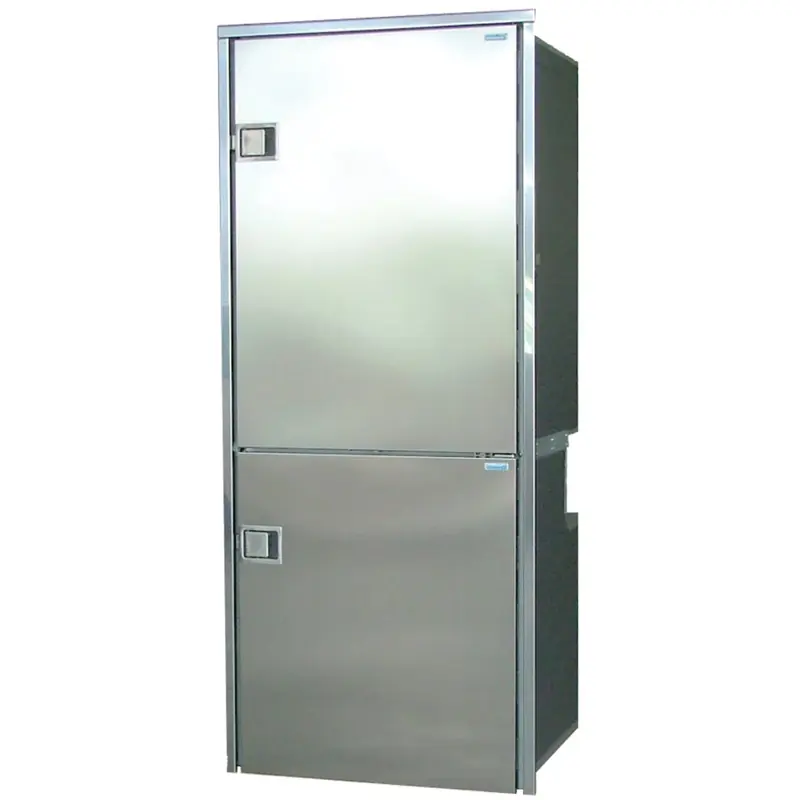
| Category | marine and yacht galley refrigeration - built-in drawer and cruise-style fridges and freezers, ice makers, a wine cooler, holding-plate systems and Isotemp water heaters |
|---|---|
| History | Isotherm is a brand of Indel B, founded in Italy in 1967; Indel B had sold its 100,000th refrigerator by 1975 and built a zero-gravity refrigerator for NASA's Space Shuttle Columbia in 1982 |
| Structure | Indel Webasto Marine is the joint venture between Indel B of Italy and Webasto of Germany, based around Novafeltria and Sant'Agata Feltria in Rimini province, and markets the Isotherm and Isotemp brand names |
| Ownership | Indel B has been part of the Berloni group since 1988 and listed on the Milan stock exchange since 2017, with more than 800 employees group-wide |
| Manufacturing | Italy, at the historic Sant'Agata Feltria site plus a newer plant at Secchiano di Novafeltria opened in 2021 |
| Scale | Isotherm's own material describes it as the choice of more than 160 major boat builders worldwide |
| Product range | the Cruise series (models 42 to 226), the Drawer series (49 to 190), Compact and Magnum conversion kits, ITC+ holding-plate systems (3201, 3251, 3701, 3751), ice makers, a wine cooler and Isotemp water heaters |
| Pricing | retail runs from about USD 919 for a small Compact conversion kit to more than USD 3,400 for a top stainless Cruise 195, confirmed across West Marine's 76-SKU catalogue and Fisheries Supply, both read September 2026 |
| Power | the Danfoss/Secop BD35F compressor used across the small Isotherm line draws about 3.75 amps at 12 volts, 45 watts, running, in the same band independently reported for modern 12V compressor fridges generally, 3.5 to 4.5 amps |
| Warranty | 5 years on the compressor, 2 years on all other parts |
Fifty-nine years of one Italian compressor company
Indel B started in Sant'Agata Feltria in 1967 and had sold its 100,000th refrigerator by 1975, a decade in which most boats still ran an ice box. The company's biggest credibility marker predates the marine business entirely: NASA selected Indel B in 1982 to build a refrigerator able to work in zero gravity for the Space Shuttle Columbia, which is the kind of reference a compressor maker does not buy, only earns. Indel B has been part of the Berloni group since 1988 and has been listed on the Milan stock exchange since 2017, and today runs more than 800 employees across vehicle, leisure, marine and hospitality refrigeration.
Indel Webasto Marine is the joint venture that actually sells Isotherm and its water-heater sibling Isotemp, pairing Indel B's compressor engineering with Webasto, the German automotive and marine climate supplier. It is based around Novafeltria and Sant'Agata Feltria in Italy's Rimini province, manufacturing at the historic Sant'Agata Feltria site and at a newer plant in Secchiano di Novafeltria that opened in 2021. Isotherm's own material claims the brand is the choice of more than 160 major boat builders worldwide, a figure the company publishes rather than one this desk can verify independently, but it lines up with how often the name turns up unprompted across owner forums for boats built by yards that never mention their fridge supplier in a brochure.
Twelve volts changes everything about the compressor
Passagemaker's own technical breakdown puts a number on the gap: a Danfoss BD35F compressor, the workhorse behind most small Isotherm units, draws about 3.75 amps at 12 volts, roughly 45 watts, and cools up to 12 cubic feet of refrigerator space or 5 cubic feet of freezer. Running a domestic 120VAC unit off an inverter instead means multiplying its AC amp draw by ten and then by 1.1 for inverter losses, so a 2.4 amp household compressor becomes a 26.4 amp DC load, nearly seven times an Isotherm BD35F pulling its full running current. That gap is why almost no cruising boat carries a household fridge off an inverter as its primary galley cooling.
The direct-drive units most Isotherm Cruise and Drawer models use cycle on and off, running an estimated 40 to 60 percent of the time depending on ambient heat and box insulation. Isotherm's holding-plate systems work differently: the ITC+ range freezes a eutectic solution inside a plate, and that stored cold keeps the box down for hours with the compressor off entirely. Sail Magazine's own comparison is blunt about the tradeoff: a holding plate system is relatively power hungry when it does run, so cruisers time it to when batteries are being charged, while a direct-drive unit's steadier, smaller draw is something a small solar array or an hour or two of engine charging covers easily. Insulation is the other constraint a yacht galley imposes that a kitchen never does. Passagemaker specifies 4 inches of urethane foam for a fridge and 6 inches for a freezer as standard, with vacuum-panel insulation buying the same performance in about a quarter of the thickness for roughly USD 1,000 a unit, useful where the cabinetry simply has no depth to spare. Yachting Monthly's own build guidance lands in a related but not identical place, recommending 50mm on the sidewalls, 75mm on the bottom and 25mm on the lid as a minimum, with 50 percent more again on a freezer compartment, and is explicit that insulation, not the compressor, is the single biggest factor in how many amp-hours a fridge actually draws over a day.
The same Danfoss compressor that keeps a weekend cruiser's beer cold cools a charter yacht's galley, and it fails the same way in both.
The range, and the price nobody publishes
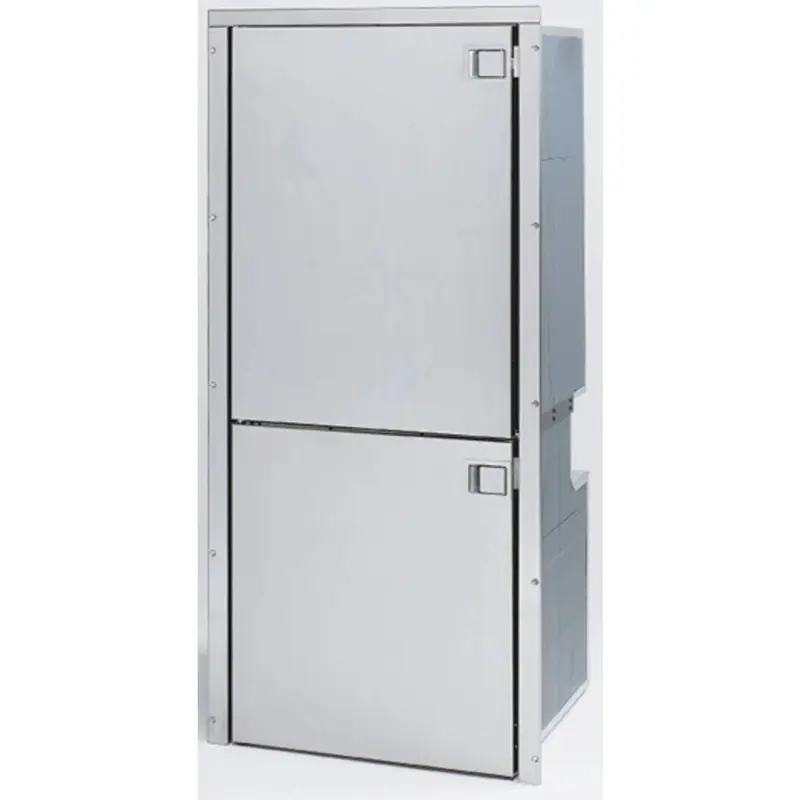
West Marine's live catalogue lists 76 Isotherm SKUs spanning that range: Compact 2010 and 2001 conversion kits at USD 919 and 1,029, mid-range Cruise 65 and 85 Elegance units around USD 1,400 to 1,670 and stainless Drawer and Cruise 195 models running USD 2,100 to 2,879. Fisheries Supply's separate listing cross-checks the top end, pricing a Cruise 130 Clean Touch stainless unit at USD 2,247.71 and a Cruise 195 at USD 3,477.05, both read September 2026, which confirms the top of the line runs comfortably past USD 3,000 at retail rather than being a West Marine-specific markup. Passagemaker's own figure for a small Cruise 36 drawer unit, just over USD 1,000, sits above a directly comparable Dometic CD-030 at roughly USD 800, so Isotherm is not the cheapest name in the category even at its smallest size. The range runs past cooling, too: Fisheries Supply prices a Clear Ice Maker at USD 2,185.35 and Isotemp basic water heaters, the sibling product line sold by the same joint venture, at USD 1,082.86 to 1,364.90, so a full galley refit under this one brand covers refrigeration, ice and hot water rather than fridge and freezer alone.
What none of those retailers, or Isotherm itself, publishes is a labor figure. Passagemaker's advice stops at a warning rather than a number: add the installation, and you are looking at some real money, with a marine yard or qualified electrician recommended for any job involving compressor relocation, a new ventilation path or wiring to ABYC standard. Custom galley integration is a different business again. Frigibar, which has built bespoke yacht refrigeration for more than 45 years, tells buyers to start with the exact dimensions of the space and the finish they want, then approach a manufacturer or builder directly for a quote, because nothing at that end of the market carries a published price until a yard has the actual cabinetry in hand.
What the compressor actually costs the battery bank
The clearest real-world number on record comes from a liveaboard owner who ran a 65 litre Isotherm Cruise-line drawer unit for six years and logged a 2.5 amp draw at 12 volts, translating to under 30 amp-hours a day even in hot, humid conditions, alongside a measured 38 decibel noise level she called whisper-quiet. That figure sits in the same band as Passagemaker's engineering number for the BD35F compressor itself, and against a typical cruising boat's daily budget of 60 to 200 amp-hours, an Isotherm drawer unit is a real load but rarely the one that decides the battery bank size.
The number only holds if the installation matches the unit to its locker. Trawler Forum's long-running thread on the Cruise 130 and 195 models describes owners whose fridges struggled to hold temperature not because the compressor was faulty but because it was undersized for the heat the cabinet had to shed, especially in a tight, poorly ventilated locker near an engine room. Fixes owners reported included adding intake and exhaust fans to the cabinet and re-tuning the analog thermostat down, and in at least one case a unit that could not hold vacuum was replaced outright under warranty. Heat rejection, not the compressor's rated amperage alone, is what decides whether the spec sheet number survives contact with a real boat in a real anchorage.
Same compressor family, different badge on the door
Owner debates on YachtForums and YBW Forum comparing Isotherm against Vitrifrigo rarely turn up a measured performance gap, because both brands specify SECOP or Danfoss compressors, both offer roughly one cubic foot drawer formats, and both use closed-cell polyurethane insulation of similar thickness. What tips an individual buyer tends to be which brand their local rigger stocks parts for, or which one came fitted from the yard, rather than anything in the cooling curve. Frigoboat, which competes in the same tier and is reported as the standard fit on Island Packet's production line, is in fact built by Vitrifrigo itself, so the three-way comparison many forum threads run is really a two-way one with a brand name layered on top. Isotherm's own answer to the same question is scale rather than a technical claim: a self-reported 160-plus boat builders using the brand, against Vitrifrigo and Frigoboat's smaller, more sailboat-concentrated OEM base.
The tradeoff that is specific to Isotherm's design is the quick-connect fitting between compressor and evaporator plate, which lets a unit ship precharged with refrigerant and be self-installed without brazing. YBW Forum's account of a 20-year-old Isotherm type 2001 failure traced the fault to exactly those fittings: the o-rings had degraded with age, the charge had leaked out slowly, and the owner was offered a GBP50 to 60 DIY recharge as a temporary fix, a GBP150 to 200-plus-parts professional repair with proper pressure testing, or a full GBP400 replacement, and chose the replacement rather than gamble on the same fitting failing again. The same design that makes an Isotherm compressor a bolt-in swap rather than a written-off galley is the reason a 20-year-old unit failed at a seal rather than at the compressor itself, and a buyer should read that as the fitting having a service life shorter than the compressor's own 5-year warranty implies about the unit as a whole.
Información práctica
| Published unit prices, by capacity | West Marine's live 76-SKU Isotherm catalogue runs from USD 919 for a Compact 2010 conversion kit to USD 2,879 for a Drawer 160 or Cruise 195 stainless unit. Fisheries Supply cross-checks the top end at USD 2,247.71 for a Cruise 130 Clean Touch stainless model and USD 3,477.05 for a Cruise 195, both read September 2026, confirming retail runs comfortably past USD 3,000 at the top of the range. |
|---|---|
| Where it sits against the mainstream alternative | Passagemaker's own figures put the small Isotherm Cruise 36 drawer unit at just over USD 1,000 against roughly USD 800 for a directly comparable Dometic CD-030, so Isotherm is not the cheapest name in the category even at its smallest size. |
| Installation labor is not a published number | Neither Isotherm nor its retailers publish a labor figure. Passagemaker's own advice is a warning rather than a price: add the installation and you are looking at some real money, with a marine yard or qualified electrician recommended for compressor relocation, a new ventilation path or wiring to ABYC standard. |
| Custom galley cabinetry integration adds real, unlisted labor | Frigibar, a custom yacht refrigeration builder of more than 45 years standing, tells buyers to start with the exact cabinet dimensions and finish wanted, then approach a manufacturer or builder directly for a project quote. Nothing at that end of the market carries a published price. |
| Power draw and the battery bank | The Danfoss/Secop BD35F compressor behind most small Isotherm units draws about 3.75 amps at 12 volts, 45 watts, running. One owner's six-year log on a 65 litre Cruise-line drawer unit measured 2.5 amps and under 30 amp-hours a day even in hot humid conditions, a real but not dominant slice of a typical cruising boat's 60 to 200 amp-hour daily budget. |
| Holding plate versus direct drive, priced | Sail Magazine's comparison puts a holding plate ITC+ system's running draw as relatively power hungry, timed to when the engine or shore power is charging, against a direct-drive Cruise or Drawer unit whose smaller, steadier draw a modest solar array or an hour or two of engine charging covers easily. |
| What a real repair costs | YBW Forum's documented case on a 20-year-old unit found the compressor-to-evaporator quick-connect o-rings had failed. The owner's options were a GBP50 to 60 DIY recharge, a GBP150 to 200-plus-parts professional repair with proper pressure testing, or a GBP400 full replacement, and the owner chose the replacement. |
| Compressor and parts warranty | 5 years on the compressor, 2 years on all other parts, per Isotherm's own published terms. The compressor is the expensive failure, so the longer cover sits on the part that matters most. |
| Noise, in a real installation | One owner measured 38 decibels on a 65 litre Cruise-line unit, genuinely quiet. Trawler Forum reports on the Cruise 130 and 195 describe the opposite outcome in a hot, poorly ventilated locker, where the compressor runs harder and louder than the spec sheet implies until owners add supplementary ventilation. |
| What is NOT published | No installation labor figure exists anywhere in Isotherm's own material or its retailers'. No compressor or bearing overhaul cost schedule is published. Large custom yacht galley refrigeration is not listed at all; that category is quoted per-project once a builder has the boat's actual dimensions. |
Lo que cuentan armadores y tripulaciones
A 20-year-old unit failed at the fitting, not the compressor
The quick-connect o-rings between compressor and evaporator plate on an Isotherm type 2001 degraded with age and leaked the charge out slowly. The owner weighed a GBP150 to 200-plus-parts professional repair against a GBP400 full replacement and chose the replacement rather than risk the same fitting failing again.
YBW ForumUndersized for a hot, tight cabinet until it was fixed by hand
Owners running the Cruise 130 and 195 reported the fridge struggling to hold temperature in poorly ventilated lockers, traced to the compressor working harder than the box could shed heat rather than to a fault in the unit itself. One defective fridge that could not hold vacuum was replaced under warranty, and fixes included adding intake and exhaust fans to the cabinet and re-tuning the analog thermostat.
Trawler ForumSix years, zero repairs, under 30 amp-hours a day
A liveaboard owner running a 65 litre Isotherm Cruise-line drawer unit for six years reported no repairs or maintenance beyond routine defrosting every other month, a measured 2.5 amp draw and under 30 amp-hours a day even in hot humid conditions, and a 38 decibel noise level. The one recurring complaint was an unreliable door latch that does not always engage securely.
Everywhere with ClaireHolding plate versus drop-in is a real fork, not a brand preference
A marine trade comparison found holding plate systems relatively power hungry whenever the compressor runs, which is why cruisers time them to engine charging, against a direct-drive unit whose smaller, steadier draw a modest solar array or an hour or two of engine time covers easily.
Sail MagazineCustom yacht galley integration has no price list, by design
A custom galley refrigeration builder of more than 45 years standing tells buyers to start with the exact cabinet dimensions and finish they want, then approach a manufacturer or builder directly for a quote, because nothing at that end of the market carries a number until a yard has the boat in hand.
Frigibar
Lo bueno y lo que conviene vigilar
Puntos fuertes
- A SECOP/Danfoss compressor backed by a 5-year warrantyIsotherm's small units run on the same Danfoss/Secop BD35F platform trusted across the marine and overlanding markets for durability and quiet running, and the compressor, the expensive part to replace, carries the longest cover in the warranty at 5 years against 2 years on everything else.
- Genuinely low real-world power draw, when matched to the boxOne owner's six-year log on a 65 litre drawer unit measured 2.5 amps and under 30 amp-hours a day even in the tropics, in line with Passagemaker's own engineering figure for the compressor, a real but rarely dominant slice of a typical 60 to 200 amp-hour cruising budget.
- Decades of engineering scale behind the brandIndel B has built compressor refrigeration since 1967, sold its 100,000th unit by 1975 and built a zero-gravity refrigerator for NASA's Space Shuttle Columbia in 1982, a reference that predates the marine refrigeration market it now leads.
- Field-serviceable by designQuick-connect fittings between compressor and evaporator let a unit ship precharged and be installed or swapped without brazing, which is why a 20-year-old failure on YBW Forum was a GBP400 fix rather than a written-off galley.
- One brand covers a drop-in swap through a full sailboat retrofitCompact and Magnum conversion kits under USD 1,000, the Cruise and Drawer lines through roughly USD 3,400, and ITC+ holding-plate systems for an owner building refrigeration into an ice box from scratch all sit under the same name and the same compressor family.
A tener en cuenta
- The equipment price is not the installed price, and nobody publishes the gapPassagemaker's own advice stops at a warning, add the installation and you are looking at some real money, rather than a figure, and neither Isotherm nor its retailers fill in the number a buyer actually needs to budget.
- It costs more than the mainstream alternative at the small endThe Isotherm Cruise 36 lists at just over USD 1,000 against roughly USD 800 for a directly comparable Dometic CD-030, a real premium for a name rather than a measured performance gap at that size.
- The serviceable fitting that helps also ages and leaksYBW Forum's 20-year case traced the failure to the compressor-to-evaporator quick-connect o-rings, not the compressor, which means the fitting has a service life shorter than the 5-year compressor warranty implies about the unit as a whole.
- A holding plate system is a real power and cost step upSail Magazine describes ITC+ holding plate systems as relatively power hungry whenever they do run, which forces cruisers to time compressor cycles to engine charging, a poor fit for a boat without spare charging capacity.
- The compressor can be undersized for the locker it is fitted intoTrawler Forum's Cruise 130 and 195 thread describes fridges struggling to hold temperature in hot, poorly ventilated cabinets until owners added supplementary fans, an installation defect that a correctly rated compressor alone cannot solve.
Para quién es: Owners specifying or retrofitting galley refrigeration on anything from a coastal cruiser to a crewed charter yacht who want a drop-in drawer unit or a full holding-plate system from one brand, provided someone checks the locker can actually shed the heat the compressor rejects.