Triton Submarines
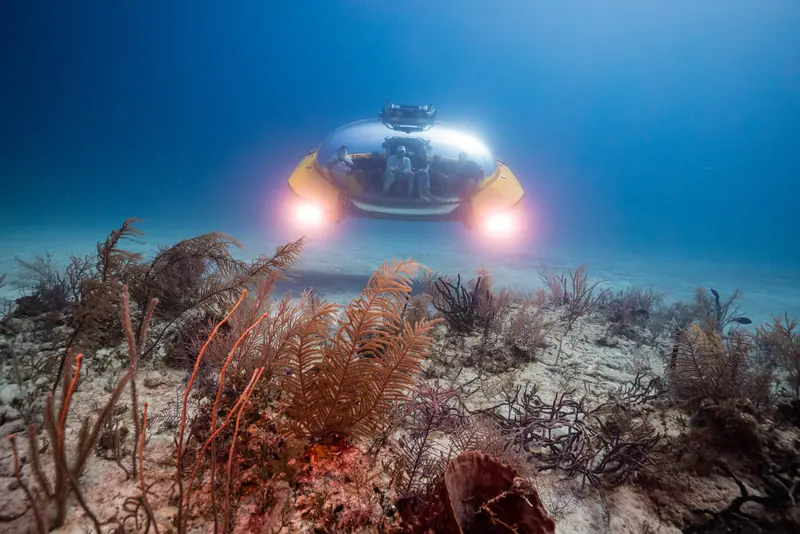
| Category | crewed acrylic-hulled personal submersibles, classed by DNV and ABS |
|---|---|
| Founded | 2008 by Patrick Lahey and L. Bruce Jones, building on Jones's earlier company U.S. Submarines Inc, founded 1993, which built the first two Triton 1000/2 units delivered in 2007 and 2009 |
| First customer | Chris Cline in 2006 |
| Headquarters and manufacturing | Sebastian, Florida, relocated from Vero Beach in 2019, plus a European facility in Barcelona, Spain (Triton Submarines EMEA) |
| Ownership | private; filmmaker James Cameron and investor Ray Dalio became minority shareholders in December 2022, after Dalio had provided emergency financing in 2012 |
| Range | about a dozen models across three series, from the 1000/2 MKII (305 m, pilot plus one) to the full ocean depth 36000/2 (10,928 m, two occupants) |
| 1650/3 LP | 500 m depth, pilot plus two, 4,000 kg, 12 hour endurance, built to fit a tender garage footprint |
| 3300/3 MKII | 1,000 m depth, pilot plus two, 8,000 kg, 12 hour endurance, 57 kWh battery, the bestselling model in the range |
| 7500/3 | 2,286 m depth, three occupants, 300 mm acrylic hull thickness, 10 plus hour endurance, the world's deepest diving acrylic-hulled submersible, first delivered to REV Ocean as Aurelia |
| Production | fewer than 25 submersibles delivered by August 2023 per co-founder Patrick Lahey, against a historic rate of one or two a year, now building three to six a year with capacity for four simultaneous builds |
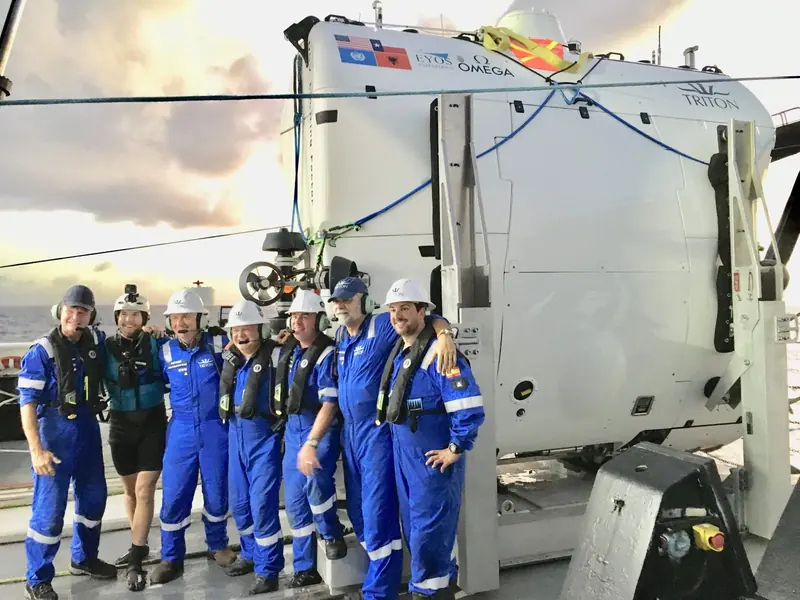
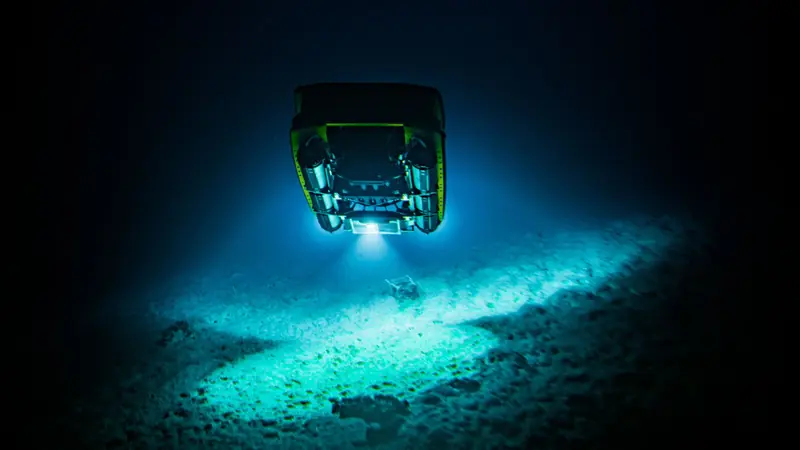
| Milestone | the Triton 36000/2, DSV Limiting Factor, completed the Five Deeps Expedition in 2019, the first vessel to reach the deepest point in all five oceans, touching 10,928 m in the Challenger Deep |
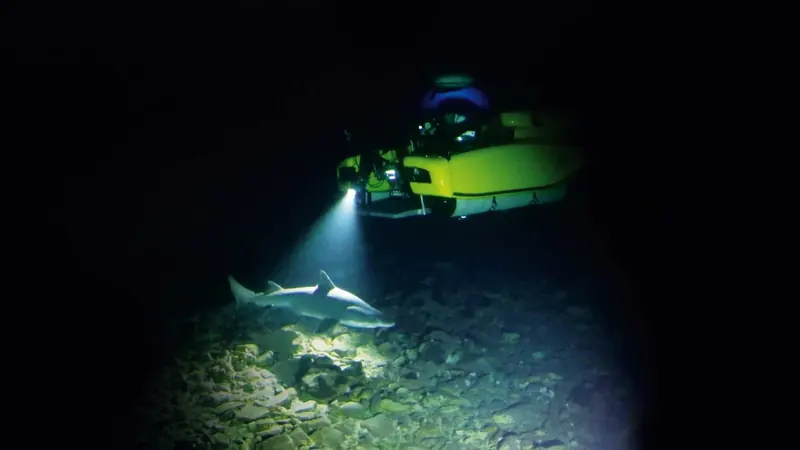
| Milestone | a Triton 3300/3 piloted by Jim Harris captured the first ever video of a live giant squid in its natural habitat off Japan's Ogasawara Islands in 2012, broadcast by Discovery Channel and NHK in January 2013 |
| Milestone | Project Neptune, a styling collaboration with Aston Martin on the 1650/3 LP platform, announced in Monaco in September 2017 |
From a Vero Beach workshop to full ocean depth
Jones became a consultant to the tourist submarine industry in 1987 and formed U.S. Submarines Inc in 1993, which designed and built the first two Triton 1000/2 units, delivered to the company's first customer Chris Cline in 2007 and to a second buyer in 2009. Lahey brought a commercial diving background stretching back to 1975 and had already worked on the design, engineering and testing of dozens of manned submersibles by the time the two men formally established Triton Submarines in 2008. The company grew on the back of its own sales rather than outside capital for its first years, a rarity in a business this capital intensive, until Ray Dalio stepped in with emergency financing in 2012 when Triton hit a cash crisis. Ten years later, in December 2022, Dalio and filmmaker James Cameron both became minority shareholders, a vote of confidence from two people with direct experience of deep-ocean engineering.
Triton moved its headquarters and manufacturing from Vero Beach to Sebastian, Florida in 2019 and added a European support and assembly facility in Barcelona, Spain, run as Triton Submarines EMEA. Output has grown from Jones and Lahey's original rate of one or two submersibles a year to three to six a year, with Lahey stating the company had capacity for four simultaneous builds and was closing in on 25 total deliveries as of August 2023. That is a small business by any normal manufacturing standard, and it is the reason a Triton still reads as bespoke rather than catalogue, even on a model the company has built more than a dozen times.
The three sizes a buyer actually chooses between
The 1650/3 LP is Triton's garage submersible: 4,000 kg, under 1.8 m tall, with a single lift point so an existing tender crane can launch and recover it, and a published 12 hour endurance. Triton built it specifically for owners who did not want to refit a tender garage to fit a submarine. The 3300/3 MKII is heavier at 8,000 kg and reaches three times the depth, 1,000 m, on the same three-person capacity and the same 12 hour endurance, running from a 57 kWh main battery. It is the model Triton itself calls its bestseller, and the eighth unit off the line was completed in a 10 month build, evidence the company has industrialised a design it once built one at a time.
The 7500/3 is a different proposition. Its pressure hull runs 300 mm thick, nearly a foot, to survive 2,286 m, and Triton markets it as the deepest diving acrylic-hulled submersible in production anywhere, with 10 plus hours of endurance for three occupants. The first unit went to REV Ocean, the 183 m research and expedition vessel, where it operates as Aurelia. Either side of these three sit the rest of the range: the entry-level 1000/2 MKII, a 3,000 kg two-seater rated to 305 m, the six and seven-seat 3300/6 and 1650/7 for owners who want to take more guests down at once, the free-form-hulled 660/9 AVA built for expedition cruise operators, and at the far end the 4000/2 Abyssal Explorer and the full ocean depth 36000/2, which are research and record-attempt machines rather than yacht toys.
The same company that built the only submersible to touch the bottom of all five oceans will not tell a buyer what a garage-sized one costs to buy or to run.
What a Triton actually costs
Yachting Magazine reported in May 2023 that the entry-level model runs around USD 2.7 million and the largest seven-seat configuration around USD 5.25 million. IEEE Spectrum separately put the 3300/3, the model most superyacht owners actually order, at roughly USD 3.8 million. Fast Company quoted Lahey directly pricing the 660/9 AVA, the free-form-hulled expedition-cruise model, from USD 6.35 million per unit, a figure The Manual repeated independently. None of these is a list price in the way Seakeeper or even U-Boat Worx's NEMO publish one; each is a snapshot a journalist got out of the company at a point in time, and a real quote today would need to come from Triton directly.
At the top of the range the numbers get harder to pin down and further from list prices. Larry Connor's Titanic-capable Triton 4000/2 Abyssal Explorer was widely reported in 2024, including by Forbes, at USD 20 million. New Atlas priced Victor Vescovo's full ocean depth 36000/2, the future DSV Limiting Factor, at a combined USD 48 million in 2018, a figure that bundles the submersible with its dedicated 68 m support ship rather than pricing the sub alone. Asked directly what a six-seat 3300/6 costs, New Atlas's own reporter could only get as far as it running well into the range of a really nice house. That sentence, more than any number in this section, is the honest answer a shopper gets before Triton returns a call.
Getting one aboard: hangar, crane and build time
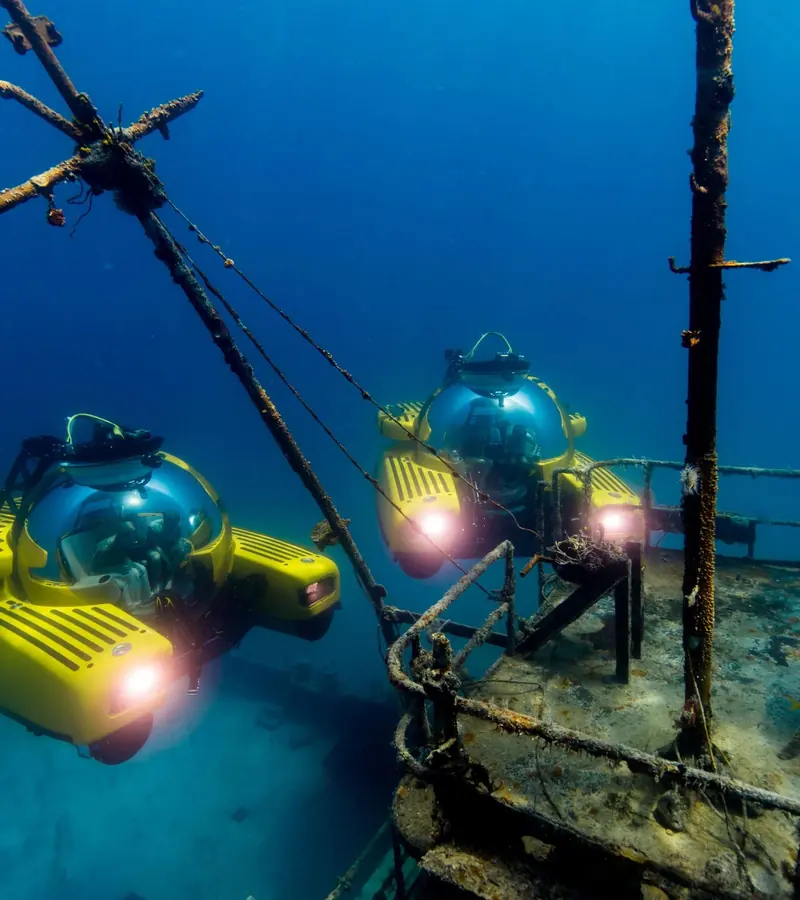
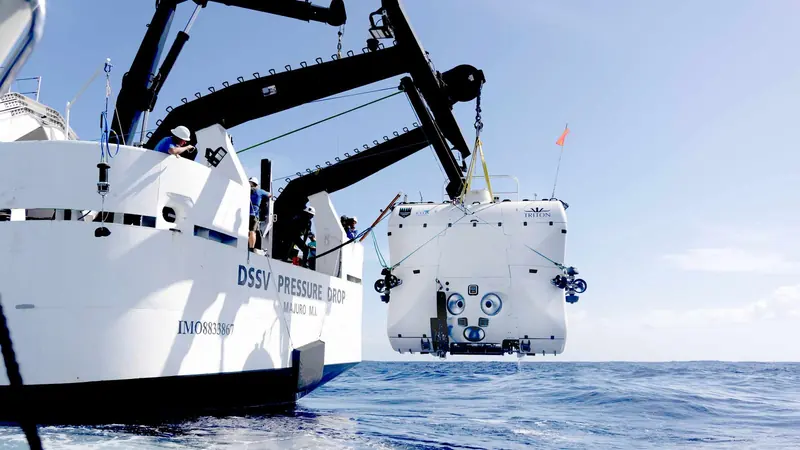
Even the 1650/3 LP, Triton's compact model, needs a single-point overhead lift roughly rated for its 4,000 kg weight, and its main ballast tanks are engineered so guests board and disembark from the swim platform rather than a dedicated dock, which still changes how that section of the yacht is laid out. The 3300/3 at 8,000 kg and the 3300/6 at 11,000 kg are heavier again, and Triton's own marketing concedes that submarine integration demands more forethought than a tender: garage dimensions, overhead clearance, crane or davit capacity, a launch and recovery system and a safe boarding arrangement all have to be fixed before the hull is cut, not chosen from a refit catalogue afterward. Some owners solve the problem outside the hull altogether. Damen built Five Oceans, delivered in 2024, with its own operational support container purpose-built to maintain and recharge her Triton 3300 independently of the mothership, and the container is transferable between yachts.
Lurssen's 126 m Octopus and Damen's 77 m La Datcha both carry Triton submersibles finished to match their yachts rather than off a shelf, which is normal for this end of the market: a Triton is built to order, and the interior trim, exterior colour and instrumentation are chosen alongside the depth rating. That customisation is also why lead times remain long by yacht-toy standards even as Triton has scaled up. The company's own record for the 3300/3, a design it has now built more than a dozen times, is a 10 month build. A less standard configuration, or a model further from the 3300/3's production line, should be expected to take longer, and Triton does not publish a lead time an owner can plan a delivery date against.
Classification, testing and who is allowed to pilot one
Triton submits its hulls, life support and every major system to DNV or ABS classification, with the class society's surveyors present from pressure hull fabrication through to commissioning rather than signing off a finished product. The company states each unit goes through more than 1,000 individual tests and checks before delivery, and that its combined team has more than 350 years of submersible design, production and operation experience and has logged upward of 25,000 dives between them. Those are the company's own figures, not an independently audited registry, but they are consistent with the fact that Triton-built submersibles, including the Five Deeps Expedition's DSV Limiting Factor, have completed dives to the deepest point on Earth without a fatality or a hull failure on record.
A pilot has to hold Triton's own certification before taking anyone else down, and Boat International's Marilyn Mower was told by Triton's then general manager Troy Engen, during a 2017 test dive off the Bahamas, that the basic course for a 3300/3 runs about 20 hours. Guests need no qualification at all; they sit inside a dry, one-atmosphere acrylic sphere and never feel the pressure change. Lahey has made certification the centre of how he talks about the business since the 2023 loss of OceanGate's Titan, a submersible that was never classed by any society. Testifying to a US Coast Guard hearing into the implosion in September 2024, Lahey said he had seen the Titan in the Bahamas in March 2019 and was not impressed, describing amateurish workmanship, and told the panel plainly that the certification process works and that Triton's own safety record proves it.
Where the record dives happened, and what that history buys a buyer
The Triton 36000/2, later named DSV Limiting Factor, carried Victor Vescovo to the deepest point of all five oceans between 2018 and 2019, including the Challenger Deep at 10,928 m in the Mariana Trench, the deepest crewed descent ever recorded. No other privately built submersible has repeated that feat, and the vehicle was later sold on and renamed Bakunawa under new ownership. Three years earlier, in 2012, a standard Triton 3300/3 piloted by Jim Harris carried scientist Tsunemi Kubodera to a face-to-face encounter with a live giant squid off Japan's Ogasawara Islands, a first that oceanographer Edith Widder's Medusa camera rig, deployed from the same expedition, had helped locate. Discovery Channel and NHK broadcast the footage in January 2013, and it remains the reference point for what a Triton can do beyond ferrying guests around a reef.
The rest of Triton's client list reads more like a research and hospitality roster than a superyacht toy shop. REV Ocean, the 183 m expedition and research vessel, ordered the first 7500/3, and Scenic Eclipse II, an expedition cruise ship, took delivery of the free-form-hulled 660/9 AVA in May 2024 after DNV certification, landing in Valparaiso, Chile to begin commercial dives for paying passengers. Aston Martin chose Triton's 1650/3 LP as the base for Project Neptune, a styling collaboration announced in Monaco in September 2017 that put automotive design language, rather than yacht-tender styling, on a submersible for the first time. None of that changes the specification sheet, but it is the difference between a company that has proven its machines against the ocean's hardest problems and one that has only proven them against a marketing brief.
Triton against U-Boat Worx
U-Boat Worx counts more than 60 submersibles in service, the largest private fleet in the world, against Triton's fewer than 25 as of August 2023, even allowing for Triton's faster recent build rate. U-Boat Worx also publishes one real number, EUR 1,650,000 excluding VAT for its entry NEMO as of July 2026, where Triton publishes nothing at all, leaving every buyer to work from press estimates years out of date or start a conversation with no reference point. U-Boat Worx has also opened a lower-commitment route into the category: a turnkey wet lease programme launched in 2025, bundling a submersible, pilot and insurance from around EUR 50,000 a month on a multi-year contract. Nothing comparable has been reported for Triton, so an owner who wants to try before an eight-figure order has fewer options with this builder.
Depth is where Triton pulls ahead. U-Boat Worx's standard range tops out around 300 m on the Super Yacht Sub 3, with its C-Researcher rated deeper at 3,000 m for a small number of expedition-grade builds; Triton's 7500/3 alone reaches 2,286 m as a standard production model, and the 36000/2 has proven full ocean depth. For an owner whose interest is reef and wreck diving inside a few hundred metres, that headroom changes nothing and U-Boat Worx's larger fleet, published price and wet lease option make it the easier company to buy from. For an owner who wants a machine capable of genuinely deep science-grade dives, or who wants the brand association of the only company that has been to the bottom of every ocean, Triton is the one with a track record to point to.
Información práctica
| Price, model by model, all press-sourced | Triton publishes no price list. Yachting Magazine, May 2023, put the entry two-seat 1000/2 MKII at around USD 2.7 million and a seven-seat configuration at around USD 5.25 million. IEEE Spectrum separately quoted roughly USD 3.8 million for the bestselling 3300/3. Fast Company quoted Patrick Lahey pricing the 660/9 AVA from USD 6.35 million, a figure The Manual repeated independently. Treat every one of these as a snapshot from the year it was reported, not a current list price. |
|---|---|
| The top of the range | Larry Connor's Titanic-capable Triton 4000/2 Abyssal Explorer was widely reported in 2024, including by Forbes, at USD 20 million. New Atlas priced Victor Vescovo's full ocean depth Triton 36000/2 at a combined USD 48 million in 2018, a figure that bundles the submersible with its dedicated support ship rather than the sub alone. |
| What integration actually requires | Garage dimensions sized to the model, overhead clearance, a crane or davit rated for the submersible's weight (4,000 kg for the 1650/3 LP up to 11,000 kg for the 3300/6), a launch and recovery system and a safe boarding arrangement, all fixed at the naval architecture stage. Damen built Five Oceans in 2024 with its own transferable support container to maintain and recharge her Triton 3300 independently of the yacht. |
| Build time | Triton's own record for the 3300/3, its highest-volume model, is a 10 month build for the eighth unit off the line. Historic output across the whole range was one or two submersibles a year; the company states it now builds three to six a year with capacity for four simultaneous builds. No published lead time exists for a first-time buyer to plan against. |
| Who can pilot it | Guests need no qualification and never feel a pressure change inside the one-atmosphere acrylic sphere. Triton's then general manager Troy Engen told Boat International in 2017 that the basic pilot course for a 3300/3 runs about 20 hours; Triton does not publish a fixed price or duration for training on its other models. |
| Classification and testing | Every model is classed by DNV or ABS, with surveyors present from pressure hull fabrication through commissioning. Triton states each unit passes more than 1,000 individual tests and checks before delivery. These are the company's own figures; no independent register of Triton's testing programme is published. |
| Running and service costs: what is NOT published | Triton states only that a submersible can remain in the water for months or years with minimised scheduled and reactive maintenance, and that service is available from its Florida and Barcelona facilities or on site worldwide. No annual service figure, no bearing or battery overhaul cost and no insurance band is published anywhere, in contrast to the itemised service tables some rival marine-equipment makers now publish. |
| A lower-commitment alternative does not exist here | U-Boat Worx launched a turnkey wet lease programme in 2025 from around EUR 50,000 a month, letting an operator or owner try a submersible before buying one. No equivalent Triton programme has been reported, so trying before ordering means chartering a yacht that already carries one, such as Octopus or La Datcha, rather than leasing from the builder directly. |
Lo que cuentan armadores y tripulaciones
A test dive that dispelled claustrophobia and found the sub rock steady
Marilyn Mower dived a Triton 3300/3 off the Bahamas with marine biologist Justin Hofman and Triton's then general manager Troy Engen piloting. She reported no ear pressure despite depth because the sphere holds surface pressure throughout, described the sub as rock steady and silent on the bottom, and watched a lionfish confront the craft and a trumpetfish hunt in a way neither the biologist nor the pilot had seen before.
Boat International (Marilyn Mower, October 2017)An independent scientist rated the handling on par with flying
Bioluminescence researcher Edith Widder, whose Medusa camera system helped locate the first ever filmed live giant squid from the same 2012 Triton-supported expedition, separately praised a Triton's maneuverability as top notch and compared piloting one to flying a helicopter, while noting that crewed submersibles remain unbeatable for venturing into genuinely unknown terrain compared with cheaper unmanned alternatives.
IEEE SpectrumThe giant squid encounter itself, from the people in the water
Pilot Jim Harris flew scientist Tsunemi Kubodera to a face to face encounter with a live giant squid off Japan's Ogasawara Islands in 2012, an 18 minute encounter during which the animal's skin shifted between gold and silver as it circled the submersible, the climax of a six week expedition that logged some 285 hours of dives near 3,000 feet.
Slate, reporting the Edith Widder expedition
Lo bueno y lo que conviene vigilar
Puntos fuertes
- The only private submersible builder with a full ocean depth recordThe Triton 36000/2, DSV Limiting Factor, reached the deepest point of all five oceans between 2018 and 2019, including 10,928 m in the Challenger Deep, a feat no other privately built submersible has repeated. That is engineering credibility no marketing budget can buy.
- Production has industrialised without losing certificationThe eighth 3300/3 was built in 10 months, and Triton states it now completes three to six submersibles a year with capacity for four simultaneous builds, up from a historic rate of one or two a year, all while keeping every unit under DNV or ABS class.
- A safety and science record independent of the sales brochureA Triton 3300/3 captured the first ever video of a live giant squid in its natural habitat in 2012, working alongside Edith Widder's Medusa camera system, and Triton submersibles now serve aboard REV Ocean and Scenic Eclipse II as working research and expedition tools, not just yacht toys.
- The founder has made certification the company's public argumentAfter the 2023 OceanGate Titan implosion, Patrick Lahey testified to a US Coast Guard hearing that he had seen the uncertified Titan in 2019 and found its construction amateurish, and argued publicly that classification is what prevents this kind of tragedy, putting Triton's own record behind the claim.
- The deepest standard production model on the marketThe 7500/3 reaches 2,286 m as a catalogue model, well beyond U-Boat Worx's standard 300 m range, for an owner whose interest runs to genuinely deep water rather than reef and wreck diving.
A tener en cuenta
- Total price opacity, worse than the rest of this marketTriton has never published a price for any current model. Every figure available, from USD 2.7 million to USD 20 million, comes from a journalist's interview at a point in time, not a list a buyer can check today, and even U-Boat Worx publishes one real number.
- Hangar and crane demands are severe even on the compact modelThe 1650/3 LP was built specifically to ease this problem and still weighs 4,000 kg and needs a rated single-point lift; the 3300/3 runs to 8,000 kg and the 3300/6 to 11,000 kg, so integration has to be designed into a yacht's garage and crane from the earliest drawings, not retrofitted.
- No published lead time, and a business still built one at a timeEven Triton's fastest documented build, the eighth 3300/3, took 10 months, and the company does not publish a standard lead time for a first order. A less common configuration should be expected to take longer with no published benchmark to check it against.
- No lower-commitment way to try one before buyingU-Boat Worx now leases submersibles from around EUR 50,000 a month with no long-term commitment. No Triton equivalent has been reported, so a prospective buyer's only way to experience the product short of ordering is chartering a yacht that already carries one.
- Running costs are entirely unpublishedTriton states maintenance is minimised by the ability to leave a submersible in the water for extended periods, but no annual service figure, battery or bearing overhaul cost, or insurance band appears anywhere in the company's own materials or in independent coverage.
Para quién es: Owners who want the deepest capability the private submersible market offers and are prepared to design the hangar into the yacht from day one, not owners looking for a fast purchase or a published price.