Zodiac Nautic
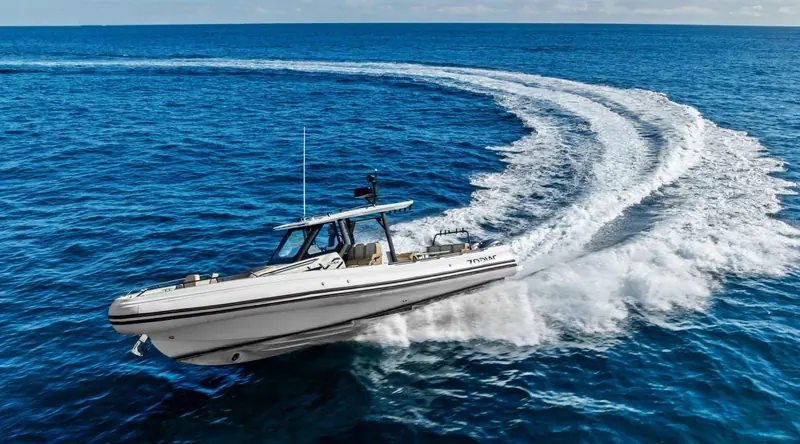
| Founded 1896 in France as an airship and aviation manufacturer; an engineer at the company, Pierre Debroutelle, built one of the first practical inflatable boat prototypes in the late 1930s | |
| The boating business split off from the aerospace-focused Zodiac Group as its own company in 2007 | |
| In July 2015, Zodiac Nautic was acquired by a group of entrepreneurs including current CEO Dominique Heber-Suffrin, separating it from Zodiac Milpro, the unrelated military and rescue-craft business that still carries the Zodiac name | |
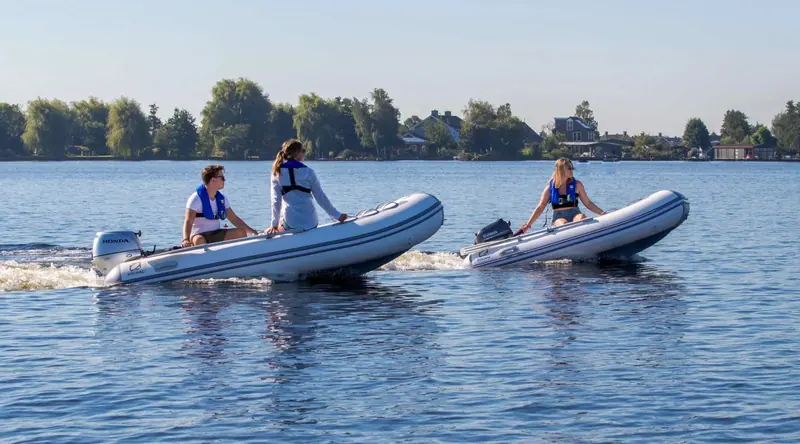
| Product range spans compact roll-up CADET tenders, the NOMAD and Medline RIB ranges, the higher-specification Yachtline series for use as a day boat rather than only ship-to-shore transport, and the eOpen range powered entirely by Torqeedo electric outboards | |
| The eOpen range uses Torqeedo Cruise electric motors, equivalent to roughly 12 hp, for a top speed of about 13 knots with no combustion engine aboard | |
| The N-ZO performance RIB line was designed by the Italian designer Vittorio Garroni, distinct from the brand's tender-focused ranges | |
| Secondary-market pricing tracked by Boat Trader puts the Yachtline range from about USD 5,900 to USD 42,000, averaging around USD 29,900, and the larger Medline range from about USD 33,000 to USD 249,998, averaging around USD 99,543 | |
| Zodiac Nautic is one of four related but separately owned brands carrying some form of the Zodiac name, alongside Zodiac Milpro (military and rescue) and other regional licensees, a split that regularly confuses buyers searching for parts or support |
From airships to inflatable boats, and a company that split in two
The Zodiac name began with a company built around airships and aviation, not boats, and the inflatable boat only entered the business through one engineer's prototype work in the late 1930s. That origin matters for how the brand still markets itself: welded rather than glued tube seams, presented as a direct inheritance from decades of inflatable-structure engineering rather than a recent manufacturing choice. The aerospace side of the original business and the boating side eventually diverged, with the boating division splitting off as its own company in 2007.
In July 2015, a group of entrepreneurs including current CEO Dominique Heber-Suffrin bought Zodiac Nautic outright, putting the tender and RIB business under independent ownership separate from any aerospace parent. That separation also means Zodiac Nautic is a different company from Zodiac Milpro, which makes military and rescue craft under a related version of the name, a split that regularly confuses buyers who search for parts, warranty support or company history and land on the wrong entity's material. Neither split is obvious from the Zodiac name alone, which is exactly why it is worth stating plainly here.
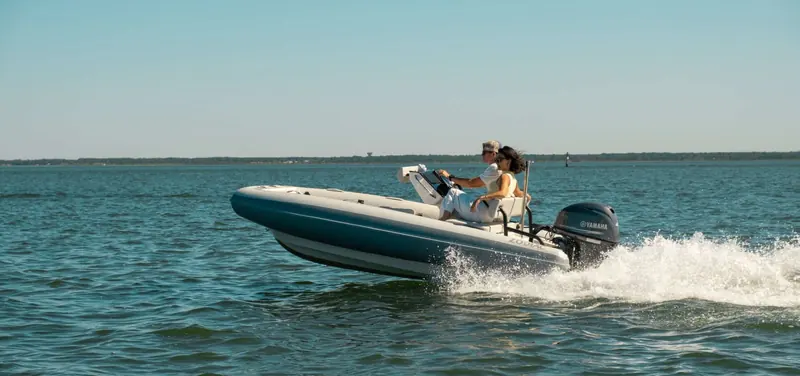
A wider range than most tender brands, electric included
CADET covers the compact, stowable end of the range, tenders built to fold or roll away on a smaller yacht rather than serve as a boat in their own right. Medline and the N-ZO performance line, designed by the Italian designer Vittorio Garroni, sit above that as RIBs built for actual cruising and performance rather than only shore transfers. Yachtline is positioned differently again: a day-boat range with lounge seating and a finish aimed at guests spending hours aboard rather than a five-minute ride to the beach.
The eOpen range is the brand's clearest point of difference from most tender makers: it runs entirely on Torqeedo Cruise electric outboards, equivalent to roughly 12 hp, for a top speed of about 13 knots with no fuel, exhaust or engine noise aboard. For an owner anchored somewhere that restricts combustion tenders, or who simply wants a quiet way to reach shore, that is a shipping product rather than a concept model, which is not true of every brand's electric tender announcement. A buyer choosing between eOpen and a conventional outboard tender should also weigh range and charging: an electric tender's 13 knot top speed and Torqeedo-rated capacity suit short hops to a beach or a nearby restaurant dock far better than a long provisioning run, and it needs a charging point aboard the mothership rather than a fuel can.
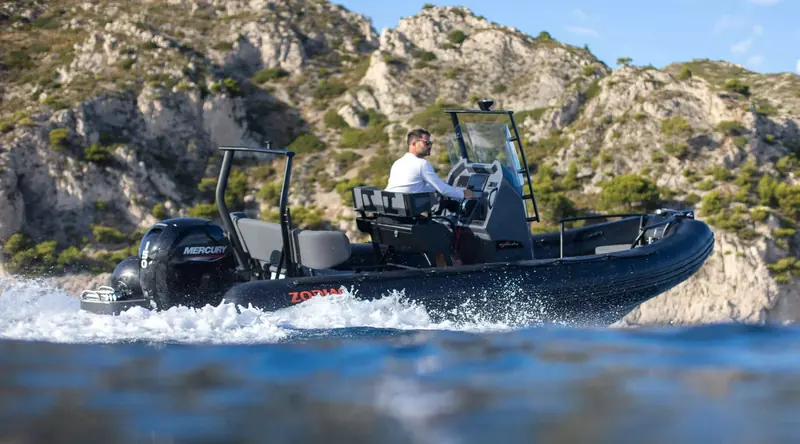
A century of inflatable-boat history, a genuinely electric range in eOpen, and a name split across companies that confuses buyers searching for parts.
What it costs, and what nobody outside the company has checked
Boat Trader's tracked resale data gives the clearest public price signal available: Yachtline models average around USD 29,900 across that USD 5,900 to USD 42,000 range, while Medline, a larger and more heavily equipped RIB line, averages around USD 99,543 across a USD 33,000 to USD 249,998 spread. New pricing depends on hull length, tube fabric, console fit-out and engine choice, and has to be quoted through an authorised dealer since Zodiac Nautic's own site does not carry a public price list.
The brand's central marketing claim, that its welded tube construction gives the range superior durability, is plausible given the company's specific engineering history, but no independent long-term fleet study or owner survey of the current Yachtline, Medline or CADET ranges was located to test it against. A buyer weighing Zodiac Nautic against another tender brand is, at the moment, weighing one company's own account of its durability against another's, not against independently verified data. Ask a dealer directly, and ask for it in writing.

One group, several brands, and where the confusion actually comes from
Reporting on the group describes four distinct brands under common ownership: Zodiac itself as the generalist, universal brand for both leisure and professional buyers; Bombard as the budget option, described by the group's own leadership as playing a similar role to Skoda in the car market, robust and simple rather than premium; Avon Marine as the brand aimed specifically at superyacht owners, built around electric and jet propulsion, including a fully electric tender called the Avon Ejet and a partnership with the yard Sanlorenzo; and Aka Marine, which sells exclusively into professional and military or security markets rather than to private owners at all.
That four-brand structure is a separate thing from the Zodiac Milpro naming overlap described earlier, and the two should not be assumed to be the same relationship: one is a deliberate group strategy of separate brands for separate market segments, the other is a historical split between companies that happen to share a name. For an owner specifically interested in an electric or jet-propelled superyacht tender, Avon Marine rather than Zodiac Nautic's own eOpen range is the group's dedicated answer to that market, worth checking directly rather than assuming the two ranges are interchangeable.
A military commission that became a generic word for an inflatable boat
Pierre Debroutelle, an engineer at the airship company, finished a small inflatable kayak in 1934 that caught the French Aeronavale's attention; the navy commissioned Zodiac to develop it into a boat capable of carrying torpedoes and other munitions. In 1937 Debroutelle designed the U-shaped inflatable hull still associated with the brand today, and it became the first inflatable boat certified by the French Navy. When Germany occupied France during the Second World War, Zodiac's war-related work went underground, and Debroutelle reportedly kept experimenting on the design in secret using scrap materials before the company publicly relaunched its U-shaped boats in 1946.
That military lineage did not stay in the past: the Zodiac Milpro Futura Commando 470, more widely known by its US military designation as the Combat Rubber Raiding Craft, remains in widespread military service and is commonly just called a Zodiac regardless of who actually built it, the way some brand names become the generic word for a category. That is a separate business today, but the underlying design tradition, and the reason the name carries the weight it does, traces directly back to Debroutelle's 1930s and 1940s work at the company Zodiac Nautic descends from.
What to check before buying a used Zodiac tender
Because Zodiac's own welded-seam construction is the brand's central durability claim, the seams themselves are the first thing worth a close look on any used example, along with UV degradation of the tube fabric, whether Orca-equivalent or PVC, since both fade and stiffen with age at different rates and a tube that has spent years uncovered in strong sun is a real cost to replace. The transom, where the outboard mounts, is the other classic stress point on any RIB and is worth checking for cracking or flexing under load rather than taking a static inspection at face value.
Given that Boat Trader's own tracked data shows the Yachtline and Medline ranges each spanning a price difference of six to seven times between their cheapest and most expensive examples, a low asking price on paper tells a buyer very little without service records for the engine and a clear history of how and where the tender was stored, covered or left exposed. That due diligence matters more on this brand than on some others precisely because Zodiac Nautic itself, as discussed above, publishes no factory price list to compare an asking price against. A sea trial at wide-open throttle, not just an idle-speed viewing at the dock, is the only reliable way to hear whether an outboard is actually sound, and it costs nothing to insist on one before money changes hands.
Información práctica
| What it costs | Zodiac Nautic does not publish a single retail price list across its full range. Secondary-market data tracked by Boat Trader shows the Yachtline range trading from about USD 5,900 to USD 42,000, averaging around USD 29,900, and the larger Medline range from about USD 33,000 to USD 249,998, averaging around USD 99,543. New pricing depends on hull length, tube material, console and engine choice, and should be quoted through an authorised dealer rather than assumed from any listing. |
|---|---|
| Choosing a range | CADET is the roll-up and compact tender line for stowage on a smaller yacht. Medline and the N-ZO performance line sit above it as RIBs built for cruising and performance rather than only ferrying guests ashore. Yachtline is the range built specifically as a day boat, with lounge seating and finish aimed at time spent aboard. The eOpen range is the brand's fully electric option, using Torqeedo Cruise motors for about 13 knots with no fuel or exhaust aboard, relevant on a yacht where a silent, zero-emission tender matters for anchorage etiquette. |
| What is not published | There is no independent long-term reliability or resale-value study of the current range, and Zodiac Nautic's own site does not carry a public price list, so every figure above other than the Boat Trader secondary-market data comes from the brand's own marketing rather than a verified third party. |
Solicitar presupuesto para Zodiac Nautic.
Dinos el modelo y adónde debe llegar. La redacción obtiene una oferta por escrito del fabricante o de un distribuidor autorizado, la contrasta con los precios publicados en esta página y te responde por email. Sin compromiso y sin coste.
- 01Una oferta por escritoEn tu moneda, con IVA, entrega y plazo indicados, no una cifra de catálogo.
- 02Entregado donde está el yateEn el puerto, el astillero o tu dirección, con la documentación que exige una batería de litio o una maniobra de grúa.
- 03IndependienteYotters no depende de ningún distribuidor, así que la oferta se compara antes de llegarte.
Lo que cuentan armadores y tripulaciones
Tube welding is the brand's own claimed differentiator
Zodiac Nautic markets its welded, rather than glued, tube seams as the reason for the range's durability, a construction detail that traces back to the company's decades as an inflatable-boat pioneer rather than a recent design choice.
Zodiac NauticNo independent long-run reliability study exists for the current tender range
General boating forums discuss individual Zodiac tenders and RIBs, but no independent long-term owner survey or fleet study of the current Yachtline, Medline or CADET ranges was found. Buyers comparing brands should weigh that gap against the marketing claims above rather than treat either as settled.
the desk
Lo bueno y lo que conviene vigilar
Puntos fuertes
- Over a century of specific inflatable-boat historyThe company's engineers built some of the first workable inflatable boat prototypes in the 1930s, and the welded-tube construction the brand still markets today is a direct continuation of that history rather than a recent claim.
- A genuinely wide range for one nameplateFrom roll-up CADET tenders through performance N-ZO RIBs to the fully electric eOpen and the lounge-focused Yachtline day-boat range, Zodiac Nautic covers a wider span of use cases than most single tender brands.
- A real electric option, not a conceptThe eOpen range is a shipping product built around Torqeedo's electric outboards, giving an owner who wants a silent, zero-emission tender an actual model to buy rather than a press-release promise.
A tener en cuenta
- The Zodiac name is split across unrelated companiesZodiac Nautic, separated from the aerospace-focused Zodiac Group in 2007 and independently owned since 2015, is a different company from Zodiac Milpro, which makes military and rescue craft under a related name. A buyer searching for parts, support or history can easily land on the wrong company's material.
- No independent reliability dataEvery durability and quality claim available comes from Zodiac Nautic's own marketing. No independent long-term fleet study or owner survey of the current range was found to check it against.
- No single published price listNew pricing varies by dealer and configuration with nothing centralised on the brand's own site, so a buyer has to go through a dealer for a real quote rather than compare models directly online.
Para quién es: An owner who wants a tender range wide enough to cover a roll-up dinghy, a performance RIB and a lounge-fitted day boat under one brand, and who is willing to get pricing and support through an authorised dealer rather than the brand's own site.