Awlgrip
| Category | two-part polyurethane and polyester urethane topside coating systems for yacht hulls, topsides and superstructures, plus matched primers, fairing compounds and clearcoats |
|---|---|
| Founded | 1973, when Merritt Boat and Engine Works of Pompano Beach, Florida sprayed the aircraft coating Alumigrip on two Eastern Airlines pilots' boats at their request; US Paint then took the product, renamed Awlgrip, to market |
| Ownership | a brand of AkzoNobel's Marine and Protective Coatings business, acquired by AkzoNobel in 2002 |
| Manufacturing and training | produced and supported through AkzoNobel's yacht coatings network, with dedicated Yacht Paint Application Centers in North America, Europe and Asia Pacific (Gold Coast City Marina, opened for the Asia Pacific region) |
| Range | topcoats (Awlgrip Topcoat, Awlcraft 2000, Awlcraft SE, Awlcraft 3000, Awlgrip HDT), clearcoats (Awlgrip HDT Clear, Awlcraft CS, Awlcraft 3000 Clearcoat), primers (545 Epoxy Primer), fairing compounds (Awlfair, Awlfair SF spray filler), varnish (Awlwood) and a protective sealer (AwlCare) |
| Topcoat price | roughly USD 200 to 380-plus per gallon depending on color and retailer, before the required catalyst and reducer |
| Full repaint quotes | commonly USD 200 to 400 per linear foot for hull topsides including prep, primer, base coats and clearcoat, with some yards and larger or more complicated hulls running USD 850 to 1,000 per foot |
| Warranty | tiered from 12 months on the standard system up to 36 months on Awlgrip HDT, all conditioned on gloss retention thresholds and on never polishing or buffing the finish with an abrasive |
| Awlgrip makes no antifouling coating of its own; AkzoNobel directs owners to its sister brands International and Interlux for everything below the waterline | |
Fifty Years From an Aircraft Coating to a Verb
The origin story is well documented on both sides: two Eastern Airlines pilots liked the look of Alumigrip on aircraft and asked Merritt Boat and Engine Works, a Pompano Beach yard, to spray it on their own boats. US Paint, which made Alumigrip, saw the result and decided to market a version for boats. The new name was picked at a bar table as Allgrip and garbled into Awlgrip when a secretary misread the handwriting on a napkin, and the accident stuck. By 1979 the company had shifted its focus from general industrial coatings toward the yacht and pleasure marine market specifically, and the brand grew from there into finishes, primers, fillers and varnishes across the following decades.
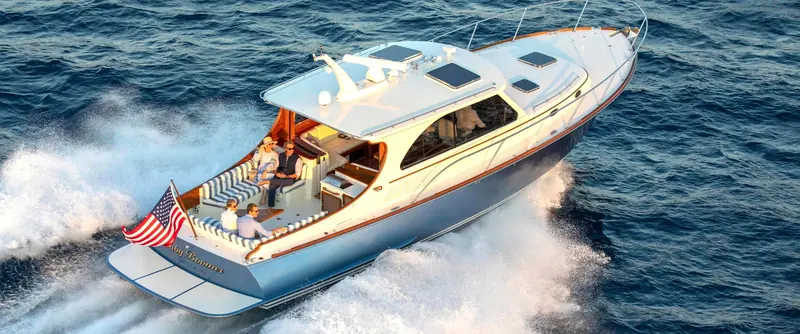
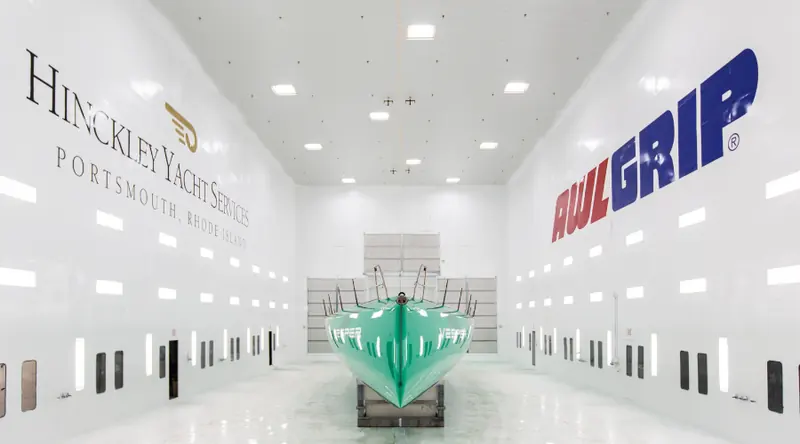
AkzoNobel, the Amsterdam-headquartered group that also owns International and Interlux, acquired Awlgrip in 2002 as part of a push to lead the global yacht coatings market, and Awlgrip is now run inside AkzoNobel's Marine and Protective Coatings business. The brand marked its 50th anniversary in 2023, and its longest-running yard relationship, with Hinckley in Maine and Rhode Island, has run the full 50 years, Hinckley naming Awlgrip its preferred premium topcoat throughout. The reputation is strong enough that people in the trade use the brand name as a verb: a boat gets Awlgripped, in the same way a name becomes shorthand for the whole category.
What Actually Happens When a Hull Gets Awlgripped
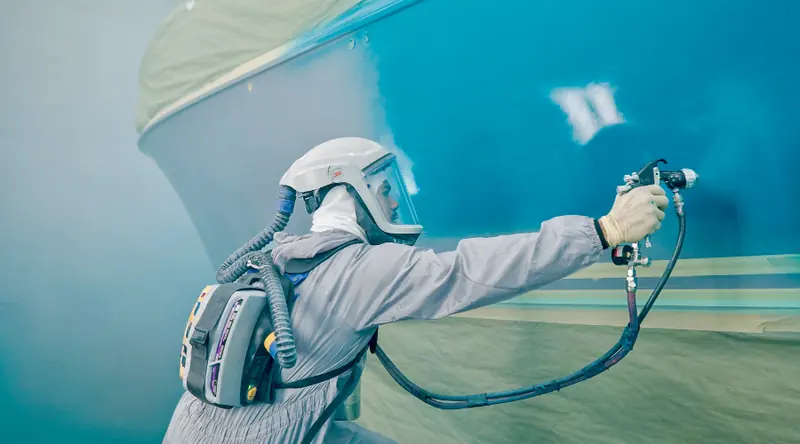
Awlfair, an epoxy-based fairing compound, goes on first wherever the hull needs correcting, with a low-density version (Awlfair LW) for thicker fills and a newer spray-applied version, Awlfair SF, that a shipyard can apply with a spray gun instead of a trowel. AkzoNobel and the applicator group Pinmar ran a public trial of Awlfair SF on a 30 meter superyacht hull at a shipyard in Bremerhaven, with Pinmar's technical team fairing and painting the starboard side over a 12 week project, specifically to prove the spray method against the trowel method side by side. Once the fairing is sound, 545 Epoxy Primer seals it, which the maker says maximizes gloss and color hold-out in the topcoat that follows.
The topcoat itself comes in two families with different hardness. Awlgrip Topcoat is a polyester urethane, sprayed in two coats to a wet film of roughly 4.5 to 6 mils for a 2 to 3 mil dry film, and it cures into an extremely hard, high-gloss single-stage finish. Awlcraft SE is a basecoat instead, fast-drying with metallic and pearl effects, paired with a separate clearcoat such as Awlgrip HDT Clear, which is spray-only and carries the brand's longest warranty. Ambient conditions matter more than most owners expect: the maker specifies a working range of roughly 13 to 41 degrees Celsius, and low temperature combined with high humidity can trigger a hazy surface by-product that has to be sanded back out before the job can be signed off, which is why a controlled, enclosed spray bay does more for the final result than any single product choice.
A hull described as Awlgripped, with the year named, reads to a buyer the way a recent engine survey does.

The Range, and What a Repaint Actually Costs
Retail topcoat prices run roughly USD 200 to 380 or more per gallon depending on color, plus a separate catalyst and, often, a reducer, so the raw material for an average 40 to 50 foot hull is a few thousand dollars before a brush or gun touches it. That number is almost beside the point. Owners comparing real quotes on the Sam's Marine Hatteras owners forum reported figures from around USD 850 a foot outside South Florida to roughly USD 1,000 a foot as not unreasonable for a full hull and deck job, with one poster naming the North Carolina yard Jarret Bay as a shop that could bundle a repaint with other refit work. A separate set of yard quotes gathered across boating forums puts a more typical enclosed-shop job at USD 200 to 400 a foot for prep, primer, base coats and clearcoat, with professional spray labor alone adding USD 3,000 to 8,000 on a 30 foot boat and USD 15,000 or more on larger or more complex hulls in expensive markets.
What separates the low and high ends of that range is preparation, not paint. Multiple independent yards and forum posters converge on the same point: prep is roughly 95 percent of the job, because a hull has to be stripped or scuffed, faired where it has print-through or old repairs, masked in full and primed before the topcoat ever gets sprayed, and consumables like sandpaper discs alone can run into the thousands. A boat presented fair and sound can cost half what a boat with hidden gelcoat damage costs, on the identical paint system, which is why two boats of the same length from the same yard can carry visibly different invoices.
What the Finish Actually Does for an Owner
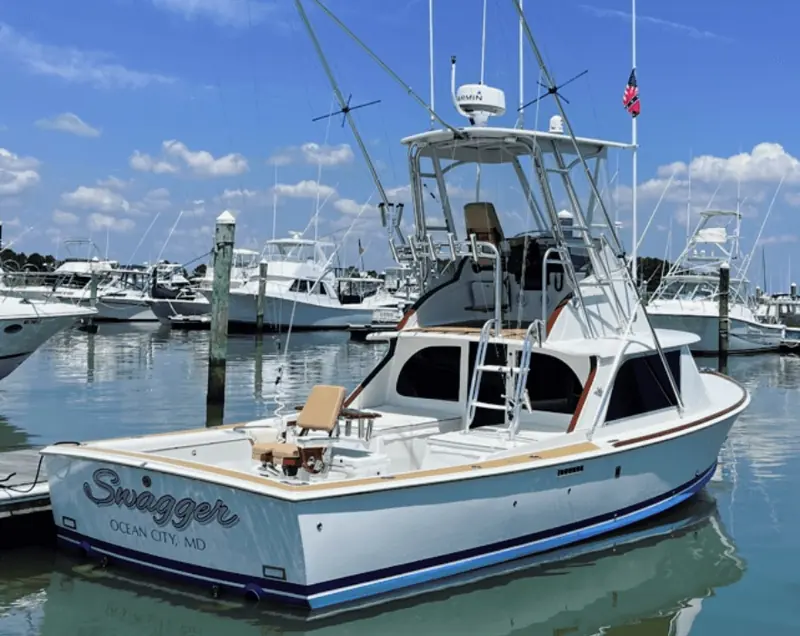
The polyester urethane chemistry is genuinely harder and more chemically resistant than gelcoat, and posters on the Trawler Forum comparing Awlgrip against the competing system Alexseal describe Awlgrip's surface hardness as incredible, even where they prefer a rival product's easier application or repair. That hardness is also why the brand carries the weight it does in the brokerage market: a hull described as Awlgripped, with the year of the job named, reads to a buyer as a maintained boat, in the same way a fresh set of sails or a recent engine survey does, and yards market the fact prominently in listings and refit case studies.
The tradeoff is that the hardness which protects the surface is the same property that makes it unforgiving to fix. A scuff or a UV-faded panel does not blend back in the way a buffed gelcoat repair can, so an owner is buying a finish that looks better for longer between incidents but is less forgiving when an incident happens. AkzoNobel's own answer to part of that problem is the softer Awlcraft 2000 acrylic urethane, sold specifically because it can be color sanded and polished much like automotive paint, trading a little of the hardest system's outright durability for a finish an owner or a general yard can actually touch up.

The Real Tradeoffs: Repair, Weather and the Warranty
Repair is the complaint that comes up most consistently across independent owner forums. A well-known rigger and marine writer known on Sailboat Owners Forums as Maine Sail has described Awlgrip's thin, hard resin layer as unsafe to buff or compound once it is scratched or chalked, and pointed to a real comparison of two neighboring boats where a 10 year old hull finished in the rival product Imron, buffed once, looked fresher than an 8 year old Awlgrip hull that had never been touched up. Awlgrip's own literature backs that account up rather than contradicting it: using an abrasive of any kind on the finish voids the Awlgrip limited warranty outright, which leaves an owner choosing between a compromised warranty and a dull patch of hull. On The Hull Truth, posters discussing touch-ups note there are very few applicators who do enough Awlgrip work to make a repair invisible, and that on a hard, single-stage system the more reliable fix is to scuff and respray a full panel rather than chase a small area. A YBW Forum poster living aboard an Aphrodite 42 described exactly that problem three years after a professional Awlgrip job, picking up ordinary liveaboard chips and scrapes and asking, without much success, how to blend a touch-up himself.
Application itself is weather-sensitive in a way that pushes the work toward specialist yards. The maker's own data sheets set a working window of roughly 13 to 41 degrees Celsius, note that low temperature paired with high humidity can leave a hazy by-product on the surface that must be sanded out, and warn that over-relying on the fast reducer in hot, humid conditions risks a hazy, lower-gloss result from trapped moisture. That sensitivity is also a regulatory exposure: the topcoat's base and converters carry stated VOC content, and Awlgrip sells VOC-exempt reducers specifically so applicators can keep working in tightly regulated markets such as California, which signals how close standard two-part isocyanate systems sit to current air-quality limits. The warranty reflects all of this in its structure rather than papering over it: cover runs from 12 months on the standard system up to 36 months on Awlgrip HDT, gloss has to stay above 60 to 80 percent of its original reading depending on the tier, a claim has to be reported in writing within 30 days of being noticed, and yachts over 30 meters require a signed warranty and, above 50 meters, a formal pre-project meeting between owner, yard and Awlgrip before the job even starts.
Against Gelcoat and Vinyl Wrap, and Who Should Choose It
A vinyl wrap is the cheapest and fastest of the three: small boat wraps start around USD 1,500 and a typical 25 foot center console runs roughly USD 3,000 to 5,000 in premium film, installed in three to seven days, but the film itself is rated for roughly five to seven years before it needs replacing and it is protecting the gelcoat underneath rather than replacing it. A full Awlgrip system on a comparable boat starts around USD 15,000 and can clear USD 30,000 once the hull needs real fairing, and the boat is typically out of commission for two to four weeks rather than days, but the finish is reported to outlast gelcoat by roughly two to three times and does not need replacing on a wrap's five to seven year cycle.
None of that makes Awlgrip the right choice for every owner. A boat being sold within a season or one being wrapped for a specific look or livery is better served by vinyl, and a boat with sound, glossy factory gelcoat gains little from a premium repaint beyond color changes. The owners who get the most from the system are the ones planning to keep a boat long enough for the extra years of gloss retention to matter, or a seller who wants Awlgripped and a date to appear in the listing, and who can find, or already work with, a yard experienced enough to control the spray environment and to avoid leaving them with a finish nobody can touch up cleanly afterward.
Informations pratiques
| Topcoat price, published by retailers | Awlgrip Topcoat and Awlcraft 2000 run roughly USD 200 to 380 or more per gallon depending on color, with darker and specialty colors at the top of the range. A separate catalyst and, often, a reducer are required and sold separately, so the base gallon price is not the full material cost. |
|---|---|
| What a full repaint actually costs, and why labor dominates | Real yard quotes gathered from owner forums cluster around USD 200 to 400 per linear foot of hull for prep, primer, base coats and clearcoat, with professional spray labor alone adding USD 3,000 to 8,000 on a 30 foot boat at most yards. Owners on the Sam's Marine Hatteras forum reported complete hull and deck jobs from about USD 850 a foot outside South Florida to roughly USD 1,000 a foot elsewhere. Multiple independent sources agree that preparation, not the spray coat, is roughly 95 percent of the labor, so hull condition moves the price far more than the paint choice does. |
| Maintenance and recoat interval | There is no fixed recoat interval published by the maker. AwlCare, a protective sealer, is sold to extend gloss life against acid rain, pollutants and abrasion between jobs, and Awlgrip's own care guidance is to hand wash and avoid any abrasive; how many years pass before a panel needs respraying depends on climate, berth and how it is cleaned, and owner reports of 8 to 20-plus years on a single job both appear in the forums cited here. |
| What voids the warranty | Using an abrasive of any kind, including ordinary buffing or polishing compound, voids the Awlgrip limited warranty outright. Acrylic Teflon coatings, mechanical damage, welding nearby, improper cleaning, substrate flexing and antifouling coatings applied without the correct barrier are also specifically excluded. |
| Warranty length and what it actually requires | Cover runs from 12 months on the standard Awlgrip system up to 36 months on Awlgrip HDT, with gloss required to stay above 60 to 80 percent of the original reading depending on the tier. A claim must be reported in writing within 30 days of being noticed. Boats between 30 and 50 meters need a signed warranty in advance and boats over 50 meters require a formal pre-project meeting between owner, yard and Awlgrip. |
| The system options beyond a plain topcoat | Awlcraft SE adds metallic and pearl basecoat effects under a separate clearcoat. Awlgrip HDT is the hardest, highest-gloss single topcoat in the range and carries the longest warranty. AwlMatch and an online color-formulation database let a yard match or create a custom color on demand rather than choosing only from the standard chip range. There is no ceramic-branded coating in the Awlgrip line; HDT is the closest the brand offers to that positioning. |
| Application conditions that decide the outcome | The maker specifies an ambient working range of roughly 13 to 41 degrees Celsius. Low temperature with high humidity can raise a hazy surface by-product that must be sanded out before the job is finished, and hot, humid conditions require adjusting the reducer mix or risking a lower-gloss result from trapped moisture, which is why the work is done in controlled, enclosed spray bays rather than in the open. |
| What is below the waterline is a different brand entirely | Awlgrip does not make an antifouling coating. AkzoNobel pairs the topside system with its sister brands International and Interlux for bottom paint, so a full repaint quote from a yard is really two product lines and two sets of instructions, not one. |
| What is NOT published | Awlgrip publishes no standard labor-hour figure and no fixed repaint price list; every full-job quote is yard-specific and depends on hull condition, access, location and season, which is why the forum figures above vary by a factor of four. The maker also publishes no independent third-party gloss-retention study; the gloss figures behind its own warranty tiers are its own measurement standard. |
Ce que rapportent propriétaires et équipages
A rigger's side-by-side comparison favors the rival that can be buffed
Maine Sail has written that Awlgrip's thin, hard resin layer cannot safely be buffed or compounded once damaged, and described a real comparison of two neighboring boats where a 10 year old hull finished in the competing product Imron, buffed once, looked fresher than an 8 year old Awlgrip hull that had never been touched up.
Sailboat Owners ForumsReal repaint invoices run from about USD 850 to USD 1,000 a foot
Owners comparing actual quotes reported a complete hull and deck job at roughly USD 850 a foot outside South Florida, with another poster calling USD 1,000 a foot not unreasonable for a full job, and naming the North Carolina yard Jarret Bay as a shop that could bundle a repaint with other refit work.
Sam's Marine Hatteras Owners ForumHardness versus repairability is the whole debate against Alexseal
Owners who have run both systems describe Awlgrip's surface hardness as incredible but say patching old paint with new paint is far easier on the rival Alexseal, and that applicators who are equally skilled on both tend to recommend letting the applicator work in whichever system he knows best.
Trawler ForumVery few applicators can make a repair disappear
Posters discussing touch-ups note there are very few pros around who do enough Awlgrip work to pull off an invisible repair, and that on the hard single-stage topcoat the more reliable fix for a damaged area is to scuff and respray a full panel rather than chase a small spot.
The Hull TruthOrdinary liveaboard wear shows up fast, and DIY touch-up is hard
An owner living aboard an Aphrodite 42 asked for help touching up minor chips and scrapes three years after a professional Awlgrip job, describing the damage as the kind that comes with living aboard and travelling, and got no simple answer for blending a repair himself.
YBW Forum
Les points forts et les points de vigilance
Points forts
- The brand name is a verb, and that reputation is fifty years deepAwlgrip has been the reference yacht topcoat since 1973, and its name is used as a verb in the trade, boats get Awlgripped rather than just painted. Hinckley alone has specified it as a preferred topcoat for the full 50 years, which is the kind of single-yard endorsement a coatings brand cannot buy with marketing alone.
- The hardness and gloss are real, not just marketingIndependent forum comparisons against rival systems describe Awlgrip's surface hardness as incredible, and the same hardness is what lets a well-applied job hold its shine for years longer than gelcoat under the same sun and salt exposure.
- It is an engineered system, not a single productFairing compound, epoxy primer, basecoat, clearcoat and a protective sealer are all designed to work together, down to a sprayable fairing filler trialled publicly with the applicator group Pinmar specifically to cut labor time on large hulls.
- A structured global applicator network backs the productAkzoNobel runs dedicated Yacht Paint Application Centers across North America, Europe and Asia Pacific to train applicators on the system, which matters because outcome depends heavily on who is holding the spray gun and how controlled the bay is.
- Real color flexibility, not a fixed chip rangeAwlMatch and an online formulation database let a yard match or build a custom color on demand rather than restricting an owner to a standard swatch card, and the basecoat and clearcoat system adds metallic and pearl finishes a single-stage topcoat cannot do.
Points de vigilance
- It is genuinely difficult and often impossible to touch upThe hard, single-stage topcoat cannot safely be buffed or compounded once scratched or chalked, using an abrasive on it voids the warranty outright, and independent forum posters note there are very few applicators who do enough Awlgrip work to make a repair invisible, so the practical fix for a damaged panel is often a full respray.
- The real cost is a lottery run by hull condition, not the paint brandOwner-reported full-job quotes range roughly fourfold, from about USD 200 a foot to USD 1,000 a foot, because preparation is roughly 95 percent of the labor. An owner cannot get a reliable number without a yard survey of the actual hull.
- Application is weather-sensitive enough to require a controlled bayThe working range is roughly 13 to 41 degrees Celsius, low temperature with high humidity can leave a hazy by-product that has to be sanded back out, and getting the reducer mix wrong in hot, humid air risks a lower-gloss finish, which pushes the work toward specialist yards rather than a general boatyard.
- Regulatory exposure on VOC contentThe standard topcoat's base and converters carry meaningful stated VOC content, and Awlgrip sells VOC-exempt reducers specifically to keep applicators legal in tightly regulated markets such as California, which signals the standard system sits close to current air-quality limits in parts of the US and Europe.
- No antifouling of its ownThe system stops at the waterline. An owner has to pair it with a separate AkzoNobel brand, International or Interlux, for bottom paint, which means two product lines, two sets of application rules and two warranty regimes on one hull.
Pour qui: Owners planning to keep a boat long enough for years of extra gloss retention to pay back the labor bill, and sellers who want the paint history itself to read as a maintenance signal.