Castoldi
| Catégorie | systèmes de propulsion par hydrojet marin et tenders à jet |
|---|---|
| Fondée | en 1962 |
| Basée | Albairate, Lombardie, à l'ouest de Milan |
| Site | 18 000 mètres carrés, dont 8 000 mètres carrés de halls de production et de bureaux, un bassin d'essai et une aire d'atterrissage pour hélicoptère |
| Hydrojets | neuf modèles Turbodrive, du Turbodrive 224 D.D. au Turbodrive 600 H.C.T. |
| Tenders à jet | quatorze modèles, du JT 14 au JT 34 LIMO |
| Plage de tailles | de 14 à 34 pieds, soit environ 4,3 m à 10,4 m |
| Variantes de sauvetage | JT 14, JT 18 et JT 19 proposés en version RB/SOLAS |
| Système qualité | certifié ISO 9001 |
| Agréments de classification | ABS, BV, DNV, RINA, RMRS et RRR |
| Marchés | superyachts, garde-côtes et militaire |
| Données publiées | Castoldi ne met ni poids, ni vitesses, ni prix sur ses pages de modèles publiques |
| Dry weight, from Castoldi's own range page, read July 2026: 790 kg for the Jet Tender 14, 1,270 kg for the 19, 1,580 kg for the 21, 2,480 kg for the 28 and 3,740 kg to 4,100 kg for the 34 LIMO | |
| SOLAS penalty | the RB/SOLAS variants weigh roughly 70 kg to 95 kg more than the equivalent guest boat, 860 kg against 790 kg on the 14 |
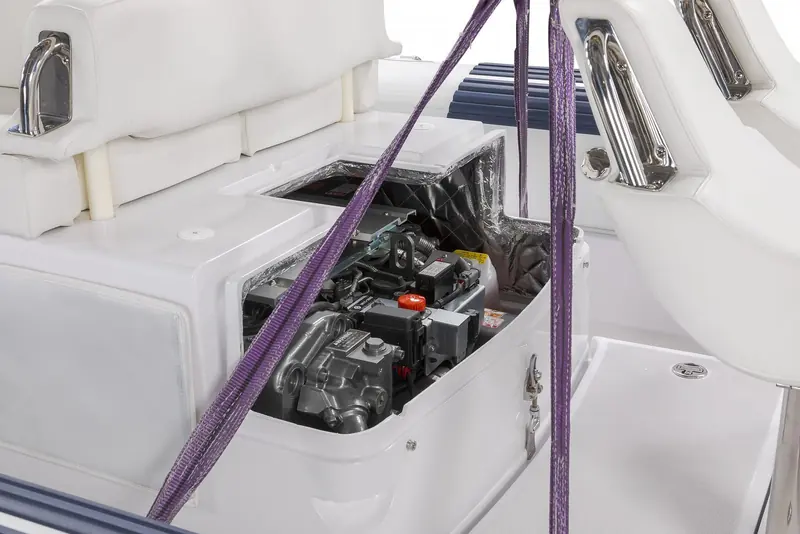
| Turbodrive 240 H.C.T., the drive in a Jet Tender 21: up to 309 kW or 420 mHP input, 238 mm impeller, 130 kg dry including gearbox, clutch, intake, duct, anodes and levers | |
| Waterjet unit dry weight ranges from 61.7 kg for the Turbodrive 224 D.D. to 1,700 kg for the 600 H.C.T. | |
| Intake protection | a movable grid at the duct water inlet, with the patented Clear-Duct system reversing the impeller and opening the grid together to back-flush the duct |
| US after-sales | Castoldi USA Inc., Seattle, announced 25 October 2022 |
| Not published | prices, lead times and any service-point directory by country |
La maison qui a fait fonctionner l'hydrojet
Castoldi a lancé ses recherches sur la propulsion par hydrojet en 1962 et se présente comme l'innovateur du système. L'affirmation se défend en ce que la société travaillait sur les jets pour petites unités quand presque personne d'autre ne le faisait, et qu'elle est restée sur le même problème depuis plus de soixante ans. Un hydrojet aspire l'eau sous la coque, l'accélère dans une pompe et la rejette vers l'arrière.
Ce qui le rend utilisable sur un tender, c'est le dispositif de direction et d'inversion. Castoldi construit des déflecteurs de poussée réversibles et un système capable de tenir une poussée neutre verticale indépendamment du régime de pompe, ce qui permet au bateau de rester immobile moteur tournant puis de partir dans n'importe quelle direction sans changement de rapport. C'est ce qui rend un tender à jet facile à manoeuvrer par un invité le long du bord.
Albairate
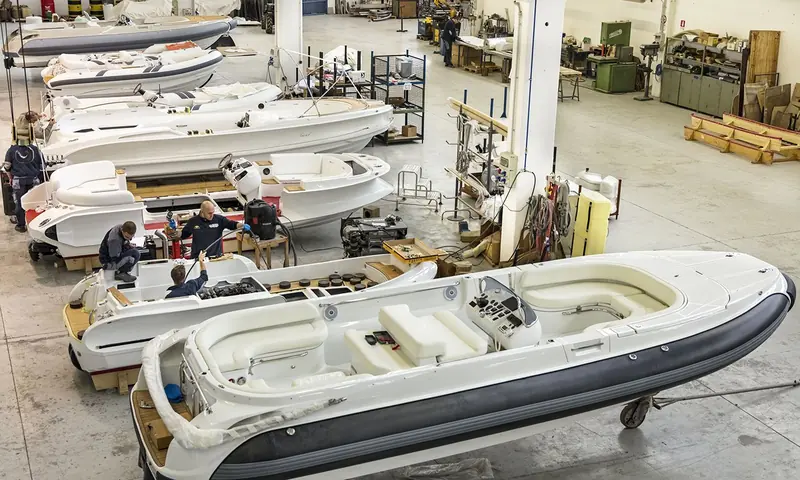
L'usine se trouve à Albairate, en Lombardie, à l'ouest de Milan, sur un site de 18 000 mètres carrés avec 8 000 mètres carrés de halls de production et de bureaux. Il y a un bassin d'essai sur place, ce qui est rare et dit quelque chose de la façon dont la maison développe ses produits. Il y a aussi une aire d'atterrissage pour hélicoptère, ce qui dit quelque chose de ceux qui viennent en visite.
L'exploitation est certifiée ISO 9001 et détient des agréments des principaux registres de classification, dont ABS, Bureau Veritas, DNV, RINA, le Registre maritime russe et le Registre fluvial russe. Ces agréments existent parce que les jets équipent aussi des unités commerciales et militaires, et ce sont eux qui font qu'un constructeur qui prescrit une propulsion Castoldi n'a pas à la justifier devant un expert.
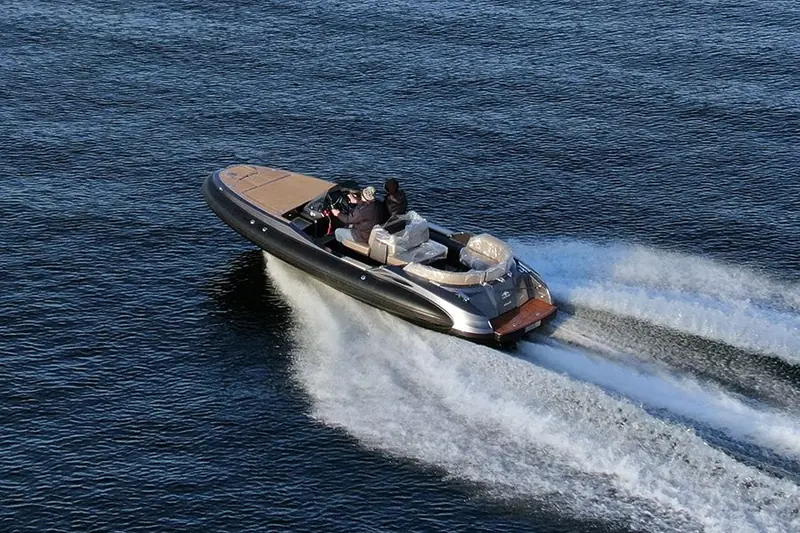
La propulsion qui permet à un tender de tourner au ralenti au milieu des nageurs, le plus souvent sous le sigle d'un autre.
Pourquoi un propriétaire doit s'intéresser à l'hydrojet
L'argument pratique, ce sont les nageurs. Un tender à hélice exposée ne peut pas tourner au ralenti en sécurité au milieu de gens dans l'eau, ne peut pas venir toucher un banc de sable, et ne peut pas être confié à un invité pour aller à la plage sans une conversation. Un hydrojet supprime ces trois problèmes, parce que rien ne tourne à l'extérieur de la coque. C'est pourquoi tant de tenders de superyachts sont à jet.
Le second argument est le tirant d'eau. Un bateau à jet cale moins qu'un bateau à ligne d'arbres ou à embase Z de même taille et entrera dans une eau peu profonde qui détruirait une hélice. Les inconvénients sont réels. Un jet est moins efficace qu'une hélice à basse vitesse, il avale algues et sacs plastique par la grille d'entrée d'eau, et la turbine est une pièce d'usure.
La gamme Turbodrive
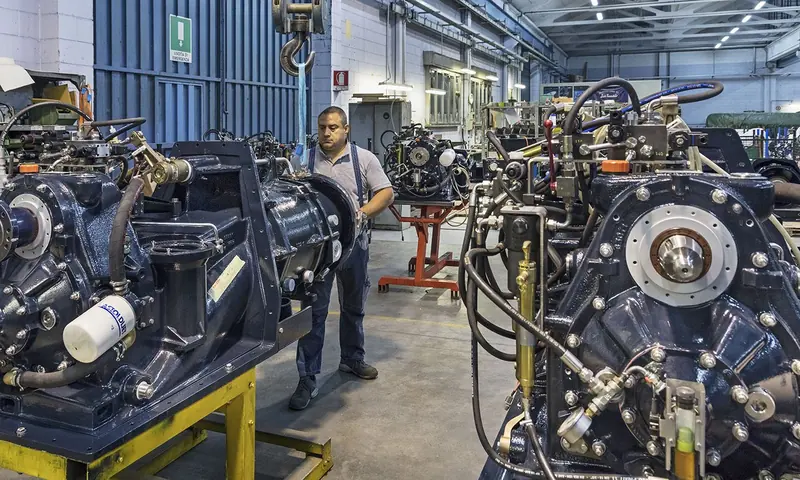
Neuf modèles Turbodrive couvrent la gamme, du Turbodrive 224 D.D. à l'extrémité basse jusqu'aux 240 et 284 en versions H.C.T. et L.V.T., au 340 H.C., aux 400 et 490 H.C.T. et au 600 H.C.T. au sommet. Ils sont vendus aux constructeurs de bateaux, si bien que la plupart des propriétaires rencontrent une propulsion Castoldi à l'intérieur du tender de quelqu'un d'autre.
C'est le fait commercial important sur cette maison. Un hydrojet Castoldi peut se trouver sous un tender construit par un chantier italien, britannique ou néerlandais, et le sigle sur le tableau arrière n'est pas Castoldi. Les propriétaires qui choisissent un tender doivent demander quelle propulsion est montée, parce que c'est elle, plus que la coque, qui détermine les pièces de service, la disponibilité des turbines et le comportement.
Les tenders à jet
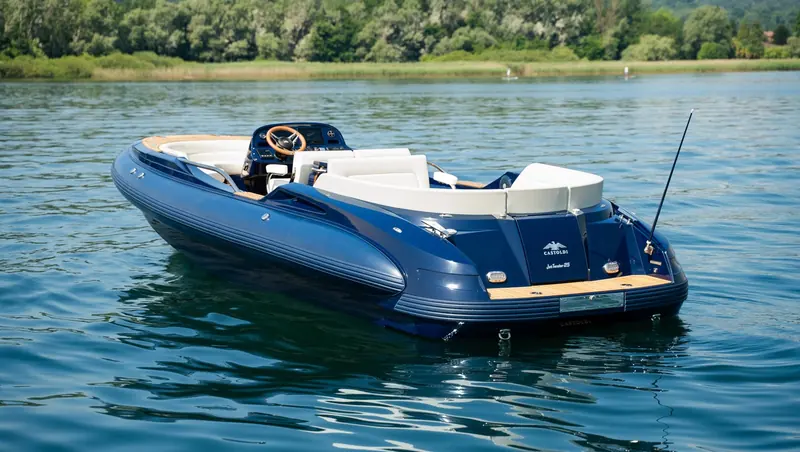
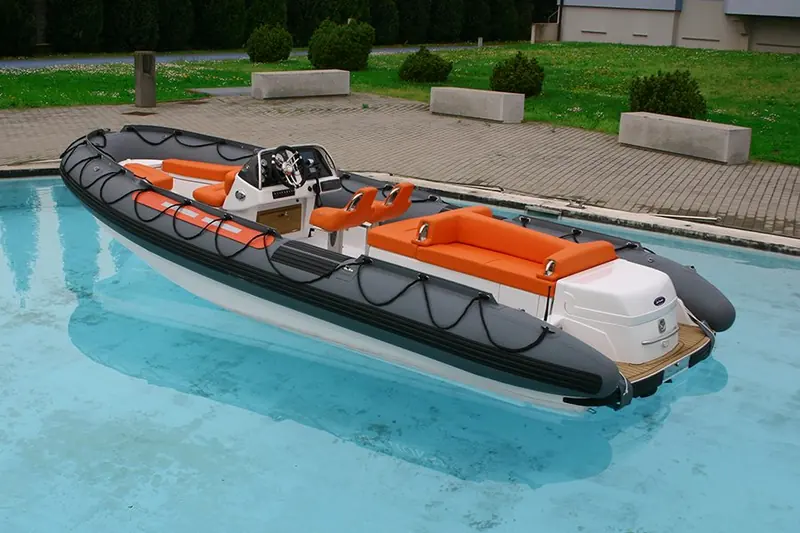
Castoldi construit aussi des bateaux complets. Quatorze modèles de tenders à jet vont du JT 14, environ 4,3 m, au JT 34 LIMO, environ 10,4 m, en passant par les JT 15, 16, 17, 18, 19, 21, 23, 25 et 28. Ce sont des semi-rigides à moteur diesel équipés des propres hydrojets de Castoldi, une combinaison inhabituelle sur un tender de yacht de cette taille.
Le diesel compte à bord. Un yacht dont les machines tournent au gazole et qui ne veut pas d'essence sur la plateforme de bain peut prescrire un tender à jet diesel et éviter entièrement un second carburant. L'échelle qui va d'un bateau de 4,3 m à une limousine de 10,4 m couvre l'essentiel de ce dont un yacht de 30 m et plus a réellement besoin, et la nomenclature progresse pied par pied, ce qui montre à quel point ces bateaux sont ajustés aux garages.
Les variantes de sauvetage SOLAS
Les JT 14, JT 18 et JT 19 sont proposés en version RB/SOLAS, construits comme canots de sauvetage au standard de la convention internationale. C'est un produit différent d'un tender pour invités. Un canot de sauvetage SOLAS doit pouvoir être mis à l'eau et récupéré dans des états de mer définis, doit se redresser seul ou rester stable une fois envahi, et doit être entretenu et inspecté selon un calendrier.
Pour un grand yacht, cela compte directement, parce que les navires immatriculés en commercial au-delà d'une certaine taille sont tenus d'emporter un canot de sauvetage conforme. Pouvoir acheter ce canot chez le même fabricant que le tender pour invités simplifie la formation, les pièces et le service. C'est aussi un rappel que l'ingénierie de Castoldi est validée sur un marché où une défaillance n'est pas un désagrément.
Ce que Castoldi ne publie pas
La société ne publie ni poids, ni vitesses, ni capacités, ni prix sur ses pages de modèles publiques. Les spécifications sont fournies sur demande par le chantier, le revendeur ou le constructeur. C'est normal pour une maison dont les clients sont surtout d'autres fabricants, et c'est gênant pour un propriétaire qui essaie de comparer un tender Castoldi à un Williams ou à un Novurania sur un écran.
La conséquence pratique est que la comparaison doit passer par le commandant ou le responsable de construction. Les chiffres qui décident du résultat sont le poids de levage plein de carburant, la longueur et la largeur face au garage, et le nombre d'invités que le bateau portera réellement. Quiconque établit une liste restreinte de tenders devrait exiger ces trois chiffres par écrit avant de trancher.
Service et pièces
La situation du service découle du portefeuille de clients. Comme les propulsions Castoldi sont montées par de nombreux constructeurs et par des exploitants commerciaux et militaires, les composants de jet et les turbines circulent dans une filière établie, et les mécaniciens marins italiens connaissent le produit. En Méditerranée, c'est à peu près le mieux que l'on puisse espérer pour une propulsion spécialisée.
Les Caraïbes sont plus maigres et la réponse pratique y consiste à garder à bord une turbine et une bague d'usure de rechange. Les pannes courantes en saison sur n'importe quel hydrojet sont l'obstruction de l'entrée d'eau et l'endommagement de la turbine par ingestion de débris, deux problèmes que l'on règle sur place avec un plongeur ou une sortie d'eau. Un vrai travail de pompe repart chez un spécialiste.
Face aux hors-bord, aux embases Z et à Williams
Pour un petit tender, la comparaison se fait avec Williams Jet Tenders, qui a bâti son affaire sur des tenders à jet essence dimensionnés pour les garages de yachts et que beaucoup de chantiers prescrivent en standard. Williams est la réponse de volume. Les tenders Castoldi sont plus lourds, diesel et plus proches d'un bateau de travail, et sa vraie portée passe par les propulsions montées dans les coques d'autres constructeurs.
Face à un hors-bord, un jet abandonne du rendement et de la simplicité et achète la sécurité autour des nageurs et l'accès aux petits fonds. Face à une embase Z, il abandonne de la poussée à basse vitesse et achète l'absence de tout élément vulnérable sous la coque. Sur un yacht où les invités se baignent depuis la plateforme et où le tender fait des allers-retours toute la journée, cet arbitrage penche en général du côté du jet.
Weed, sand and what the crew does about it
Every waterjet shares one failure mode. The intake is an opening in the bottom of the boat, and sooner or later it takes in weed, a plastic bag, a trailing line or a load of sand off a beach, at which point thrust falls away and the tender is unusable until it is cleared. Castoldi fits a movable grid at the duct water inlet on its drives to keep debris out in the first place.
What matters more is the drill after something gets past the grid. The Clear-Duct system reverses the impeller and opens the intake grid together, back-flushing the duct from the helm, and it is not reserved for the large commercial units: the Turbodrive 240 H.C.T. fitted to a Jet Tender 21 carries it. The consequence for a crew is that routine clearance is a lever at the console rather than somebody in the water with a knife, and only a blockage that survives a back-flush needs a diver. In a weedy anchorage that is worth more than a knot of top speed.
Price, lead time and the three numbers to get in writing
Prices and lead times are the real omission. Castoldi publishes neither, dealers quote on request, and the specialist tender brokers list every current model as built to order with no figure attached. Brokerage asking prices for used boats cover a decade of model years across a wide band and are no guide to a new hull or a refit replacement. Cost cannot be shortlisted from the websites at all, which is an argument for making the enquiry before the garage dimensions are frozen.
Three numbers decide the outcome and all three should come back in writing: lifting weight for the boat as actually fitted, length and beam against the garage opening and its door, and the guest number the boat will really carry. The published capacities are CE design category figures, 12 people on a Jet Tender 21 and 16 on a 25, which is not the number who will sit in one with towels, a cooler and a crew member driving. The drive model belongs in the same document, because it sets the spares list for the next ten years.
Informations pratiques
| Turbodrive unit pricing | No public list price. Distributor listings (e.g. the Turbodrive 490HC) show call-for-price / enquire-now -- this is a quote-only B2B market and Castoldi does not publish unit prices. |
|---|---|
| Jet Tender pricing (new) | No public factory price list found; Castoldi jet tenders are sold and specified through dealers, so new pricing is quote-only like the drive units themselves. |
| Jet Tender pricing (secondary market, for context only) | Used listings on DailyBoats (Europe) range from about $19,800 for the smallest models up to about $182,000; YachtWorld/Boat Trader show used Castoldi tenders from roughly $32,000-$42,000 up to $99,500-$318,000 depending on size and age. The two aggregators disagree on the top end, so treat this only as a rough band, not a reliable ceiling. |
| How a yard or owner specifies a unit | Through Castoldi's own dealer and qualified-service network rather than direct factory retail -- named distributors include Heavy Seas (UK, Castoldi Qualified Service), Golden Arrow Marine (UK), Performance Diesel and Maucour (France) and Varriale (Italy), several of which also stock Castoldi/Williams spare parts. |
| Service and parts network | Multiple independent marine distributors across Europe (UK, France, Italy, Germany via Maritimus) carry Castoldi/Williams jet-drive parts and offer qualified servicing, in addition to Castoldi's own factory support -- a broader independent-dealer network than a single-source OEM-only support model. |
| Comparable propulsion alternatives | At the small-craft end, Castoldi's largest Turbodrive (490 H.C.) tops out around 1324kW/1800hp. At the larger commercial/naval end, Kongsberg (Rolls-Royce) Kamewa waterjets scale from about 450kW to over 30,000kW with a stated average 15,000-hour interval between overhauls, and HamiltonJet focuses heavily on the passenger-ferry segment -- both operate mostly above Castoldi's leisure/patrol-boat scale rather than competing model-for-model on small tenders. No public price comparison was found between Castoldi and these alternatives, or between waterjet and propeller/sterndrive cost for an equivalent small tender; industry commentary consistently describes waterjets as carrying a higher initial and maintenance cost than propeller drives, but without a specific published figure. |
Demander un devis pour Castoldi.
Indiquez-nous le modèle et sa destination. La rédaction obtient une offre écrite du fabricant ou d'un revendeur agréé, la confronte aux prix publiés sur cette page et vous répond par email. Sans engagement, sans frais.
- 01Une offre écriteDans votre devise, TVA, livraison et délai précisés, pas un chiffre de brochure.
- 02Livré là où se trouve le yachtÀ la marina, au chantier ou à votre adresse, avec les documents qu'exigent une batterie lithium ou un levage à la grue.
- 03IndépendantYotters n'est lié à aucun revendeur : l'offre est comparée avant de vous parvenir.
Ce que rapportent propriétaires et équipages
Italian Coastguard patrol boat exceeded its design speed on a demanding delivery trip
FB Design's 16m CP335 patrol vessel, fitted with twin Castoldi Turbodrive 400 HCT waterjets, ran a winter delivery voyage from Venice to Puglia and recorded speeds up to 38 knots, higher than the designers' forecast maximum. FB Design's commercial director Ebe Buzzi credited the ease of installation and the performance of the units.
Marine Industry NewsGerman fisheries patrol authority runs twin Turbodrive 400 HCT on a North Sea patrol vessel
A 17m fisheries patrol vessel for North Sea duty in Germany was completed at Tamsen Maritim shipyard in Rostock with dual Castoldi Turbodrive 400 HCT installations, reported alongside the Italian Coastguard trial as one of two successful newbuild sea trials.
Marine Industry NewsIndependent sea-trial test of the Jet Tender 17 published real performance numbers
A road-test style write-up of the Castoldi Jet Tender 17 (170hp diesel with Castoldi waterjet drive) recorded 34 knots maximum light-ship and 32.5 knots fully loaded, describing it as a can-do RIB with the performance, reliability and safety of waterjet drive.
Yachting Magazine
Les points forts et les points de vigilance
Points forts
- No exposed propeller and near-zero draft restrictionThe waterjet has no rotating parts below the keel, so Castoldi tenders can land on beaches and cross sandbanks and are inherently safer to operate around swimmers and water-sports guests, a genuine differentiator over a shaft-and-propeller tender of the same size.
- High power density for the installed weightThe largest Turbodrive, the 490 H.C., is rated to take up to 1324kW (1800hp) of input power at a dry weight of about 890kg in an aluminum-alloy housing, giving a strong power-to-weight figure versus a comparable shaft/strut/propeller installation, corroborated by both the manufacturer's spec sheet and independent industry summaries of waterjet advantages.
- Proven at the high end of leisure/patrol speed envelopes, independently verifiedThe Turbodrive 400 HCT pushed a 16m coastguard patrol hull to 38 knots in a real winter sea trial, beating the naval architect's own forecast; this is a third-party (FB Design) verified result, not a manufacturer claim in isolation.
- Long, continuous manufacturing pedigree since 1962Castoldi states more than 40,000 units have been delivered worldwide since it began producing scaled waterjets in 1962 and mass-produced its first unit (Jet 05) in 1969; the company's waterjets also won long-distance offshore powerboat races in the 1970s-80s and powered the support boat for the 1992 transatlantic speed record attempt by Destriero, indicating decades of field-proven use rather than a recent market entrant.
Points de vigilance
- Waterjets lose efficiency to propellers at low-to-moderate speedThe propulsive coefficient of a typical propeller at 16 knots (around 65 percent) is markedly better than a waterjet at the same speed (around 40 percent); waterjets only pull ahead of propeller efficiency at higher speeds (industry figures put the crossover in the 20-50 knot range depending on hull and load). This is a genuine physics tradeoff of the Turbodrive product line, not specific to Castoldi's execution.
- Real-world fuel consumption can run noticeably higher than an equivalent propeller boatOwner/operator discussion on jet-vs-prop performance reports comparable-power jet boats needing significantly higher engine RPM to match a propeller boat's cruise speed and burning roughly twice the fuel in some like-for-like comparisons, because pump power absorption rises with the cube of RPM. This is anecdotal rather than a controlled test, but it is a consistent, independently-reported theme.
- Debris and weed ingestion is a known failure mode that Castoldi has had to engineer aroundFloating weed, sea grass and other debris can be drawn to the intake grate and restrict flow in any waterjet; Castoldi's own Turbodrive line addresses this with a movable intake grid and a Clear-Duct unclogging system, which is itself evidence the vulnerability is real enough to need a dedicated feature, and matches the general clogging problem documented for jet propulsion craft.
- Impeller and wear-ring clearances need active maintenance; cavitation erosion is commonJet pressure and thrust depend on tight impeller-to-wear-ring clearances that open up over time, and cavitation erosion at the impeller is a recognized wear mechanism in waterjets generally; clean, well-maintained units can run for years, but this is a maintenance dependency that a fixed-pitch shaft propeller does not have to the same degree.
Pour qui: Les propriétaires qui veulent un tender diesel sans rien qui tourne sous la coque, et quiconque spécifie un tender et devrait demander quel hydrojet se trouve dedans.