Rolex
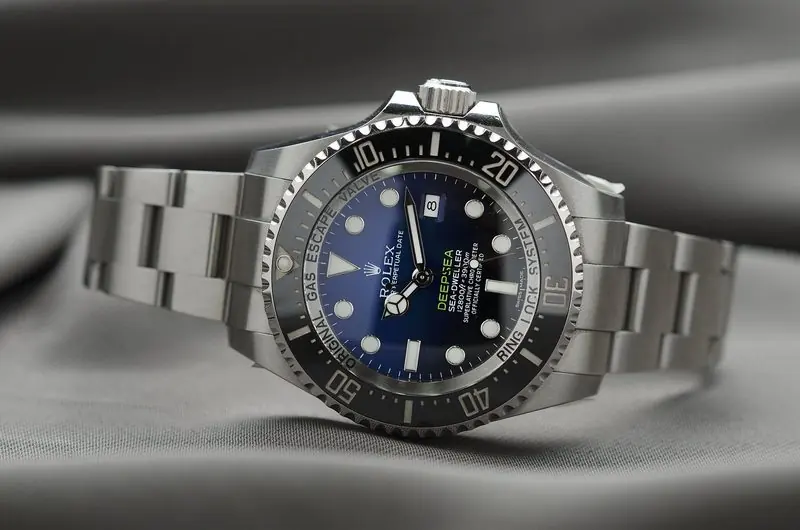
| Catégorie | montres de luxe à héritage de voile |
|---|---|
| Fondé | 1905 par Hans Wilsdorf |
| Base | Genève, Suisse |
| Montre de yachting | la Yacht-Master, lancée en 1992 |
| Innovations | boîtier Oyster étanche et mouvement automatique Perpetual |
| Parrainage | parrain titre de nombreuses grandes régates internationales |
| Épreuves phares | Rolex Sydney Hobart, Rolex Fastnet et Maxi Yacht Rolex Cup |
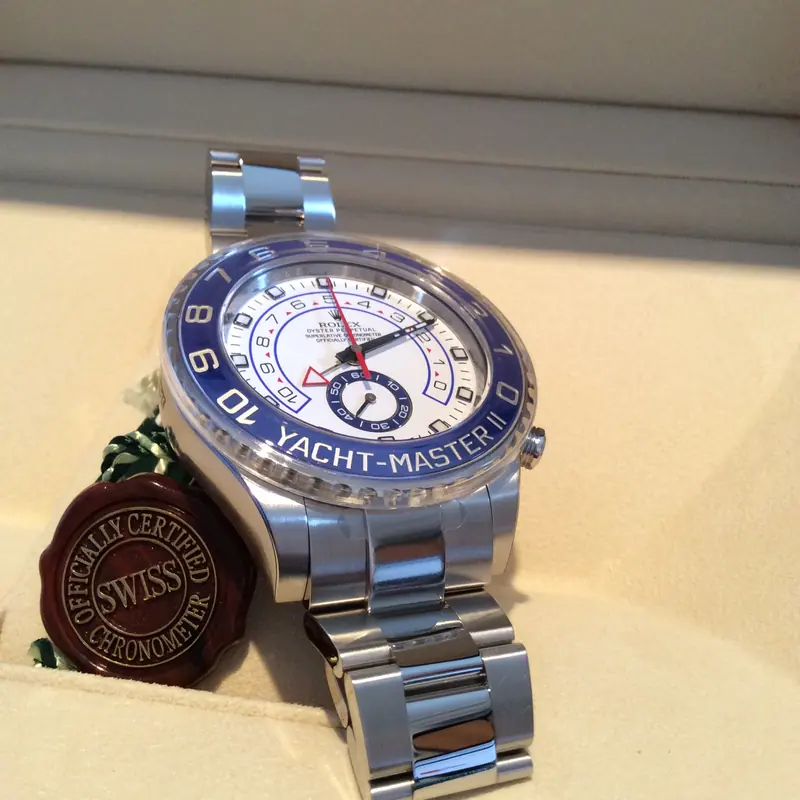
| The 2026 change | the countdown is now programmed from the lower pusher instead of the Ring Command bezel, with the countdown hands running anticlockwise |
| Yacht-Master II prices, July 2026 | USD 20,300 in Oystersteel and USD 57,800 in 18 ct yellow gold |
| Water resistance | the Yacht-Master case is guaranteed to 100 m, and the bezel is bidirectional |
| Guarantee and service | a five-year international guarantee on new watches, with Rolex recommending a service roughly every ten years |
| Sailing | title sponsor of fifteen major international events, including the Rolex Sydney Hobart and Rolex Middle Sea Race since 2002, the Maxi Yacht Rolex Cup since 1985, the biennial Rolex Fastnet Race and the Rolex SailGP Championship since 2024 |
Un horloger bâti sur l'Oyster
Rolex a été fondé en 1905 par Hans Wilsdorf, qui a transféré l'entreprise à Genève en 1919. La société a bâti sa réputation sur la précision et sur le boîtier Oyster scellé et étanche qu'elle a introduit dans les années 1920. Un mouvement automatique a suivi, donnant naissance au nom Oyster Perpetual qui définit encore une grande part de la gamme. Ces innovations ont rendu les montres Rolex adaptées à une vie active, y compris au temps passé sur l'eau. La marque est devenue l'un des noms de luxe les plus reconnus partout.
L'étanchéité est au coeur de l'histoire Rolex, ce qui donne à son lien avec la voile une logique naturelle. Les mêmes qualités qui convenaient aux plongeurs et aux explorateurs convenaient aux marins. Au cours du vingtième siècle, la société a constitué un catalogue de montres outils pour des pratiques exigeantes. Ses montres sont devenues des symboles de réussite autant que des instruments. Cette double identité sous-tend sa place dans le yachting.
La Yacht-Master
Rolex a lancé la Yacht-Master en 1992 comme une montre destinée au monde de la voile et de la mer. Elle associait la robustesse du boîtier Oyster à un style nautique et à des finitions adaptées à un public de yachting. La ligne s'est depuis élargie à plusieurs variantes, dans des matières et des tailles différentes. Un modèle Yacht-Master ultérieur a ajouté une fonction de compte à rebours de régate pour les marins de compétition. Ensemble, ces montres forment le lien le plus explicite de la marque avec le sport.
La Yacht-Master est une montre de style enracinée dans l'imaginaire de la voile. Elle porte les codes du monde du yachting au poignet de façon reconnaissable. Pour les propriétaires et les amateurs, elle signale un lien avec la mer et avec la culture qui entoure le sport. La ligne est devenue l'un des piliers de la gamme Rolex aux côtés de la Submariner et de la Daytona. Son nom relie la marque à la vie de yacht plus ouvertement que tout autre modèle sur le cadran.
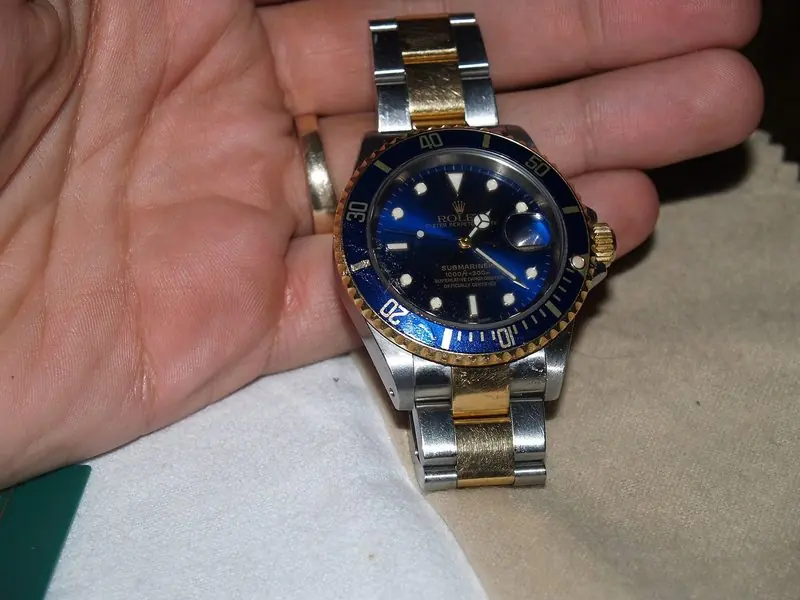
L'Oyster qui a pris la mer, et le nom derrière les plus grandes régates du sport.
Une ingénierie de précision
Rolex est connu pour fabriquer ses montres selon un standard interne exigeant, en maîtrisant une grande part du processus en interne. Le boîtier Oyster est étudié pour tenir l'eau à l'écart sous pression, une qualité éprouvée sur des décennies. Les mouvements sont construits et testés selon des tolérances serrées de précision et de fiabilité. Les matières, de l'acier à l'or et à la céramique, sont travaillées avec une haute finition. Cette ingénierie est le socle de la réputation de la marque.
Pour une montre associée à la mer, l'étanchéité et la robustesse sont essentielles et non décoratives. Rolex a passé un siècle à affiner ces qualités. Une Yacht-Master est faite pour supporter un usage réel sur l'eau autant que pour avoir l'allure qu'il faut. Cette fiabilité fait partie de ce que les acheteurs paient. Le savoir-faire derrière la montre est à la hauteur du prestige du nom sur le cadran.
Au coeur du sport
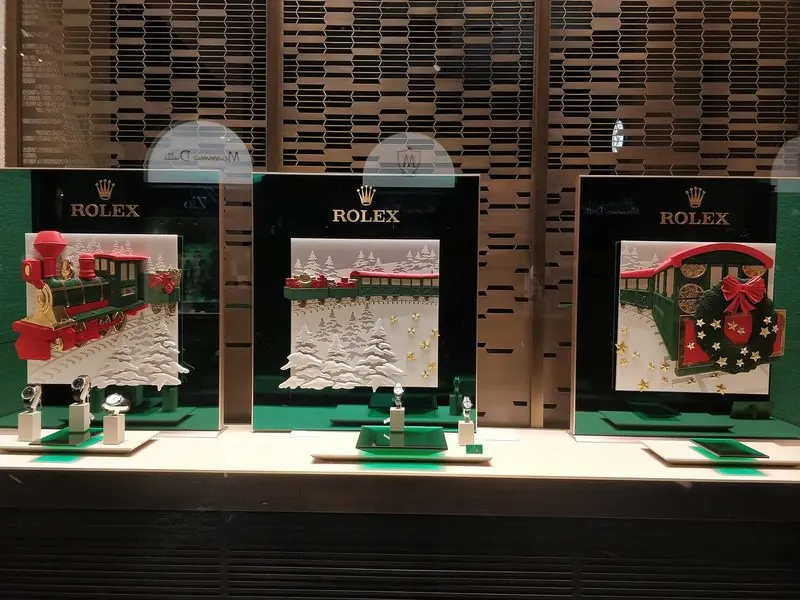
Rolex soutient la voile de haut niveau depuis environ soixante-dix ans, au point d'être profondément tissé dans le sport. Il est le parrain titre de bon nombre des plus grandes régates du monde, des longues courses au large aux flottes de grand prix. Des épreuves comme la Rolex Sydney Hobart Yacht Race et la Rolex Fastnet Race portent son nom. La Maxi Yacht Rolex Cup réunit certains des plus grands et des plus beaux voiliers sous sa bannière. Cette présence fait de Rolex une constante de la voile de compétition.
Ces parrainages relient la marque au monde du yachting bien au-delà des montres elles-mêmes. Les propriétaires qui régatent au plus haut niveau courent dans des épreuves qui portent le nom Rolex. La société soutient aussi de grands yacht clubs et des marins, ce qui approfondit ses racines dans le sport. Cet engagement de longue durée donne à son identité yachting une vraie substance. Rolex est présent aux rendez-vous qui comptent le plus pour la communauté de la voile.
Une marque de rang universelle
Rolex compte parmi les marques de luxe les plus reconnues au monde, et son lien avec le yachting est bien établi. Pour les propriétaires, une Yacht-Master ou une autre Rolex est un signal de rang simple et familier. La présence de la marque aux grands rendez-vous du sport renforce cette association. Ses montres se portent dans tout le monde du yachting, chez les propriétaires, les commandants et les invités. Peu de noms bénéficient d'une reconnaissance aussi large.
La force de Rolex tient à la fiabilité du produit comme de la réputation. Une Rolex est une valeur connue qui tient sa valeur et son statut dans le temps. Les parrainages profonds dans la voile donnent à son image yachting de vraies racines. Pour les propriétaires qui veulent une marque de réussite reconnue sur l'eau, c'est un choix évident. Rolex reste solidement lié à la culture du sport.

Guarantee, servicing and where to get it done
New Rolexes carry a five-year international guarantee alongside the Superlative Chronometer certification, and the company recommends a service roughly every ten years, with a two-year warranty on the service work itself. Independent watchmakers commonly advise a shorter interval for a watch that lives in salt air and gets wet regularly.
Service is genuinely international, which matters more for a yacht owner than for anyone else. A watch can be handed in at a service centre in Geneva, Fort Lauderdale, Dubai or Sydney and collected in another. Turnaround is measured in weeks, so it is a job for the winter lay-up and not for the week before a regatta.
The sponsorships, and what they buy
Rolex is title sponsor of fifteen major international events. It has backed the Sydney Hobart and the Middle Sea Race since 2002, the Maxi Yacht Rolex Cup since 1985, the biennial Fastnet as the Royal Ocean Racing Club's first naming-rights partner, and since 2024 the SailGP championship, whose 2026 season ran thirteen races across five continents.
For an owner who races, this is not decoration. Rolex's calendar is effectively the calendar, the winner of each event receives a watch, and the brand's presence at Porto Cervo, Cowes, Malta and Hobart is part of what those weeks feel like. For an owner who cruises and never crosses a start line, the sponsorship buys nothing at all, and the watch should be chosen on the same basis as any other watch.
Holding value, and the awkward part of that
Rolex holds value better than almost any comparable object an owner buys for a boat, and steel sports models have often sold above list on the secondary market. That is a real financial characteristic and it is worth knowing. It is also volatile, and prices for the most speculative references have moved sharply in both directions since 2022.
The practical risk is theft. A recognisable watch worn ashore in a Mediterranean port in August is a known target, and insurance for jewellery carried aboard is usually a separate policy from the yacht's. Check the wording before the season, particularly for items worn off the boat.
Who it suits, and who should buy something else
The Yacht-Master II suits an owner who actually races and starts under a five-minute sequence, and no other mechanical watch does that job as cleanly. The rest of the Yacht-Master line suits an owner who wants a robust, serviceable, internationally supported watch with a nautical face and does not mind that the nautical part is styling.
An owner who dives should buy a dive watch. An owner who needs a start timer and does not care what it looks like should buy a purpose-built electronic regatta watch for a fraction of the money, and it will be easier to read wet. An owner who wants a watch nobody else at the dock is wearing is in the wrong shop entirely.
Buying pre-owned without buying a fake
Every Rolex carries a serial number, engraved behind the bracelet lugs at six o'clock on watches made before 2005 and on the inner rehaut from 2005 onward, exclusively on the rehaut from 2008. On a genuine watch that engraving is crisp and laser sharp; on a counterfeit it is often dotted or slightly blurred under a loupe, and the case weight tends to feel light rather than the solid, balanced heft of the real thing.
Papers and a box are not proof by themselves, because counterfeiters now fake those too, sometimes convincingly. The reliable check is to have an authorised dealer or an established pre-owned specialist verify the serial number and movement against Rolex's own records before money changes hands, which is a service worth paying for on anything bought outside a dealer's own counter.
Informations pratiques
| New, list price (US, July 2026) | USD 12,500 for the 37 mm Yacht-Master in Oystersteel and platinum up to USD 40,000 for the 42 mm in white gold; the Yacht-Master II is USD 20,300 in Oystersteel and USD 57,800 in yellow gold. |
|---|---|
| Buying new | Sold only through authorised dealers, who set their own waiting list and allocation by relationship with the shop. Rolex does not publish wait times, and that silence is itself the answer to how scarce a given reference is. |
| Buying used | A recognised secondary market runs through dealers such as Bob's Watches and marketplaces such as Chrono24. Popular steel references such as the 40 mm Yacht-Master 126622 have traded a few thousand dollars over list; some gold Yacht-Master II references have sold below list. |
| Servicing | A standard service at an authorised centre runs roughly USD 800 to USD 1,600, more for a Yacht-Master II with its chronograph movement, with parts replacement pushing a job past USD 2,500. Turnaround is typically six to eight weeks, so plan it for winter lay-up, not the week before a regatta. |
| Warranty | Five years on a new watch, two years on service work. |
| What is not published | Rolex publishes no production figures, no wholesale pricing and no allocation criteria for its authorised dealers; every scarcity figure in circulation is a dealer's or an analyst's estimate, never the company's own. |
Ce que rapportent propriétaires et équipages
Comfort and everyday reliability
A long-term owner writing under the name Tokyo Watch Guy described the Yacht-Master 40's movement as insanely robust and accurate, and called it his most comfortable watch.
WatchCrunchThe 2026 redesign was well received on first handling
Hands-on reviewers found the new winch-shaped pushers more intuitive than the previous Ring Command bezel, calling the change a rare case of a company fixing exactly what owners had complained about.
Monochrome WatchesThe pre-2026 countdown function saw little real use
The old Yacht-Master II was described as Rolex's most divisive watch, built around a function that almost none of its owners would ever use.
aBlogtoWatchSecondary-market pricing is model-specific, not uniform
Popular Rolesium and steel references trade at a modest premium to list, while some gold Yacht-Master II references sell below retail, so the invest-grade reputation does not apply evenly across the range.
WatchCharts
Les points forts et les points de vigilance
Points forts
- A service network built for an owner who movesA watch can be handed in at an authorised centre in Fort Lauderdale and collected in Geneva or Dubai, which matters more to an owner who crosses three countries a year than to anyone buying one watch for one desk.
- Genuine value retention on the sports referencesSteel and titanium sports Rolexes have a long record of holding or exceeding retail on the secondary market, which is not true of most watches at any price.
- The 2026 Yacht-Master II fixes the real complaintProgramming the countdown from a winch-shaped pusher instead of the old Ring Command bezel removes the one thing reviewers and owners had complained about since 2007.
Points de vigilance
- The Yacht-Master is not a dive watch100 m and a bidirectional bezel are a styling choice, not a safety instrument, and an owner who actually dives is buying the wrong Rolex.
- Waiting lists are opaque and can run yearsFor the most wanted steel references, allocation depends on a buyer's history with a dealer rather than a published queue, which is a frustrating way to spend six figures.
- The countdown function goes unused by most ownersReviewers have called the pre-2026 Yacht-Master II Rolex's most divisive watch precisely because most owners never start a race under a five-minute sequence.
Pour qui: Les propriétaires et les marins qui veulent une montre reconnue, liée à l'héritage de la voile de compétition.