TRAC
| Category | hydraulic and electric fin stabilizers, including a zero-speed (at-rest) stabilization option |
|---|---|
| Brand | TRAC, made by ABT-TRAC, formerly American Bow Thruster, founded 1986 as Arcturus Marine Systems by D'Milo Hallerberg |
| Ownership | part of Inov8v Marine Group since July 2022, alongside sister brand WESMAR (sonar and thrusters) and SmartCatch |
| Not a Twin Disc product | Twin Disc is a separate public company that makes marine transmissions and has acquired Kobelt and Katsa Oy, not TRAC |
| Headquarters and manufacturing | Arlington, Washington, USA (6108 188th Street NE) |
| Renamed from American Bow Thruster to ABT-TRAC in 2009 as its product range broadened beyond thrusters | |
| Milestone | TRAC Digital Stabilizers launched 1999, the first fully digital, touchscreen-controlled fin stabilizer in the industry |
| Milestone | within a few years of the 1999 launch, American Bow Thruster's share of the world yacht-building market passed 50 percent |
| Zero-speed system | TRAC-STAR (Stabilization At Rest), introduced 2005, swings longer-chord fins to counter roll at anchor |
| Fin range | 0.4 to 4.1 square meters, fitting vessels 39 to 225 feet (10 to 70 meters) |
| Electric line | eTRAC digital electric actuators (models 250, 300, 370) for 95 to 140-foot yachts |
| Newest line | DC Electric Stabilizers, announced April 2026, with 360-degree fin travel and under 4 kW peak draw per actuator |
| Fin design | computer-optimized fin with optional winglet, claimed 20 percent more anti-roll force and 10 percent less tip vortex drag than a plain fin |
| Control | 4 by 4.75-inch touchscreen LCD helm panel, one-touch activation, TracLink CAN bus integration with thrusters and hydraulics since 2014 |
| Warranty | 2-year limited warranty on new systems |
| Service interval | shaft seal replacement at roughly 6 years, longer than Naiad's 3-year/4,000-hour interval |
What is TRAC and who actually makes it?
TRAC is the fin-stabilizer and zero-speed stabilization brand built by ABT-TRAC, formerly named American Bow Thruster, and it is not a Twin Disc product. Twin Disc is a separate publicly traded company that makes marine transmissions and control systems and has recently acquired Kobelt and Katsa Oy, but neither TRAC nor ABT-TRAC appears in any Twin Disc acquisition filing or press release; the pairing is a common mix-up because both are old-line marine driveline names. The company behind TRAC actually traces to 1986, when D'Milo Hallerberg founded Arcturus Marine Systems and began building the MiniThruster bow thruster line, later replaced by the six-bladed Magnum Series.
The business was renamed American Bow Thruster as its product range grew, then rebranded again to ABT-TRAC in 2009 once thrusters were no longer its only line. In July 2022, Roger Fellows, who already owned ABT-TRAC and the sonar and thruster maker WESMAR, merged both companies with the underwater-camera brand SmartCatch into a single holding company, Inov8v Marine Group, headquartered in Arlington, Washington. TRAC is now sold as one of Inov8v's three legacy brands, alongside WESMAR sonar and thrusters, with combined engineering, parts and service backing it rather than a standalone small manufacturer.
How does a TRAC fin stabilizer actually work?
A TRAC system reads the boat's roll with a motion sensor and hydraulically or electrically drives a pair of underwater fins to counter that roll in real time. TRAC calls its control logic three-term control: it continuously measures roll angle, roll rate and roll acceleration and commands the fins to the angle that produces the opposing lift needed at that instant, rather than simply chasing the current tilt. The system was the first in the industry to go fully digital, launched in 1999 with an LCD touchscreen helm panel (now 4 by 4.75 inches) and one-touch automatic operation, replacing the analog dial controls that had been standard until then.
The fins themselves are computer-optimized foils, and TRAC was also first to market with a winglet tip, a small upturned extension borrowed from aircraft-wing design that the company says adds about 20 percent more anti-roll force and cuts tip vortex drag by roughly 10 percent compared with a plain rectangular fin. Actuation is hydraulic on most of the range, powered off the main engine's PTO or a dedicated hydraulic power unit that ABT-TRAC has offered pre-plumbed to builders since 2007, but the eTRAC line swaps in electric actuators, and a new DC Electric Stabilizer line announced in April 2026 pushes that further with 360-degree fin travel and a peak draw under 4 kW per actuator, aimed at owners who want the engine room space and simplicity of electric drive.
TRAC fins have been standard equipment on more production motor yachts than any rival stabilizer, and they still work the instant the pump starts turning, no thirty-minute wait required.
How does TRAC's STAR system stop the boat rolling at anchor?
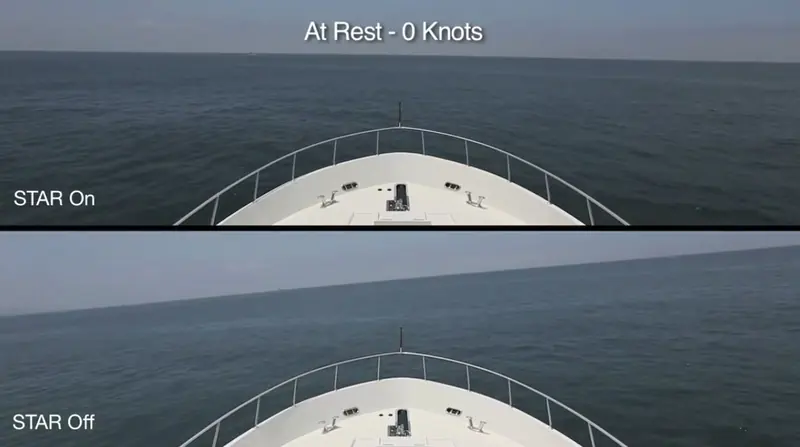
TRAC-STAR (Stabilization At Rest) fights roll with no forward speed by rhythmically swinging oversized, longer-chord fins back and forth through the water at the exact moment and speed needed to generate an opposing force. A conventional fin only produces lift when water is flowing past it, which is why plain fins go slack at anchor; STAR fins are cut with more chord and are driven through a wider, faster arc so that the fin's own motion through still water creates the flow. ABT-TRAC introduced STAR in 2005 as an option on new TRAC systems, and it can also be retrofitted to many existing installations rather than requiring a whole new stabilizer.
Because the fins are working harder at anchor than underway, STAR needs a beefier hydraulic supply, either the boat's generator or a dedicated AC-driven pump running through what TRAC calls Integrated Hydraulics, and the load-bearing shaft and bearing housings are built oversized with double seals so they do not need attention between haulouts. Owners describe the effect as similar in magnitude to a gyro at rest, and it activates from the same helm touchscreen used underway, but it is not free: a documented retrofit of a STAR kit onto an existing TRAC 250 system, covering larger winglet fins, an oil accumulator, a new actuator kit and updated control software, ran to roughly $18,000 a few years ago, on top of the original stabilizer.
How does TRAC compare with a Seakeeper gyro?
TRAC fins and Seakeeper gyros solve the same problem, comfort at rest and underway, with opposite tradeoffs. A fin system works the instant the hydraulic pump is turning, needs only about 0.5 to 1.5 kW to run the pump and control electronics, and its correcting force actually improves as the boat goes faster, which is why fin boats are so flat and quiet at 20 knots and above. A Seakeeper gyro, by contrast, has to spin its flywheel up to speed first, a process most owners and reviewers put at somewhere between 15 and 50 minutes depending on the model, and it then draws a steady 1.5 to 3 kW of AC power the whole time it is running, whether the boat is moving or not.
The installation tradeoff runs the other way. A gyro is a self-contained sealed unit with no hull penetration, so it can go almost anywhere near the center of gravity, commonly the engine room, and a retrofit does not always require a haulout; a fin system needs two through-hull shaft penetrations positioned close to amidships, which on an existing boat usually does mean hauling out and cutting into the hull. Fins also add wetted-surface drag and are exposed to line and debris strikes underway, while a gyro's only real penalty is weight, several hundred to several thousand pounds depending on size. On yaw and sway, fins have the edge because they are a genuine underwater appendage pushing water, while a gyro only resists roll and does nothing for yaw or sway; TRAC's STAR option closes most of the historic gap in at-rest performance, so the remaining choice is mostly about power source, drag tolerance and whether a haulout is acceptable.
What does a TRAC system actually cost, new and installed?
ABT-TRAC does not publish a price list; every quote is built around the boat's length, displacement, fin size and whether it is a new build or a retrofit, and it comes from the dealer network rather than a public catalog. Market figures gathered from owners and installers put a complete new fin system, equipment and installation together, at roughly $80,000 to $150,000 on a 60-foot motor yacht, with the hardware itself accounting for something like $30,000 to $40,000 of that and the rest going to haulout, shaft penetrations, hydraulic plumbing and helm integration labor. Older ex-factory quotes for base hardware alone have been reported around $100,000, though pricing has clearly moved since and should not be treated as current.
Running costs are modest by comparison: hydraulic oil and filter changes on a normal maintenance schedule, plus fuel or generator load for the pump, a small fraction of what the main engines burn. The bigger recurring cost is the shaft seal service, due at roughly six years on TRAC systems, a job that needs a trained technician and specialized pullers to drop the fins, genuinely comparable in scope to an engine-room refit rather than routine service, and billed at a yard's marine hourly rate on top of parts. Adding STAR zero-speed capability to an existing TRAC system has run about $18,000 for the fin, hydraulic and control upgrade alone. None of this is published anywhere as a fixed number, so any buyer should treat every figure here as a starting point for a dealer quote, not a firm price.
Which TRAC model fits which size of boat?
TRAC's hydraulic fin range spans 0.4 to 4.1 square meters and covers boats from about 39 to 225 feet, sized by displacement and hull form rather than length alone, which is why a heavy full-displacement trawler and a lighter planing yacht of the same length can end up on different fin sizes. Real installs bear this out: a Nordhavn 41 trawler carries a TRAC 220 system with roughly 6-square-foot fins as standard equipment, an Outer Reef 700 runs 7.5-square-foot fins, and a Fleming 78 with the STAR option uses 16-square-foot fins driven by a generator-fed hydraulic pump. Larger megayachts at the top of the range use the biggest fins in the lineup and typically run multiple hydraulic pumps.
Alongside the hydraulic range, the eTRAC digital electric line uses electric rather than hydraulic actuators in three sizes, the eTrac 250 for roughly 95 to 100-foot yachts, the eTrac 300 for 100 to 120 feet, and the eTrac 370 for 120 to 140 feet, aimed at builders who want to cut hydraulic plumbing weight and complexity. In April 2026 ABT-TRAC went further with a DC Electric Stabilizer line, described as delivering the same stabilizing authority as the hydraulic systems with zero-backlash drive technology, full 360-degree fin travel and a peak load under 4 kW per actuator, plus instant startup and less engine-room space and maintenance than a hydraulic pump and manifold. All new systems, hydraulic or electric, carry a 2-year limited warranty and can be specified with or without the STAR zero-speed option.
How reliable is TRAC, and what do owners actually say about it?
Owners on trawler and boating forums describe TRAC as among the most effective fin stabilizers on the water and consistently praise ABT-TRAC's factory support. On Trawler Forum, long-time owners call the system a genuine necessity that flattens wake roll on the Intracoastal Waterway and say factory support is second to none in the marine industry, with quick parts turnaround and free owner maintenance classes; one engineer running a 140-foot vessel with the zero-speed option reported no maintenance issues at all. On The Hull Truth, a technician who has worked on both TRAC and the lower-cost Keypower system rated TRAC's engineering and parts support well ahead of that rival, while noting plainly that ABT-TRAC costs significantly more.
The most consistent complaint, echoed across forums, is parts and service pricing: on the UK's YBW forum, an owner whose stabilizer fin failed 500 miles from his dealer in Scotland praised Golden Arrow Marine for free, fast phone diagnosis that traced the fault to a short in a servo wiring loom, but balked at being charged 305 pounds sterling for what he described as a few feet of multi-core cable and three connectors, a complaint other forum members said matched their own experience of TRAC's parts pricing. A smaller number of owners report a rougher edge to the electronics: one Trawler Forum post described repeated software and hydraulic-mechanical issues on a fully electronic TRAC installation, while crediting the company with actively working to improve reliability. Read together, the pattern is a stabilizer that performs and is well supported when something goes wrong, at a price that both the hardware and the parts counter make clear from the start.
Informations pratiques
| New system, installed | No published price list. Market-gathered figures put a complete new hydraulic fin system on a 60-foot motor yacht at roughly $80,000 to $150,000 installed, requiring a haulout for the through-hull shaft penetrations; hardware alone typically runs $30,000 to $40,000 of that total, with the balance in haulout, hull work, hydraulic plumbing and helm integration labor. Larger yachts and multi-fin megayacht installations run well beyond this range; ABT-TRAC quotes every job individually through its dealer network. |
|---|---|
| STAR zero-speed option | Sold as an option on new systems or a retrofit to many existing TRAC installations. A documented retrofit onto an existing TRAC 250, including larger winglet fins, an oil accumulator, an actuator kit and updated control software, totaled roughly $18,000 a few years ago; current pricing is dealer-quoted only and not published. |
| Running costs | Hydraulic oil and filter changes on a routine schedule, plus the fuel or generator load to run the pump, which is a small fraction of main-engine consumption. Electric eTRAC and DC Electric variants remove the hydraulic fluid and pump entirely, trading that cost for higher-voltage electrical draw instead. |
| Service interval | Shaft seal replacement is required at roughly every 6 years on TRAC systems, longer than Naiad's stated 3-year or 4,000-hour interval but shorter than Quantum's 5-year or 8,000-hour figure. The job requires dropping the fins with hydraulic or mechanical pullers and a trained technician, making it a significant labor cost rather than a routine service item. |
| Warranty | 2-year limited warranty on new hydraulic and electric TRAC systems, per the manufacturer's published spec sheet; exact terms and coverage should be confirmed with the dealer at time of quote since ABT-TRAC does not publish the full warranty document online. |
| What is not published | ABT-TRAC publishes no retail price list, no online configurator pricing and no standard install labor rate; every figure in this entry comes from third-party owner and installer reports rather than a manufacturer price sheet, and actual quotes will vary by boat, region and dealer. |
Ce que rapportent propriétaires et équipages
Support rated the best in the industry
Long-time TRAC owners describe factory and dealer support as second to none in the marine industry, citing fast parts turnaround, free owner maintenance classes and an engineer running a 140-foot vessel with the STAR zero-speed option who reported no maintenance issues at all.
Trawler ForumBetter engineering than budget rivals, at a real premium
A technician who has serviced both TRAC and the lower-cost Keypower system rated TRAC's engineering, parts availability and support well ahead of that competitor, while stating plainly that ABT-TRAC systems cost significantly more to buy.
The Hull TruthFree phone diagnosis, expensive parts
An owner whose stabilizer fin failed 500 miles from his dealer had the fault, a short wiring loom at a servo, diagnosed free and quickly over the phone by Golden Arrow Marine, but was then charged 305 pounds sterling for the replacement loom, a cost other forum members said matched their own experience with TRAC parts pricing.
YBW ForumSTAR held a yacht steady in an ocean swell on sea trial
On a Fleming 78 fitted with TRAC-Star, the generator-driven hydraulic system swinging 16-square-foot fins was tested directly against an ocean swell at anchor and the reviewer called its effectiveness superb.
PassagemakerOccasional software and hydraulic gremlins on a full-electronic install
One owner of a fully electronic TRAC system reported repeated software and hydraulic-mechanical issues over time, though credited the company with actively working to resolve them, a more mixed account than the majority of forum reports.
Trawler Forum
Les points forts et les points de vigilance
Points forts
- Works at any speed, no warm-upUnlike a gyro's 15 to 50-minute spool-up, a TRAC fin system is providing corrective force as soon as the hydraulic pump or electric actuator is powered, and its performance holds or improves as the boat speeds up rather than degrading.
- First-in-class fin engineeringTRAC introduced the industry's first fully digital touchscreen stabilizer control in 1999 and the first winglet-tipped fin, which the company documents as adding roughly 20 percent more anti-roll force and cutting tip vortex drag by about 10 percent versus a plain fin.
- STAR closes most of the at-rest gap with gyrosThe Stabilization At Rest option lets the same fin hardware fight roll at anchor by swinging larger-chord fins through the water, bringing at-rest performance much closer to a dedicated gyro while keeping the underway advantages of fins.
- Widely praised factory and dealer supportMultiple independent owner threads describe ABT-TRAC support as the best they have encountered in the marine industry, with fast parts turnaround, free owner maintenance classes and technicians who will troubleshoot by phone at no charge.
- Broad size and power-type rangeFin sizes from 0.4 to 4.1 square meters cover boats from 39 to 225 feet, and the lineup now spans hydraulic, eTRAC electric and the newest DC Electric actuator technology, so a buyer is not locked into one drivetrain type.
Points de vigilance
- No published pricing anywhereThere is no retail price list, online configurator or published install labor rate; every number a buyer sees comes from a dealer quote or a third-party forum report, which makes it hard to comparison-shop against a gyro system like Seakeeper that does publish base prices.
- Parts and service pricing runs highEven owners who rate TRAC's engineering and support highly single out parts cost as a recurring frustration, down to a UK owner charged over 300 pounds sterling for a short replacement wiring loom, and a Hull Truth technician's blunt comparison that TRAC costs significantly more than lower-cost rivals such as Keypower.
- Underway drag and haulout-dependent retrofitFins are a genuine underwater appendage, so they add wetted-surface drag and are exposed to line and debris strikes that a gyro simply does not face, and fitting or servicing them on an existing boat normally requires a haulout and hull penetration that a gyro retrofit can often avoid.
- A minority report real electronics gremlinsAlongside the largely positive reliability record, at least one detailed forum account describes recurring software and hydraulic-mechanical problems on a fully electronic TRAC installation, a reminder that a digitally controlled hydraulic system has more failure points than a simple mechanical one, even if the company is reported to respond well when it happens.
Pour qui: Owners of full-displacement and semi-displacement motor yachts from about 39 to 225 feet who want instant, works-at-any-speed fin stabilization and are willing to pay dealer-quoted premium pricing and accept a haulout for a proven, factory-backed system.