Yanmar Marine
| Founded March 1912 in Osaka by Magokichi Yamaoka; 1933 HB diesel described as the world's first practical small diesel (Wikipedia) | |
| First purpose-built recreational marine diesel in 1971 per Murray Yacht Sales' model chart | |
| 6LY440 | 434 bhp (440 mhp) at 3,300 rpm, 5,813 cc, 1,200 Nm from 2,100 to 2,500 rpm, 666 kg with gearbox, 87 L/h at 3,300 rpm (Trade A Boat) |
|---|---|
| 8LV | 4.6 L twin-turbo common rail V8, 320 to 370 hp, 435 kg dry without gearbox per YachtBuyer, about 450 kg per BoatTest |
| 6CXBM | 7.4 L, 856 kg dry without gearbox, 265 kW (360 mhp) at 2,400 rpm in H rating to 374 kW (509 mhp) at 2,700 rpm in S rating (Europort 2019 spec card) |
| Dtorque 111 diesel outboard | 36.8 kW (50 mhp), 0.804 L, 175 kg, built by Neander of Kiel; Neander took back sales on 1 June 2021 (Marine Business World) |
| Warranty | 2+3 years for private powerboats with 4LV, 8LV and 6LY common rail engines, announced 10 March 2026 (Boating Industry Canada) |
| Keelindex estimates JH series at 9,000 to 10,000 hours before rebuild and a 2026 repower at USD 12,000 to 25,000 for a 28 to 35 ft boat | |
| No independent fuel table for the 8LV and no independent Dtorque fuel test was found by the desk | |
Where Yanmar comes from
The company started life as Yamaoka Hatsudoki Kosakusho making petrol engines and moved to a small kerosene engine in 1920, according to Wikipedia's company entry. It became Yanmar Holdings on 1 April 2013 and had built its ten millionth diesel by 1992. For boat people the useful date is earlier and quieter: Murray Yacht Sales' model chart says Yanmar developed its first purpose-built recreational marine diesel in 1971, and the small GM and HM sailboat engines followed from 1980. Those are the engines that made the name. Keelindex estimates Yanmar held about 45 percent of the US auxiliary diesel market in 1986, and calls the 3GM30 probably the most installed engine in 30 foot US production sailboats from 1985 onward.
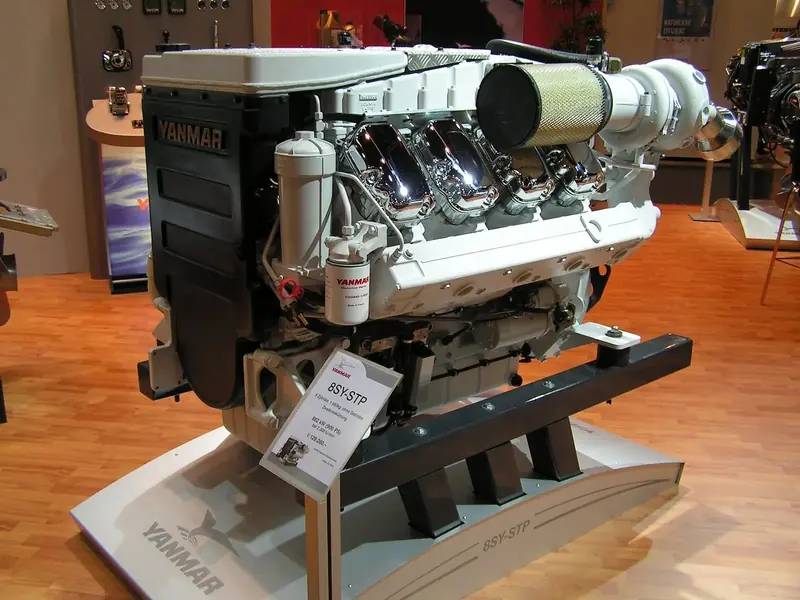
Yachts meet Yanmar mostly through one door, which is the mid-size motor yacht and the cruising catamaran rather than the 50 metre project. Greenline lists the 4LV, 8LV and 6LY in its own Yanmar partnership page, and YachtBuyer's spec pages show a standard Yanmar 4LV250 in the Greenline 39, an 8LV320 as standard in the Greenline 45 Coupe and 48 Coupe, and a 4LV150 in the Fountaine Pajot MY4.S. Above about 600 horsepower the company's own range thins out, although a V8 called the 8SY-STP, rated 662 kW (900 PS) at 2,300 rpm, stood on a German boat show floor in 2009 with a stand card price of EUR 128,260 without gearbox. Nobody should read that as a current list price.
The range: which Yanmar fits which boat
Murray Yacht Sales' chart sorts the family by generation. The YM series from 2004 covers 14 to 29 hp sailboat auxiliaries. The JH series covers 38 to about 110 hp, with the 4JH4E and 4JH5E naturally aspirated and the 3JH40, 4JH45, 4JH57, 4JH80 and 4JH110 common rail versions. The 4LV runs 150 to 250 hp and has been on sale since 2017 on that chart, the 6BY from 220 to 260 hp since 2006, and the older 6LP, 6LPA and 6LYA six-cylinders cover roughly 250 to 370 hp through the 1990s and 2000s. YachtBuyer's Yanmar page lists 39 inboard series and one outboard series, and says the company builds from 9 hp to 440 hp.
Two spec cards from Europort 2019 show how the middle of the range is rated. The 6CXBM is a 7.4 litre six-cylinder, 110 by 130 mm, 856 kg dry without gearbox. It carries four ratings: 265 kW (360 mhp) at 2,400 rpm in the H rating, 294 kW (400 mhp) at 2,500, 341 kW (464 mhp) at 2,700 and 374 kW (509 mhp) at 2,700 in the S rating, certified to IMO Tier 2 and CCNR-2. The practical point is that one block comes in several duty ratings, so two boats with 'the same Yanmar' can have very different engines under them. Ask for the rating, not just the model name.
Ask for the rating, not just the model name: one Yanmar block is sold in four duty ratings.
The common rail generation: 6LY, 8LV and 4LV
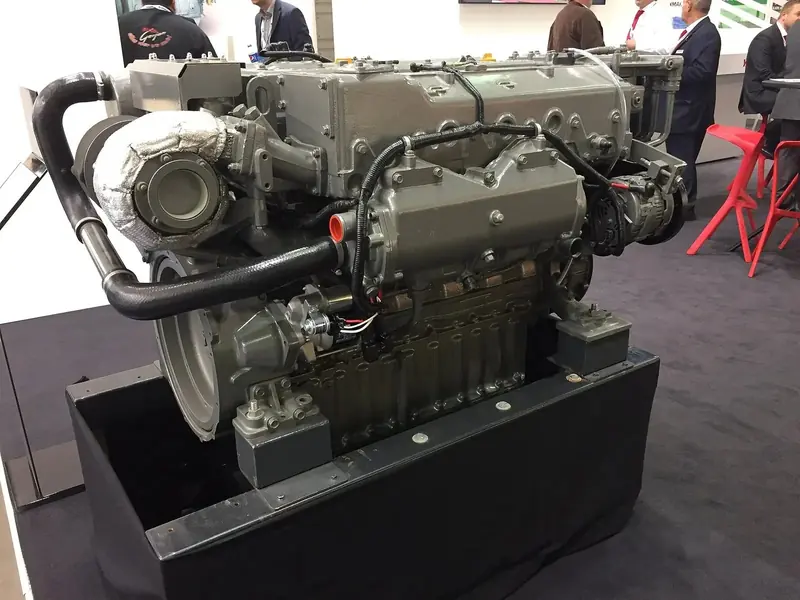
Trade A Boat's review of the 6LY440 is the most complete independent data we found. It gives 5,813 cc, 106 by 110 mm, 1,200 Nm flat from 2,100 to 2,500 rpm and Denso common rail injection. Its sea trial table shows fuel burn of 10 litres an hour at 1,500 rpm, 24 at 2,100, 47 at 2,700 and 87 at 3,300, with the reviewer suggesting the engine be propped to reach 3,400 rpm. Earlier 6LY3 engines had a pleasure duty rating of 250 hours a year, while the common rail 440 is rated light-duty commercial at 1,000 hours a year, and the reviewer called the older pleasure rating inadequate for cruisers. Criticisms are real: early mechanical engines smoked when running astern under load, and the 440 is described as high revving against some rivals.
The 8LV is the engine the magazines like. BoatTest describes it as a 370 hp light V8 of about 450 kg, the lightest diesel in its class, and Trade A Boat argues it suits repowering big-block petrol cruisers. Weight is quoted as 435 kg by YachtBuyer and 450 kg by BoatTest, so treat the difference as gearbox and trim until you see a build sheet. YachtBuyer lists a 12 V 180 A alternator as standard and an idle of 550 rpm with 3,800 rpm at full power. No independent fuel table for the 8LV turned up, so any claim about its burn against a Volvo Penta or Cummins is the yard's, not a test.
Sailboat and displacement engines: the JH and YM line
The 4JH4-TE tested by Trade A Boat gives a sense of the class: 74 bhp at 3,200 rpm, 220 Nm at 1,800 to 2,000 rpm, 1,995 cc, and 237 kg dry with gearbox. Fuel burn runs from 0.9 litres an hour at 1,200 rpm to 17 at 3,200, and the reviewer liked its reliability and its resale value when repowering. He did not like the 80 A alternator, which he called a bit light, or a 3,100 rpm maximum continuous rating that sits too close to wide open throttle. His verdict was that it suits performance keelboats up to 15 metres or 13 tonnes better than heavy displacement cruisers.
Owners on the SailboatOwners forum in October 2017 describe what ownership looks like at 500 to 2,500 hours. One 4JH4 HTE owner at 1,000 hours had changed oil, filters, impeller and coolant and nothing else. Another with a 1991 4JH2-TE at about 1,900 hours changed oil every 150 hours and never replaced the seawater impeller. A third with a 4JH2-DTBE over 2,500 hours found a hidden crack in the mixing elbow and replaced it. That elbow is the engine's best known weak point: keelindex calls the exhaust elbow the single most common diesel failure in this class, and a forum poster warned that a defective elbow can destroy the turbocharger.
The diesel outboard that was never really Yanmar's
Power & Motoryacht's Capt. Bill Pike, writing on 20 October 2017, called it the smallest turbocharged common rail diesel outboard on the market and said it would burn roughly 2.5 to 3 US gallons an hour at wide open throttle, where a 70 hp four-stroke petrol outboard burns more than twice that. The show card in our photograph gives the hard numbers: two cylinders in line, 0.804 litres, 36.8 kW (50 mhp) at 3,500 to 4,000 rpm, 111 Nm, 175 kg dry, turbocharged with intercooler, Bosch common rail and dual counter-rotating crankshafts. That is heavy against a petrol 50, and the reason people accept it is fuel: Yanmar's brochure claims 40 percent less than petrol, a retailer claims up to 50 percent, and nobody independent has published a matched test.
Marine Business World reported on 2 June 2021 that the agreement ran three years from 1 June, that Neander now sells and supports the engine directly, that Yanmar Europe handles parts and that Yanmar Italy stays the production partner. So the sensible question for a buyer is who answers the phone. A US retailer listed the 50 hp at USD 12,988 when we searched, a price we could not reopen. We found no long term owner report, and we did not confirm current availability.
What it costs: engines, repowers and service
Keelindex's 2026 repower estimate for a 28 to 35 foot boat is USD 7,000 to 15,000 for the engine, 4,000 to 8,000 for installation, 1,000 to 3,000 for mounts, hoses and coupling, and 2,000 to 5,000 for a fuel tank where needed, so USD 12,000 to 25,000 typical, USD 20,000 to 30,000 at 36 to 37 feet and 30,000 to 50,000 at 40 to 45 feet. These are the article's own estimates. On the used side a 2016 SailboatOwners thread put a new 4JH5E, without transmission, at about AUD 11,000 to 13,000 in Australia, saving under USD 1,000 by dropping the gearbox because the factory sells the two together. Two US dealer listings we found by search showed the 6LY440 at USD 38,918 and USD 47,895, without a gearbox price and without a date we could confirm.
For service, Yanmar's 6LYA manual puts valve clearance and the oil and filter change at every 250 hours, while a later common rail manual puts the seawater impeller at 1,000 hours against 2,000 in the older one, so read the manual for your own engine. Trade A Boat's reviewer prefers oil every 100 hours or six months. One owner thread estimated that doing the whole 1,000 hour service on a 4JH4 professionally would cost USD 3,000 to 5,000. Keelindex suggests impellers every 200 to 500 hours and a heat exchanger service every 5 to 10 years. Yanmar announced on 10 March 2026 a 2+3 year, five year warranty for private recreational powerboats with 4LV, 8LV and 6LY common rail engines, and a 2+1 programme for light-duty commercial and charter use, with conditions in its Limited Warranty Handbook.
How Yanmar compares with Volvo Penta, Cummins and Beta
YachtBuyer shows the practical choice on the Greenline 48 Coupe: Yanmar's 8LV320 as standard against Cummins QSB6.7 units at 380 and 480 mhp, and a 6LY440 as the Yanmar option. On the Aquila 54 it lists a Cummins QSB6.7 at 550 mhp. The Cummins is a 6.7 litre in-line six and carries more power, and the Yanmar V8 carries less weight. Keelindex says Volvo Penta parts cost more in the US than Yanmar's and estimates 15 to 25 percent higher lifetime maintenance, but it states that figure without a source. For sailboats it calls Beta Marine, which uses Kubota blocks, the quiet default repower choice, and Westerbeke and Universal cheap to keep because their parts come from tractor dealers.
What does that mean for a buyer? Ask the yard which engine and which rating is under the floor, ask who services it within a day of the boat's home port, and ask for the fuel table at your own cruise speed instead of the maximum. A Yanmar with a good local dealer beats a better engine two countries away. Resale matters too: Trade A Boat says the 4JH4-TE holds good resale value, and keelindex estimates Yanmar-equipped 30 foot cruisers sell for USD 1,500 to 3,000 more than Universal ones, again without citing a source.
What to check on a used boat with a Yanmar
Ask for the engine model suffix and rating, because the same block was sold at pleasure, light-commercial and heavy ratings. Look at the exhaust elbow and its joint to the heat exchanger: one owner found a gap and a missing bolt, and the SailboatOwners threads disagree on whether the 4JH elbow is bronze, cast or alloy, so the part number is worth asking for. Check the valve clearance record at the 250 hour mark and whether the impeller was changed. On common rail engines ask for the dealer's service stamps, because the 2+3 year warranty depends on dealer maintenance. A mechanic quoted in one thread recommended running at 75 to 80 percent of maximum rpm.
Be careful with year claims. A boat described as 'Yanmar powered' may carry an older mechanical 6LY3 or 6LPA, or a Yanmar marinised block that was repowered a decade ago, and the engine plate and hour meter tell a different story from the brochure. Compare the hours with the running pattern: a marina boat that did 80 hours a year is a different engine from a charter boat that did 600.
Informations pratiques
| Price, small and mid | Keelindex 2026 repower estimate USD 12,000 to 25,000 for 28 to 35 ft; engine USD 7,000 to 15,000. New 4JH5E without gearbox about AUD 11,000 to 13,000 in 2016 (SailboatOwners) |
|---|---|
| Price, 6LY440 | Two US dealer listings found by search: USD 38,918 and USD 47,895, bare engine, undated; pages could not be reopened |
| Price, large V8 (2009) | 8SY-STP, 662 kW (900 PS), EUR 128,260 on a German boat show card, 2009, without gearbox |
| Price, Dtorque | USD 12,988 on a US retailer listing found by search; not reopened |
| Service | 6LYA manual: valve clearance and oil at 250 hours; impeller at 1,000 or 2,000 hours depending on manual; Trade A Boat suggests oil every 100 hours or six months |
| Warranty | 2+3 years private powerboats (4LV, 8LV, 6LY CR), 2+1 charter and light commercial; conditions in the Limited Warranty Handbook (Boating Industry Canada, 10 March 2026) |
| Check before buying | Duty rating, hours against rating, mixing elbow, heat exchanger, impeller and valve records, dealer stamps |
| What is not published | Dealer list prices, an independent 8LV fuel table, a matched fuel test against Volvo Penta or Cummins, and any long term Dtorque owner report |
Ce que rapportent propriétaires et équipages
1,000 hour service done lightly
A four year old 4JH4 HTE at 1,000 hours had only oil, filters, impeller and coolant changed; he estimated a full manual service done professionally at USD 3,000 to 5,000
SailboatOwners forum, thread 'Yanmar 4JH4 1000 hour service', October 2017High hours with light servicing
A 1991 4JH2-TE at about 1,900 hours changed oil every 150 hours and never replaced the seawater impeller or checked injectors
SailboatOwners forum, October 2017Hidden crack in the mixing elbow
A 4JH2-DTBE owner over 2,500 hours replaced the elbow after finding a hidden crack; another poster warned a defective elbow can destroy the turbocharger
SailboatOwners forum, October 2017Smoke astern and a high-revving character on the 6LY
Early mechanical engines gave black smoke going astern under load and the 440 is described as high revving; light-duty commercial rating of 1,000 hours a year praised
Trade A Boat engine review of the 6LY 440Alternator and rating limits on the 4JH4-TE
The 80 A alternator is a bit light and the 3,100 rpm maximum continuous rating sits too close to wide open throttle
Trade A Boat engine review of the 4JH4-TE
Les points forts et les points de vigilance
Points forts
- Long service life and wide dealer networkKeelindex estimates 9,000 to 10,000 hours for the JH before rebuild, and YachtBuyer lists 39 Yanmar inboard series
- Light for the power8LV about 435 to 450 kg for 320 to 370 hp; 6LY440 1,200 Nm flat across 400 rpm
- Five year warranty on the newer powerboat engines2+3 years for private owners of 4LV, 8LV and 6LY common rail engines from March 2026, with dealer maintenance
- Good resale and partsTrade A Boat says the 4JH4-TE holds resale value; keelindex says parts are cheaper than Volvo Penta in the US
Points de vigilance
- Prices are hiddenDealers rarely publish list prices; the numbers we found are listings, forum posts and a 2009 show card
- No independent fuel comparisonWe found no matched-power test of Yanmar against Volvo Penta or Cummins, and no fuel table for the 8LV
- Known weak point on the JHThe mixing elbow and heat exchanger need inspection and can fail without warning
- Dtorque is Neander's nowYanmar handed direct sales back in June 2021; sellers, support and availability differ from the main range
- Rating confusionOne block comes in several duty ratings, from pleasure to heavy, so the model name alone does not tell you the engine
Pour qui: Buyers and owners of motor yachts up to about 15 metres, catamarans and sailboats choosing or repowering an engine, and yards and brokers who need to know what the Yanmar name actually covers.