Project 821 (Breakthrough)
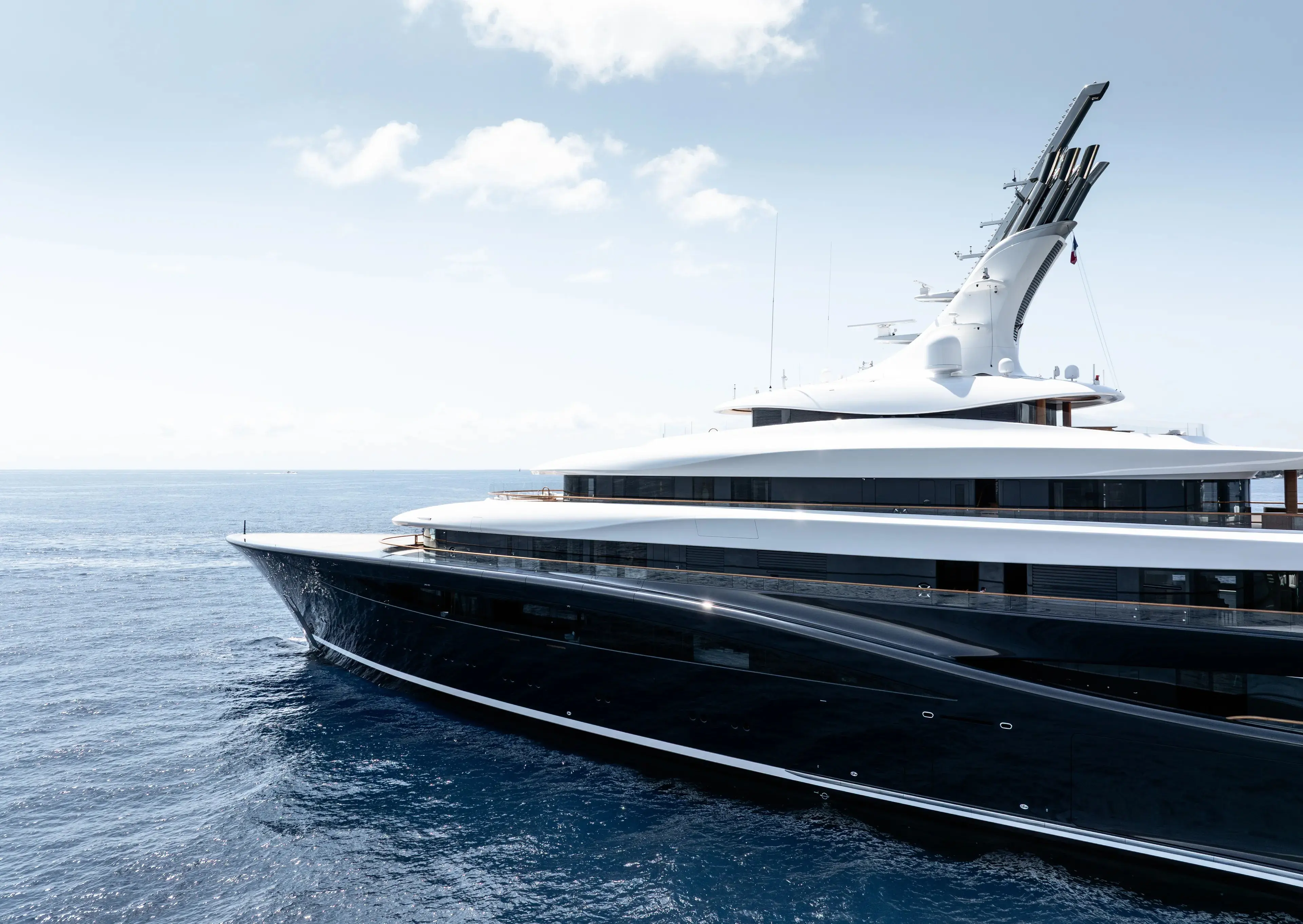
| 118,8 m Länge über alles (390 ft), 7.247 GT | |
| Weltweit erste Superyacht mit Wasserstoff-Brennstoffzelle | |
| Brennstoffzellensystem ca. 3,2 MW, flüssiger Wasserstoff bei -253 C | |
| Rund 4 Tonnen Wasserstoff, deckt die gesamte Hotellast | |
| Reichweite ca. 6.500 nm bei 14 Knoten, hybrid dieselelektrisch | |
| Exterieur und Interieur von RWD, 14 Balkone | |
| Größte je in den Niederlanden gebaute Yacht | |
| Stapellauf Amsterdam 2024, Probefahrten vor IJmuiden, Wasserstoffbunkerung 2025 |
Die erste ihrer Art
Project 821, unter dem Namen Breakthrough abgeliefert, ist die weltweit erste Superyacht, die mit einer Wasserstoff-Brennstoffzelle fährt. Feadship hat fast ein Jahrzehnt gebraucht, um aus diesem Satz statt einer Forschungsabsicht eine 118,8 Meter lange Yacht zu machen, die 2024 die überdachte Halle in Amsterdam verließ. Nichts davon ist eine Nachrüstung oder eine Geste. Das Wasserstoffsystem wurde zuerst entworfen, und die Yacht wurde darum herum gebaut.
Bedeutsam ist nicht die Neuheit, sondern der Beleg. Vor Breakthrough war die emissionsfreie Superyacht eine Folie in einem Konferenzvortrag. Jetzt liegt ein Rumpf im Wasser, der rund eine Woche vor Anker liegen kann, ohne vor Ort irgendwelche Emissionen zu erzeugen, und dabei Licht, Klimaanlage, Kombüse und Systeme vollständig aus Wasserstoff speist. Das ist der Teil der tatsächlichen Nutzung einer großen Yacht mit dem höchsten CO2-Anteil, und genau diesen Teil hat Feadship zuerst gelöst.
Wie der Wasserstoff arbeitet
Im Zentrum der Yacht steht ein Brennstoffzellensystem von rund 3,2 Megawatt, gespeist aus flüssigem Wasserstoff in einem kryogenen Tank bei minus 253 Grad Celsius. Diese Temperatur ist der schwierige Teil. Wasserstoff wird erst dicht genug, um ihn in nutzbarer Menge mitzuführen, wenn er nahe an den absoluten Nullpunkt heruntergekühlt wird, und ihn dort an Bord einer fahrenden Yacht sicher zu halten, war ein Problem, das die maritime Industrie in dieser Größenordnung zuvor nicht gelöst hatte.
Der Tank fasst rund vier Tonnen flüssigen Wasserstoff, genug für die Hotellast, also den alltäglichen Strombedarf, der anfällt, ob die Yacht fährt oder nicht. Wenn die Brennstoffzellen diesen Wasserstoff in Elektrizität umwandeln, entsteht als einziges Nebenprodukt Wasser. Es gibt keine Verbrennung, keinen Abgasstrom und kein Maschinengeräusch, weshalb das Erlebnis vor Anker näher an der Stille liegt als alles, was eine konventionelle Yacht dieser Größe bieten kann.
Eine emissionsfreie Superyacht war einmal eine Folie auf einer Konferenz. Breakthrough ist die Einheit, die daraus Wirklichkeit gemacht hat.
Eine Yacht, um einen Tank herum gebaut
Breakthrough ist die größte Yacht, die Feadship je gebaut hat, und die größte, die je in den Niederlanden zu Wasser gelassen wurde, mit 118,8 Metern und 7.247 GT. Ein Teil dieser Größe folgt unmittelbar aus der Technik. Die kryogene Wasserstoffanlage und ihre Sicherheitszonen brauchen echtes Volumen, und die Konstruktion musste wachsen, um sie unterzubringen, ohne den Innenraum aufzugeben, den Eigner auf diesem Niveau erwarten.
Exterieur und Interieur stammen von RWD, Edmiston vertrat den Eigner über den Bau hinweg. Die Yacht trägt vierzehn Balkone, so viele Rumpföffnungen wie keine Feadship zuvor, ein Detail, das zeigt, wie weit der Entwurf Glas und Tageslicht in einen Rumpf hineingedrückt hat, der zugleich eine Antriebsanlage der ersten Generation aufnehmen musste. Das Ergebnis liest sich als moderne Feadship und nicht als Forschungsprojekt in Yachtkleidern.
Leistung, Reichweite und wie sie fährt
Die Wasserstoff-Brennstoffzellen tragen die Hotellast. Für die Fahrt sorgt eine hybride dieselelektrische Anlage, denn die Energiedichte, die man braucht, um Ozeane allein mit Wasserstoff zu queren, gibt es noch nicht. Die Installation kombiniert zwei MTU-Generatoren mit 900 Kilowatt und drei mit 2.500 Kilowatt mit sechzehn PowerCell-Wasserstoffeinheiten zu je 185 Kilowatt, eine Auslegung, die der Yacht erlaubt, jeweils die passende Quelle zu nutzen.
Diese Kombination ergibt eine Reichweite von rund 6.500 Seemeilen bei 14 Knoten, also echte Hochseefähigkeit. Breakthrough lief im Mai 2024 am Amsterdamer Dock vom Stapel und absolvierte im November desselben Jahres ihre ersten Probefahrten vor IJmuiden, die Wasserstoffbunkerung folgte 2025. Die gestaffelte Inbetriebnahme zeigt, wie viel daran neu war, nicht nur für Feadship, sondern auch für die Häfen und Zulieferer um sie herum.
Was das für die Flotte bedeutet
Die berichteten Kosten liegen bei rund 600 Millionen Euro, verkauft wurde die Yacht hausintern bei Edmiston. Feadship hat nie bestätigt, wem sie gehört, und wir handeln nicht mit Eignernamen. Bei einem Bau der ersten Generation zählt der Eigner weit weniger als die schlichte Tatsache, dass jemand bereit war, das Risiko zu finanzieren.
Das ist die eigentliche Geschichte von Project 821. Eine Werft, ein Eigner und eine lange Kette von Zulieferern haben die Kosten und die Unsicherheit auf sich genommen, um zu belegen, dass Wasserstoff in dieser Größenordnung funktioniert, und der Rest der Branche hat nun einen Bezugspunkt, den es zuvor nicht gab. Ob die nächste Wasserstoff-Feadship in drei oder in zehn Jahren kommt, jede von ihnen wird sich auf diesen Rumpf zurückführen lassen.
What happened after delivery
Breakthrough did not stay with the family who commissioned her. Bill Gates never boarded the finished yacht, and Feadship's landmark hydrogen project was quietly remarketed within about a year of delivery. Canadian waste-management entrepreneur Patrick Dovigi bought her in a deal reported at more than USD 650 million, becoming the owner who has actually put the technology to work at sea.
Running her has proven expensive in ways a conventional yacht would not be. Her first annual class survey and maintenance program, carried out at the MB92 yard in La Ciotat over about a month in mid-2026, was reported at around USD 5 million, largely spent inspecting the cryogenic hydrogen installation alongside the five MTU generator sets and the twin ABB azimuth propulsion pods. And because the fuel cells cannot yet cover a transoceanic passage on their own, moving the yacht from Europe to Miami under her new owner meant loading roughly 605,000 litres of conventional fuel at a single stop, a bill reported at about USD 435,000. The zero-emission story holds up at anchor. Getting the yacht across an ocean still means a diesel bill like any other superyacht her size, which is the honest limit of where the technology stands today. That gap between the anchor-side promise and the open-ocean reality is exactly what the rest of the industry is watching Breakthrough to answer over the coming years.
Motoren und Technik
| Hydrogen fuel-cell system | 16 PowerCell H2 fuel-cell modules producing about 3.2 MW combined, fed by liquid hydrogen stored at minus 253 C in a 92 cubic metre vacuum-insulated Type C tank supplied by MAN Cryo, holding about 4 tonnes (BOAT International, Luxurylaunches agree) |
|---|---|
| Backup and hybrid power | Three MTU 2,500 kW and two MTU 900 kW diesel generator sets, switching to conventional diesel-electric power when hydrogen is unavailable or for ocean crossings (BOAT International, Wikipedia) |
| Propulsion | Twin ABB 3,200 kW azimuth pods, top speed 17 knots, range about 6,500 nm at 14 knots (Wikipedia, Luxurylaunches) |
| Hull and naval architecture | De Voogt Naval Architects, steel hull with aluminium superstructure, 118.8 m LOA, 19.0 m beam, 7,247 GT (Wikipedia) |
| Accommodation | Reported inconsistently across the trade press: cabin counts of 12, 13 and 15 all appear for the same 30-guest capacity, and crew is reported as 43 or 44. Both ranges are given here rather than picked, per the two-source rule |
Was Eigner und Crew berichten
Commissioned by Bill Gates, delivered to a different owner
Project 821 was built to a brief shaped in part by Melinda French Gates, but Bill Gates never boarded the finished yacht. It was quietly remarketed after delivery and bought by Canadian waste-management entrepreneur Patrick Dovigi in a deal reported at more than USD 650 million.
Wikipedia and Luxurylaunches, corroborated by SuperYachtFan and Supercar BlondieFirst-year running cost
The new owner's first annual class survey and maintenance program, carried out at MB92 La Ciotat over about a month in mid-2026, was reported at around USD 5 million, covering the five MTU generator sets, the twin ABB azimuth pods and a full inspection of the cryogenic hydrogen installation.
LuxurylaunchesFuel bill for an ocean crossing
Moving the yacht from Europe to Miami under her new owner required about 605,000 litres of fuel at a single stop, reported to cost around USD 435,000, because the hydrogen system cannot cover a transoceanic passage on its own.
Supercar BlondieBroker's assessment
Jamie Edmiston, whose brokerage represented the seller, called Breakthrough "the most extraordinary yacht ever built, the one that will change it all."
Jamie Edmiston, Edmiston, quoted by BOAT International
Was gut ist und worauf zu achten ist
Stärken
- A working zero-emission system, not a conceptThe hydrogen fuel cells genuinely cover the hotel load, roughly 70 to 78 per cent of a yacht's annual energy use, letting Breakthrough sit at anchor for about a week producing only water as exhaust, the first time this has been proven at superyacht scale.
- Engineering that reshaped the hullFeadship grew the design specifically to house a 92 cubic metre cryogenic tank and its safety zones, and still delivered the largest yacht ever built in the Netherlands, at 118.8 m and 7,247 GT, with 14 balconies and seven fold-out platforms.
Worauf zu achten ist
- Cannot yet cross an ocean on hydrogenThe fuel cells cannot power a transoceanic passage. Long-range cruising still means loading hundreds of thousands of litres of conventional or biofuel diesel, as the delivery run to Miami showed.
- Very expensive to keep runningA single early maintenance cycle was reported at about USD 5 million, and the first Atlantic refuelling stop alone cost roughly USD 435,000, costs a buyer of a pioneering system should expect to sit well above a conventional yacht of the same size.
Praktische Angaben
| Reported price | Asking price reported at approximately EUR 600 million / USD 645 to 650 million; sold to Patrick Dovigi in a deal reported at over USD 650 million. Figures are press-reported, not an official Feadship price (BOAT International, Wikipedia, Supercar Blondie). |
|---|---|
| Reported running cost | First annual maintenance program reported at about USD 5 million in 2026, on top of normal crew, insurance and berthing for a roughly 44-crew, 118.8 m yacht (Luxurylaunches). |
| Fuel for long range | Hydrogen covers hotel load only. An Atlantic crossing under diesel or biofuel power was reported to need about 605,000 litres, costing roughly USD 435,000 at a single stop (Supercar Blondie). |
| Bunkering infrastructure | Received the first liquid-hydrogen bunkering ever supplied to a superyacht in the Netherlands, in June 2025, which required new regulatory sign-off (BOAT International). |
| Not publicly known | An official Feadship-confirmed sale price, the exact cabin count (reported variously as 12, 13 or 15), and independent third-party verification of the claimed one-week zero-emission endurance at anchor. |
Design
| Exterieurdesign | RWD (Redman Whiteley Dixon) |
|---|---|
| Konstruktion | Feadship - De Voogt Naval Architects |
Für wen: Ein Eigner, der bereit ist, Technik der ersten Generation zu finanzieren und seinen Namen hinter den Weg der Branche zur Emissionsfreiheit zu stellen.
Richtpreis: Berichteter Angebotspreis rund EUR 600 Millionen / USD 645 Millionen, hausintern bei Edmiston verkauft. Die Zahlen stammen aus der Presse und sind kein offizieller Feadship-Preis.