Leviathan
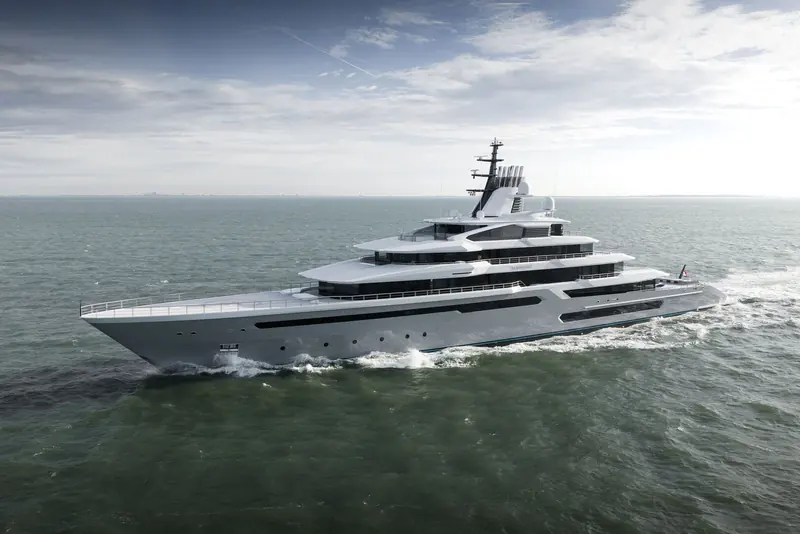
| LOA | 111.0 m (364 ft), beam 17.8 m, draft approx. 4.6-4.8 m, gross tonnage 4,970 GT |
|---|---|
| Steel hull, aluminium superstructure; diesel-electric propulsion via two ABB Azipod thrusters | |
| Battery bank approx. 5.3-5.5 MWh, up to 10 hours of house power at anchor with generators off | |
| 17.6 knots top speed, 13 knots cruise, 6,500 nm range | |
| Guest and cabin counts reported inconsistently across sources: 12-26 guests, 6-13 cabins, 33-43 crew | |
| Forward helipad, aft 10 m pool with tri-fold beach club, submarine and toy garages, 3 tender platforms | |
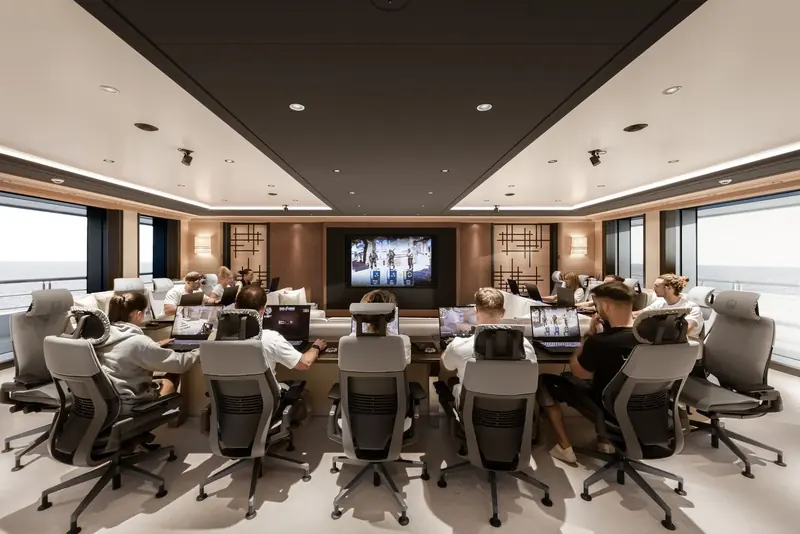
| Gaming lounge (15 stations, 2 racing simulators) in place of a formal saloon; hospital, lab and dive centre in place of a beach club/spa deck | |
| Purchase price undisclosed; press estimates range $400m-$500m and are unconfirmed | |
The largest yacht Oceanco has ever built, delivered to a gaming billionaire
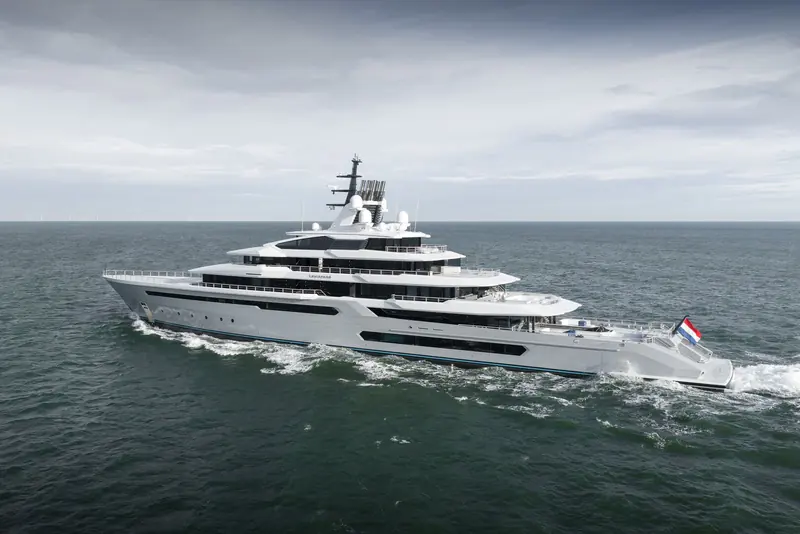
Oceanco delivered Leviathan to Gabe Newell, co-founder of Valve Corporation, on 12 November 2025, a date the yard's own press release confirms directly, after launching the 111-metre hull in August 2025 and running sea trials in the North Sea that October. Built under the project number Y722 at Oceanco's Alblasserdam yard in the Netherlands, she is described by the yard and by charter broker YachtCharterFleet as the largest yacht Oceanco has built by volume, surpassing the yard's own Kaos and Infinity, though Oceanco's sailing yacht Koru, built for Jeff Bezos, remains longer overall at 127 metres on a much smaller gross tonnage.
Within months of taking delivery, Newell went further than any previous Oceanco client: he bought the yard itself from the Barwani family, who had owned it for fifteen years and built Kaos, Bravo Eugenia and Koru under their stewardship, with Oceanco describing him publicly as a hands-on visionary rather than a financier. Oceanco Head of Design Gilles Vernhet noted the significance of the moment as reuniting two Oceanco-designed yachts under one owner, though this page could not independently confirm which second yacht he was referring to.
A hybrid drivetrain built to run silent at anchor for half a day
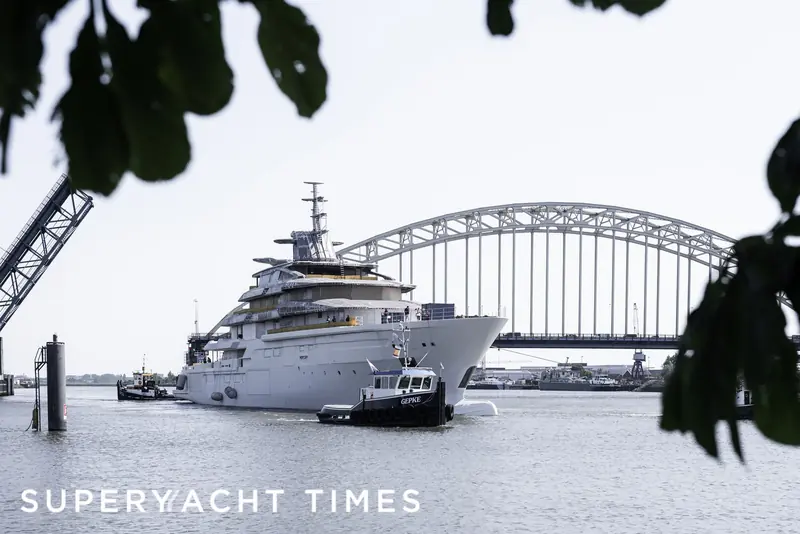
Leviathan runs on two ABB Azipod thrusters powered through a diesel-electric system backed by a battery bank of roughly 5.3 to 5.5 megawatt-hours, sources give both figures and this page cannot resolve which is exact, large enough that Oceanco Sales Director Bas Swanink says she can shut down every generator at anchor and run her house systems on batteries alone for up to ten hours. Top speed is 17.6 knots, cruise is 13 knots, and range is given as 6,500 nautical miles, figures consistent across every source checked, though the specific main engine make behind the electric system is named only once, as MTU, in Boat International's own directory listing, and could not be corroborated elsewhere.
Oceanco senior designer Patrick Casanova described noise and vibration damping as one of the most ambitious goals ever set for a yacht of this kind, and the yacht's captain, Alan Pike, is reported to have called the result remarkably quiet, with low noise and vibration even at full speed. Quantum MagLift and XT fin stabilizers are fitted per Oceanco's own press release, and the hull carries a custom Bolidt synthetic deck compound developed specifically for this yacht, chosen for heat dissipation and low maintenance rather than a stock product.
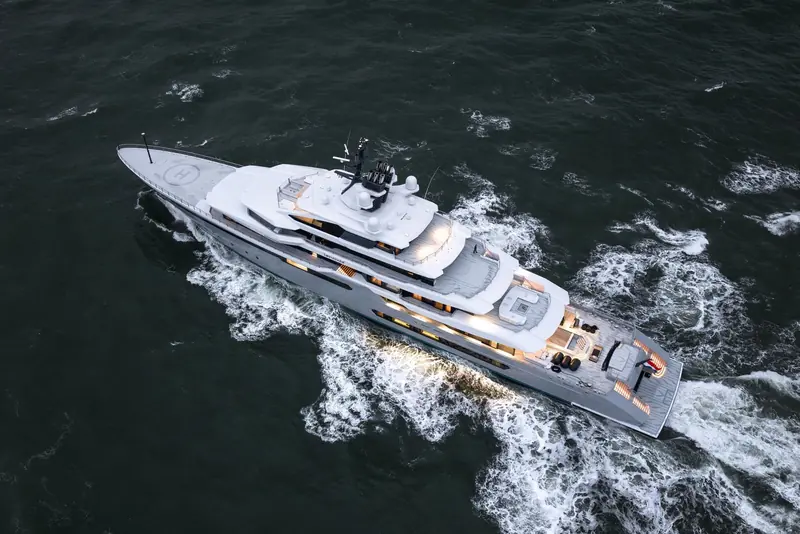
Oceanco Sales Director Bas Swanink says Leviathan can shut down every generator at anchor and run her entire house system on batteries alone for up to ten hours, the kind of hybrid capability usually associated with a research vessel rather than a private superyacht.
Rooms a beach club would normally hold, given to crew and science instead
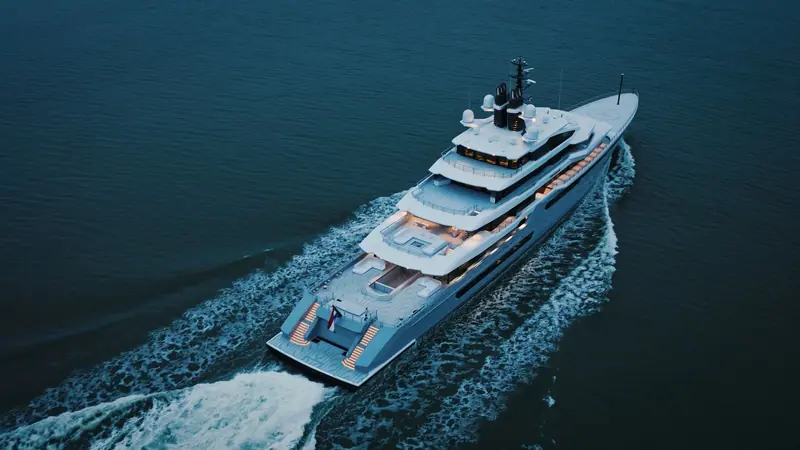
Newell told Oceanco that the more the crew is involved in designing the spaces they operate in, the better the outcome, and the finished yacht gave traditionally guest-only decks to that idea directly: a communal dining hall seating guests and crew together, reported at roughly 54 to 56 people, replaces the formal saloon, and a beach-club deck instead holds a hospital, a laboratory, a dive centre and a 3D-printing workshop, tied to Newell's marine-research organisation Inkfish. A basketball hoop and a regulation beer-pong table sit on decks that would normally carry only guest lounging space, and interior designer Mark Berryman called the whole brief a challenge to convention.
Materials throughout were chosen specifically to cut crew workload rather than for show: honed stone, natural wool carpets, composite capping rails and bead-blasted stainless steel replace the polished handrails and varnished teak that need constant upkeep on a yacht this size, a detail Oceanco's own release frames as freeing crew time for guest experience rather than maintenance. The bridge-deck saloon that would normally be the formal reception room instead became a gaming lounge with fifteen stations, two full racing simulators, ceiling cameras and a projector for shared visual experiences, which Berryman separately called absolutely fantastic and doubles as a crew training and classroom space.
What the yacht actually holds, and where the published numbers disagree
Published guest and cabin figures for Leviathan genuinely disagree across otherwise credible outlets, from 12 guests in 6 cabins per Boat International's own superyacht directory to 26 guests in 13 staterooms per Megayacht News, with a third figure of 22 guests appearing on Wikipedia and a fourth of 22 guests in 11 suites elsewhere, and crew numbers reported anywhere from 33 to 43. That is not a rounding difference, it is four incompatible layouts, and the most likely explanation is that different outlets worked from different stages of the yacht's confidential deck plans rather than one outlet simply getting it wrong.
What is confirmed without dispute: an aft deck built around a roughly ten-metre pool with decks stepping down toward the water and a tri-fold beach club opening to the sea, a forward helipad, a submarine garage, a separate toy garage stocked with jet skis and spearfishing gear, and three tender or docking platforms. Beyond the confirmed dimensions and the design-brief detail above, a reader should treat any specific guest or cabin number found elsewhere as one outlet's account rather than an agreed fact, at least until Oceanco or Newell publishes a single authoritative figure.
What Leviathan cost, and what nobody involved has said
Neither Oceanco nor Gabe Newell has disclosed a purchase price for Leviathan, and third-party estimates conflict sharply between 400 million and 500 million dollars depending on the outlet, figures this page reports as unconfirmed press speculation rather than fact, since no named source inside the build or the ownership structure has put a number on the record. That silence is itself informative: Oceanco's own press materials, unusually detailed on design philosophy and crew quotes, name no figure at all, which is consistent with a private, non-brokered new-build rather than an oversight.
A commonly repeated claim that Leviathan carries around 280 miles of onboard cabling could not be verified against a primary source in this research, a competing figure converts to roughly 261 miles, and the two are close enough that one may simply be a rounding of the other, though neither could be confirmed directly. What is solid is the scale of the human effort behind the build: an engraved glass panel on the main staircase names everyone who worked on her, a figure Oceanco-linked sources give as close to 2,000 people and a later account puts nearer 3,000, itself a sign of how large a project this was even before a price tag is attached.
Motoren und Technik
| Propulsion | Diesel-electric, driving two ABB DO980P Azipod thrusters, backed by a battery bank reported as either 5.3 or 5.5 MWh depending on source (Wikipedia, SuperyachtNews/Navis Yachts, Boat International) |
|---|---|
| Main engines | Named only once, as MTU, in Boat International's own superyacht directory listing; not corroborated by any other source checked, so treated here as unconfirmed rather than fact |
| Generators and battery management | Oceanco Sales Director Bas Swanink states the battery bank can power all house systems at anchor for up to 10 hours with every generator shut down; no generator make, model or output is published anywhere found |
| Stabilizer | Quantum MagLift and XT fin stabilizers, per Oceanco's own press release |
| Range and speed | 17.6 knots top speed, 13 knots cruise, 6,500 nm range, consistent across Wikipedia and Boat International's superyacht directory |
| Deck and hull materials | Steel hull, aluminium superstructure, with a custom Bolidt synthetic deck compound developed specifically for this yacht for heat dissipation and low maintenance rather than a stock product (Megayacht News, SuperyachtNews/Navis Yachts) |
| What is not published | Main engine make and model beyond one single, uncorroborated mention of MTU; generator specification; exact cabling length (280 miles versus a competing approx. 261-mile conversion); and a reconciled guest, cabin and crew count, which four otherwise credible outlets currently report differently |
Was Eigner und Crew berichten
The more the crew shapes the space, the better the result
Gabe Newell told Oceanco directly that the more the crew is involved in designing the spaces they operate in, the better the outcome, the stated philosophy behind reassigning several traditionally guest-only decks to crew and shared use.
Gabe Newell, quoted in Oceanco's delivery press materialsNothing about her was done in a traditional way
Oceanco CEO Marcel Onkenhout said what makes Leviathan unique is the way she came to life, adding that from the very start the team knew nothing about her would be done in a traditional way.
Marcel Onkenhout, Oceanco CEO, Oceanco press materialsA challenge to convention, and a gaming lounge he calls fantastic
Interior designer Mark Berryman said Leviathan challenged convention from an operational standpoint, and separately called the finished gaming lounge, in place of a traditional saloon, absolutely fantastic.
Mark Berryman, interior designer, reported by Boat InternationalRemarkably quiet, even at full speed
The yacht's captain is reported to have called the noise and vibration levels remarkably quiet and extraordinary even at full speed, after Oceanco senior designer Patrick Casanova described the damping target as one of the most ambitious goals set for a yacht of this kind.
Captain Alan Pike, reported via Oceanco press materialsFour outlets, four different guest counts
Boat International's own superyacht directory lists 12 guests in 6 cabins, while Megayacht News reports 26 guests in 13 staterooms, Wikipedia gives 22 guests, and a separate report gives 22 guests in 11 suites, a genuine unresolved conflict rather than a single sourcing error.
Yotters research desk, cross-checking Boat International, Megayacht News and Wikipedia
Was gut ist und worauf zu achten ist
Stärken
- A hybrid system built for genuine silent endurance, not just marketingA battery bank able to run the entire house system at anchor for up to ten hours with generators off, confirmed directly by Oceanco's own sales director, is a real operational capability rather than a spec-sheet number, and independent reports of the yacht's low noise and vibration at full speed back up the engineering claim.
- A genuinely research-capable platform, not just a themed deckA working hospital, laboratory, dive centre and 3D-printing workshop in place of a conventional beach club, tied to owner Gabe Newell's Inkfish marine-research organisation, is a real functional commitment rather than a cosmetic novelty.
Worauf zu achten ist
- Basic capacity figures are not settled in public reportingGuest counts ranging from 12 to 26 and cabin counts from 6 to 13 across otherwise credible outlets mean a reader cannot currently get a single reliable answer to how many people the yacht sleeps, a genuine information gap rather than a minor rounding issue.
- No purchase price, and conflicting unofficial estimatesNeither Oceanco nor Newell has disclosed what Leviathan cost, and the two most-repeated press estimates, 400 million and 500 million dollars, differ by a quarter of a billion dollars with no named source standing behind either figure.
- Key engineering specifics rest on single, uncorroborated sourcesThe only named main engine manufacturer, MTU, appears in one directory listing and nowhere else, and the battery bank's exact capacity is given as either 5.3 or 5.5 megawatt-hours depending on the outlet, gaps a buyer researching hybrid superyacht technology should not treat as settled.
Praktische Angaben
| Purchase price | Undisclosed by Oceanco or the owner. Unofficial press estimates range from $400m to $500m and should be treated as speculation, not fact |
|---|---|
| Delivery | Launched August 2025, sea-trialled in the North Sea in October 2025, delivered to owner Gabe Newell on 12 November 2025 |
| Ownership since delivery | Newell subsequently acquired Oceanco itself from the Barwani family within months of taking delivery, becoming owner of both the yacht and the yard that built her |
| Not publicly disclosed | Exact guest, cabin and crew capacity (four sources disagree), main engine make beyond one uncorroborated mention, generator specification, exact cabling length, and the purchase price |
Für wen: An owner who wants the largest hybrid motor yacht Oceanco has built and a genuinely research-capable platform, hospital, laboratory, dive centre and submarine garage built in as standard, and who is buying into a one-off design brief rather than a production model, meaning even basic facts like guest capacity are not settled in public reporting and must be confirmed directly with the yard or the owner's representatives.