Philippe Starck
| Born Paris, 1949; career built in furniture, hotels and product design before yachts | |
| First yacht work | Virtuelle, a 24 metre Tencara sloop, 1999, with naval architect Andrea Vallicelli |
|---|---|
| First superyacht-scale commission | Wedge Too, 65 metre Feadship, delivered 2002 |
| Motor Yacht A | 119 m, Blohm+Voss (HDW, Kiel), delivered January 2008 for Andrey Melnichenko; four years of personal involvement on exterior and interior; naval architecture by Martin Francis; reported cost around $300 million |
| Sailing Yacht A | 142.81 m, Nobiskrug, delivered 3 February 2017, Melnichenko's second Starck commission; largest private sailing yacht ever built; three freestanding carbon masts to around 100 m; reported build cost $400-450 million (2015 reporting, pre-delivery) |
| Venus | 78.2 m Feadship, delivered October 2012 for Steve Jobs, who died in 2011 before completion; now with the Jobs family under Laurene Powell Jobs |
| The one published fee figure | a EUR 9 million fee reported for Venus, disputed at EUR 3 million unpaid, cited at around 6 per cent of build cost (December 2012) |
| Sailing Yacht A seized by Italian authorities at Trieste, 12 March 2022, under EU sanctions on Melnichenko; still detained as of 2026 after a June 2026 Court of Justice of the European Union ruling | |
| Motor Yacht A never formally seized; lost Isle of Man flag in 2022, later flagged Sierra Leone then Malaysia, based in Dubai over two years; current ownership unresolved in available reporting | |
| No published fee scale exists for any Starck yacht commission beyond the Venus dispute figure | |
| Naval architecture always contracted separately from Starck's own design work on every yacht listed here | |
A Product Designer Who Became a Yacht Name
Philippe Starck was born in Paris in 1949 and made his name everywhere except boats first: furniture for Kartell, hotel interiors for Ian Schrager, the Alessi lemon squeezer, even the private apartments of the Elysee Palace under Francois Mitterrand. He came to yachts almost sideways, working with the Italian naval architect Andrea Vallicelli on Virtuelle, a 24 metre all-GRP sloop launched by the yard Tencara in 1999. It is a minor boat in a major career, but it fixed the working pattern he has kept ever since: Starck draws the shape and the mood, and a separate naval architect makes it float, move and pass class.
His first commission at real superyacht scale followed three years later. Wedge Too, a 65 metre Feadship delivered in 2002, put his name on the front pages of the yachting press for the first time, with a luminous green staircase and art deco detailing that had nothing in common with the flush teak decks and beige saloons that dominated the class at the time. It proved the idea of Starck-as-yacht-designer to the only clientele that could actually test it: owners rich enough to want a boat that looked like nothing else afloat, and unconcerned that there would be no comparables when they came to sell it.
Motor Yacht A: Four Years, One Client, No Precedent
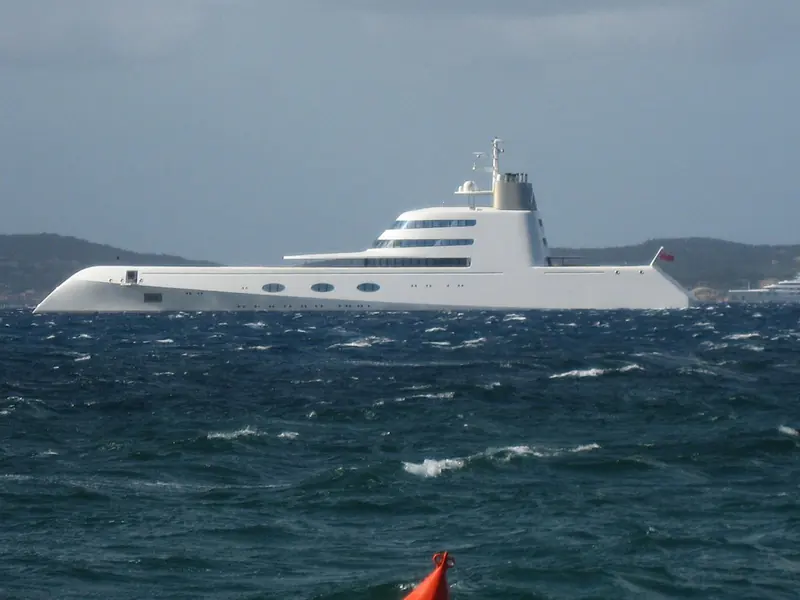
Andrey Melnichenko commissioned Motor Yacht A directly from Starck, and by Starck's own account the two of them worked together for four years on both the exterior and the entire interior, an unusually long personal involvement for a designer who normally hands a project to a studio once the concept is fixed. Blohm+Voss built the hull at its HDW deepwater facility in Kiel, delivering the yacht in January 2008 at 119 metres length, 18.87 metres beam and 5,959 GT, with the naval architecture credited to Martin Francis rather than to Starck's own office. Two MAN diesel engines give a listed 23 knot top speed, a 19 knot cruising speed and a range of up to 6,500 nautical miles, with accommodation for 14 guests in seven staterooms.
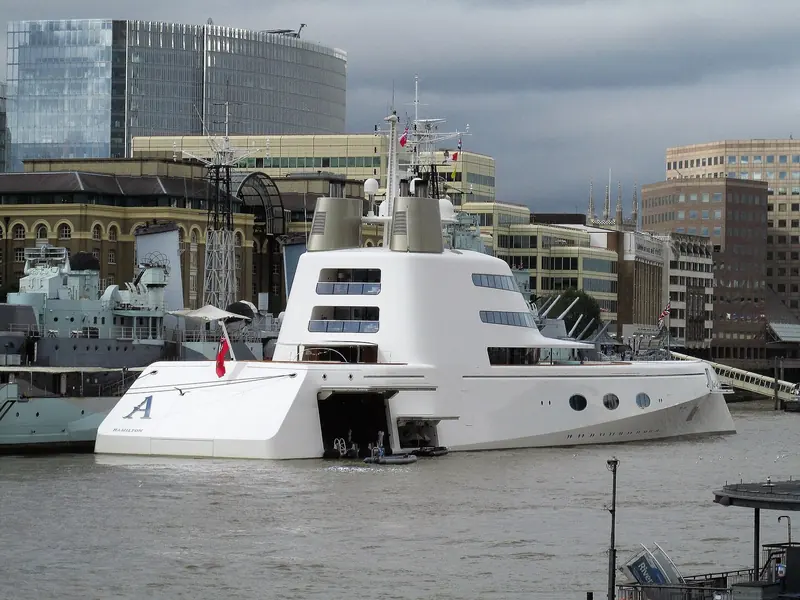
Starck has told two different stories about how fast the design came together: "it only takes 30 seconds" to BOAT International in one telling, "one month later, it was designed" to Wallpaper in another, and both can describe different stages of the same process, a fast concept sketch followed by years of development. What is not in dispute is the intent behind it. Starck has said he wanted the yacht to be "as invisible as possible," moving through the water "like a whale," and the hull's blade-like profile and pronounced tumblehome have drawn repeated comparisons in the press to the US Navy's Zumwalt-class stealth destroyer, a resemblance Starck has never disowned and the yachting press has repeated for close to two decades.
Starck took thirty seconds to sketch what became Motor Yacht A, by his own account. Its owner spent four years and a reported $300 million building it, and the Wall Street Journal called it one of the ghastliest megayachts ever created - before changing its mind.
A Boat the Trade Press Could Not Agree On
Motor Yacht A split professional opinion the moment she was delivered, and the split ran straight through the industry rather than between insiders and outsiders. The broker Jonathan Beckett of Burgess said he was "impressed... simply unlike anything that's ever been done," and BOAT International's David Pelly called her "the most extraordinary yacht launched in recent memory." The New York Times's Nazanin Lankarini wrote that her lines were "reminiscent of a nuclear submarine," and meant it as a compliment.
Other named critics went the other way and did not soften their language for print. The Wall Street Journal's Robert Frank called her one of the "ghastliest megayachts ever created," writing that she looked "more like a cruiser for Darth Vader's navy," and the maritime commentator Peter Mello called her "one of the most hideous vessels ever to sail the seas." The yacht designer Donald Starkey went further, describing her as "aggressive, like a giant finger pointing at you" and "nothing to do with yachting." Frank himself later revised his verdict in print, writing that he had "gained respect" for a boat he still called "a monster" but found "technically impressive" and worth "a tip of the hat for being different" - close to the reaction Starck says he expects, and has learned to wait out.
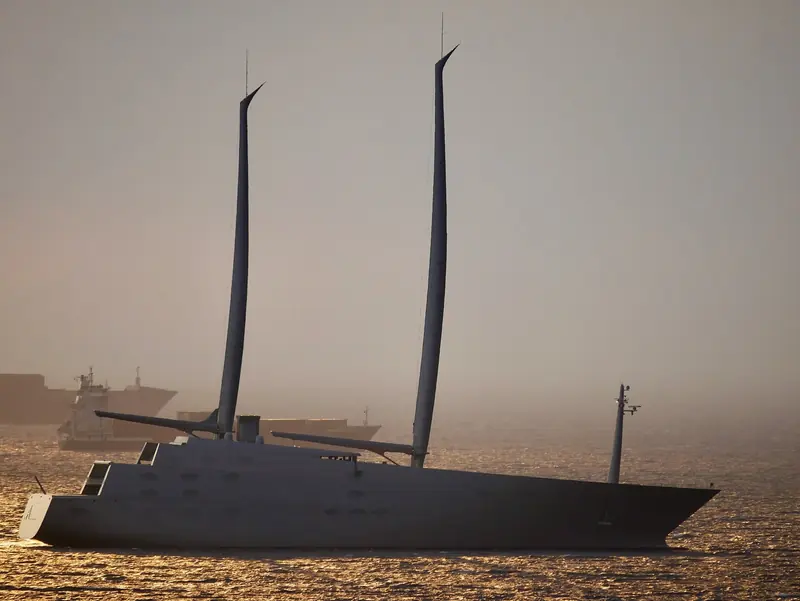
Sailing Yacht A: The Largest Sailing Yacht Ever Built
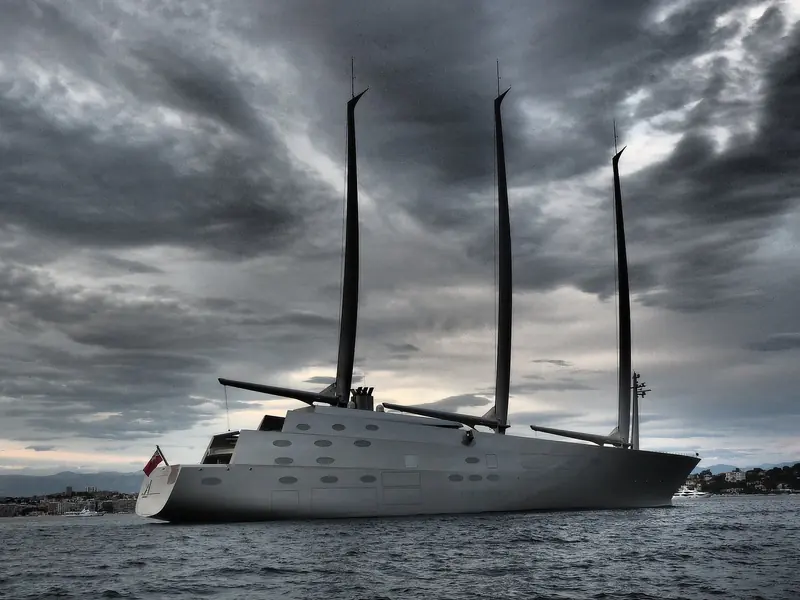
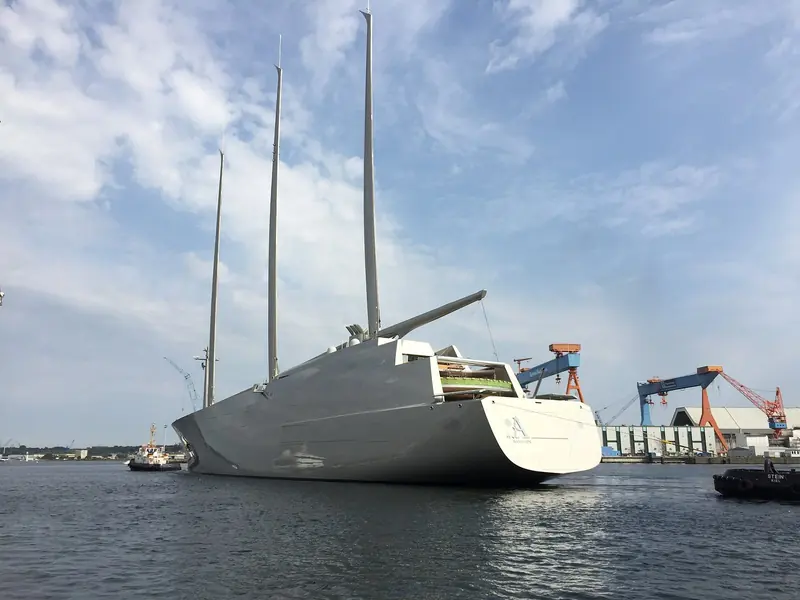
Sailing Yacht A is 142.81 metres long with a 24.88 metre beam and 12,558 GT, making her the largest private sailing yacht ever built, and she was Melnichenko's second commission from Starck rather than his first. Nobiskrug in Kiel built her, delivering the finished yacht on 3 February 2017 after a public launch on 27 January of that year. She carries three freestanding carbon-fibre masts rising to around 100 metres, engineered by Magma Structures with sails by Doyle Sailmakers, and Dykstra Naval Architects handled the naval architecture behind Starck's exterior and interior design.
Reported build costs published before delivery ran between roughly $400 million and $450 million (Yacht Harbour and Elite Traveler, both October 2015), a figure Forbes translated at the time into "about $20 million per guest" given her 20 guest capacity in 27 cabins, with a crew of 54. Under power she is rated for 21 knots and a 5,340 nautical mile range on twin diesels; under sail, her three-masted schooner rig is routinely described as the largest ever fitted to a private yacht. Each mast carries an internal elevator, a detail that says as much about how the boat is actually used as any brochure copy could.
A Floating Sculpture, or a Motor Yacht That Happens to Have Sails
Starck has called his own creation "a floating sculpture coming from a mental space," and the description reads more like an admission than a marketing line, because Sailing Yacht A's most specific criticism has never really been about her looks. SuperyachtNews, in an August 2022 opinion piece on the difference between a sailing yacht and a sail-assisted motor yacht, named her directly as a vessel that is "technically speaking... a sail-assisted motor yacht" rather than a true sailing yacht, and contrasted her with the 106 metre Black Pearl, whose captain has said her sails are used roughly 80 per cent of the time underway. The distinction matters commercially as well as critically: a boat marketed as a sailing yacht carries an environmental halo that one mostly cruising on diesel has arguably not earned.
Starck has addressed the aesthetic argument head-on rather than avoid it. Speaking at the Superyacht Design Symposium in 2018, he said of the reaction to Sailing Yacht A: "Some people hate it, I can understand; some people love it, I can understand also - but it exists, and I can wait, because everybody hated Motor Yacht A at first as well." It is an unusual thing for a designer to say about his own most expensive work, and on the evidence of what happened to Motor Yacht A's reputation over the following decade, not an unreasonable bet to make.
Venus: Five Years for Steve Jobs, and a Bill He Never Paid
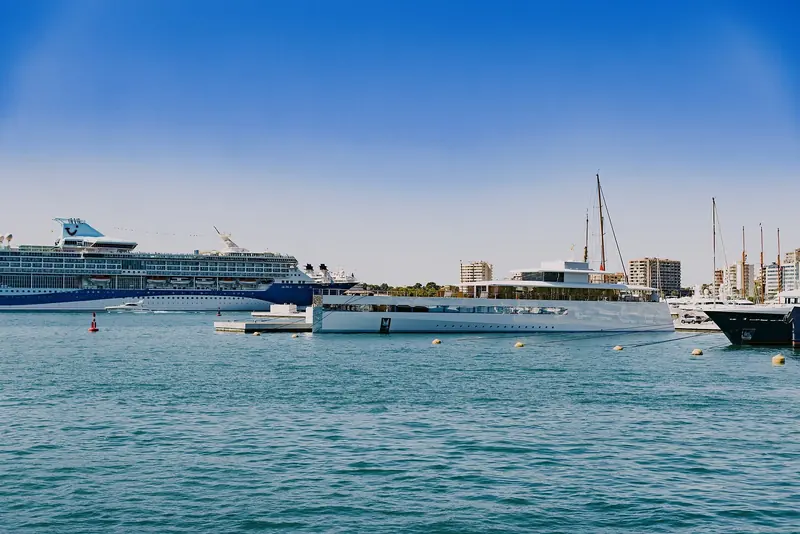
Venus took shape over roughly five years of collaboration between Starck and Steve Jobs, according to reporting on Jobs's design process published at the time, and Feadship delivered the finished 78.2 metre yacht in October 2012, a year after Jobs died and without him ever having set foot aboard. The exterior is built from straight lines and 90 degree angles on an axe bow, clad largely in glass held by structural mullions that Apple's Jony Ive is reported to have worked on alongside Starck. Feadship's own build director, Henk de Vries, gave the plainest verdict on the reaction to her: "I think as many people hate it visually as like it" - from the man who actually built the boat, not from a marketing department.
The Jobs family kept Venus after his death; she remains registered to the family, now under Laurene Powell Jobs. The commission also produced the one moment any of the three yachts' design fees became public. On 21 December 2012, Dutch authorities impounded Venus at the Port of Amsterdam over an unpaid bill: Starck said the Jobs estate owed him roughly EUR 3 million of a EUR 9 million fee, a figure reported at the time as tied to around 6 per cent of the yacht's cost, calculated against a lower final build cost than the original budget had assumed. The dispute was resolved within days and the yacht released, but the number it put into print - a percentage-of-build-cost fee running above the typical band cited for specialist naval architecture studios - is the only hard figure that exists for what a Starck yacht commission actually costs.
What a Starck Commission Costs, and How It Is Actually Built
No fee scale for Starck's yacht work has ever been published, on any of the three boats, by Starck's studio, by Melnichenko or by the Jobs estate. The single public number is the Venus dispute above, and it should be read as one data point rather than a rule: a fee near 6 per cent of build cost sits above the 1 to 5 per cent band that SuperYachtReview's 2026 price guide gives for specialist yacht naval architecture and design studios, which is consistent with what a client should expect from a name with Starck's fame outside yachting rather than a yacht-only practice's more standardised rate card.
The commercial structure is also different from a dedicated yacht studio's. Starck's side of the table supplies the concept, the exterior form and the interior design; naval architecture and engineering have always been contracted separately, to Martin Francis on Motor Yacht A and to Dykstra Naval Architects alongside Nobiskrug's own engineers on Sailing Yacht A. An owner commissioning Starck is buying an aesthetic argument and then assembling, as a second and distinct appointment, the engineering team that will make it real - much as an owner commissioning a pure exterior specialist must separately appoint an interior house. The difference here is that Starck's studio is not primarily a yacht practice at all; the yacht work sits inside a career that also runs hotels, furniture, cutlery and consumer electronics, and there is no run of dozens of hulls to check a fee or a timeline against, only these three.
Where the Three Yachts Are Today
Venus is the untroubled boat of the three: she remains with the Jobs family and has been seen at charter and at events with no ownership or legal dispute attached to her name. The other two are entangled, to very different degrees, in the sanctions regime that followed Russia's full-scale invasion of Ukraine in February 2022. Sailing Yacht A was seized by the Italian Guardia di Finanza at Trieste on 12 March 2022 under EU sanctions naming Melnichenko, and she remains detained there as of 2026. The Court of Justice of the European Union issued a preliminary ruling in June 2026 rejecting the argument that transferring beneficial control to a trust for Melnichenko's wife took the yacht outside the sanctions regime, and the underlying case continues before Italy's Lazio regional court while the Italian state pays an estimated EUR 10 million a year to keep her maintained at anchor (Megayacht News, June 2026; a Reuters valuation cited in the same reporting puts her worth at roughly EUR 530 million).
Motor Yacht A has never been formally seized, which is a narrower and more fragile status than it sounds. She lost her Isle of Man flag registration after Melnichenko was sanctioned in 2022, was later reported flying a Sierra Leone flag, and by 2023 to 2025 reporting had moved to a Malaysian flag while she sat for more than two years at a yard in Dubai. Trade press reported in early 2025 that she left Dubai under a newly registered owner, without independently confirming who that owner is; a widely circulated rumour that she had been sold to the Japanese investor Masayoshi Son was denied by Melnichenko's representatives. Her current ownership is genuinely unresolved rather than simply undisclosed: nothing in the available reporting clears the two-source bar this page holds itself to, and the honest answer for a reader is that Motor Yacht A's paper trail has been made deliberately hard to follow since 2022.
Praktische Angaben
| Design fee | not published for Motor Yacht A or Sailing Yacht A; the one public figure is Venus, where a 2012 billing dispute put the fee at roughly EUR 9 million, cited as around 6 per cent of build cost - above the 1 to 5 per cent band SuperYachtReview's 2026 price guide gives for specialist yacht design studios |
|---|---|
| Commission structure | Starck's office supplies concept, exterior and interior design only; naval architecture and engineering are contracted separately every time (Martin Francis on Motor Yacht A; Dykstra Naval Architects with Nobiskrug's own team on Sailing Yacht A) |
| Typical timeline | measured in years of personal involvement, not weeks - about four years on Motor Yacht A and roughly five on Venus by contemporaneous accounts, on top of however long the yard then takes to build |
| What is not published | confirmed build costs for any of the three yachts; all figures in circulation (around $300 million for Motor Yacht A, $400-450 million pre-delivery reports for Sailing Yacht A, a disputed EUR 105-150 million range for Venus) are press estimates, never confirmed by builder or owner |
| Track record to check against | three yachts total, all one-off and all for two clients; there is no series or fleet to compare pricing, timelines or systems reliability against, unlike a studio with dozens of delivered hulls |
| What a prospective owner needs to know | a Starck commission buys a singular aesthetic argument and the attention that follows a famous name, not a repeatable yacht-design product; be prepared to run naval architecture as a separate appointment, to find no fee precedent beyond one disputed figure, and to own a silhouette that will be debated for the life of the boat |
Was Eigner und Crew berichten
No independently attributable owner or crew testimony found
press coverage of all three yachts repeats quotes from Starck himself, from brokers such as Jonathan Beckett, and from Feadship's own build director Henk de Vries, but this research found no on-the-record account from a private owner, guest or named captain describing how Motor Yacht A, Sailing Yacht A or Venus actually handles or lives day to day; Melnichenko's and the Jobs family's operations are both run under the strict confidentiality typical at this size, and two of the three boats are additionally under active legal dispute, which makes any crew or owner going on the record even less likely
Yotters research desk
Was gut ist und worauf zu achten ist
Stärken
- Nobody else has built anything like these three boatsSailing Yacht A remains the largest private sailing yacht ever built and Motor Yacht A's silhouette has no real precedent or successor; both are proof that a non-yacht designer can produce something a specialist studio never has
- Sustained personal involvement, not a one-off sketchfour years of Starck's own time on Motor Yacht A and roughly five on Venus, by his own and contemporaneous accounts, well beyond a concept commission handed off to a studio
- The same design identity survived three unrelated yardsBlohm+Voss, Nobiskrug and Feadship each engineered a completely different hull, yet all three read unmistakably as Starck's work, which argues the vision is his and not an artefact of one yard's team
- Reputations that improved with time rather than fadingMotor Yacht A went from Robert Frank's 'ghastliest megayachts ever created' to his own later 'gained respect... tip of the hat for being different,' and Starck's own prediction that Sailing Yacht A will follow the same arc has a decade of precedent behind it
- Global name recognition beyond yachting itselfBOAT International has called Motor Yacht A the world's most talked-about superyacht; a Starck commission buys press attention no yacht-specialist studio can generate on its own
Worauf zu achten ist
- A genuinely deep and credentialed body of criticism, not a fringe viewthe Wall Street Journal's Robert Frank, maritime commentator Peter Mello and yacht designer Donald Starkey have each gone on record calling Motor Yacht A hideous, aggressive or unrelated to yachting - this is not a handful of anonymous forum posts
- Sailing Yacht A's own classification is contestedSuperyachtNews has named her directly as 'technically speaking... a sail-assisted motor yacht' rather than a genuine sailing yacht, unlike Black Pearl, whose captain reports sailing roughly 80 per cent of the time underway
- No published fee scale and only one public data pointthe sole figure on record is the disputed EUR 9 million Venus fee, which became public only because of a billing dispute and impoundment, not because either party chose to disclose it
- Not a yacht-specialist practice, so naval architecture is always a second appointmentMartin Francis and Dykstra Naval Architects each had to be contracted separately from Starck's own office, unlike a studio that carries naval architecture in-house
- The name now carries real geopolitical and reputational risktwo of Starck's three most famous yachts are entangled in an active sanctions dispute or an unresolved ownership picture, which is now part of what any prospective client associates with the name, fairly or not
Für wen: Owners who want a globally famous name's one-off aesthetic argument rather than a yacht-design specialist's repeatable system, who are prepared to appoint naval architects and engineers as a separate contract, and who can live with the boat's silhouette being argued about in public for the rest of its life.