William Fife (Fife of Fairlie)
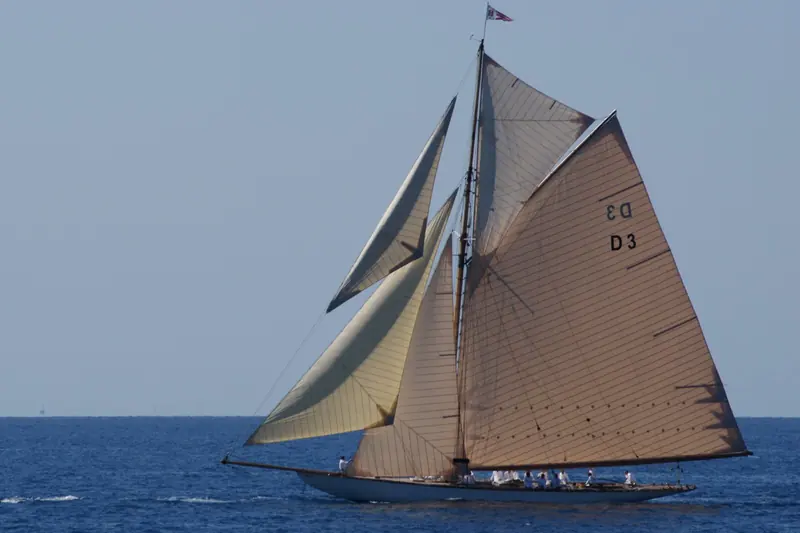
| Born 15 June 1857 at Fairlie, died there 11 August 1944; third William Fife in the family business | |
| About 600 yachts designed (Wikipedia); over 900 boats built by Fairlie's craftsmen across three generations (Fairlie memorial source) | |
| Shamrock I (1899) and Shamrock III (1903) for Sir Thomas Lipton; both lost, Shamrock III 3-0 to Reliance | |
| Eight of the twenty 15 Metres ever built; four survive, Mariska, Tuiga, Hispania and The Lady Anne | |
| Altair | 40.8 m schooner, yard number 789, launched 1931 |
|---|---|
| Mariquita (1911) | the last surviving 19 Metre, relaunched in 2004 after restoration at Fairlie Restorations |
| Latifa | 70 ft Bermudan yawl, 1935 or 1936, said to be his favourite |
| Fairlie yard closed around 1939; incorporated as The Fairlie Yacht Slip Limited in 1948 | |
| Honours per Wikipedia | OBE in the 1919 New Year Honours; America's Cup Hall of Fame in 2004 |
| Fee, price list and current studio | none, he died in 1944 |
A Fairlie Yard, Three Generations
His grandfather, William Fyfe (1785-1865) and his father, William Fife Sr. (1821-1902), had already made Fairlie a yachting address before he started building under his own name in 1890. Wikipedia says he never married and had no children, and that he was buried in Largs. A Fairlie memorial source counts over 900 boats built by the village's craftsmen across the generations, while Wikipedia credits Fife III personally with about 600 designs. Those are different measures, one of hulls built at the yard and one of drawings, so don't read them as a contradiction or add them together. His trademark was a stylised dragon, adopted after his design Dragon of 1888, worked into scrollwork on Fairlie-built boats.
The yard stood on the beach on Bay Street and is gone: terraced houses occupy the site, and Fairlie Community Trust put up a monument to three generations of the family and their workers in July 2011, a sculpture of the 15 Metre The Lady Anne. Fife is reported to have said a great yacht should be fast and bonnie, and Fast and Bonnie is also the title of May Fife McCallum's history of the firm. Important for a buyer: a boat described as a Fife may have been drawn by William Fife III and built at Fairlie, drawn by him and built elsewhere or built there to a design drawn by someone else. Shamrock III is the obvious example. Fife drew her, but William Denny and Brothers built her at Dumbarton.
The America's Cup Years
Lipton challenged five times in all, and Fife's two boats were the first and third. Shamrock I lost to Columbia. Shamrock III, launched on 17 March 1903 and built by Denny at Dumbarton, lost to Reliance in all three races, according to the America's Cup history pages and American Heritage. Sources give her at about 109 ft 4 in on deck with 14,337 sq ft of sail, a figure I could only find in one place, so treat it as indicative. One account says Lipton approved aluminium for her decks.
This is the part of Fife's record that is easiest to overstate. He was never the designer of a Cup winner, and Reliance, the boat that beat Shamrock III, was a Herreshoff design built with Tobin bronze, a very different tradition. His reputation rests on something else: the large number of handicap and rule-class yachts that won races on the Clyde and the Solent and, above all, on the fact that so many of them survive. He and G.L. Watson were the two Clyde names at the centre of the rule changes that followed the formation of the Royal Yachting Association in 1875, which is as close as the record gets to saying he helped write the game he played.
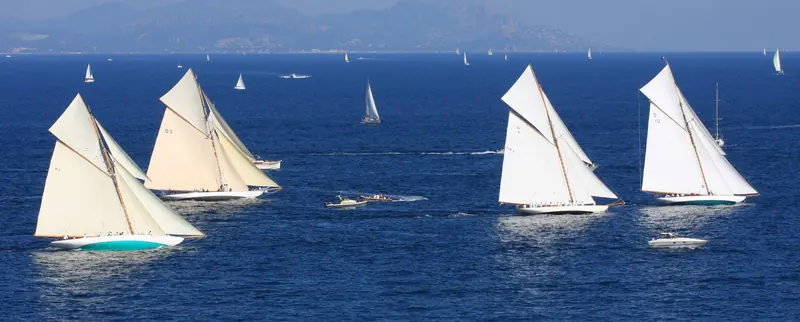
His reputation rests less on a Cup win than on how many of his boats are still afloat.
Metre Boats: Tuiga, Mariska, Hispania and Cintra
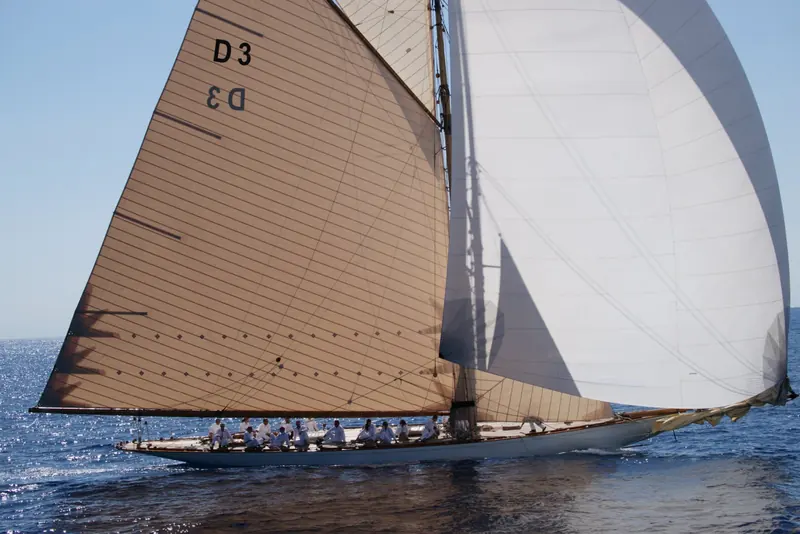
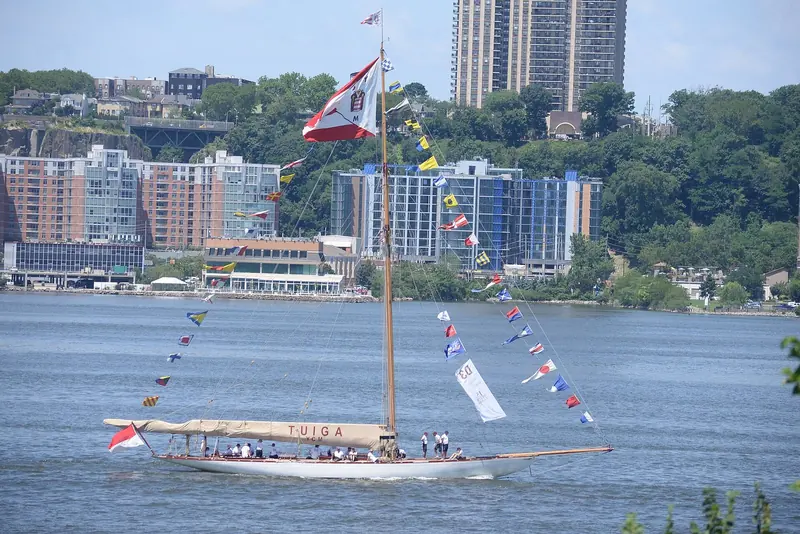
Wikipedia gives the eight-of-twenty figure, and a second source confirms that eight of the twenty were his and that only four 15 Metres survive: Mariska (1908), Tuiga (1909), Hispania (1909) and The Lady Anne (1912), all Fife designs. His first, Shimna, was built by Alexander Robertson and Sons rather than at Fairlie, because the yard was busy on Myles Kennedy's 23 Metre White Heather II. Tuiga was commissioned by the Duke of Medinaceli, a friend of King Alfonso XIII and drawn as a twin to Hispania so the two could race evenly. The Yacht Club de Monaco has owned her since 1995. She is about 28 m on deck by one source and 28.7 m by the plate on her own dock board, the sort of small discrepancy that is normal for these boats.
Cintra is the small end of the story. Fife drew her in 1909 for Andrew Coats under the First International Rule as his second 12 Metre, and she is widely described as the oldest 12 Metre still sailing, though that is a broker's claim and I wouldn't print it as settled. She is about 22 m overall, won 13 of her 33 starts in her first season, and was last raced in 1956 before going to a German owner. The point for a reader is the scale of the survival. A hull of this age racing at Cannes and Saint-Tropez is a testament to the construction, yes and equally to owners who have spent very large sums on it.
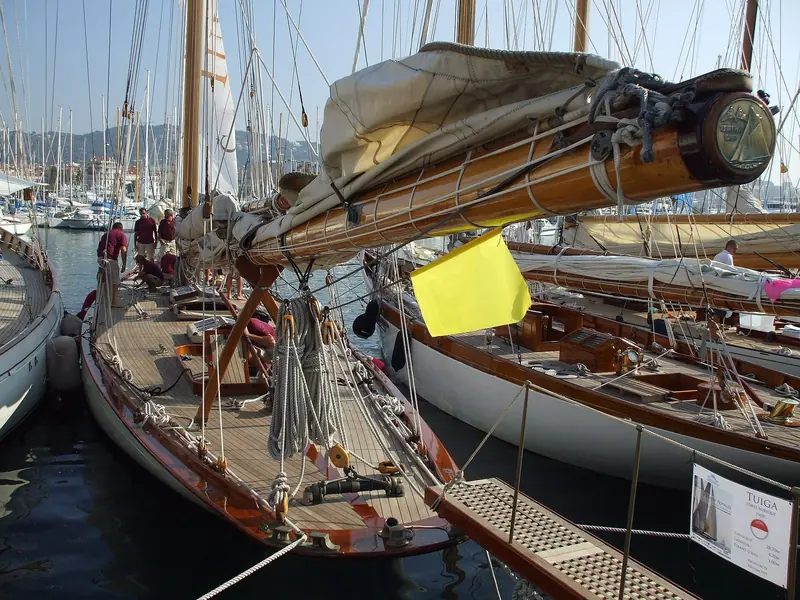
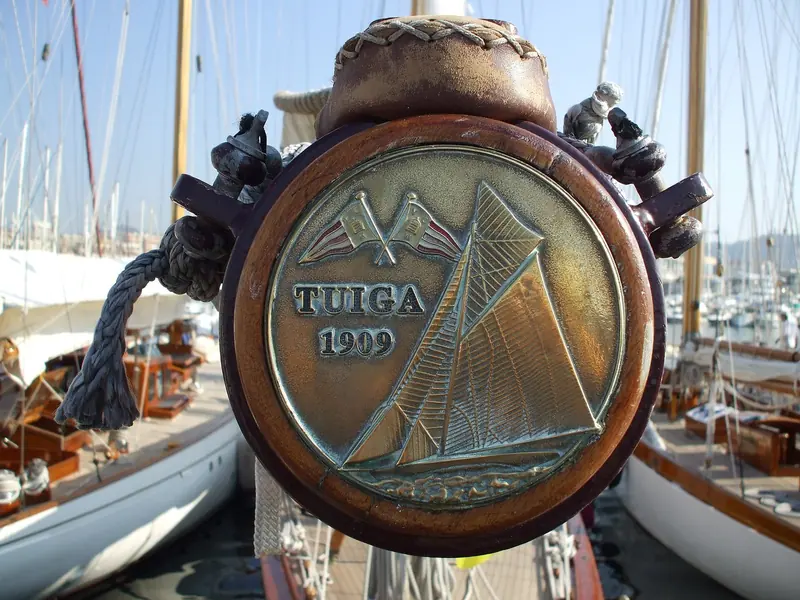
Cruisers and Big Yachts: Altair, Latifa, Eilean, Mariquita
Altair is a 40.8 m schooner, yard number 789, launched in May 1931 for Captain Guy MacCaw as a sound cruiser. She was restored at Southampton Yacht Services in 1985-87, and later work is reported inconsistently: Boat International mentions Fairlie Restorations in 2007-08 and a New Zealand refit in 2020-22, while another listing dates a restoration to 2007-2010. Boat International also reports a 2024 listing through Sandeman Yacht Company at EUR 6.5 million, lying in Spain; I found no second source for the price. Latifa, a 70 ft Bermudan yawl built for Michael Mason, is said to be the boat Fife thought his finest. After his death his sisters had a gilded model made of her, and a weather vane in the form of Latifa stands on Fairlie parish church. Her launch year is given as 1935 in one source and 1936 in others.
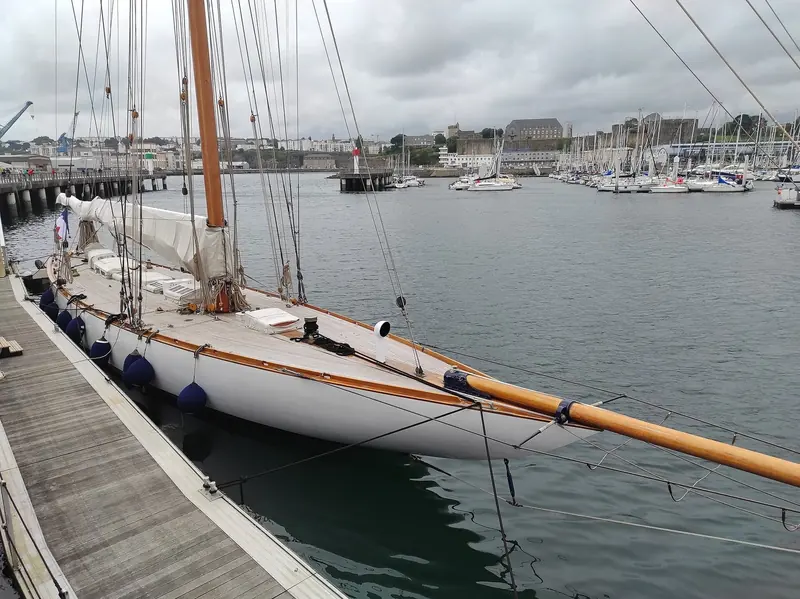
Eilean is a Bermudan ketch of about 70 to 72 ft, found in poor condition in Antigua by Panerai in 2006, restored at Viareggio from 2007 and relaunched on 22 October 2009, though one charter site gives La Spezia as the place. Mariquita is the sole survivor of the 19 Metre class, built for Arthur Stothert in 1911, rescued from Pin Mill in 1991 by William Collier and Albert Obrist and restored at Fairlie Restorations before relaunching in 2004. Her length is given variously as 125 ft (38.1 m) and about 130 ft, so quote 38 m if you must quote one. Hallowe'en (1926) was built for Norman Baxendale for that year's Fastnet and set a course record, but the race was won overall by the 1899 Camper and Nicholsons yawl Ilex, not by a Fife.
After 1944: The Yard, the Name and the Market
Sources agree that the yard closed on the eve of the Second World War and was taken over by the Admiralty, as in the First, though not to build boats. A classic yacht blog says William Fife III's nephew, Balderston Fife, sold it afterwards to the Parker brothers, Colin and Ian and Grace's Guide records the 1948 incorporation of The Fairlie Yacht Slip Limited; the sources do not settle whether the 1948 company was the Parkers' business. His nephew ran the yard for some years, and Wikipedia says it never regained its old reputation. A sloop, Sumarel, was built in 1973 to a Fife design, long after his death.
For a buyer or an owner, three things follow. First, Fife is a design-and-build name, so a yacht's file should say who drew it, who built it and when. Second, provenance matters more than the label: a boat with a continuous history and a documented rebuild is worth far more than one with a gap. Third, running one is not cheap. Wilfried Beeck, who owns the 1909 12 Metre Cintra, is quoted by Boat International at about GBP 90,000 a year per boat in his fleet for everything from mooring to insurance and repairs, and says it is too much work to do yourself. It is one owner's figure, not a survey. There is no current Fife studio to commission and no published price list, so the real market is brokerage and restoration yards.
Praktische Angaben
| Design fee | none; William Fife III died in 1944 and there is no current studio. His successor yard was incorporated as The Fairlie Yacht Slip Limited in 1948 |
|---|---|
| Where it began | Fairlie, North Ayrshire, on Bay Street; the site now holds houses and a 2011 memorial sculpture of The Lady Anne |
| Buying | through brokerage or from the owner; Altair was listed in 2024 at EUR 6.5 million via Sandeman Yacht Company per Boat International, one source only |
| Running cost | one Cintra owner quotes about GBP 90,000 a year per boat (Boat International); ask for the last three years of yard invoices |
| What to check | the full rebuild history (stem, frames, deck, keel bolts), the registered class certificate, the yard number and who actually built her |
| Where to see them | the big classic regattas, among them the Regates Royales at Cannes and the Voiles de Saint-Tropez, where Tuiga and the other 15 Metres race |
| What is not published | fees, a complete yard list, an agreed count of survivors and verified lengths for several of the larger boats |
| Alternatives | G.L. Watson and Alfred Mylne for Clyde classics, Sparkman and Stephens and Laurent Giles elsewhere on this site |
Was Eigner und Crew berichten
Upkeep is a professional job
the owner of the 12 Metre Cintra says each of his two classic boats costs about GBP 90,000 a year including mooring, insurance and repairs and that it is too much work to do yourself
Boat InternationalA well-travelled Fife still goes back to the yard
Latifa broke off a long cruise at the start of the pandemic to return to Rockport Marine for a systems refit, interior joinery and a rig inspection, before leaving again for Tahiti
Rockport MarineRebuilds are the norm, and the record can be patchy
on Altair, Yachting World reports rotten oak stem timbers replaced with a laminated iroko stem, and the dates of her later refits differ between sources
Yachting WorldMariquita came back from a mud berth
she was found at Pin Mill in 1991 and took until 2004 to be restored and relaunched at Fairlie Restorations, a project of roughly three years in most accounts
Classic Yacht Info
Was gut ist und worauf zu achten ist
Stärken
- The survival record is unmatchedTuiga, Mariska, Hispania, Lady Anne, Cintra, Mariquita, Altair, Latifa and Eilean all still sail or have been rebuilt to sail
- A documented lineageyard numbers, rule-class registers and restoration books exist for many of the larger boats, so provenance can be checked
- A trusted name at resalethe Fife label carries real weight in the classic market, and the yachts are raced at the big classic regattas
Worauf zu achten ist
- There is no studioFife died in 1944 and the yard has been closed for decades, so there is nothing to commission, no design fee and no builder's support
- The label is loosely useda Fife may mean drawn and built at Fairlie, drawn there and built elsewhere or a later copy, and the file should say which
- Running costs are large and mostly unpublishedthe only per-year figure found is one owner's, not a survey and prices for most boats are quoted on application
- Facts drift between sourceslengths, launch years and restoration dates for Latifa, Mariquita, Eilean and Altair differ from page to page
Für wen: Buyers and owners of classic gaff and early Bermudan yachts who want to know what a Fife is, what to check in the file and what the upkeep is likely to cost, and anyone researching the history of the Clyde and the metre classes.