Fendertex
| Category | inflatable textile (knitted) yacht fenders, dock and pontoon bumpers, and mooring packs |
|---|---|
| Founded | 3 February 2014 in France, originally registered as Safe Boat Equipment, by founder Jean-Luc Vanoise |
| R&D | began 2010 at CETI, the European Centre for Innovative Textiles in Tourcoing; sea trials from 2012 on vessels 39 to 150 feet; patent filed 2014 |
| HQ and manufacturing | Aire-sur-la-Lys, Pas-de-Calais, northern France; the company states every Fendertex product is made exclusively in France |
| US and Americas distribution | PYI Inc of Lynnwood, Washington, exclusive distributor since 2019 |
| Range | cylindrical (C62 to C248, nine sizes), spherical (S60 to S120, five sizes), tandem or teardrop (T73 to T248, eight sizes), plus tubular dock and pontoon bumpers and Mooring Packs for 23 to 98 foot boats |
| Coverage claimed by the company | fits vessels from about 18 feet to 590 feet |
| Milestone | passed 1,000 vessels equipped within its first three years on the water, by the company's own account; about 18,000 products made in 2023 on EUR 1.7 million turnover |
| Weight | a standard C104, sized for a 52 to 62 foot boat, weighs 1.36 kg against 4.2 kg for a similarly sized Polyform F-6, by the two makers' own published figures |
| 2026 Monaco Yacht Show exhibitor, stand DS59, Equipment category | |
What Fendertex Actually Makes
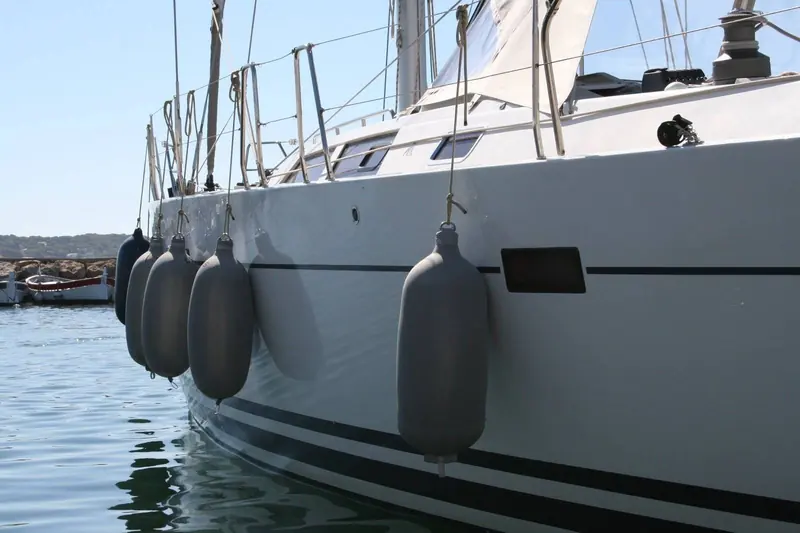
Every fender before Fendertex was built the same way: a tube or sphere of PVC or rubber, molded in one piece and filled with air. Fendertex inverted the construction. Inside is a welded polyurethane air chamber, made the way an inflatable paddleboard or tender tube is made, which can be topped up with water as ballast to help hold a fender in place. Outside is a knitted polyester cover, solution-dyed so the color runs through the yarn rather than sitting on top of it as a coating, which is what the company and its US distributor both point to as the reason the color does not chalk or fade the way a molded PVC fender's finish can over a few seasons at anchor.
The result, on the maker's own account and repeated in SAIL Magazine's gear pages, is a fender described as up to 95 percent lighter than a PVC one of the same rating, though independent spec sheets tell a more moderate but still real story: a Fendertex C104, sized for a 52 to 62 foot boat, weighs 1.36 kg against 4.2 kg for a Polyform F-6 of similar physical length, based on the two companies' own published figures. It deflates to a fraction of its inflated size for stowage, and it is machine washable at 40 degrees Celsius without removing the bladder, a routine that is not possible on a fender where the cover and the air chamber are the same molded piece.
The Range, By Size and Shape
The cylindrical range runs C62 through C248, sized by US distributor PYI Inc to boats from about 15 to 30 feet on the smallest C62 up to 230 to 328 feet on the largest C248, with a C84 covering roughly 43 to 52 feet and a C124 stretching to 62 to 98 feet. The spherical range, S60 to S120, is pitched as a hand-held fender for maneuvering as much as a hung one, useful where a round profile suits a flared hull or a raft-up better than a cylinder does. The tandem or teardrop shape, T73 to T248, pairs two lobes on one strap for boats that need more coverage along the topsides than a single cylinder gives without hanging twice as many fenders.
Below the yacht-fender range sits a line of tubular dock and pontoon bumpers, aimed at the berth rather than the boat, and Mooring Packs bundled for vessels of 23 to 98 feet, by the company's own description of its product lines. Across the whole catalogue the company states its products fit vessels from about 18 feet to 590 feet, which spans a tender to the largest yachts afloat, though the giga-yacht end of that claim is necessarily served by custom sizing rather than a standard catalogue part number.
A Fendertex fender costs about 80 percent more than a Polyform of the same length and weighs about a third as much, which is either an easy decision or a hard one depending entirely on who has to carry it.
What It Actually Costs
PYI Inc's dated 2026 price list, as the exclusive US and Americas distributor, gives standard pricing of USD 130 for a C62, USD 246 for a C84, USD 345 for a C104, USD 398 for a C124, USD 548 for a C175 and USD 1,240 for the flagship C248, with a reinforced option adding about 80 percent to the standard price consistently across the range. Spherical fenders run USD 289 for an S60 to USD 649 for an S120, and the teardrop-shaped tandem range runs USD 259 to USD 1,860 with no reinforced option offered. Fisheries Supply's own retail listings match the C73, C84, C104 and C124 figures exactly, and West Marine's live prices for the S60 to S80 sit close behind PYI's list, within the range a retailer's own seasonal pricing would explain. Fendertex's home-market site, fendertex.eu, prices the same cylindrical range from about EUR 99 to EUR 975, a similar spread in the maker's own currency.
The fender itself is not the whole bill. A standard cover costs USD 71 on a C62 rising to USD 365 on a C248, and any model C84 or larger needs a separate long-side cover, at USD 168 to USD 824, if it will be hung horizontally rather than vertically. A custom knit-in cover with an embroidered name or crest costs more again, USD 97 to USD 459 depending on size, and carries a 6 to 10 week lead time by the same price list; plain embroidery on the collar straps alone, without a full custom knit, is a flat USD 46 add-on. A spare inner bladder, needed after a puncture, runs USD 28 on the smallest size to USD 249 on the largest. Neither the maker nor its distributors publish a secondhand or resale value for a used fender, which is not surprising for a piece of consumable safety equipment, but it means a buyer is pricing new against new, not new against used.
The Material, and Why It Doesn't Mark a Hull
Ultrasonic welding, rather than glued or vulcanized seams, is the same joining method used on quality inflatable paddleboards and tender tubes, and it is what lets the bladder be filled with water as ballast as well as air, helping hold a fender in position against a hull without extra weights, according to the maker's own technical pages. The cover over it is knitted from a high-tenacity polyester yarn that is solution-dyed, meaning the color is mixed into the polymer before the fiber is spun rather than applied as a surface coating afterward. That is the same dyeing method used on outdoor marine upholstery fabric precisely because a surface coating chalks and fades under UV where a solution-dyed fiber resists it.
The practical payoff, repeated across the maker's site, its distributors and Dockwalk's own reporting, is threefold: the cover resists abrasion better than gelcoat expects a fender to, it does not transfer the black marks a PVC fender leaves on white topsides after a season of rubbing at a berth, and the whole fender is machine washable at 40 degrees Celsius, which a molded fender cannot be without risking the material. None of that removes the ordinary maintenance a fender needs. PYI's own instructions call for checking bladder pressure with a calibrated gauge at least every two months on a fender left moored for a season, and warn against ever using the valve wrench to deflate the unit, which the maker says can damage the fender or injure whoever is holding it.
Color and Customization
PYI's price list carries black, navy blue and gray as stock colors with no lead-time penalty, and dark gray, royal blue, beige, burgundy, green, orange and red as custom colors; Fendertex's own European site lists a broadly similar palette and adds yellow and a pale lagoon shade not on the US list, a small regional difference worth checking before ordering rather than assuming. A plain color change adds a modest amount to the price and, by the maker's own customization page, a four to six week lead time. A fully custom cover, knitted with a boat's name, a house flag or a yacht club crest worked into the fabric itself rather than embroidered on top, is the more involved order: PYI's price list puts the lead time at six to ten weeks, while simple embroidery on the collar straps alone, without a full custom knit, is a flat USD 46 add-on that ships faster.
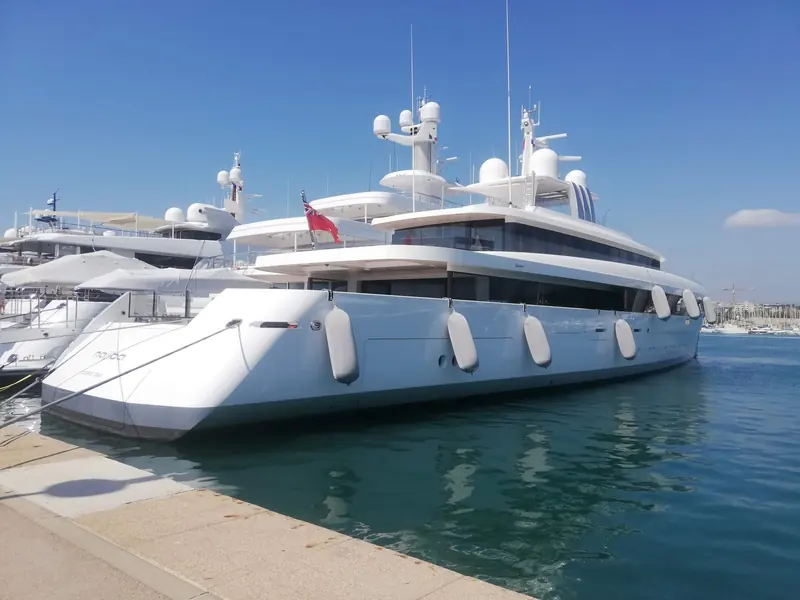
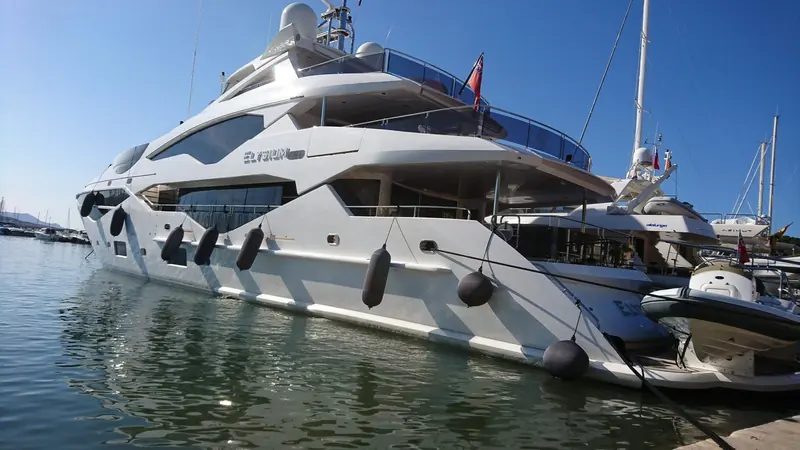
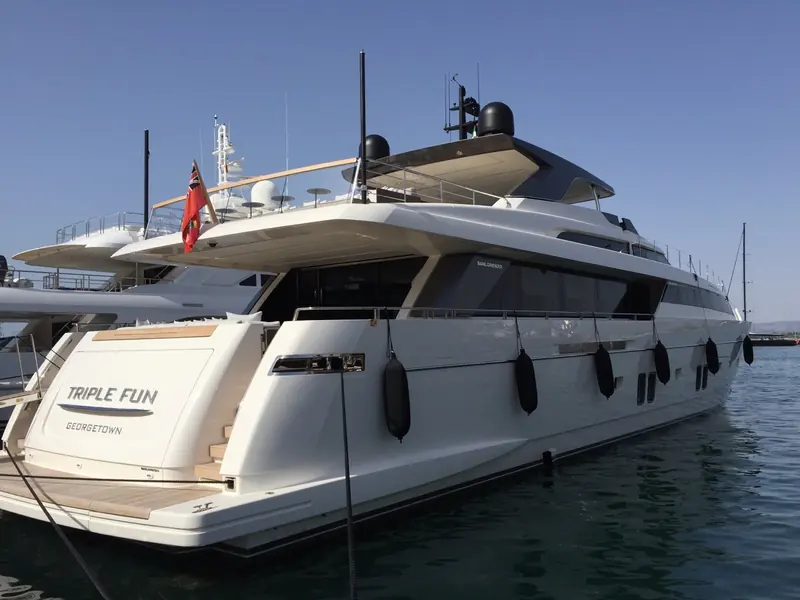
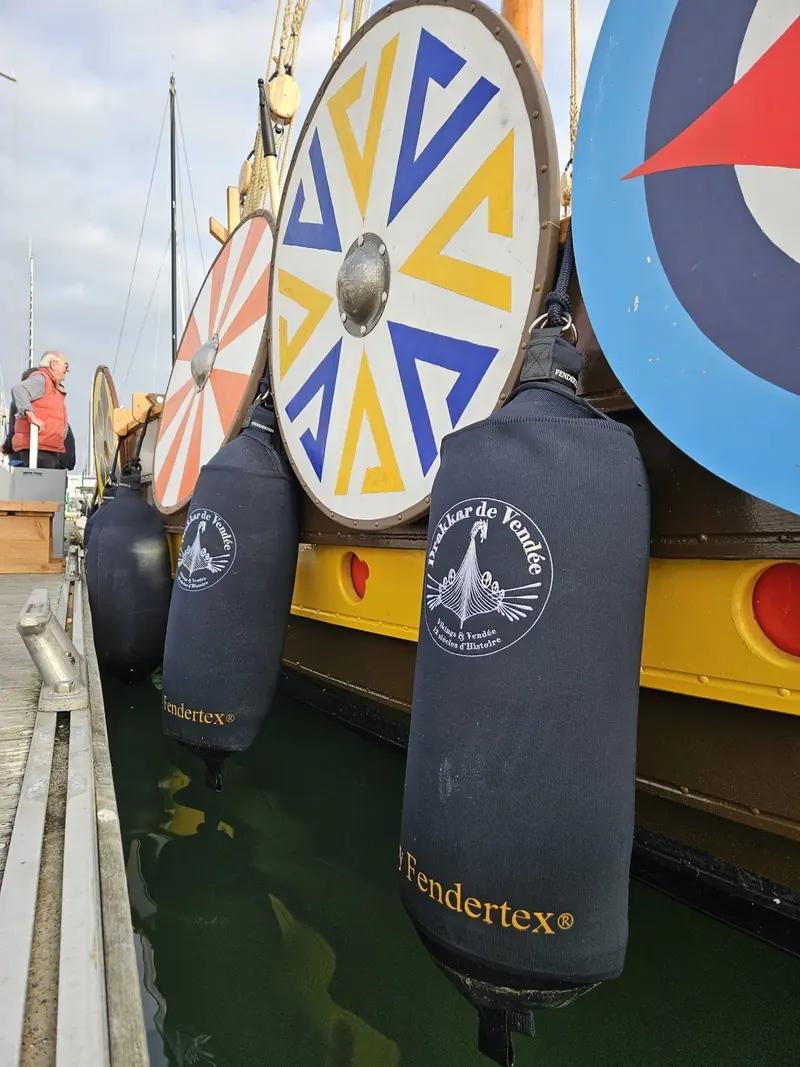
Some of that customization work happens outside Fendertex's own French plant. The company's European distributor, Seaview Progress, finishes and personalizes fenders for parts of its own market under an arrangement in which the core textile knitting and the welded air chamber stay with Fendertex in France while the strap seams and embroidery are completed at Seaview Progress's own premises, which the two companies describe as a way of shortening delivery times on customized orders without moving the patented process itself. For an owner, the practical result is the same fender shown in the photographs on this page: a pale, color-matched cover on the superyacht Najiba, dark gray and black on the motor yachts Elysium and Triple Fun, and navy covers embroidered with a client's own crest on a French tourist longship, all real deliveries rather than a catalogue render.
Against Plain PVC and Against Leather
The premium is real and it is not small. Polyform US lists its own F-6, an 11 by 42 inch PVC fender the company recommends for boats of 40 to 50 feet, at USD 192.57 direct from the manufacturer. The closest Fendertex by physical length, the 13.5 by 39.5 inch C104, which PYI rates to boats of 52 to 62 feet, a more conservative bracket for a similarly long fender, lists at USD 345 standard before a cover is added, which is roughly 80 percent more for a fender of comparable size. What the buyer gets for that premium, on the two makers' own spec sheets, is a fender at less than a third of the weight, 1.36 kg against the Polyform's 4.2 kg, plus the color-matching and the non-marking cover neither PVC fender offers.
Against the older tradition of a rope-sennit or leather-wrapped cover over a plain PVC or rubber fender, which remains common on classic yachts and on crews who want a traditional look without buying a specialist product, Fendertex's pitch is that a knitted, color-matched cover gets a similar finished appearance without the maintenance a natural-fiber wrap needs and without the extra bulk rope work adds to a fender that already has to be stowed somewhere. That is a fair comparison of finish and upkeep; it is not one this page can put a hard number on, because no published source prices rope or leather fender-wrapping as a like-for-like alternative the way Polyform prices its own PVC range.
History, Scale and Who Actually Uses Them
Research on an inflatable textile fender began in 2010 at CETI, the European Centre for Innovative Textiles in Tourcoing, in partnership with boating professionals and industrial textile specialists, and sea trials followed from 2012 on vessels from 39 to 150 feet, by the company's own account. The business was registered on 3 February 2014, originally as Safe Boat Equipment, with the patent filed the same year, and manufacturing has stayed at Aire-sur-la-Lys in the Pas-de-Calais ever since; the company states every Fendertex product is made exclusively in France. The company says it passed 1,000 vessels equipped within about three years of launch, brought out its tubular fender range in 2017, and in 2019 signed PYI Inc of Lynnwood, Washington as its exclusive distributor for the United States and the wider Americas, the same year Dockwalk covered the product reaching the US market.
By its own figures the company made about 18,000 products in 2023 against a turnover of EUR 1.7 million, a genuinely small manufacturing base next to a fifty-year-old PVC fender maker like Polyform, and worth knowing before assuming the same spare-parts and warranty infrastructure exists behind it. It is, all the same, an established name at the top of the market: Fendertex is a confirmed exhibitor at the 2026 Monaco Yacht Show, on stand DS59 in the Equipment category, and its own achievements photography, rather than only its marketing copy, shows real deliveries: a pale color-matched set on the superyacht Najiba, dark cylindrical fenders on the motor yacht Elysium and on the Sanlorenzo Triple Fun in Palma, and embroidered navy covers on a Vendee tourist longship, the Drakkar de Vendee, alongside its close-quarters replica Viking shields. Its Dutch distributor's own marketing also names Feadship, Oceanco, Lurssen, Damen and Heesen among the yards whose yachts it has equipped, a claim made by the distributor rather than independently confirmed by any of those yards.
Care, Durability and What Can Go Wrong
On Tugnuts, an owner forum, a poster using the handle Gin, who bought a pair from Fisheries Supply, reported them as amazingly stout, taking much harder impacts than a PVC fender and staying firm in cold weather where PVC can go soft or brittle, but flagged that their lightness is both a plus and a minus: used forward alongside larger Polyform fenders, they needed securing so they would not blow around underway, a problem the maker addresses by selling a weighted bean-bag accessory rather than by claiming it away. On Trustpilot, a verified Fendertex.nl reviewer named Vivienne Logan-Reid called the fenders not cheap but real value for money and one of the best boat purchases made, while another reviewer, Miriam, praised how easy the large sizes were to handle precisely because of the low weight, and a third, C. Hoppenbrouwers, singled out being able to deflate and pack the fenders away properly as the main practical difference from a rigid fender.
What is not published anywhere in the maker's or its distributors' material is any independent compression, abrasion or puncture-resistance test; every strength figure on this page traces back to Fendertex or to a retailer repeating Fendertex's own copy, including the widely repeated claim of being up to 95 percent lighter than PVC, which nobody outside the company appears to have measured independently. Routine care is straightforward: PYI's own instructions call for a pressure check with a calibrated gauge at least every two months on a fender left in the water for a season, and warn against using the valve wrench to deflate the unit. A puncture is dealt with by fitting a spare inner bladder, priced from USD 28 to USD 249 depending on size in PYI's 2026 list, rather than a field patch, a real running cost a first-time buyer should budget for alongside the fender and its cover.
Praktische Angaben
| Equipment prices, new | PYI Inc's 2026 US price list runs the cylindrical range from USD 130 (C62, standard) to USD 1,240 (C248, standard), with a reinforced option adding about 80 percent across the range; spherical fenders run USD 289 to USD 649, and the tandem or teardrop range runs USD 259 to USD 1,860 with no reinforced option. Fendertex's own EU site prices the same cylindrical range at roughly EUR 99 to EUR 975. Prices are for the fender alone. |
|---|---|
| Covers, whips and accessories are priced separately | A standard cover is USD 71 to USD 365 depending on size, and a custom knit cover with an embroidered name or crest is USD 97 to USD 459. Any C84 or larger needs a separate long-side cover, USD 168 to USD 824, if it will hang horizontally. Plain embroidery on the collar straps alone is a flat USD 46. Fender whips run USD 14 to USD 20, and a rechargeable inflation pump is USD 130 to USD 1,827 depending on speed. |
| Running costs: bladders, pumps and pressure checks | A spare inner bladder for a puncture runs USD 28 (C62) to USD 249 (C248), and USD 59 to USD 130 across the spherical range. The maker's own instructions call for a calibrated pressure check at least every two months on a fender left moored for a season, and warn against using the valve wrench to deflate the unit. |
| How you order, and lead times | Stock colors (black, navy blue, gray in the US range) ship without an extra wait. A plain custom color adds about a four to six week lead time; a fully custom knitted cover with a name or crest worked into the fabric adds six to ten weeks. Ordering runs through PYI Inc for the US and the Americas, through Seaview Progress and other distributors in parts of Europe, or direct from Fendertex's own French site elsewhere. |
| Used market and resale | No secondhand or resale pricing is published by the maker or any distributor. As a consumable, hand-fitted item rather than a fixed piece of equipment, almost all trade appears to be new. |
| What is NOT published | No independent compression, abrasion or puncture-resistance test exists; every strength and weight-saving figure, including the widely repeated claim of being up to 95 percent lighter than PVC, comes from Fendertex or a retailer repeating its own copy. The company's only published scale figures are its own: about 18,000 products made in 2023 on EUR 1.7 million turnover. No formal warranty document is published beyond a three-year cover guarantee mentioned by a Dutch distributor. |
Was Eigner und Crew berichten
Amazingly stout, but needs securing against wind
A Tugnuts forum poster using the handle Gin, who bought a pair from Fisheries Supply, described them as amazingly stout, taking much harder impacts than a PVC fender and staying firm in cold weather where PVC can go soft, but noted their lightness is both a plus and a minus and that they needed securing so they would not blow around when used forward underway.
Tugnuts (owner forum)Not cheap, but real value for money
A verified purchaser reviewing on Trustpilot called the fenders not cheap but real value for money and one of the best boat purchases made, an honest acknowledgment of the price alongside genuine satisfaction with the product.
Trustpilot (verified Fendertex.nl review, Vivienne Logan-Reid)Easy to handle at large sizes, easy to stow deflated
Two further verified Trustpilot reviewers praised how easy the large sizes were to handle precisely because of the low weight, and singled out being able to deflate and pack the fenders away properly as the main practical difference from a rigid PVC fender.
Trustpilot (verified Fendertex.nl reviews, Miriam and C. Hoppenbrouwers)
Was gut ist und worauf zu achten ist
Stärken
- A real, measured weight advantagePYI's and Polyform's own spec sheets, not just marketing copy, show a similarly sized Fendertex fender at roughly a third the weight of an equivalent Polyform PVC fender, 1.36 kg against 4.2 kg on the C104 against the F-6, which matters directly to any crew handling fenders by hand.
- It will not scuff a painted hullThe knitted, solution-dyed cover is built and marketed specifically to avoid the dark rub marks a PVC fender leaves on white or pale topsides, the reason Dockwalk and several superyacht suppliers point to first when explaining why crews switch to it.
- Deflates for real stowage savingsThe fender packs down to a fraction of its inflated size and is machine washable at 40 degrees Celsius without removing the bladder, a routine a molded fender cannot offer, useful on any boat short of locker space.
- Genuine color-matching and embroideryTen stock and custom colors plus a knit-in name, crest or house flag, priced and lead-timed in the maker's own published list, let an owner match a whole set of fenders to the hull rather than accept black or white PVC.
- Owners who have bought them report real durabilityIndependent forum and review feedback, not just maker copy, describes the fenders as stout under hard impacts and firm in cold weather where PVC can stiffen or soften, with buyers on Trustpilot calling them worth the price despite it not being low.
Worauf zu achten ist
- The premium over plain PVC is real, and it is not smallA similarly sized Fendertex cylindrical fender lists at roughly 80 percent more than Polyform's own F-6, based on both makers' published US prices, before a cover, which typically adds USD 70 to USD 365 more, is even added.
- Covers, whips and pumps are all extraThe fender price on the list is for the bladder and knitted shell alone. A cover, a long-side cover on larger sizes, a whip and an inflation pump can add several hundred dollars more before the fender is actually usable at the berth.
- Light weight cuts both waysAn owner-forum reviewer who bought a pair reported needing to secure them against wind and current underway, something a heavier PVC fender resists simply by sitting under its own weight, and the maker sells a weighted accessory specifically to address it.
- No independent strength or durability testing existsEvery compression, abrasion and weight-saving figure, including the up to 95 percent lighter than PVC claim repeated across the maker's own material and its retailers, traces back to Fendertex itself; nobody outside the company appears to have tested it independently.
- It is a small manufacturerAbout 18,000 products made in 2023 on EUR 1.7 million turnover, by the company's own figures, is a modest production base next to a fifty-year-old PVC maker like Polyform, worth weighing against how much an owner will rely on future spare parts and warranty support.
Für wen: Owners and crews who handle fenders by hand every day, who want a fender that will not scuff a painted hull, or who want a set color-matched to the yacht rather than settling for black or white PVC.