Humphree
| Category | transom-mounted interceptor blades for trim and steering control, plus zero-speed and underway fin stabilisers, unified under Humphree's Active Ride Control and Total Stabilization systems; no hydraulics anywhere in either product line |
|---|---|
| Founded | 2002 in Gothenburg, Sweden, by a team of hydrodynamic and marine engineers; no individual founder is named in the company's own materials |
| Ownership | Volvo Penta acquired a majority, controlling interest in 2016; Humphree states it operates as a company separate from the Volvo Penta organisation |
| US operations | Humphree USA opened a facility in Virginia Beach, Virginia in 2012, led today by chief executive Sean Berrie |
| Leisure range | X-Series interceptors in five sizes, X300 through X900, for boats of roughly 25 to 60 feet, each blade with a 50mm (2 inch) stroke |
| Commercial range | HA750, H800, H1250 and the newer HLS Series for vessels of 170 feet and up, plus fin stabilisers with 180-degree blade rotation in dual or quad configurations |
| Response speed | full interceptor blade travel in under 2 seconds against 6 to 8 seconds for a traditional trim tab, per BoatTest's side-by-side comparison of the two technologies |
| Reduction claims | automatic Active Ride Control is stated to cut pitch angle by up to 70 percent and roll by more than 50 percent; this page found no fully independent trial confirming either figure |
| Pricing | the smallest leisure kit, the X300, lists at USD 4,000 fully equipped; every larger leisure, fin or commercial system is custom quoted with no published price |
| Commercial base | fitted across New York City's 30-vessel ferry fleet, the Seastreak Commodore, Metal Shark's US Navy Coastal Riverine patrol boat program and multiple East Coast pilot boats; about 25 percent of all Humphree installations are retrofits rather than new-build |
How Does A Humphree Interceptor Actually Work
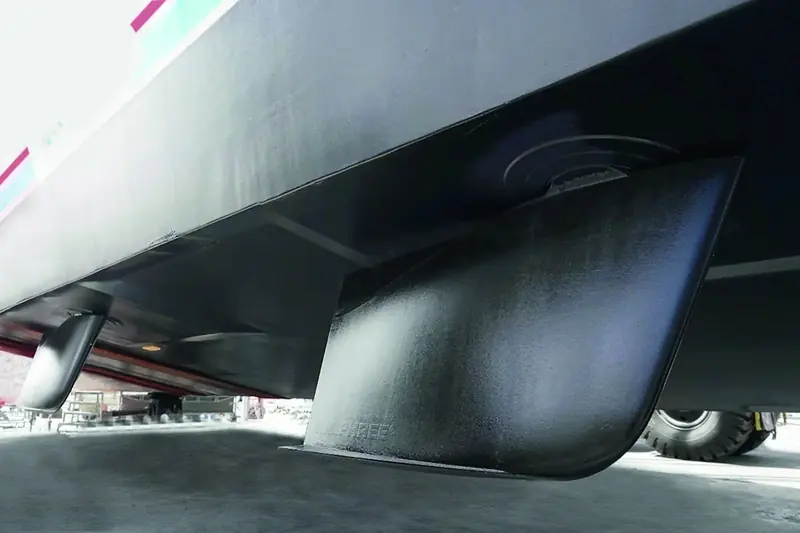
The blade sits flush across the bottom edge of the transom and extends downward into the flow on command from a 12 or 24 volt DC brushless servo motor, with no hydraulic hose, pump or reservoir anywhere in the system. How far the blade extends, not the angle it sits at, is what generates lift, which is why the response is close to instant rather than needing a fin to sweep through an arc or a trim tab to tilt slowly on a hinge. Humphree's own chief executive of its US arm, Sean Berrie, put it directly to Marine Link: deployment speeds are virtually instantaneous, with none of the delays of traditional horizontal trim tabs.
That speed is also why an interceptor can go where a fin or a trim tab cannot: inside a propeller tunnel, between a pair of outboards, or low enough on the transom that it never blocks a swim ladder. It is a genuinely different mechanism from the two stabilisation technologies already covered on this site, a hydraulic fin's pivoting airfoil and a gyro's spinning-mass precession, and it solves a different problem in the first place, trim and steering assistance rather than pure roll damping, even though Humphree's fin line does also compete directly with both.
Who Owns Humphree, And How Did It Start
The founding team came out of high-speed marine propulsion and ship hydrodynamics work dating to the early 1990s, and Humphree's own history material describes them collectively rather than by name, unusual for a company this well documented elsewhere. The US side of the business followed a decade later: Humphree USA opened a facility in Virginia Beach, Virginia in 2012 to serve its growing North American business, and it is led today by chief executive Sean Berrie.
Volvo Penta announced the acquisition of a majority, controlling stake in Humphree in 2016. Unlike the false but widely repeated trade-show rumour that ties an entirely different stabiliser maker to Twin Disc, this ownership link is real and confirmed by both companies; what Humphree disputes is only the degree of integration, stating that it continues to operate as a company separate from the Volvo Penta organisation rather than as an absorbed division.
Humphree's own interceptor kit for a runabout costs exactly USD 4,000; ask about the fin system for anything bigger and the answer is always a custom quote.
What Does Humphrees Product Range Actually Cover
The X-Series covers boats of roughly 25 to 60 feet in five standard sizes, X300, X450, X600, X750 and X900, each blade delivering a 50mm (2 inch) stroke. A newer Lightning sub-line moves the servo motor into an external housing rather than a separate internal box, and Humphree states its actuation speed and blade travel run at roughly double a Zipwake unit's, the nearest direct competitor in the same interceptor category.
On the commercial side, the HA750, H800, H1250 and the newer HLS Series cover vessels from ferries down to large sportfishing convertibles, and vessels of 170 feet and beyond. Fin stabilisers run a 180-degree blade rotation in dual or quad configurations, working both underway and at zero speed at anchor, and are self-cooled through an underwater flange plate rather than a hydraulic reservoir and heat exchanger. Total Stabilization ties interceptors and fins together under the HCS-5 controller, which reads GPS position, three electronic gyros and accelerometers to run Active Ride Control automatically, and Humphree has more recently extended the same electric-actuator approach into waterjet steering, offering electric rudders and interceptor-based steering as an alternative to bucket deflection.
Interceptors Versus Trim Tabs What Actually Differs
BoatTest's side-by-side comparison of the two technologies found interceptors consistently faster to deploy and more precise at speed, since a small blade movement produces disproportionately more lift the faster the boat goes, the opposite of how a trim tab's fixed-angle surface behaves. That same review credited interceptors with fitting in locations a trim tab cannot use at all, inside a propeller tunnel or between twin outboards, and noted they never obstruct a stern boarding ladder the way a hinged trim tab can.
The honest limitation shows up at the two speed extremes, and real owners disagree about exactly where the line sits. One Trawler Forum poster who asked Humphree directly about fitting interceptors to a slow-displacement trawler says the company told them the technology was not recommended at those speeds, since there simply is not enough flow under a hull doing 8 to 10 knots to generate useful lift; a Humphree distributor in the same discussion pushed back, saying trawler installations they had done worked just fine. A production builder in Taiwan, running both interceptors and fins across new builds for five years with no warranty issues on either, told the same forum the two technologies performed about the same in practice, which is a useful, if informal, data point that the debate is real rather than settled.
Which Vessels And Builders Actually Run Humphree
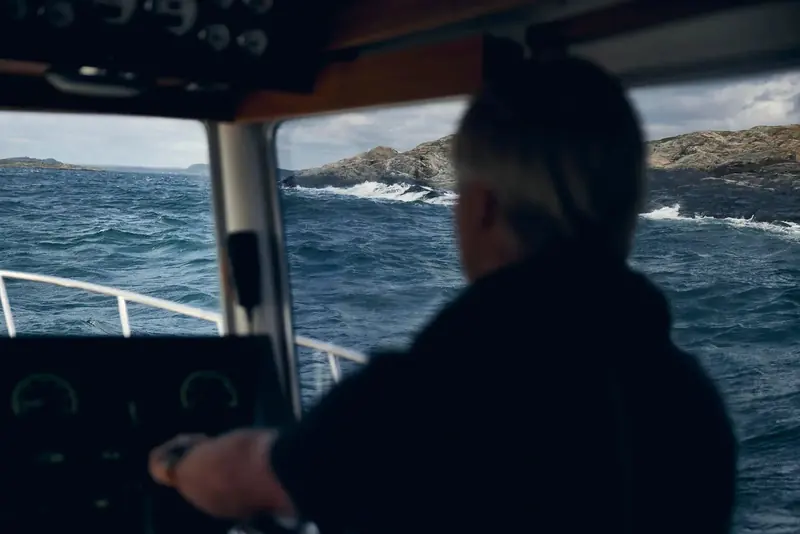
Seastreak's own engineering director, Brian Achille, named speed, safety and stability as key design criteria for the Commodore, a vessel Humphree's interceptors and Total Stabilization system were specified onto directly. The same commercial base includes the 98-foot whale-watching catamaran Acadia Explorer, a 55-foot Gladding-Hearn pilot boat named Hampton Roads, Metal Shark's US Navy Coastal Riverine Forces patrol boat program, and a wind farm support vessel built by Blount Boats for the Block Island project. Custom sportfishing yards Jarrett Bay and Spencer Yachts have both specified Humphree on new builds, and a cluster of New England lobster boats have been retrofitted with interceptors rather than built with them from new.
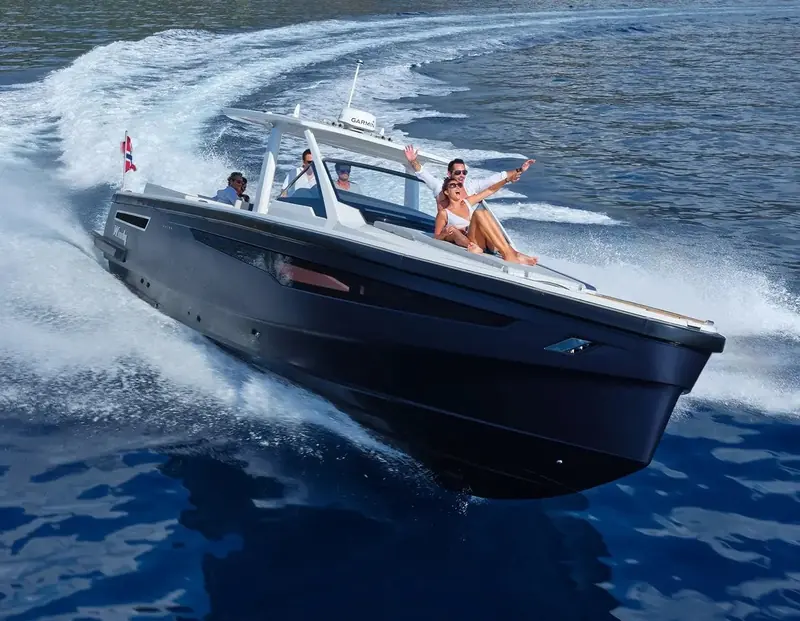
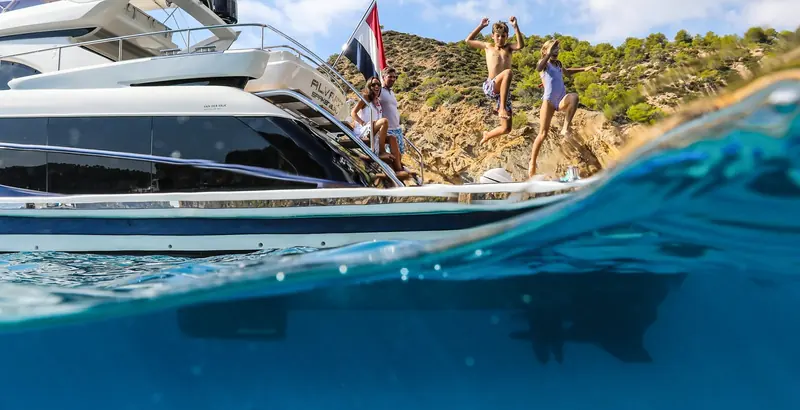
On the leisure side, Humphree's own marketing material features a Windy sportboat running fast with guests aboard, illustrating exactly the kind of production day boat the X-Series was built for; the company does not disclose unit sales by builder, so this page can confirm the relationship exists in Humphree's own materials without claiming it as the boat's sole equipment. Roughly a quarter of all Humphree installations, across every market segment, are retrofits onto an existing hull rather than fitted at new construction, and the company states its interceptors now equip the majority of newly built US pilot boats.
What Does A Humphree System Actually Cost
Boating Magazine's own install guide names the number directly: a Humphree X300 kit, a pair of 11 13/16 inch interceptors with servo actuators, a control unit, a helm panel, a GPS antenna, wiring and a Humphree wrench, lists at USD 4,000 through humphree.com. The same guide fitted that kit to a 27-foot runabout with a single sterndrive and clocked roughly 12 hours of yard time for the first half of a two-part job, rating the work a 4 out of 5 on its own difficulty scale, clearly a job for a yard rather than a weekend DIY project for most owners.
Nothing else in the range carries a public number. Every larger X-Series kit, every fin stabiliser system and every commercial HA, H or HLS package is quoted per boat through a dealer, the same pattern followed by nearly every stabiliser and trim-control maker this site has researched. On the used market, a complete Interceptor 450 kit, pulled off a low-hour prototype hull suited to boats of 24 to 34 feet with only 6 hours of run time, was listed on owner forums at USD 6,000, giving a rough sense of resale value against the new X-Series pricing above, though it is a single listing rather than a market average.
What Does Installing Or Maintaining A Humphree System Involve
Southern Boating and Yachting's own installation guide walked through that Hatteras refit step by step: glass bead blasting to strip years of accumulated antifouling paint off the transom, filling and flattening the boat's original recessed trim tab indentation, since any deviation from flat risks the interceptor blade binding in its housing, then a barrier coat primer before new antifouling goes back on. The servo motors themselves, 12 or 24 volt DC, mount in the lazarette in a waterproof housing built to resist moisture from dock equipment, and the blades are designed to fully extend and retract on their own to self-clean marine growth such as barnacles or tube coral before it can build up.
The same guide flagged power planning as the part owners most often get wrong: depending on the vessel's speed, the fin size chosen and whether zero-speed anchoring stabilisation is wanted, the installer recommends budgeting for an additional 24 volt battery bank rather than assuming existing house power will cover it. The fin line's self-cooling underwater flange plate does remove one real maintenance item a hydraulic fin system carries, the reservoir and seawater heat exchanger, but this is still a planned system integration for most hulls, not an aftermarket accessory a boat yard fits in an afternoon.
Where Do Real Owners And Operators Land On Humphree
On the commercial side the record is clean and specific: Seastreak's engineering director named stability as a design criterion for the Commodore directly to Marine Link, and a Taiwan-based production builder told Trawler Forum that interceptors and fins had performed about the same across five years of new builds with no warranty issues on either technology, a strong, if informal, signal of durability at commercial-build volumes.
At the individual boat level the picture is more mixed. The Trawler Forum disagreement over slow-speed trawler suitability, one owner told directly by Humphree that interceptors were not recommended at those speeds, a distributor in the same thread insisting trawler installs worked fine, is a genuine open question rather than a settled answer, and this page could not resolve it further. Separately, one Trawler Forum poster reported a friend's Humphree fin stabiliser system giving real trouble on the water, resolved only by working directly through Humphree's own support line rather than a local dealer, a data point worth asking about before buying a fin system for a boat far from Humphree's own US or Swedish bases.
Praktische Angaben
| New price, leisure entry kit | The X300, Humphree's smallest interceptor kit for boats around 25 feet, lists at USD 4,000 complete: a pair of interceptors, servo actuators, a control unit, helm panel, GPS antenna, wiring and a Humphree wrench, per Boating Magazine's own install guide sourced to humphree.com. |
|---|---|
| Larger leisure, fin and commercial systems | No published price for anything past the X300. Larger X-Series kits, every fin stabiliser system and every commercial HA, H or HLS package are quoted per boat through a dealer, the same pattern followed by nearly every stabiliser maker on this site. |
| Used and resale | A complete Interceptor 450 kit, pulled off a low-hour prototype hull suited to boats of 24 to 34 feet with 6 hours of run time, was listed on owner forums at USD 6,000, a single data point rather than a market average. |
| Installation and retrofit | Retrofitting an existing hull is real yard work: one documented 70-foot Hatteras refit needed the entire transom bead-blasted, filled flat and barrier coated before the mounting plate would sit correctly, plus a recommended additional 24 volt battery bank. New-build integration is simpler since the builder does that glasswork during construction. |
| Service and dealer network | Humphree USA has operated a facility in Virginia Beach, Virginia since 2012 alongside the Gothenburg, Sweden head office; commercial fault resolution can run directly through Humphree's own support line rather than only a local dealer, per one owner's account. |
| What is NOT published | No price for any system beyond the X300; no independent trial confirming the stated up to 70 percent pitch and 50 percent-plus roll reduction figures; no resolution of the genuine forum disagreement over whether interceptors suit slow-displacement trawlers. |
Angebot anfragen für Humphree.
Nennen Sie uns das Modell und wohin es geliefert werden soll. Die Redaktion holt ein schriftliches Angebot beim Hersteller oder einem autorisierten Händler ein, prüft es gegen die auf dieser Seite veröffentlichten Preise und meldet sich per E-Mail. Unverbindlich und ohne Gebühr.
- 01Ein schriftliches AngebotIn Ihrer Währung, mit Mehrwertsteuer, Lieferung und Lieferzeit, kein Prospektpreis.
- 02Geliefert dorthin, wo die Yacht liegtIn die Marina, auf die Werft oder an Ihre Adresse, mit den Papieren, die ein Lithium-Akku oder ein Kranhub braucht.
- 03UnabhängigYotters ist an keinen Händler gebunden, das Angebot wird verglichen, bevor es Sie erreicht.
Was Eigner und Crew berichten
Seastreak's engineering director named stability as a core design requirement
Brian Achille, Seastreak's engineering director, told Marine Link that speed, safety and stability were key design criteria for the Seastreak Commodore, a 150-foot, 600-passenger catamaran ferry fitted with Humphree's interceptors and Total Stabilization system.
Marine Link (Brian Achille, Seastreak Engineering Director)A Taiwan-based production builder rates interceptors and fins about equal over five years
A poster identifying as a production boat builder in Taiwan reported using both Humphree interceptors and fin stabilisers across new builds for five years, finding the two technologies performed about the same in practice with no warranty issues on either.
Trawler ForumHumphree itself advised against interceptors for slow trawler speeds, a distributor disagreed
One owner who contacted Humphree directly about fitting interceptors to a slow-displacement trawler says the company told them the technology was not recommended at those speeds; a Humphree distributor participating in the same forum thread disagreed, saying trawler installations they had done worked just fine.
Trawler ForumA fin stabiliser fault needed Humphree's own support team to resolve
One poster reported that a friend's Humphree fin stabilisation system gave real trouble on the water, and the issue was worked through directly with Humphree's own support rather than resolved locally.
Trawler Forum
Was gut ist und worauf zu achten ist
Stärken
- No hydraulics anywhere in either product lineBoth interceptors and fins run on 12 or 24 volt DC brushless servo motors with no hydraulic hose, pump, reservoir or heat exchanger, which the fin line's self-cooling underwater flange plate makes explicit by removing a maintenance item a hydraulic fin system always carries.
- Genuinely fast responseFull interceptor blade travel in under 2 seconds against 6 to 8 seconds for a traditional trim tab, per BoatTest's own comparison, with non-linear lift that grows rather than shrinks as the boat speeds up.
- Real commercial fleet penetration, not just marketing claimsNamed, checkable installations span New York City's 30-vessel ferry fleet, the Seastreak Commodore, a US Navy Coastal Riverine patrol boat program and multiple East Coast pilot boats, backed by a named engineering director's own account of why the equipment was specified.
- One controller for trim, steering and rollThe HCS-5 controller and Active Ride Control tie interceptors and fins together using GPS, three electronic gyros and accelerometers, so a single boat can run both technologies from one system rather than two unrelated boxes.
Worauf zu achten ist
- Genuine disagreement over slow-speed suitabilityOne owner reports Humphree itself advised against interceptors for a slow-displacement trawler, while a Humphree distributor in the same forum thread says trawler installations work fine; this page found no way to resolve which account generalises.
- No published price beyond the smallest leisure kitOnly the X300 has a listed price, USD 4,000; every larger X-Series kit, every fin system and every commercial HA, H or HLS package requires a dealer quote, leaving most buyers with no way to budget in advance.
- Blade limits at both speed extremesInterceptors need real water flow to generate lift, so they underperform on slow trawlers doing 8 to 10 knots, and face real blade damage risk above roughly 60 knots, a speed band where a traditional trim tab keeps working.
- Majority owned by Volvo Penta since 2016Volvo Penta holds a controlling stake, and while Humphree states it operates separately from the Volvo Penta organisation, a buyer weighing long-term independence and support continuity should treat that as a real ownership fact, not a rumour to dismiss the way the unrelated Twin Disc claim about a different stabiliser brand should be.
Für wen: Owners and buyers who want faster-reacting trim and roll control than a hydraulic system without adding a pump, reservoir or generator load, and who are comparing it honestly against a gyro or a hydraulic fin rather than assuming an interceptor does the same job as either.