Naiad Dynamics
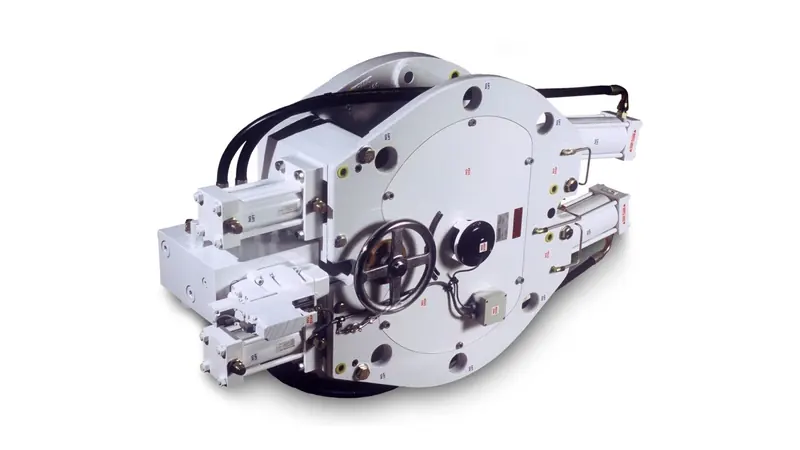
| Category | hydraulic and electric fin stabilisers, at-anchor (AtRest) and underway (AtSpeed) roll stabilisation, plus Total Ride Control for planing hulls and fast ferries |
|---|---|
| Formed | as "Naiad Dynamics" in 2009, when Naiad Maritime Group Inc bought and merged the VT Motion Control Group (Naiad Marine Systems, Maritime Dynamics, Vosper Motion Control, Vosper Stabilisers, VT Marine Products, KoopNautic Holland) from VT Group plc |
| Heritage | traces to John I. Thornycroft's 1891 yacht stabiliser and Sperry's 1915 gyro-stabiliser work; the Naiad name dates to 1976, when Van Dusen and Meyer Inc bought the rights to Sperry's Dol-Fin fin stabiliser |
| Owner | independently owned by Naiad Maritime Group Inc, led by president and CEO John Venables since the 2009 buyout; not part of Twin Disc, despite an assumption that circulates in the trade - no corporate link between the two companies was found in either company's own filings or press record |
| Facilities | Connecticut, Maryland, Florida and Washington in the US, plus Portsmouth (UK) and Maastricht (Netherlands); sales offices added in Australia (2017) and France (2018) |
| Hydraulic range | eight model families from Model 162 to Model 1400, sized by fin area and torque rather than by a simple length chart; Model 525 suits vessels of about 39 to 49 m (130 to 160 ft) per the company's own product flyer |
| Electric range | E-Series, from the E-525 (7.5 or 11 kW AC servo motor, fin size 1.0 to over 3.5 sq m) for vessels of about 35 to 50 m |
| Patents | AtRest zero-speed stabilisation is covered by US Patent 8,534,211; a further fin-actuation patent, US 12,227,272 B2, was granted in 2025 |
| Roll reduction claim | up to 90 percent, in the company's own figures; this page found no independent trial confirming that number |
| Pricing | no published price list for any model, hydraulic or electric; every cost figure on this page is an owner-reported anecdote, not a company quote |
Who owns Naiad Dynamics, and is it really part of Twin Disc?
The Naiad name goes back further than either company most people guess. Naiad Dynamics traces two separate lineages: John I. Thornycroft and Co fitted the first actively controlled yacht stabiliser to a vessel in 1891, and Sperry introduced gyro-stabilisers to shipping in 1915, before Van Dusen and Meyer Inc bought the rights to Sperry's Dol-Fin fin stabiliser in 1976 and put the Naiad name on it. Vosper and Thornycroft merged into Vosper Thornycroft in 1966, and between 1991 and 1998 the enlarged VT Group folded in Van Dusen and Meyer (Naiad), Maritime Dynamics, Hydra-Power Systems and KoopNautic Holland, consolidating all of it as Vosper Motion Control.
That consolidated business changed hands again in 2009, when Naiad Maritime Group Inc, led by John Venables after 27 years in engineering and executive roles across the same companies, bought VT's motion control group outright and renamed it Naiad Dynamics. Venables remains president and chief executive of Naiad Maritime Group today, and the company operates from Connecticut, Maryland, Florida and Washington in the United States plus Portsmouth in the UK and Maastricht in the Netherlands, with sales offices added in Australia in 2017 and France in 2018. It is a common assumption in yachting circles that Naiad sits inside the Twin Disc group, alongside Twin Disc's own marine gearbox and thruster businesses. There is no evidence for that: Twin Disc's own SEC filings and acquisition announcements make no mention of Naiad at any point, and every corporate record found here names Naiad Maritime Group, not Twin Disc, as the parent. Anyone who has heard the Twin Disc claim repeated at a boat show should treat it as false until Naiad or Twin Disc says otherwise.
How does a Naiad fin stabiliser actually work?
Two or four fins are mounted low on the hull near midships, each on a rotating shaft driven by a hydraulic actuator or, on the newer E-Series, an electric AC servo motor. Naiad's control system, called DATUM in its current digital form, reads the vessel's roll continuously through motion sensors and commands the fins to pivot through their arc, generating lift to port or starboard exactly opposite the direction the hull is rolling. The company states the result is up to 90 percent roll reduction across a wide range of speeds, a figure this page could not independently verify.
That is mechanically unrelated to how a gyroscopic stabiliser such as Seakeeper works. A gyro spins a flywheel and uses precession, the tendency of a spinning mass to resist a change in the angle of its axis, to generate a righting torque with no moving parts outside the hull. A fin stabiliser instead pushes water, which is why it needs a hole in the hull for every shaft, and why, unlike a gyro, its force increases with boat speed rather than falling away once the flywheel exhausts its stroke.

Naiad publishes no price for a single stabiliser, hydraulic or electric; every number on this page came from an owner who actually paid one.
What does Naiad's product range actually cover?
The hydraulic line runs 162, 174, 252, 254, 302, 320, 360, 420 and 525, then the larger 575, 621, 720, 820, 925, 1050 and 1400 assemblies, sized to fin area and torque rather than to a simple length chart; naiad.com and the company's own product flyers, read August 2026, put the Model 525 actuator against vessels of roughly 39 to 49 m (130 to 160 ft). The E-Series, introduced from 2014, adapted stabiliser technology Naiad first built for naval customers in 2008; the launch model E-525 uses a single AC servo motor generating the torque of two hydraulic cylinders, offered in 7.5 kW or 11 kW versions for fin sizes from 1.0 to over 3.5 sq m on vessels of about 35 to 50 m, and the electric drive removes the hydraulic hoses, tank and pump a hydraulic fin needs.
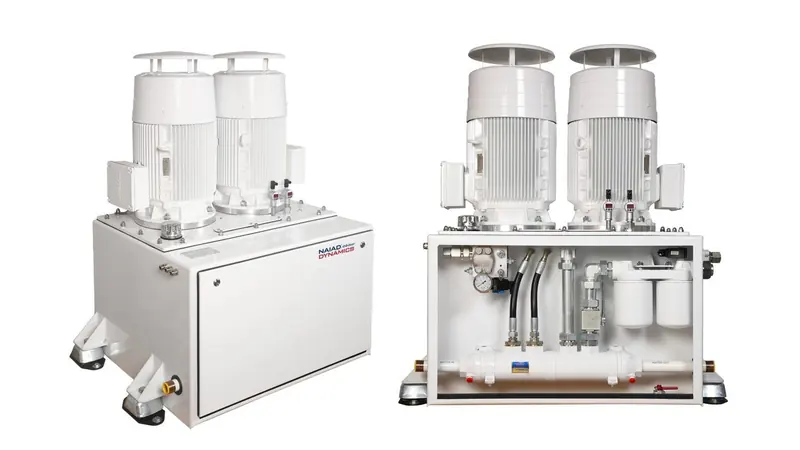
Beyond the fins, Naiad sells the hydraulic power packs that drive a hydraulic system, the DATUM digital control system rolled out as a modular, node-based design in 2024, and Total Ride Control, a separate pitch-and-roll product for planing hulls and fast ferries under way rather than at anchor. A 2025 US patent, 12,227,272 B2, covers a fin that houses its own actuation mechanism inside the blade rather than in a separate gearbox, which the company says saves interior space; it had not appeared in a delivered yacht installation this page could verify by publication date.
What is AtRest, and does it really stop roll at anchor?
Fin stabilisers historically only worked underway, because a stationary fin generates no lift; a gyro's advantage was always that it worked equally well at rest. Naiad's answer, AtRest, expands the fin's effective area and drives it through a different stroke once the vessel's speed drops to zero, generating enough thrust from the fin's own motion through the water to counter a roll with no forward speed at all. Naiad calls itself the first company to do this successfully, a claim this page could not independently corroborate beyond the company's own patent filing and product literature, though no rival's marketing was found disputing it.
Boat International's own stabiliser guide, read August 2026, singles out Naiad by name for a related feature: retractable inner blades that expand a fin's surface area in rougher conditions, giving more force at anchor without needing a permanently oversized fin under way. The tradeoff, reported directly by one owner who ran Naiad's zero-speed system for years before switching brands, is that AtRest needs the boat's generator running and needs specific spare parts that were not always readily available, which is a real operating cost a gyro of the same size does not carry.
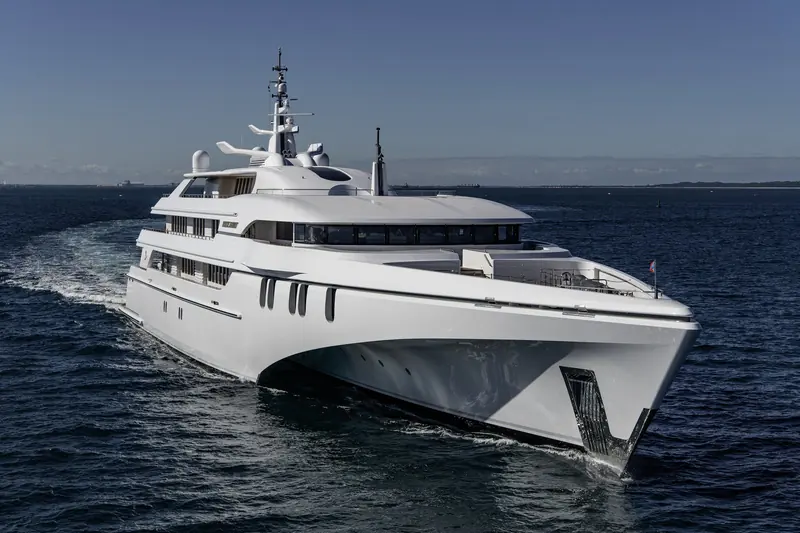
Fin stabilisers vs a gyro like Seakeeper: what actually differs?
Every trade comparison found agrees on the same shape of tradeoff. A gyro sits entirely inside the hull, so it adds no appendage, no drag and no risk of striking a submerged object, but its stabilising force is fixed by the flywheel's size and falls away as a boat's speed and the resulting wave-encounter frequency increase; a Yachting magazine comparison, sponsored by a rival fin brand but consistent with the rest of the trade press, states plainly that fins are usually superior to a gyro under way because gyro precession has a limited stroke and eventually exhausts it. A fin's force instead increases with speed, the way any hydrofoil's lift does, which is one reason fins remain the standard fit on yachts that cruise fast and far rather than sitting at anchor most nights.
The costs run the other way. A fin needs a hull penetration for every shaft and structural reinforcement at the mounting point, and, on Naiad's hydraulic models, a hydraulic system with its own maintenance interval; a gyro needs none of that but does need 20 to 43 minutes of spool-up before it stabilises anything, a dependency this page verified separately on Seakeeper's own published figures, and it is a poor fit above roughly 115 tons, where multiple gyros would be needed. Naiad's AtRest closes some of the at-anchor gap a fin traditionally had against a gyro, but, per the owner account below, it does so by drawing on the generator rather than sitting silently on 12 or 24 volt battery power the way a small gyro or an electric competitor can.
Which yachts and ships actually carry Naiad equipment?
A 2013 Westport 164 offered for sale through Bluewater Yacht Sales, its listing read August 2026, specifies a Naiad Model 621 four-fin system driven from the main engine PTO or a central hydraulic system rated at 85 hp, with at-anchor stabilisation included; Westport buyers and brokers on owner forums describe Naiad as the yard's long-standing supplier of choice. On the refit side, Hatteras owners on Sam's Marine's dedicated forum, read August 2026, discuss retrofitting Naiad stabilisers into older sportfish hulls, a job that typically means drilling new holes and fitting mahogany reinforcing blocks to take the actuator loads, work several posters describe having done on 48 to 55 foot Hatteras convertibles.
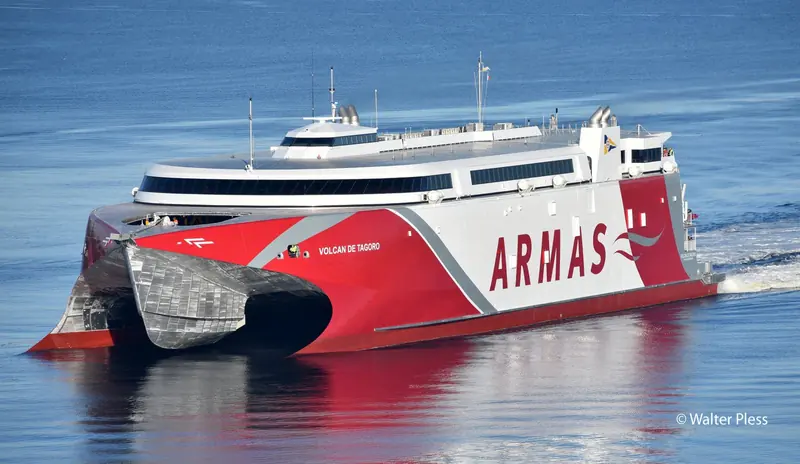
Outside yachting, Naiad's Total Ride Control equips the Naviera Armas fast ferry Volcan de Tagoro, a high-speed trimaran running in the Canary Islands, and the company states its ride-control systems serve more than fifty navies and coast guards, a figure that appears across Naiad's own materials but that this page could not verify independently. That commercial and military base is also what funds the yacht-side engineering: naiad.com states the company has fitted more motor yachts than any other stabiliser brand, a claim made in its own marketing rather than by an independent tally, so treat it as Naiad's figure rather than a verified market share.
What does a Naiad system actually cost?
Nothing on naiad.com, in its dealer literature or in its trade show materials names a single price; every source, including Naiad's own dealers, directs a buyer to a custom quote. Owner-reported figures on Trawler Forum, read August 2026, put one complete Naiad system at around USD 34,000 for parts alone, a separate Pacific Northwest installation at about USD 65,000 all in, and an Australian owner's Naiad Model 252 with 7.5 sq ft fins and the newer Datum controller at roughly AUD 75,000 installed; none of these are price-list numbers and none were independently corroborated by a second source, so they should be read as anecdotes rather than a quote.
The same forum thread put rival systems in context: an ABT Trac installation on a 46 foot Ocean Alexander at well north of USD 50,000 including yard costs, a Gyro-Gale gyro fitted in Florida at about USD 40,000, and a Seakeeper gyro at about USD 75,000, figures which, again, are single owner reports rather than published prices. What is consistent across every account is that installation, not the hardware, decides the final bill: access to the hull, whether structural reinforcement is needed, and regional labour rates move the total far more than the model chosen.
What does servicing a Naiad cost, and what actually fails?
On Sam's Marine's Hatteras owners forum, read August 2026, four separate named posters gave real figures for the same job, popping off both fins to inspect and reseal them: RonNP, in Southern California, paid USD 1,200; Freestyle, in Tampa, was quoted USD 1,500 but paid USD 2,300 on the first job and USD 3,200 on the most recent one; MVCaprice, in Seattle, priced the labour at four hours at USD 95 an hour plus about USD 50 per seal; and bobk reported a similar cost when the boat was already hauled for bottom paint, which is the cheapest way to do the job since the haul-out cost is shared with other work. Naiad's own manuals, cited repeatedly by owners on Trawler Forum, call for the shaft seals to be replaced after 4,000 hours of service.
The consistently recommended independent service shop across both forums is Stabilized Marine in Fort Lauderdale, run by Craig Calkins, who owners describe as having installed and repaired Naiads for more than 20 years and as able to talk most faults through by phone; that is a strong, if informal, signal that Naiad's hydraulic systems are field-serviceable rather than requiring a factory return, which several owners contrast favourably with brands that need parts shipped from overseas. Reported failure points on the older hydraulic models cluster around worn shaft seals, a bleed manifold some owners report is hard to source, and, on units left unpowered for long periods, fins that flop audibly against their stops in a current.
Where do real owners land on Naiad?
On Trawler Forum, read August 2026, owners of older Naiad 251-series systems describe them as flawless until something eventually needs attention, and one long-time poster called the addition simply the best thing they had done to the boat, making it far more approachable for a less experienced crew to run comfortably in a chop. That is the typical account from an owner using a hydraulic Naiad under way, which is the job the equipment was originally built for and has done since well before AtRest existed.
The more critical account comes from the cruising blog of the trawler yacht Starr, read August 2026, whose owners removed their existing Naiad hydraulic stabilisers specifically because they wanted quiet, battery-powered stabilisation at rest for cruising in Hawaii; Naiad's own AtRest system could technically do it, but needed hardware the owners found was not readily available, needed the generator running rather than working off house batteries, and was not quiet, so they fitted electric fins from another maker instead. Their account is one boat's experience, not a pattern this page could confirm across other owners, but it names the exact tradeoff a buyer choosing AtRest over a modern all-electric or gyro system at anchor should ask a dealer about directly before ordering.
Praktische Angaben
| What owners have actually paid for a system | Forum-reported figures only, not a price list: one Trawler Forum owner put a complete Naiad system at around USD 34,000 for parts alone, another priced a Pacific Northwest installation at about USD 65,000 all in, and an Australian owner's Naiad Model 252 with 7.5 sq ft fins and the Datum controller at roughly AUD 75,000 installed. Each is a single owner's report, not corroborated by a second source, so treat them as a rough sense of scale rather than a quote. |
|---|---|
| Rival systems, for context | The same Trawler Forum thread, read August 2026, recorded an ABT Trac installation on a 46 foot Ocean Alexander at well north of USD 50,000 including yard costs, a Gyro-Gale gyro fitted in Florida at about USD 40,000, and a Seakeeper gyro at about USD 75,000. All are single owner reports, useful only to show the rough band a buyer should expect to shop across, not to compare brands precisely. |
| Reseal and routine service costs | Four named owners on Sam's Marine's Hatteras forum reported USD 1,200 to USD 3,200 for popping off both fins to inspect and reseal them, with one, MVCaprice, breaking the job down to four hours of labour at USD 95 an hour plus about USD 50 per seal. Naiad's own manuals call for the shaft seals to be replaced after 4,000 hours of service. |
| Where to get one serviced independently | Stabilized Marine in Fort Lauderdale, run by Craig Calkins, is the shop named repeatedly and independently across both Trawler Forum and Sam's Marine as having installed and repaired Naiad systems for more than 20 years, and as able to diagnose most faults by phone before a yard visit. |
| What is NOT published | Naiad publishes no equipment price list, no installation cost band, and no independent third-party roll-reduction test of its up to 90 percent claim. Its stated market position, having fitted more motor yachts than any other brand, is the company's own figure with no independent tally found to confirm it. A common trade assumption that Naiad is part of the Twin Disc group is not supported by either company's own filings or press record. |
Was Eigner und Crew berichten
Older hydraulic Naiads are described as flawless between services
Long-time posters on Trawler Forum running Naiad 251-series systems describe them as flawless until something eventually needs attention, with one owner calling the addition simply the best thing they had done to the boat, making it far more approachable for a less experienced crew.
Trawler ForumReseal and service costs, four named owners
RonNP in Southern California paid USD 1,200 to pop off both fins, inspect and reseal them; Freestyle in Tampa was quoted USD 1,500 but paid USD 2,300 the first time and USD 3,200 the most recent time; MVCaprice in Seattle broke the job down to four hours of labour at USD 95 an hour plus about USD 50 per seal; and bobk reported a similar cost doing the work while already hauled for bottom paint.
Sam's Marine (Hatteras Owners Forum)An owner switched away from AtRest for a quieter all-electric system
The owners of the trawler yacht Starr removed their Naiad hydraulic stabilisers after extended use because they wanted quiet, battery-powered stabilisation at rest for cruising in Hawaii; Naiad's AtRest could do it in principle but needed hardware they found was not readily available, needed the generator running, and was not quiet, so they fitted electric fins from another maker instead.
MV Starr (owner cruising blog)A Westport 164 specifies a Naiad four-fin system as standard
A brokerage listing for a 2013 Westport 164 specifies a Naiad Model 621 four-fin system with at-anchor stabilisation, driven from the main engine PTO or a central hydraulic system rated at 85 hp.
Bluewater Yacht SalesHatteras owners retrofit Naiad into older sportfish hulls
Posters on a dedicated Hatteras owners forum describe fitting Naiad stabilisers into 48 to 55 foot Hatteras convertibles, work that typically means drilling new holes through the hull and fitting mahogany reinforcing blocks to take the actuator loads.
Sam's Marine (Hatteras Owners Forum)Trade press credits Naiad by name for a retractable-blade design
A stabiliser buyer's guide singled out Naiad's retractable inner blades as a real, named feature that expands fin area in rougher conditions, distinct from a generic marketing claim.
Boat International
Was gut ist und worauf zu achten ist
Stärken
- Force increases with speed, not falls awayFins keep gaining stabilising force as the boat goes faster, the opposite of a gyro's shrinking precession stroke, which is why trade comparisons consistently rate fins ahead of a gyro under way; a Yachting magazine comparison piece states this plainly.
- No spool-up, and can run off the main engine under wayUnlike a gyro's 20 to 40 minute warm-up, fins respond the instant the control system commands them, and Naiad's hydraulic models can be driven from the main engine's PTO rather than the generator under way, as specified on the Westport 164 example's 85 hp PTO or central hydraulic drive.
- Field-serviceable by an independent yardNamed owners on two separate forums report resealing and repairing Naiad hydraulics locally for USD 1,200 to USD 3,200, and Stabilized Marine's Craig Calkins has built a 20-plus year independent repair business around the brand, rather than owners needing to ship a unit back to a factory.
- A genuine zero-speed option, recognised outside its own marketingAtRest was, by the company's account, the first fin system to successfully damp roll at rest, and Boat International separately credits Naiad's retractable inner blades as a distinct, real feature for expanding fin area in rough weather, not just a marketing label.
Worauf zu achten ist
- No published price, at any levelUnlike Seakeeper's fully published price list across fourteen models, a Naiad buyer has no way to budget without going to a dealer first; forum-reported figures range from USD 34,000 parts-only to well over USD 65,000 installed, with no clear pattern to rely on.
- Every fin is a hole in the hullFin shafts need through-hull penetrations and structural reinforcement at the mounting point, adding drag under way and, per general trade-press comparisons, a risk of damage from a submerged strike that a gyro simply does not carry.
- AtRest still needs the generator runningPer one owner's direct account, the company's own zero-speed hydraulic system needed the generator online and used hardware the owner found was not always in stock, and was not quiet, the same weaknesses a modern electric or gyro system at anchor is specifically built to avoid.
- No independent test of the company's own numbersThe up to 90 percent roll reduction figure and the claim of having fitted more motor yachts than any other brand are both Naiad's own, with no independent trial or market-share tally found to confirm either.
Für wen: Owners and buyers cruising fast and far rather than mostly at anchor, who want a stabiliser that gets stronger with speed and can be resealed by a local independent yard rather than shipped back to a factory.