Quantum Marine Stabilizers
| Founded 1985 as Quantum Marine Engineering in Newport, Rhode Island, by a founding team including John Allen | |
| Relocated to Florida in 1989; current Fort Lauderdale headquarters at 3685 SW 30th Avenue completed in 2017 | |
| International offices in Nuth, Netherlands (opened 2001 as Quantum Controls), Barcelona and Monaco | |
| Service department established in 1992; the company states a worldwide 24/7 technician network with remote troubleshooting | |
| President and CEO John Allen is named as still leading the company in its own materials | |
| Patent count is reported inconsistently across Quantum's own pages as three, four or five, covering Zero Speed, XT, MAGLift and Dyna-Foil | |
| Ownership structure, revenue and employee count are not disclosed in any public source found |
What Quantum Actually Makes
Quantum states it introduced the first Zero Speed system in the year 2000, describing it as a change to the marine industry that competitors have not disputed, and the term is now used across the industry as a generic description of at rest stabilization rather than a Quantum brand name alone. The mechanism is a rapid paddling motion at the fin or rotor, generating lift to counter roll without forward motion through the water, as opposed to a conventional underway fin that only works once the boat has way on. The XT fin variant extends when the vessel stops, adding, by Quantum's own figures, 30 percent more surface area and generating 100 percent more lift than a fixed fin at zero speed.
The MAGLift rotor is a different mechanism entirely, a spinning cylinder that uses the Magnus effect rather than a hydrofoil shape, turning at 300 to 1,500 RPM depending on system size. Quantum's own specification puts its effective range up to 14 knots; a forum poster comparing it against Naiad's fins gave a lower figure of 12 knots, a small but real discrepancy between the vendor's number and a user's account. It is fully retractable, useful on ice class or high speed vessels where drag matters, and Power and Motor Yacht describes its natural market as true megayachts in the 180 to 500 foot range, where the cost of a system runs, in that outlet's words, into the millions of dollars.
Dyna-Foil and the Electric Question
Dyna-Foil is described by CEO John Allen, quoted in Yachts International, as offering solutions for zero and high speed stabilization in one compact system, with more lift, less drag and less power than the fin and rotor systems it is meant to complement or replace. The first reported Dyna-Foil contract was on a 230 foot, roughly 70 metre yacht. Quantum states the system underwent third party model testing at MARIN, the Maritime Research Institute Netherlands, though the company's own pages describe the testing process without publishing the numeric roll reduction results that testing produced.
Separately, reporting places an electric or hybrid line, e-FIN for the 40 to 65 metre segment and a hydraulic hybrid called F45, as launched around 2024. That claim sits awkwardly beside a SuperyachtNews feature in which Quantum says it spent two years specifically researching all electric systems for the 50 metre plus segment and concluded hydraulic designs remain superior, citing capacitor bank energy storage and electrochemical hazard concerns. It is possible e-FIN targets a smaller size band than the 50 metre plus segment discussed in that piece, but no source found reconciles the two statements, and a buyer should ask Quantum directly which claim currently stands before specifying either system.
Quantum's own pages state its patent count as three, four or five, depending on which page you read. Its most repeated market share claim, 85 percent of yachts over 55 metres, traces to nobody but Quantum itself.
How It Compares With Naiad and Seakeeper
Naiad Dynamics is the longer established name in fin stabilization, with fins that work like rudders, deflecting in response to sensor input, and a broader Total Ride Control suite that adds T-foils, trim tabs, interceptors, lifting foils and canards to address motion on five of a vessel's six axes. Naiad's own claims, reported by Yachts International, run to 90 percent roll reduction underway and around 70 percent at rest, figures of the same order Quantum implies for its own equipment without publishing a directly comparable number.
Seakeeper works on an entirely different principle, a gyroscopic flywheel spinning in a vacuum enclosure that needs no hull penetration at all, unlike Quantum's fins and rotors. Seakeeper claims 70 to 90 percent roll reduction at rest, with models spanning the 8000 at 1,200 pounds up to the 26000 at 2,900 pounds, and Power and Motor Yacht reports a 215 foot yacht needing five 26000 units to do the job. Seakeeper's range reaches down to boats as small as 23 to 30 feet, a market Quantum's fin and rotor business, aimed at 55 metres and above, does not really compete in.
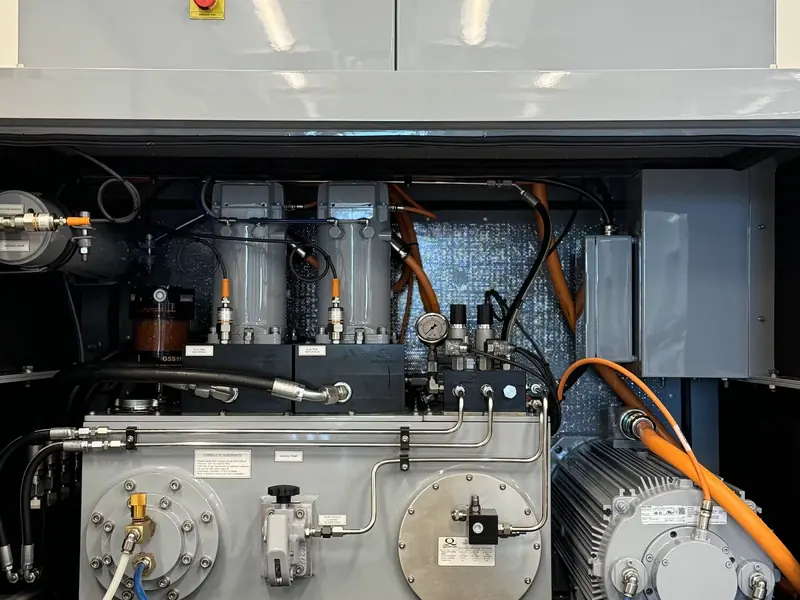
Who Actually Runs This Equipment
A Northrop and Johnson brokerage blog names several Zero Speed equipped yachts by name: Sea Owl, a 2013 Feadship over 157 feet; Unbridled, a 191 foot Trinity; Chasseur, a 2017, 160 foot Christensen; Mirabella, a 157 foot Trinity; Rochade, a 156 foot Delta from 2011; At Last, a 1990, 145 foot Heesen; and Lady J, a 142 foot Palmer Johnson from 1997. This is a brokerage marketing list rather than independent trade reporting, so the vessel names and lengths are checkable but the framing should be read as promotional; a buyer should confirm any specific yacht's stabilizer fit out against the builder's own spec sheet. None of these named yachts are independently confirmed by this research against the builder's own delivery specification; they are listed here exactly as the brokerage names them, as the only publicly available roster of real installations this research could locate.
Quantum's military and commercial record is reported with more independent structure. Naval Technology's contractor profile lists twelve Royal Australian Navy Lurssen offshore patrol vessels, thirteen Cyclone class United States Navy ship upgrades, thirteen WMEC 270 foot US Coast Guard Medium Endurance Cutter upgrades, and fifty eight Bollinger Fast Response Cutters for the same service. The same profile reports vendor supplied benefits of a 50 percent increase in safe operating time and an 18 percent fuel reduction during zero speed operations, figures that come from Quantum through a contractor directory rather than from an independent audit.
What a Quantum System Actually Costs
Quantum's own literature states plainly that its systems are completely custom and specific to the vessel, and a YATCO blog on stabilizers confirms pricing requires direct contact for a quote rather than any published rate card. The single concrete number this research turned up is Power and Motor Yacht's description of MAGLift systems for the 180 to 500 foot megayacht market running into the millions of dollars, with no further breakdown. For scale only, and not as a Quantum figure, the Sleipner Group publishes its own Vector Fins equipment cost at roughly 65,000 US dollars for a 55 foot vessel and 130,000 dollars for a 130 foot vessel, plus up to 25,000 dollars in installation and generator upgrade costs, a much smaller company's numbers offered here purely as the nearest published reference point.
What is not published anywhere for Quantum specifically is a unit price, an installation cost, or a running and maintenance cost for any named model or vessel size. Every public source this research found, including Quantum's own site, treats price as something settled only after a direct conversation with the company.
What Is Not Confirmed About Quantum
The 85 percent of yachts over 55 metres figure, repeated across multiple secondary sites, always traces back to Quantum's own marketing rather than an independent audit, and should be read as a company claim rather than a measured fact. Quantum's own pages cannot even agree with each other on how many patents the company holds, giving three, four or five across different pages covering Zero Speed, XT, MAGLift and Dyna-Foil.
Trawler Forum, the community most likely to hold real captain level reliability complaints about marine stabilizers, returned an access error to every attempt this research made to read it directly; a search summary suggested the general view there is that most stabilizer failures trace to installation or undersizing rather than to any one brand, but that could not be verified against the actual thread text. No lawsuit, recall or safety complaint record turned up for Quantum in any source checked, which is an absence of evidence rather than proof of a clean record, given that the one forum most likely to carry it could not be read.
Praktische Angaben
| Getting a quote | All Quantum systems are custom engineered per hull. The company's own literature states pricing depends entirely on vessel specification, and no online quote tool or published list price exists anywhere. |
|---|---|
| What it costs, roughly | The only public figure found puts Quantum's largest megayacht rotor systems into the millions of dollars. For scale, a much smaller competitor's fin system runs roughly 65,000 to 130,000 US dollars in equipment alone on a 55 to 130 foot boat, which is not a Quantum number but the nearest published reference point available. |
| Where the service network is | Fort Lauderdale headquarters, plus international offices in Nuth in the Netherlands, Barcelona and Monaco, with a stated worldwide 24/7 technician network and remote troubleshooting capability. |
| Which system fits which size | Zero Speed XT fins across the broad yacht range; MAGLift rotors specifically marketed at the 180 to 500 foot megayacht bracket; Dyna-Foil aimed at combining zero speed and high speed performance in one system, with its first reported contract on a 230 foot yacht. |
| What is NOT published | Any list price, per model installation cost, running or maintenance cost, current confirmed patent count, employee headcount, or ownership structure. |
Angebot anfragen für Quantum Marine Stabilizers.
Nennen Sie uns das Modell und wohin es geliefert werden soll. Die Redaktion holt ein schriftliches Angebot beim Hersteller oder einem autorisierten Händler ein, prüft es gegen die auf dieser Seite veröffentlichten Preise und meldet sich per E-Mail. Unverbindlich und ohne Gebühr.
- 01Ein schriftliches AngebotIn Ihrer Währung, mit Mehrwertsteuer, Lieferung und Lieferzeit, kein Prospektpreis.
- 02Geliefert dorthin, wo die Yacht liegtIn die Marina, auf die Werft oder an Ihre Adresse, mit den Papieren, die ein Lithium-Akku oder ein Kranhub braucht.
- 03UnabhängigYotters ist an keinen Händler gebunden, das Angebot wird verglichen, bevor es Sie erreicht.
Was Eigner und Crew berichten
Owners and brokers describe Quantum as dominant in high end stabilization
In a YachtForums thread comparing Naiad and Quantum, one poster wrote that Quantum has dominated the high end yacht stabilization market in recent years and called the equipment finished beautifully; a named Quantum contact, Mike Perkins, was praised in the same thread as helpful and quick to follow up.
YachtForumsA rival system was described as costlier and heavier, not necessarily better
The same YachtForums thread had one poster note that a Rolls-Royce Kamewa related alternative was preferred by some owners but cost roughly double and weighed about four times as much as Quantum's equipment, a specific but unverified forum comparison.
YachtForumsThe forum most likely to hold captain level complaints could not be read
Trawler Forum threads discussing stabilizer reliability returned an access error to this research; the general impression from a search summary was that most stabilizer failures trace to installation or undersizing rather than to brand, but this could not be verified against the primary thread text.
Yotters research desk
Was gut ist und worauf zu achten ist
Stärken
- A real, unchallenged first mover claimQuantum's year 2000 introduction of zero speed stabilization is not disputed by competitors' own marketing, and the term is now used industry wide as a generic description of the category it created.
- Genuine military and commercial validation beyond yachtingNamed contracts covering twelve Royal Australian Navy patrol vessels and multiple classes of US Coast Guard cutter give the company a track record independent of yacht press marketing.
- A full time global service networkFort Lauderdale plus three international offices and a stated 24/7 technician network with remote troubleshooting is a real infrastructure commitment, not just a sales office.
Worauf zu achten ist
- Nothing about price is published anywhereEvery source checked, including Quantum's own site, confirms pricing is quote only; a buyer cannot compare Quantum against Naiad or Seakeeper on cost without contacting both companies directly.
- The company's own numbers do not agree with each otherPatent count is stated as three, four or five across Quantum's own pages, and MAGLift's effective speed ceiling is given as both 12 and 14 knots depending on the source.
- Its most repeated market share claim traces to nobody but QuantumThe widely repeated 85 percent of yachts over 55 metres figure appears only in Quantum's own materials and in outlets that cite Quantum as the source, with no independent audit found anywhere.
Für wen: A buyer or refit yard specifying fin or rotor stabilization on a yacht above roughly 30 metres who wants a company with a genuine first to market claim and a real global service network, and who accepts that every number that matters, price, roll reduction percentage and market share, comes only from Quantum's own materials unless independently tested.