SAILOR
| Category | maritime VSAT (Ku and Ka-band) and L-band satellite terminals for FleetBroadband, Fleet Xpress, Iridium Certus and GMDSS safety systems |
|---|---|
| Brand | SAILOR, manufactured by Cobham SATCOM, formerly Thrane and Thrane A/S |
| Origin | SAILOR name created by Norway's Nera, bought by Denmark's Thrane and Thrane in 2006 |
| Thrane and Thrane was acquired by UK defense group Cobham plc in 2012, forming the Cobham SATCOM business unit | |
| Ownership change | Cobham SATCOM sold by the Cobham Group to Solix Group, a Scandinavian investment firm, announced April 2025 and completed August 2025 |
| Further corporate move | Cobham SATCOM's network division agreed in December 2025 to merge with Gatehouse Satcom to build 5G non-terrestrial-network software, with Cobham SATCOM retaining majority ownership, pending regulatory approval |
| Headquarters and manufacturing | Lyngby, Denmark, the same site used since the Thrane and Thrane era; company founded 1972 |
| Scale claim | more than 300,000 SAILOR maritime L-band antennas deployed worldwide, per Cobham SATCOM |
| Employee count reported inconsistently across sources, from roughly 230 to around 650, reflecting the recent ownership changes | |
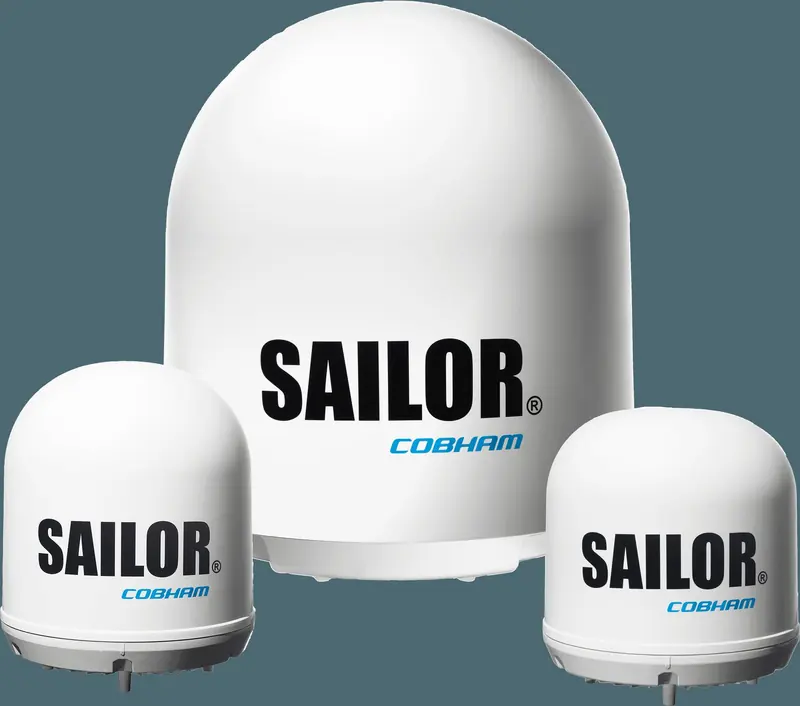
| Yacht-relevant model range | Fleet Xpress Ka-band VSAT (SAILOR 60 GX, 65cm class; SAILOR 100 GX, 1m); Ku/Ka VSAT (SAILOR 600, 800, 900); L-band FleetBroadband (SAILOR 150, 250, 500); Iridium Certus (SAILOR 4300, SAILOR 7200 GMDSS) |
| SAILOR 100 GX antenna alone lists at roughly $15,900 to $19,000 through US resellers; a complete entry Fleet Xpress hardware and two-year airtime package commonly runs $115,000 to $125,000 | |
| SAILOR 4300 Iridium Certus terminal retails roughly $5,000 to $6,700; published US airtime runs about $399 a month for 300MB (overage $1.99/MB) or $499 a month unlimited, plus $0.49 a minute voice | |
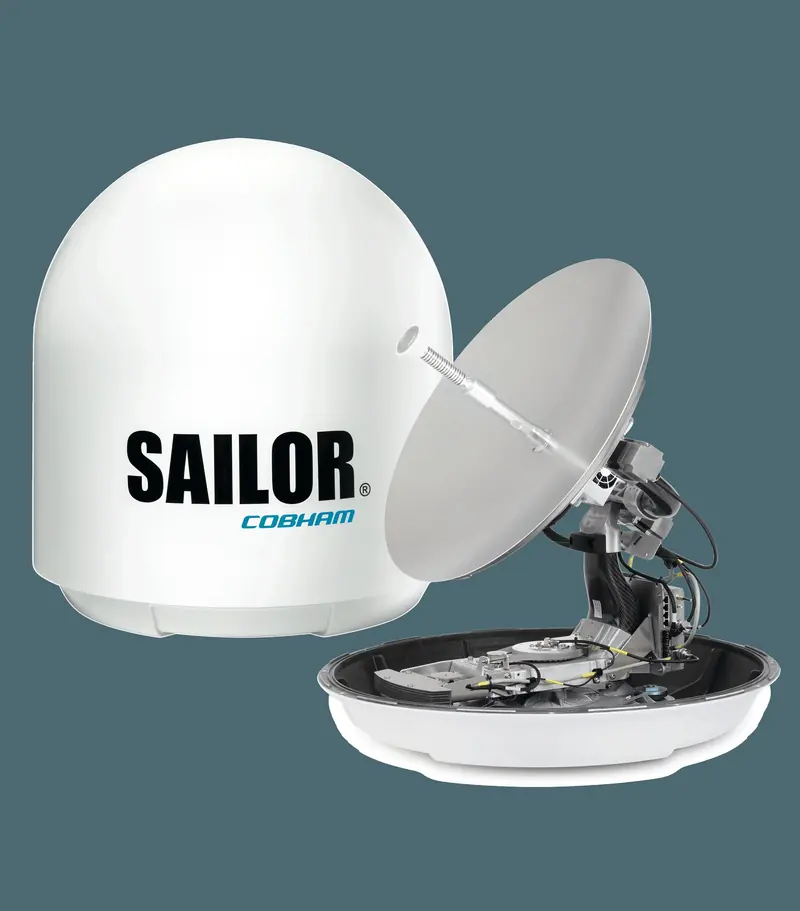
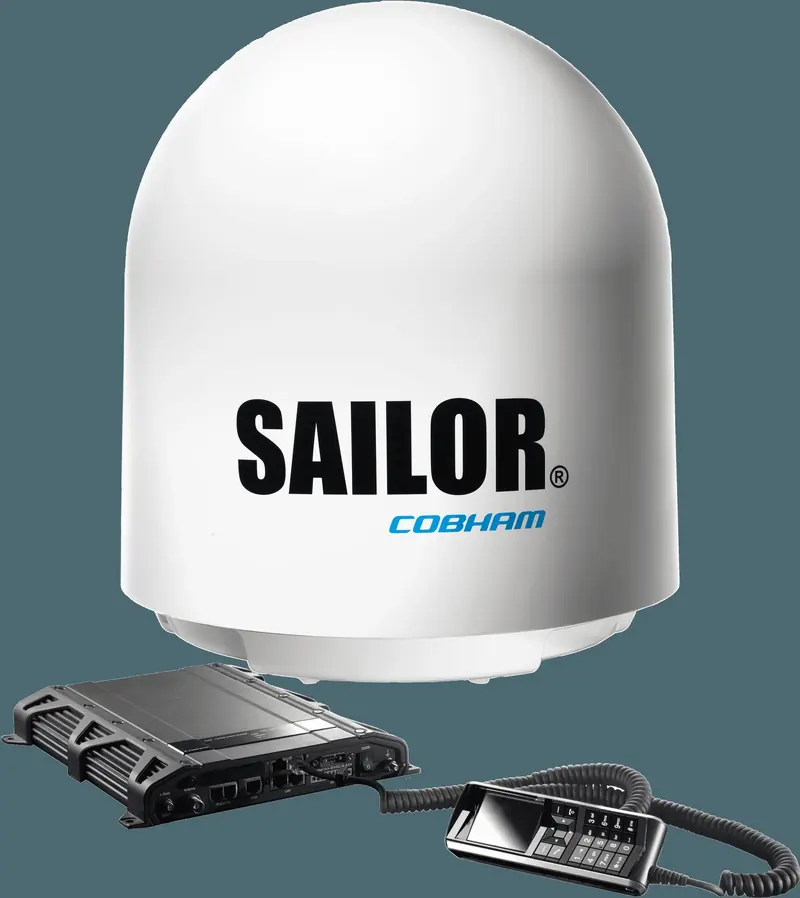
| SAILOR 900 VSAT | 1m 3-axis stabilized dish, 8W BUC standard, up to 20W in the high-power variant, single-cable run between antenna and below-deck unit |
| SAILOR 60 GX radome | 90cm diameter by 106cm height; maker states no crane is needed for installation |
| SAILOR 7200, launched 2024, is the newest Iridium Certus terminal combining GMDSS distress alerting, Ship Security Alert System and Long-Range Identification and Tracking in one unit | |
| Almost all SAILOR hardware and VSAT airtime pricing is quote-only through installers and dealers (Radio Holland, Mackay Communications, Marlink, Alphatron Marine, satellitephonestore), not published list pricing | |
What is SAILOR and who owns Cobham SATCOM now
SAILOR is the maritime satellite communications terminal brand built by Cobham SATCOM, a Danish manufacturer headquartered in Lyngby outside Copenhagen. The company traces back to Thrane and Thrane A/S, founded in 1972, which bought the SAILOR name from Norway's Nera in 2006 and was itself bought by UK defense group Cobham plc in 2012, creating the Cobham SATCOM business unit that still carries the SAILOR, Sea Tel, EXPLORER and TRACKER product families. Cobham plc's ownership ended in 2025: the Cobham Group, then Advent International backed, agreed in April 2025 to sell Cobham SATCOM to Solix Group, a Scandinavian mid-market investment firm with maritime and government roots, and that sale closed in August 2025.
So the brand a yacht buyer sees on a dome has stayed constant through three corporate parents in under twenty years, while manufacturing has stayed at the same Lyngby facility throughout. The most recent move came in December 2025, when Cobham SATCOM's network division agreed to merge with Gatehouse Satcom, a 5G non-terrestrial-network software company, with Cobham SATCOM retaining majority ownership of the combined entity; that deal was still awaiting regulatory approval at the time of writing. None of this has interrupted SAILOR hardware production or support so far, but a buyer doing diligence on a multi-year VSAT contract should ask any dealer directly which legal entity currently backs the warranty, since it has changed twice in five years.
What does the SAILOR product range actually cover
SAILOR's current yacht-relevant lineup splits into four families. Fleet Xpress Ka-band VSAT covers the SAILOR 60 GX, a 65cm class antenna in a 90cm diameter, 106cm tall radome the maker says needs no crane to install, and the larger SAILOR 100 GX, a 1 meter 3-axis stabilized dish built for bandwidth-hungry cruise and superyacht use with a 5 Watt BUC, or a high-power option at roughly double the RF output. The older Ku/Ka VSAT family, the SAILOR 600, 800 and 900, still services vessels on legacy VSAT airtime contracts, with the SAILOR 900's 1 meter dish and 8W BUC, up to 20W in the high-power variant, the most common superyacht fit from that generation.
For lower-bandwidth or backup use, the L-band SAILOR 150, 250 and 500 FleetBroadband terminals run on Inmarsat's older network at up to 432kbps through a compact 60cm, 16kg antenna, still adequate for email, weather and voice. The SAILOR 4300 covers Iridium Certus, Iridium's L-band service, and is most commonly fitted as a low-cost backup to a primary VSAT or Starlink system rather than as a standalone yacht solution. The newest unit, the SAILOR 7200 launched in 2024, is a compact Iridium Certus GMDSS terminal combining distress alerting, Ship Security Alert System and Long-Range Identification and Tracking in one box, aimed at safety certification rather than entertainment bandwidth.

A full Fleet Xpress fit-out with its mandatory two-year contract still runs $115,000 to $125,000, and none of that price is published anywhere by SAILOR itself.
How does SAILOR compare with Starlink Maritime
On raw performance, Starlink Maritime wins outright: its Flat High Performance terminal advertises speeds up to 350 to 400Mbps at 20 to 40ms latency, against SAILOR Fleet Xpress VSAT's typical single-digit-to-low-double-digit Mbps and roughly 600ms geostationary latency that visibly lags video calls. Hardware cost favors Starlink too: a Flat High Performance kit runs about $2,000 to $2,500 against $15,900 and up just for a SAILOR 100 GX antenna, before cabling and a below-deck unit are added. Ongoing cost has moved further in Starlink's favor: standard Global Priority plans run from around $250 a month for 50GB up to roughly $2,150 a month for 2TB, while SAILOR's own dealers still quote entry Fleet Xpress packages, hardware plus the mandatory two-year airtime commitment, at $115,000 to $125,000 all in.
What SAILOR VSAT still offers that Starlink does not is a committed information rate: Inmarsat backs Fleet Xpress with contracted, guaranteed bandwidth rather than Starlink's best-effort service, which several 2025 and 2026 trade pieces flag as dropping from around 300Mbps to single-digit Mbps in congested hubs like Monaco or Palma in high season. SAILOR terminals, and the Inmarsat and Iridium networks behind them, also carry GMDSS, SSAS and LRIT safety certification that Starlink Maritime does not hold, which is why classification societies and flag states still require a certified L-band or VSAT safety terminal, typically SAILOR or a direct competitor, on any vessel that needs GMDSS compliance regardless of how much Starlink capacity sits alongside it. The practical outcome on most new-build superyachts now is not either-or: SAILOR or a rival VSAT system stays aboard as the certified, guaranteed layer while Starlink carries the everyday streaming and video-call load.
How does SAILOR compare with KVH and Intellian
KVH sells a closed system: its TracPhone V-series antennas, from the V3-HTS up through the V11-HTS, plus the compact V30 at 6/2 Mbps down and up, are sold and supported as a package with KVH's own mini-VSAT Broadband airtime, so a buyer gets one phone number to call for both hardware and connectivity but cannot easily move the dish to a different carrier later. SAILOR and Intellian both sell open, carrier-agnostic hardware instead: a SAILOR 900 or an Intellian v100NX or v130NX, both roughly 1 meter Ku/Ka convertible dishes, can be provisioned on Inmarsat, Intelsat, SES or other Ku/Ka networks through whichever airtime reseller quotes the best rate, which gives an owner real negotiating leverage on the recurring bill that KVH customers do not have.
On the forums, owner sentiment runs mixed rather than lopsided toward any one brand. Trawler Forum and Cruisers Forum threads on Intellian describe generally solid hardware with occasional in-warranty customer support friction and satellite-provider handoff issues when crossing coverage boundaries, for example Florida to the Bahamas, while KVH draws more frequent complaints in the same threads about cost and support responsiveness, with one Trawler Forum poster summarizing that competing systems are cheaper and equally capable. SAILOR gets fewer forum mentions than either rival simply because it is sold mostly through professional installers such as Radio Holland, Marlink and Mackay Communications rather than direct to owner-operators, so most SAILOR feedback that exists comes from installer case studies rather than DIY cruiser threads, a gap a buyer should close by asking a dealer for named reference yachts before committing.
What does a SAILOR system actually cost
Almost none of SAILOR's own pricing is published. Cobham SATCOM's product sheets and its dealer network, including Radio Holland, Mackay Communications, Alphatron Marine and satellitephonestore, list specifications but push pricing to a quote request, which is standard practice across maritime VSAT but frustrating for a first-time buyer trying to budget. Where retail numbers do surface, a SAILOR 100 GX antenna alone lists at roughly $15,900 to $19,000 through US resellers, and trade reporting on Fleet Xpress puts a complete entry-level hardware package plus the mandatory two-year Inmarsat airtime contract at $115,000 to $125,000, a number that positions Fleet Xpress squarely at the superyacht and charter end of the market rather than at private cruisers.
At the low end, a SAILOR 4300 Iridium Certus terminal runs roughly $5,000 to $6,700 in hardware, with published US airtime plans around $399 a month for a 300MB allowance, overage at $1.99 a megabyte, or $499 a month unlimited, plus $0.49 a minute voice, making it a realistic backup-only purchase rather than a primary system. Installation is a separate line item everywhere in this category: SAILOR markets its 60 GX radome as not needing a crane, which implies that its larger dishes, along with rival Ku/Ka domes of similar size, typically do. Buyers should budget separately for the below-deck unit, cabling, commissioning and, for any Ka/Ku VSAT contract, the early-termination penalties built into that mandatory multi-year term, since none of the reseller pages that quote hardware numbers include those costs.
How reliable is SAILOR in real-world service
SAILOR's strongest reliability claim is scale and longevity rather than any single review: Cobham SATCOM states more than 300,000 SAILOR maritime L-band antennas have been deployed worldwide since the brand's introduction, and SAILOR terminals have carried GMDSS distress, safety and security functions since Inmarsat-C's rollout in the 1990s, a track record neither KVH nor Intellian, both newer to the safety-certified segment, can fully match. One Marlink-documented superyacht installation reported the owners going without an internet outage from the day their SAILOR VSAT system was commissioned, and a captain quoted in a Dockwalk guide to choosing a marine VSAT antenna said a properly specified VSAT setup is brilliant when it works but that he still would not cross the Atlantic without Inmarsat as a backup, a reminder that even satisfied professional users plan for redundancy rather than trusting any single satellite system alone.
What is missing from the public record is the kind of large, unfiltered owner-operator complaint or praise thread that KVH and Intellian each have running on Trawler Forum and Cruisers Forum. That gap is a function of distribution rather than necessarily of reliability: SAILOR sells almost exclusively through professional installers and shipyards rather than direct retail, so the people best placed to complain about it in public rarely touch the purchase or support relationship directly. A buyer should treat that silence as a research task rather than an endorsement, and specifically ask any SAILOR-recommending installer for two or three reference yachts of comparable size to call directly, the same diligence step every maritime VSAT trade guide reviewed for this piece recommends and that generic online reviews cannot substitute for.
Who should actually buy a SAILOR system
SAILOR earns its place on a yacht in two specific situations: when a vessel's size, flag or classification requires certified GMDSS, SSAS or LRIT equipment that a consumer LEO terminal cannot provide, and when an owner or charter operation needs contracted, guaranteed-rate bandwidth for business use, cybersecurity segmentation or crewed watchkeeping systems that cannot tolerate Starlink's best-effort congestion drops in busy anchorages. In both cases the buyer is paying for certification and a service-level agreement rather than for headline speed, and should evaluate SAILOR against Fleet Xpress's own direct hardware rivals, principally the open-carrier Intellian NX series, rather than against Starlink at all.
For an owner whose only goal is fast, affordable internet for guests and crew, current pricing makes the decision straightforward: a Starlink Maritime kit at roughly $2,000 to $2,500 in hardware and $250 to $2,150 a month in service will out-perform and dramatically undercut a $115,000 to $125,000 Fleet Xpress fit-out for everyday streaming and video calls, and most yacht connectivity integrators quoted in 2025 and 2026 trade coverage now recommend exactly that hybrid: LEO for bulk data, VSAT or L-band SAILOR or Iridium equipment retained as the certified, always-on layer underneath it. Anyone buying new in 2026 should also confirm in writing which legal entity, Cobham SATCOM under Solix Group, stands behind the warranty and support contract, given the two ownership changes the SAILOR brand has been through since 2025.
Praktische Angaben
| Hardware cost | Almost entirely quote-only. Where retail numbers surface, a SAILOR 100 GX Ka-band antenna alone lists at roughly $15,900 to $19,000 through US resellers such as Satellite Phone Store, before a below-deck unit, modem and cabling are added. A SAILOR 900 Ku/Ka VSAT dish and a SAILOR 4300 Iridium Certus terminal, at roughly $5,000 to $6,700, are the two most commonly quoted hardware figures found across dealer sites; no SAILOR product page publishes a full system price. |
|---|---|
| Airtime and subscription cost | Fleet Xpress (Ka-band VSAT) airtime is sold under a mandatory contract, commonly two years, and is quote-only through Inmarsat distribution partners; trade reporting puts an entry-level hardware-plus-two-year-contract package at $115,000 to $125,000 all in. Iridium Certus airtime on the SAILOR 4300 is published by some US dealers: about $399 a month for 300MB with $1.99 a megabyte overage, or $499 a month unlimited, plus $0.49 a minute voice. Older FleetBroadband plans on the SAILOR 150/250/500 run from small metered buckets up to roughly 20GB a month with steep per-megabyte overage on the smallest tiers. |
| Install cost | Not published for SAILOR specifically. Installation cost scales with dome size and typically requires a crane for the larger Ka/Ku VSAT domes (SAILOR 100 GX, 900); SAILOR markets its smaller 60 GX radome as not needing a crane, implying the rest of the range does. Below-deck unit siting, cable runs, gyro-compass integration and commissioning by a certified installer (Radio Holland, Mackay Communications, Alphatron Marine and similar) are additional line items not included in any hardware quote found. |
| What is not published | SAILOR hardware list prices, VSAT airtime rates, installation labor rates and early-termination penalties on multi-year Fleet Xpress contracts are all withheld from public product pages and disclosed only on request through a dealer. This is standard practice across maritime VSAT (KVH and Intellian are similarly opaque on airtime), but it means a buyer cannot budget a SAILOR system from the manufacturer's own site and must collect competing quotes to see real numbers. |
| Comparison hardware cost | A Starlink Maritime Flat High Performance kit runs about $2,000 to $2,500 in hardware, roughly a tenth of a SAILOR 100 GX antenna alone. KVH and Intellian dishes of comparable size to SAILOR's Ku/Ka VSAT range are generally quoted in the same low-five-figure to low-six-figure band as SAILOR, since all three use similar RF hardware and installation methods. |
| Comparison monthly cost | Starlink Global Priority plans run from about $250 a month for 50GB to roughly $2,150 a month for 2TB, and a discounted $2,495 a month unlimited plan exists for IMO-registered cargo and tanker vessels only, not yachts. SAILOR Fleet Xpress airtime, by contrast, is sold on a fixed multi-year contract rather than a flexible monthly plan, which is both its main cost disadvantage against Starlink and the source of the guaranteed bandwidth Starlink does not offer. |
Was Eigner und Crew berichten
No outage since commissioning, on a professionally installed system
A superyacht owner reported going without an internet outage from the day their SAILOR VSAT system, designed and installed by Marlink, was commissioned, according to a Marlink case study covered in the maritime trade press.
Marlink superyacht installation case study, via Riviera Maritime MediaBrilliant when it works, but still carries Inmarsat as backup
A yacht captain interviewed for a guide on choosing a marine VSAT antenna said VSAT is brilliant when it works but that he still would not cross the Atlantic without Inmarsat as a backup system, underlining that even satisfied professional VSAT users build in redundancy rather than trusting one satellite path alone.
Captain quoted in Dockwalk's marine VSAT antenna guideRival VSAT hardware seen as cheaper for comparable capability
A Trawler Forum member comparing dish antenna options summarized that competing VSAT systems are cheaper and equally capable compared with the market-leading closed-network brand, a comment made about KVH specifically but relevant to any buyer pricing SAILOR against open-hardware alternatives.
Trawler Forum member, VSAT and satellite-TV comparison threadIntellian hardware generally solid, support inconsistent
Trawler Forum posters describe their Intellian VSAT and sat-TV hardware as generally working well, while also flagging pretty poor customer support on an in-warranty unit and provider handoff problems crossing coverage boundaries such as Florida to the Bahamas, a pattern worth asking any SAILOR dealer whether it is avoided or shared.
Trawler Forum members, Intellian experience threadIntegrators now default to hybrid, not VSAT-only, for new builds
ONEXP's head of technical office said hybrid systems that blend VSAT, Starlink, 5G and GSM with automatic failover are now the standard approach because no single satellite path, SAILOR VSAT included, is treated as sufficient on its own for a modern superyacht.
Chris Poortvliet, ONEXP head of technical office, via Boat International
Was gut ist und worauf zu achten ist
Stärken
- Decades of GMDSS heritageSAILOR terminals have carried GMDSS distress, safety and security functions since Inmarsat-C's rollout in the 1990s, and Cobham SATCOM says more than 300,000 SAILOR L-band antennas have been deployed worldwide, a certification track record neither KVH nor Intellian can fully match.
- Contracted, guaranteed bandwidthFleet Xpress VSAT is backed by a committed information rate from Inmarsat rather than the best-effort service Starlink Maritime sells, which matters for bridge systems, crew safety communications and any operation that cannot tolerate a sudden congestion-driven speed drop in a busy anchorage.
- Open, carrier-agnostic hardwareUnlike KVH's closed hardware-plus-airtime bundle, a SAILOR VSAT antenna can be provisioned on Inmarsat, Intelsat, SES or other Ku/Ka networks through competing airtime resellers, giving an owner real negotiating leverage on the recurring bill over the life of the system.
- Broad, purpose-built model rangeFrom the crane-free 65cm SAILOR 60 GX up through the 1 meter SAILOR 100 GX and 900, down to the compact SAILOR 150 FleetBroadband and the new SAILOR 7200 GMDSS terminal, the range covers primary VSAT, backup L-band and dedicated safety equipment under one brand and one installer relationship.
Worauf zu achten ist
- Fleet Xpress pricing is genuinely expensiveTrade reporting puts a complete entry-level Fleet Xpress hardware and mandatory two-year airtime package at $115,000 to $125,000, an order of magnitude above a Starlink Maritime kit, and none of that number is published by SAILOR itself, forcing every buyer to negotiate blind against a dealer's first quote.
- Far behind Starlink on raw speed and latencySAILOR Fleet Xpress VSAT typically delivers single-digit-to-low-double-digit Mbps at around 600ms latency, against Starlink Maritime's advertised 350 to 400Mbps at 20 to 40ms, a gap large enough that video calls and streaming are visibly worse on SAILOR VSAT even when it is working correctly.
- Thin independent owner-review recordBecause SAILOR sells almost exclusively through professional installers rather than direct retail, there is no large public owner-operator complaint or praise thread comparable to what KVH and Intellian each have on Trawler Forum and Cruisers Forum, so a buyer has to seek out installer references directly rather than read existing user reviews.
- Two ownership changes since 2025Cobham SATCOM was sold from the Cobham Group to Solix Group in August 2025 and then, in December 2025, agreed to merge its network division with Gatehouse Satcom, so a buyer signing a multi-year Fleet Xpress contract in 2026 is doing so with a manufacturer that has changed corporate parent twice in under a year.
Für wen: Owners and captains who need certified GMDSS safety equipment or contracted guaranteed-rate bandwidth, not owners who only want the fastest or cheapest internet at anchor.