Galactica Star
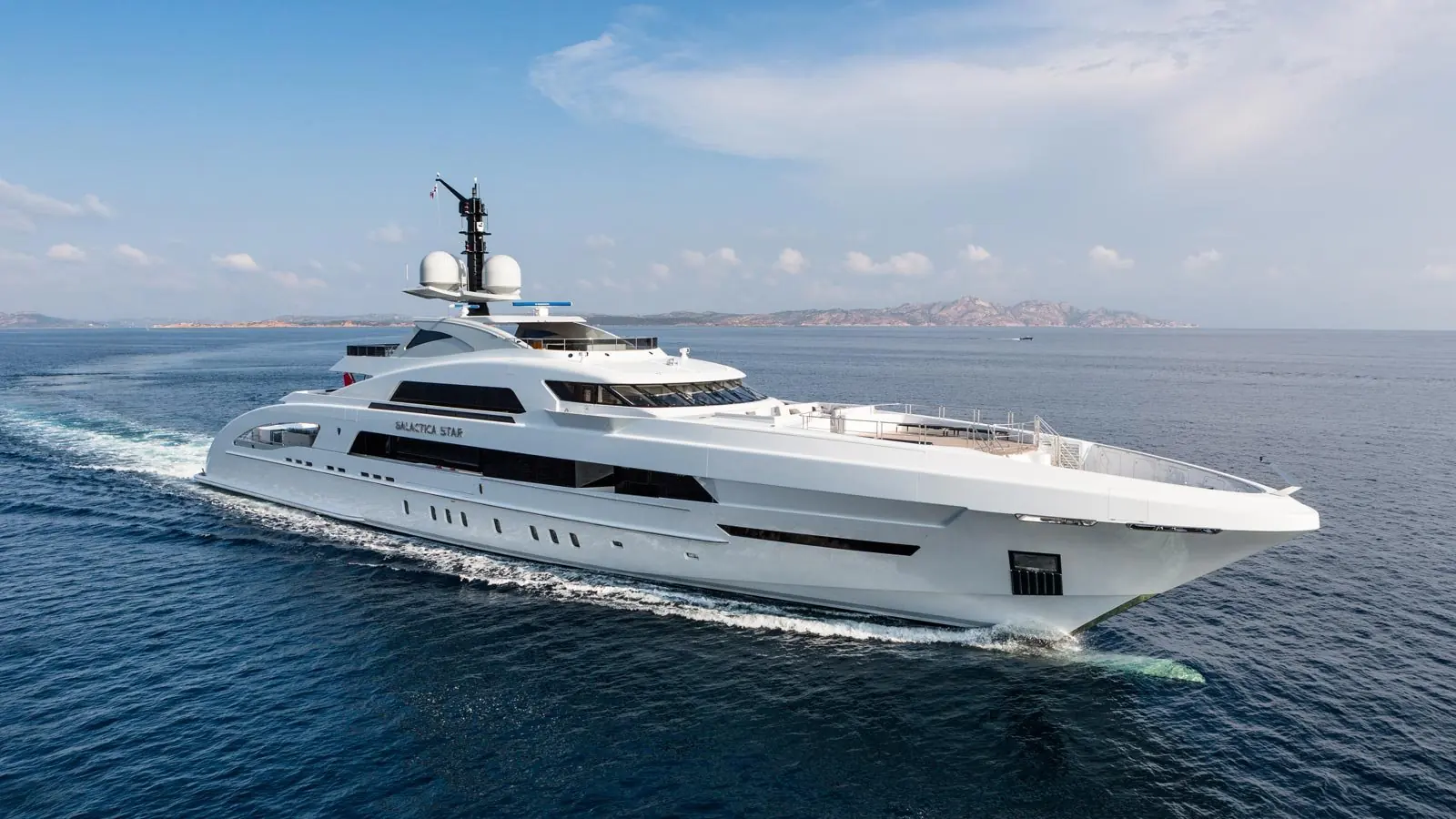
| LOA | 65 m |
|---|---|
| Entregado | 2013 |
| Arquitectura naval | FDHF de Van Oossanen, primera aplicación completa |
| Exterior | Omega Architects |
| Interior | Bannenberg and Rowell |
| Alojamiento | 12 invitados, 13 tripulantes |
| Velocidad máxima | 30 nudos en pruebas |
| Galardón | World Superyacht Award 2014 |
El yate que abrió una década
Cuando Heesen entregó el Galactica Star en mayo de 2013 hizo algo más que botar un buque insignia de 65 metros. Conocido durante la construcción como Project Omnia, fue la primera aplicación completa de la Fast Displacement Hull Form desarrollada con Van Oossanen. El casco prometía el comportamiento en la mar de un barco de desplazamiento con el ritmo de algo mucho más deportivo, y las pruebas de mar lo cumplieron. Después ganó en los World Superyacht Awards de 2014. Ese reconocimiento confirmó lo que las pruebas de mar ya habían mostrado.
Para Heesen el barco fue una prueba de concepto que reconfiguró toda la gama. Casi todos los yates que el astillero ha dibujado desde entonces deben su eficiencia a este casco. Para su armador fue un 65 metros genuinamente rápido con las maneras de un barco mucho más tranquilo. Una década después sigue siendo una referencia en cualquier conversación sobre superyates rápidos. Su influencia en la gama Heesen moderna es difícil de exagerar.
Las líneas rápidas de Frank Laupman
Frank Laupman, de Omega Architects, dibujó un exterior que parece veloz incluso parado. El perfil es largo y esbelto, con roda vertical y una superestructura tensa que encajan con el casco que hay debajo. Más de 267 metros cuadrados de cubierta se reparten por sus tres niveles superiores, así que a los invitados nunca les falta sitio al sol o a la sombra. El estilismo ha envejecido con una gracia poco común para un barco de su época. Frank Laupman le dio unas proporciones que hoy siguen pareciendo actuales.
Los detalles ingeniosos son tan estructurales como estéticos. Un helipuerto en la cubierta de proa hace también de terraza solárium, montado sobre unas puertas de ala de gaviota que se abren para descubrir un garaje de tenders a manga completa. A popa, un beach club dúplex se despliega entre la cubierta principal y la baja para bajar a los invitados hasta la línea de flotación. Eran gestos atrevidos en 2013 y hoy siguen impresionando a bordo. El resultado es un yate que acerca a los invitados al agua en cuanto puede.
El primer Heesen en llevar el casco Fast Displacement, y todavía una referencia.
La mano libre de Bannenberg and Rowell
Dentro, Bannenberg and Rowell tuvieron margen para inventar. El director creativo Simon Rowell describió un lenguaje de diseño tenso y disciplinado que fluye de un espacio a otro sin un tema fijo. El resultado se siente coherente y actual, una sola idea llevada por todo el barco. Se lee como una seguridad serena y meditada. Los materiales resultan contenidos y caros de principio a fin. Los invitados perciben la calidad antes de poder nombrarla.
La distribución acoge a 12 invitados, con un camarote del armador a manga completa, una VIP en la cubierta superior y otras cuatro suites dobles. Una tripulación de 13 mantiene un servicio impecable en todas sus cubiertas. Los volúmenes son generosos y la continuidad entre espacios sociales es fácil. Es un interior hecho para recibir a gran escala. Las estancias largas a bordo resultan sencillas gracias a esa fluidez entre espacios.
Treinta nudos ganados con honestidad
El titular de ingeniería es sencillo. El Galactica Star alcanzó 30 nudos en pruebas frente a los 27 contratados, y lo hace consumiendo en torno a un 30 por ciento menos de combustible que un casco convencional de pantoque redondo de su tamaño. Esa combinación era casi inaudita en 65 metros en 2013. La razón era la Fast Displacement Hull Form, y este barco fue su primera expresión completa. Aquel primer éxito reconfiguró todos los Heesen que vinieron después. La ingeniería se ha demostrado a lo largo de una década de servicio.
Lo que eso significa para un armador es alcance y ritmo sin una factura de combustible punitiva. Puede perseguir el buen tiempo o una reserva para cenar a toda velocidad y, a la mañana siguiente, instalarse en una travesía eficiente. La eficiencia amplía además su autonomía a velocidades de crucero. Pocos barcos han igualado la mezcla de prestaciones y economía que él introdujo. Ese equilibrio es lo que lo hizo un buque insignia tan convincente en su momento.
El armador al que encaja
El Galactica Star encaja con el armador que quiere un trozo de historia del yachting con prestaciones que respalden el relato. Es un 65 metros rápido y llamativo, con el espacio de cubierta y el beach club para recibir a una dotación completa de invitados. Su procedencia como primer Heesen con FDHF añade una capa que pocos rivales pueden reclamar. Para el comprador que valora a la vez velocidad y pedigrí, es un objeto raro. Su sitio en la historia del astillero está asegurado.
También premia al armador que navega de forma activa y detesta esperar. El ritmo le permite cubrir distancias que los buques insignia más lentos tratan como un traslado. El diseño premiado y el beach club dúplex mantienen memorable la vida a bordo en el fondeadero. Sigue girando cabezas en cualquier puerto que visita. Es un yate para un armador al que le gusta llegar rápido y con estilo.
Motores y sistemas
| Main engines | Twin MTU 20V 4000 M93L diesels, 4,300 kW each at 2,100 rpm (Romeo United Yachts, Yachts International) |
|---|---|
| Generators | Two Kohler Kilo-Pak sets, 175 kW each (Romeo United Yachts) |
| Stabilizers | Five Seakeeper M21000 gyro-stabilizers - an unusually high count, fitted to hold the fast-displacement hull steady at both speed and at anchor (Romeo United Yachts) |
| Fuel tankage | 90,000 litres / 23,770 US gallons (Romeo United Yachts) |
| Range and speed | Contracted for 27 knots, reached 30 knots on trials; range about 4,200 nm at 14 knots (Romeo United Yachts, Yachts International, the yard's own material) |
| Hull form | Van Oossanen Fast Displacement Hull Form, the first full application on an aluminium Heesen - the naval-architecture idea the boat exists to prove (Heesen, Offshore Energy) |
| Not publicly known | Bow and stern thruster make and output, watermaker capacity, and black/grey water tankage were not published in any source checked |
Lo que cuentan armadores y tripulaciones
High-profile charter guests
Beyonce and Jay-Z chartered the yacht in the Mediterranean in 2016 to mark the singer's 32nd birthday, one of the few instances of independent, named guest use reported for this yacht.
Boss Hunting, reporting contemporary celebrity-press coverageOriginal ownership and seizure
The yacht was linked in US and Nigerian investigations to Kola Aluko and the wider Diezani Alison-Madueke corruption case before its 2017 seizure and 2019 court-ordered sale.
Wikipedia, SuperYacht Times and BOAT International, drawing on US Department of Justice and contemporary press reporting
Lo bueno y lo que conviene vigilar
Puntos fuertes
- A genuine engineering landmark, not just a fast boatThe first full-scale application of Van Oossanen's Fast Displacement Hull Form on an aluminium Heesen, reaching 30 knots against a contracted 27 while burning roughly 30 per cent less fuel than a conventional round-bilge hull her size - a result the yard has built its modern range around (Heesen, Offshore Energy).
- Award-recognised design that has aged wellWon at the World Superyacht Awards in 2014, and the Omega Architects exterior and Bannenberg and Rowell interior are still cited as reference points a decade later.
A tener en cuenta
- Her ownership history is a matter of public record, not marketingSeized in 2017 under the US Kleptocracy Asset Recovery Initiative over links to a Nigerian oil-corruption case involving former petroleum minister Diezani Alison-Madueke, then sold via a US court-ordered sealed-bid auction in 2019 and renamed Illusion (Wikipedia, SuperYacht Times, BOAT International). A prospective charter guest or student of the boat should know this is part of her record, not a rumour.
- No independent sea trial data beyond the yard's own figuresThe 30-knot trial result and the fuel-saving claim both trace back to Heesen and its naval architect; no third-party publication was found independently verifying the fuel-consumption comparison against a conventional hull.
Información práctica
| Original build price | Reported as EUR 65 million at her 2013 launch (Wikipedia, citing contemporary press) |
|---|---|
| 2019 auction sale | Sold via a US court-ordered judicial sealed-bid auction after seizure, reportedly for around USD 42 million against reserve, bought through Burgess representing an undisclosed buyer (Yacht Harbour, BOAT International, SuperYacht Times) |
| Charter rate (as ILLUSION) | Reported around USD 900,000 a week by YachtCharterFleet, though she was not a full-time commercial charter yacht in her original ownership - 'you had to know the owner to step aboard' per contemporary reporting |
| 2019 refit | Refitted after the ownership change, per YachtWorld's research write-up, before returning to service under the new name |
| Not publicly known | The identity of the buyer at the 2019 auction is not public - the vessel is held through the shell company Paxford Ltd and operated by Burgess Yachts (Wikipedia) |
Para quién es: El armador que quiere un 65 metros rápido y emblemático, con un diseño premiado, un beach club dúplex y 30 nudos de verdad.