Genesis (80m, ex-Project Cosmos)
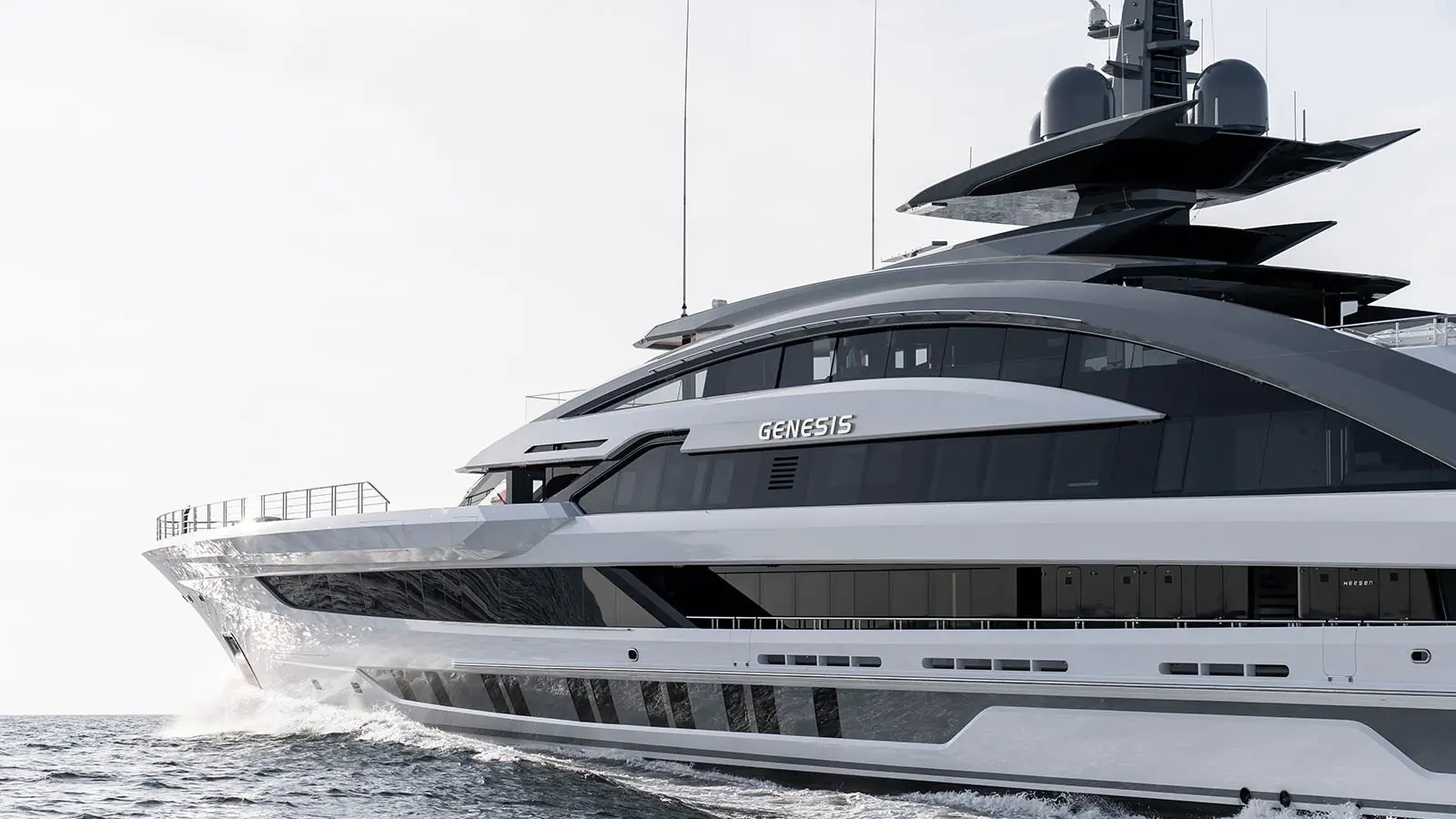
| LOA | 80,07 m |
|---|---|
| Arqueo bruto | unos 1.700 GT |
| Velocidad máxima | 29 nudos |
| Motores | cuatro MTU 20V 4000 M73, unos 19.000 hp en total |
| Casco | FDHF íntegramente de aluminio, estructura Backbone patentada |
| Invitados y tripulación | 12 invitados, 19 tripulantes |
| Diseño | exterior de Winch Design, interior de Sinot |
| Entregado | 2023 (ex Project Cosmos) |
El mayor yate rápido de aluminio a flote
El Genesis empezó su vida como Project Cosmos y se entregó bajo su nuevo nombre en agosto de 2023. Heesen lo presenta como el mayor y más rápido motoryacht del mundo íntegramente de aluminio movido por hélices convencionales. Con 80,07 metros y unos 1.700 GT es el buque insignia del astillero por un margen claro. La reclamación del récord se apoya en mantener 29 nudos a un tamaño en el que la mayoría de los yates hace tiempo que han bajado el ritmo.
Es la cumbre de todo lo que Heesen aprendió en cascos rápidos menores. Llevar el planteamiento del aluminio y de la FDHF hasta los 80 metros exigió ingeniería nueva, y el astillero la aportó. El Genesis reajustó las expectativas de lo que podía ser un yate neerlandés de aluminio a escala de buque insignia. Para Heesen es a la vez un punto álgido técnico y una tarjeta de presentación. Esa posición se mantiene desde su entrega en 2023.
Diecinueve mil hp sobre aluminio
El Genesis lleva un casco FDHF de Van Oossanen construido enteramente en aluminio para mantenerlo ligero a 80 metros. Cuatro diésel MTU 20V 4000 M73 aportan unos 19.000 hp entre todos, que es lo que hace falta para mover un yate de este tamaño a 29 nudos. La FDHF mantiene a raya la resistencia para que la potencia se traduzca en velocidad real y no solo en consumo. El resultado es un récord genuino entre los yates de aluminio con hélices convencionales. Cuatro motores de esa potencia son algo inusual en un casco de aluminio de cualquier tamaño.
Hacer que un casco tan largo fuera a la vez ligero y rígido era el problema central. El astillero lo resolvió con un refuerzo patentado de toda la eslora al que llama Backbone, que da a la estructura su resistencia longitudinal. Sin esa columna, el casco de aluminio no podría soportar las cargas que imponen la velocidad y la eslora. El Backbone es la ingeniería callada que hay detrás de la cifra de titular. Heesen patentó esa columna en lugar de guardarla como secreto industrial.
El yate íntegramente de aluminio más grande y más rápido del mundo con hélices convencionales.
Winch Design a escala de buque insignia
Winch Design firmó el exterior y conservó el carácter musculoso de Heesen mientras lo estiraba a lo largo de 80 metros. El perfil es largo y seguro, con el volumen resuelto para que el yate nunca parezca un muro liso. Los grandes acristalamientos y una línea de arrufo rotunda le dan presencia en cualquier fondeadero. El estilismo mantiene el carácter deportivo del astillero a un tamaño que fácilmente podría haber resultado pesado. Estirar el aire Heesen hasta los 80 metros sin volumen sobrante no fue tarea menor para el estudio.
El equipamiento de cubierta está a la altura de la ambición de la plataforma. Un helipuerto certificado ocupa la proa, sobre un garaje que aloja un tender limusina a medida diseñado por Winch. Una piscina de siete metros a popa monta contracorrientes para nadar y añade una cascada sobre un fondo de vidrio. Un espacio de este orden es lo que hacen posible 1.700 GT. Un beach club con una barra hundida y transitable baja a los invitados hasta el agua por la popa.
Sinot dentro del buque insignia
Sinot Yacht Architecture and Design creó el interior, su tercer proyecto con Heesen. El Genesis duerme a doce invitados entre una suite del armador en la cubierta principal, una VIP en la cubierta del puente y cuatro camarotes en la cubierta baja, con sitio para una tripulación de diecinueve. El diseño usa el enorme volumen para lograr espacios serenos y abiertos antes que puro espectáculo. Un ascensor de cristal enlaza la cubierta baja con la solárium para moverse con facilidad. Ese ascensor es uno de varios detalles pensados para recorrer las cubiertas sin esfuerzo.
El interior se apoya en la luz y en la continuidad a lo largo de sus muchas cubiertas. Los materiales naturales y los tonos contenidos mantienen un ambiente sereno pese a la potencia del yate. El helipuerto hace también de cine al aire libre y convierte la cubierta de proa en un escenario para la tarde. Cada espacio está dimensionado para un yate en el que el volumen es casi ilimitado. El tercer interior de Sinot para Heesen se lee sereno pese a la potencia bruta del yate.
Un récord hecho para usarse
El titular de ingeniería es la línea de propulsión de cuatro motores y el Backbone que permite a un casco de aluminio soportarla a 80 metros. El Genesis usa hélices convencionales en lugar de un híbrido o de una transmisión exótica, lo que mantiene honesto el récord y sencillo el barco de operar. Todo a bordo está dimensionado para un buque insignia pensado para exigirse a fondo y a menudo. Los sistemas reflejan años de experiencia de Heesen con cascos rápidos. Mantenerse en hélices contrastadas en lugar de una transmisión experimental protege tanto el récord como los costes de operación.
El Genesis encaja con un armador que quiere el yate de aluminio más grande y más rápido disponible y, con él, el equipamiento de un buque insignia completo. Compra un récord genuino junto a un helipuerto y a una piscina que pocos yates de cualquier tamaño igualan. Es un yate para el comprador que no piensa elegir entre tamaño y velocidad. El Genesis es la respuesta de Heesen a ese armador. Cierra la distancia entre un cazador de récords y un buque insignia plenamente equipado.
Motores y sistemas
| Main engines | 4 x MTU 20V 4000 M73L diesel engines (2 x 3,600 kW + 2 x 3,540 kW, approx. 4,800-4,895 hp each, approx. 19,000-19,500 hp total), driving conventional shaftlines with variable-pitch propellers and Promas rudders - confirmed by Heesen Yachts official spec sheet and YachtCharterFleet/YachtBuyer summaries |
|---|---|
| Propulsion type | Conventional all-diesel mechanical propulsion, not diesel-electric/hybrid - explicitly confirmed by Heesen's own spec sheet and YachtCharterFleet; Heesen's hybrid-diesel-electric systems are used on other models (e.g. 50m 'Home'), not on Genesis |
| Generators | 2 x Kilo-pak, 300 kW each, 50 Hz - per Heesen Yachts official technical specification (single-sourced to the builder's own spec sheet) |
| Bow thruster | 1 x ZF-Marine, 190 kW, electrically driven - per Heesen Yachts official spec sheet; no stern thruster documented in available specs |
| Stabilisers | Quantum stabilisers, 2 fins, zero-speed (at-anchor) capability - Heesen official spec sheet, corroborated generically by YachtCharterFleet's reference to at-anchor stabilizers providing exceptional comfort |
| Naval architecture / hull form | Van Oossanen Naval Architects designed a bespoke Fast Displacement Hull Form (FDHF) adapted for the 80m aluminium length - confirmed by Van Oossanen's own case study (with named naval architect Perry van Oossanen) and corroborated in Boat International/SuperyachtNews coverage |
| Exterior design | Winch Design - confirmed across Heesen official site, Boat International, SuperyachtTimes, Yacht Harbour, YachtCharterFleet |
| Interior design | Sinot Yacht Architecture and Design - confirmed across the same set of independent outlets |
| Fuel capacity | 120,000 litres (31,700 US gal) - Heesen official spec sheet, corroborated by YachtCharterFleet |
| Fresh water capacity | 30,000 litres (7,925 US gal) - Heesen official spec sheet (single-sourced) |
| Top speed | 29 knots (at half load) - confirmed by Heesen official, Yacht Harbour, YachtBuyer, CharterWorld (described as the fastest 80m superyacht in the world) |
| Cruise speed | 22 knots reported by YachtCharterFleet; note one aggregator (Yacht Harbour) instead lists 14 knots, which appears to conflate cruise speed with the range-test speed (see range figure) - treat 22 knots as the better-supported cruise figure but flagged as not fully reconciled across sources |
| Range | 4,000 nautical miles at 14 knots - confirmed by Heesen official, Yacht Harbour, and YachtCharterFleet (3 independent sources) |
| Gross tonnage | Approx. 1,700 GT (Heesen official states 1,700; Yacht Harbour states 1,711) - consistent within rounding across 2 sources |
| Hull/superstructure | All-aluminium hull and superstructure with teak decking - confirmed multiple sources; Genesis is described as the world's largest and fastest all-aluminium motoryacht with a conventional propeller propulsion system |
Lo que cuentan armadores y tripulaciones
Building an 80m yacht strained a yard built for much smaller boats
"It's a daunting size. We're used to seeing 50 and 55 metre yachts in the shipyard," and on threading the hull through Dutch waterways: "When you've got a 12-metre-wide yacht and you're going through a 13.5-metre-wide lock you breathe in when you get close to it."
Mark Cavendish, Heesen Sales Director (Boat International interview)The hull form was a bespoke engineering challenge unique to this build
"The unique part of Project Cosmos is the length of the hull in combination with the aluminium," describing the difficulty of achieving adequate structural stiffness at 80m in aluminium and the CFD/tank-testing work behind the adapted Fast Displacement Hull Form.
Perry van Oossanen, naval architect, Van Oossanen Naval ArchitectsThe yacht's original intended owner was the sanctioned president of Lukoil, who also owned the shipyard that built her
Vagit Alekperov, Russia's fourth-richest man and Lukoil's president, owned Heesen Yachts and had the 80m flagship (then named Project Cosmos/Galactica) built for himself; his 2022 UK sanctioning forced Dutch-authority-coordinated arrangements and an unprecedented pre-delivery sale to a new, undisclosed owner before she was finally delivered as Genesis in August 2023.
Giacomo Tognini, Forbes
Lo bueno y lo que conviene vigilar
Puntos fuertes
- Record-setting hull engineeringAt 80.07m she is documented as the world's largest and fastest all-aluminium motoryacht with a conventional (non-waterjet) propeller propulsion system, using a Van Oossanen-designed Fast Displacement Hull Form specifically adapted for this length in aluminium, reaching 29 knots.
- At-anchor comfort systemsZero-speed Quantum stabilisers on a yacht this size are a meaningful comfort feature, corroborated across the builder's spec sheet and charter-industry summaries.
- Top-tier, consistent design pedigreeWinch Design (exterior) and Sinot Yacht Architecture and Design (interior) are named consistently across every independent source (Heesen, Boat International, SuperyachtTimes, Yacht Harbour, YachtCharterFleet) with no conflicting attributions.
A tener en cuenta
- Sanctions-driven ownership crisis and multi-year delayOriginally built for Lukoil president Vagit Alekperov (who also owned Heesen itself), the yacht could not be delivered on the original spring 2022 schedule once he was UK-sanctioned in 2022; she sat undelivered for over a year before an unprecedented Dutch-authorities-coordinated sale to a new, undisclosed owner, finally delivering as 'Genesis' on 31 August 2023 - well documented by autoevolution, Forbes, Marine Industry News, The Islander Magazine, and Luxury Launches.
- Build/transit logistics pushed to the edge of feasibilityPer Heesen's own sales director, the 80m hull's transit from the Oss shipyard involved roughly 120km of canals, rivers, bridges and locks with only fractions of a metre of clearance - an acknowledged engineering and logistics strain rather than a routine delivery.
- No charter market presence to benchmark againstYachtCharterFleet and CharterWorld both indicate Genesis is not available for private charter and no rate is published, so - unlike most flagship-class yachts of her size - there is no independently reported day/week rate or charter track record to assess.
Información práctica
| Guests / crew | Up to 12 guests (reported as either 5 or 6 staterooms depending on outlet - 2 of 3 sources say 6 cabins/suites including one VIP); 19 crew - crew figure confirmed consistently across Heesen, Yacht Harbour, YachtCharterFleet, Boat International |
|---|---|
| Delivery | Officially delivered to her (new, post-sanctions) owner on 31 August 2023, after sea trials in April 2022 and a technical completion roughly a year earlier - confirmed by Boat International and autoevolution |
| Sale brokerage | The pre-delivery sale of the yacht (then Project Cosmos) was brokered by 26 North Yachts, with Arrow Monaco as the owner's project management company - per Yacht Harbour |
| Charter availability | Not available for private charter; no published charter rate exists - per YachtCharterFleet and CharterWorld |
| Name history | Known successively as Project Cosmos (build name), Galactica (interim name), and Genesis (final delivered name) - reflecting the ownership change |
Design
| Diseño exterior | Winch Design |
|---|---|
| Interiorismo | Sinot Yacht Architecture & Design |
| Arquitectura naval | Van Oossanen Naval Architects / Heesen (all-aluminium, conventional propeller propulsion) |
Para quién es: Un armador decidido a tener el yate de aluminio más grande y más rápido que existe, que quiere el equipamiento completo de un buque insignia, con helipuerto y una gran piscina, y que va a exigir a fondo una línea de propulsión convencional de mucha potencia.