Amels 188
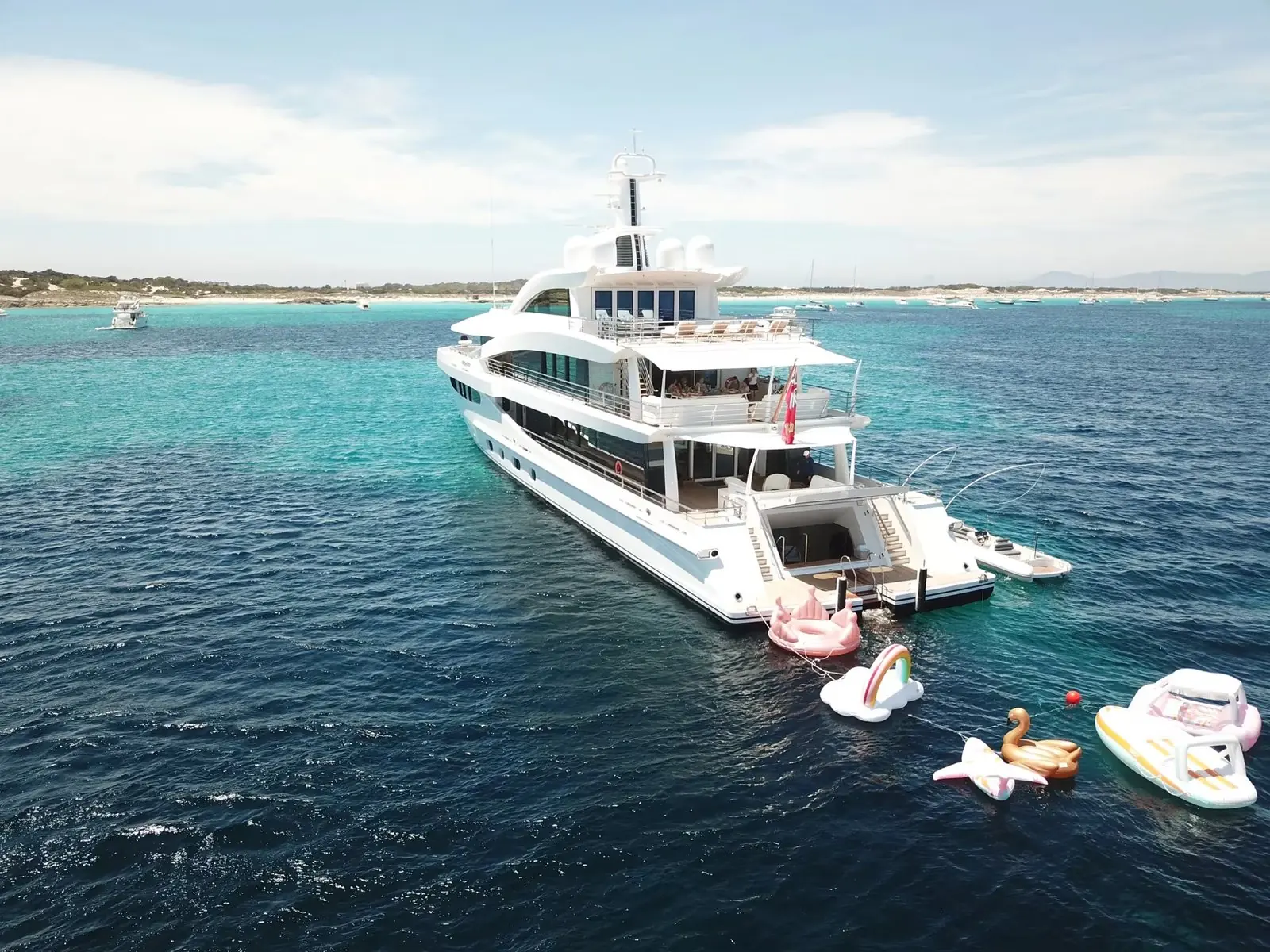
| LOA | 57,7 m (188 ft) |
|---|---|
| Baglio | 10,6 m |
| Pescaggio | 3,45 m |
| Stazza lorda | circa 970 GT |
| Motori | 2 x MTU 12V 4000 con quadro ibrido Amels e alimentazione a batteria |
| Velocità massima | circa 15,5 nodi, crociera circa 13 nodi |
| Sistemazioni | 12 ospiti in 6 cabine, più equipaggio |
| Design | esterni Tim Heywood, interni Reymond Langton, prima consegna nel 2018 |
Un passo avanti compatto nella gamma
L'idea Limited Editions era costruita sulla certezza. Amels ingegnerizzava ogni yacht in anticipo, fissava l'architettura navale e vendeva il risultato come costruzione semi-custom con prezzo noto e data di consegna ferma. Il 188 è arrivato come una delle piattaforme più piccole di quella famiglia, dimensionato a 57,7 metri per stare un gradino sopra il 180, il più venduto. Per un armatore alla prima esperienza offriva un volume da superyacht autentico senza i tempi aperti di una commessa full custom. Diversi primi scafi sono stati venduti prima del varo, e questo ha detto al cantiere che la taglia era ben calibrata.
Ciò che rendeva intelligente quella taglia era l'equilibrio raggiunto. Con 57,7 metri il 188 portava un beach club, una vera zona wellness e sei cabine ospiti, restando però nella fascia di stazza che tiene sensati i costi di gestione e i numeri di equipaggio. Gli armatori che salivano da un 40 metri trovavano il salto gestibile. Chi lo dava a charter lo trovava perfettamente inserito nella richiesta fascia sotto i 60 metri. La barca funzionava come casa privata e come fonte di reddito.
Linee Tim Heywood con un cuore ibrido
Tim Heywood ha disegnato gli esterni, e il profilo si legge come un Amels classico. La prua è lunga, la linea di cinta è calma e la sovrastruttura arretra pulita verso un ampio sun deck. Grandi finestrature nello scafo portano luce naturale in profondità sul ponte inferiore, così le cabine sotto la linea di galleggiamento risultano luminose e aperte. Lo scafo in acciaio e la sovrastruttura in alluminio seguono la costruzione standard del cantiere, ingegnerizzata per lunghe traversate oceaniche. Quell'immagine si è trasferita sull'intera flotta Limited Editions.
La storia vera stava dietro lo stile. Il 188 ha introdotto il quadro ibrido Amels, un sistema che combinava generatori diesel, un banco di batterie ed energia recuperata per ridurre consumi e rumore. A batteria lo yacht poteva reggere il carico alberghiero quasi in silenzio, cosa che cambiava la sensazione di una notte alla fonda. Amels ha stimato il risparmio potenziale in ben oltre 100.000 euro l'anno di costi di gestione. Per un armatore significava serate più silenziose e bollette più basse senza rinunciare all'autonomia.
Un 57,7 metri con scafo Heywood, potenza ibrida, notti silenziose alla fonda e autonomia oceanica vera.
Uno spazio che sembra più grande dei numeri
Reymond Langton Design ha dato forma agli interni dei primi scafi, e il brief era volume e luce. La suite armatoriale a tutto baglio arriva a quasi 80 metri quadrati sul ponte principale, con un balcone apribile e porte scorrevoli a mezzo baglio che aprono l'ambiente sul mare. Altre cinque cabine portano il conto ospiti a dodici. Trattandosi di uno yacht semi-custom il layout restava aperto all'armatore, così ogni scafo poteva essere calibrato sull'uso familiare o charter. Gli armatori potevano specificare materiali, opere d'arte e finiture dappertutto.
La vita a bordo è costruita attorno all'acqua e al benessere. Un beach club di circa 30 metri quadrati si apre a poppa per il bagno e l'accesso facile ai toys. Un centro benessere dedicato ospita palestra, sauna e bagno turco. Il sun deck offre il consueto mix Amels di vasca idromassaggio, ombra e zone relax aperte per lunghi pranzi alla fonda. Danno a una famiglia molto margine per distribuirsi lungo una settimana di charter.
Ingegnerizzato per miglia oceaniche vere
Sotto coperta il 188 è un incrociatore oceanico serio. Due MTU 12V 4000 lo portano a circa 15,5 nodi al massimo, con una crociera tranquilla vicina ai 13 nodi. Lo scafo dislocante è impostato per l'autonomia, così lo yacht può attraversare oceani e raggiungere ancoraggi remoti lontani da un porto turistico. Gli stabilizzatori zero speed lo tengono fermo all'ancora, cosa che conta per il comfort quanto la velocità in mare. È impostato per essere navigato duramente e spostato tra le stagioni con i propri mezzi.
Lo strato ibrido aggiunge flessibilità sopra quell'autonomia. Un armatore può andare in diesel diretto per una traversata veloce, prendere potenza dalle batterie per ore silenziose in una baia tranquilla, oppure mescolare le due cose per limare i consumi in una giornata lunga. I numeri di equipaggio restano contenuti per la taglia, il che mantiene abbordabile una stagione. Assistenza e ricambi stanno dentro la rete Damen, un vantaggio concreto per un programma di navigazione globale. Gli armatori ottengono il raggio di uno yacht più grande su un budget più stretto.
L'armatore a cui si addice
Il 188 risponde a un brief preciso. Si addice a un armatore che sale da uno yacht di 40 o 50 metri e vuole piena capacità oceanica senza aspettare quattro anni una costruzione custom. Il sistema ibrido attrae chi apprezza le notti silenziose e i costi di gestione più bassi. La piattaforma collaudata e il supporto Damen alle spalle abbassano il rischio di un primo grande yacht. Anche la forte domanda charter nella classe sotto i 60 metri ne fa una scelta commerciale solida.
Ripaga l'uso attivo. Le famiglie che navigano per settimane trovano un beach club vero, una zona wellness e cabine generose in uno scafo che affronta comunque con facilità una lunga traversata. Gli armatori che danno a charter trovano uno yacht che riempie il calendario e tiene il valore su un mercato vivace. Diversi scafi sono stati consegnati dal 2018, quindi il modello ha uno storico che un acquirente può verificare. Esemplari consegnati come Volpini 2 danno a un acquirente uno yacht vero da percorrere prima di impegnarsi.
Motori e impianti
| Hull / structure | Steel hull, aluminium superstructure, naval architecture by Damen Yachting/Amels in-house. Well corroborated across the broker listing, Amels' own site and BOAT International. |
|---|---|
| Engines | Two MTU 12V 4000 diesels, reported at 1,380 kW each by broker Romeo United Yachts. BOAT International's own directory instead describes the propulsion generically as "two diesel electric engines", which conflicts with the shaft-drive description elsewhere - Yotters treats this as a BOAT International simplification rather than a real diesel-electric plant, since Amels' actual hybrid system pairs mechanical shaft drive with battery and heat-recovery assist, not full diesel-electric propulsion. |
| Generators | A paired "father-and-son" configuration of differently sized gensets for load-following efficiency - one Scania 250 ekW and one Scania 185 ekW, per Romeo United Yachts; the pairing concept itself is independently confirmed by SuperYachtTimes, though the exact kW figures are brokerage-sourced only. |
| Hybrid / emissions system | Amels Hybrid Power combines waste-heat recovery, a 56 kWh battery bank and the paired generators to cut running hours and NOx. Volpini 2 was the world's first IMO Tier III-compliant new-build yacht, using SCR with diesel exhaust fluid (urea) injection; the urea tank holds 2,000 litres, good for roughly 1,500 nautical miles of NOx-reduced cruising, expandable to 5,000 nm. Well corroborated by BOAT International, SuperYachtTimes and Yachting Magazine. |
| Stabilisers | An anti-roll system active both underway and at anchor, per Romeo United Yachts; make and model are not disclosed by any source found. |
| Thrusters / watermaker | Not published anywhere Yotters could find. |
| Tankage | 146,000 litres of fuel (two-plus independent mentions) and 24,000 litres of water (single-sourced, Romeo United Yachts). |
| Speed and range | Top speed 15.5 knots, cruise 13 knots, range 4,500 nautical miles at cruise - well corroborated across four or more sources including Amels' own site, BOAT International and Yachting Magazine. |
| Dimensions | LOA 57.7 m / 188 ft. Beam and draft disagree between sources: 10.6 m beam and 3.35 m draft per the broker and BOAT International, versus 10.2 m beam and 3.45 m draft on Amels' own current fleet page - Yotters reports both rather than picking one. Gross tonnage 970 GT, displacement 924 tonnes, well corroborated. |
| Engine room | BOAT International's feature on the yacht describes the Tier III retrofit as a tight fit: "refrigerator-sized" SCR catalytic converter boxes take up significant engine-room volume, per chief engineer Paul Vickery, on the record. |
Cosa riferiscono armatori ed equipaggi
The 2.2 metre ceiling brief, in the designer's own words
"From the beginning, we wanted to create a boat with high ceilings - 2.2 metres on all decks."
Tim Heywood, exterior designerHow the interior design began
"I begin designs with the lower deck - that is the start, the heart of the boat."
Pascale Reymond, Reymond Langton DesignThe real-world scale of the NOx reduction
"That's a 90 per cent reduction in my book."
Paul Vickery, chief engineer, Volpini 2Fuel consumption matched the owner's previous, non-hybrid yacht
"We noticed that we have about the same fuel consumption on Volpini 2 as on our previous yacht."
Nathan McFadyen, captain, Volpini 2Delivery praised as on time and on budget
Praised the Amels team's delivery performance and the way the whole project team got behind it.
Ben Young, SYM Superyacht Management, owner's representative
Cosa convince e cosa va valutato
Punti di forza
- A genuine technical firstThe world's first IMO Tier III-compliant new-build yacht, and the first built with Amels' own Hybrid Power system combining heat recovery, battery and paired generators - independently reported by SuperYachtTimes, BOAT International, Yachting Magazine and Robb Report.
- A deliberate, verified design brief delivered2.2 metre ceiling height on every deck was Tim Heywood's own stated brief for the exterior design, confirmed in his own words to BOAT International.
- Delivered on time and on budgetThe owner's representative, Ben Young of SYM Superyacht Management, is quoted on the record praising the Amels team's delivery performance.
- The hybrid system's fuel economy claim held up in real operationCaptain Nathan McFadyen reported fuel consumption came out about the same as the owner's previous, non-hybrid yacht - meaning the emissions benefit was not bought with a fuel-economy penalty, a genuine and checkable claim rather than marketing language.
Da valutare
- Engine-room space penaltyThe Tier III SCR aftertreatment system needs "refrigerator-sized" catalytic converter boxes that take up meaningful engine-room volume, on the record from chief engineer Paul Vickery - a real trade-off of being first to market with Tier III compliance.
- Diesel exhaust fluid logistics were a real early headacheBOAT International reported that urea (DEF) was difficult to source in the Mediterranean at the time, requiring shipment from Germany - a genuine operational problem for early Tier III adopters, not a hypothetical one.
- Complex multi-supplier integration to get Tier III workingThe same feature describes coordination across multiple suppliers to make the compliance system function, implying real integration risk for an early adopter.
- Effectively no ongoing model lineA single hull was built before Amels stretched and renamed the platform to the Amels 200 - a genuine limitation for anyone treating the 188 as an orderable production model today rather than a one-off.
- Opaque, contradictory resale pictureNo public new-build price was ever disclosed, and the one existing hull's resale status is contradicted on its own broker's site - a poorer transparency picture than many competitors offer.
Informazioni pratiche
| The "188" is effectively a one-off | Only one hull was ever built under the Amels 188 name - Volpini 2, delivered 2018. Amels' own current fleet page now lists her as "Class: Amels 200 (originally Amels 188)": the yard stretched the platform to 60 m and continued the series as the Amels 200, with further hulls including Moonstone, Stella M and Marsa. A buyer drawn to the "188" today is really being pointed at the Amels 200. |
|---|---|
| New-build price | No public price was ever disclosed by the yard, at launch or since, and none appears in any press coverage found. |
| Resale status | Contradictory even on the same broker's own site: Romeo United Yachts' general "Limited Editions 188" landing page shows an asking price of 59,000,000 euros, while the specific Volpini 2 listing page (last updated August 2026) states she is currently not for sale and that any asking price is undisclosed. Yotters does not publish the 59 million euro figure as current or reliable. |
| How to buy one today | Through Amels/Damen Yachting's Limited Editions programme - which today means ordering an Amels 200, the 188's direct successor, since the original platform is no longer offered. |
| Comparable models | The direct successor is the Amels 200 (60 m, same design team, same semi-custom Limited Editions concept, multiple delivered hulls). In the wider 55-58 m custom and semi-custom segment, SuperYachtTimes groups Amels alongside Heesen, Feadship and Oceanco as competing builders. |
| Running costs | No published operating-cost or service figures found for this vessel - typical for a yacht this size, where running-cost figures if quoted at all tend to be rule-of-thumb industry estimates, not vessel-specific published data. |
| What is not published | Thruster specification, watermaker specification, gearbox model, exact engine-room layout and access dimensions, any running-cost figure, the original new-build contract price, and hull/yard number. |
A chi si rivolge: L'armatore che sale al primo superyacht oceanico e vuole notti ibride silenziose, un beach club vero e un forte richiamo charter in uno scafo gestibile di 57 metri.