Project 821 (Breakthrough)
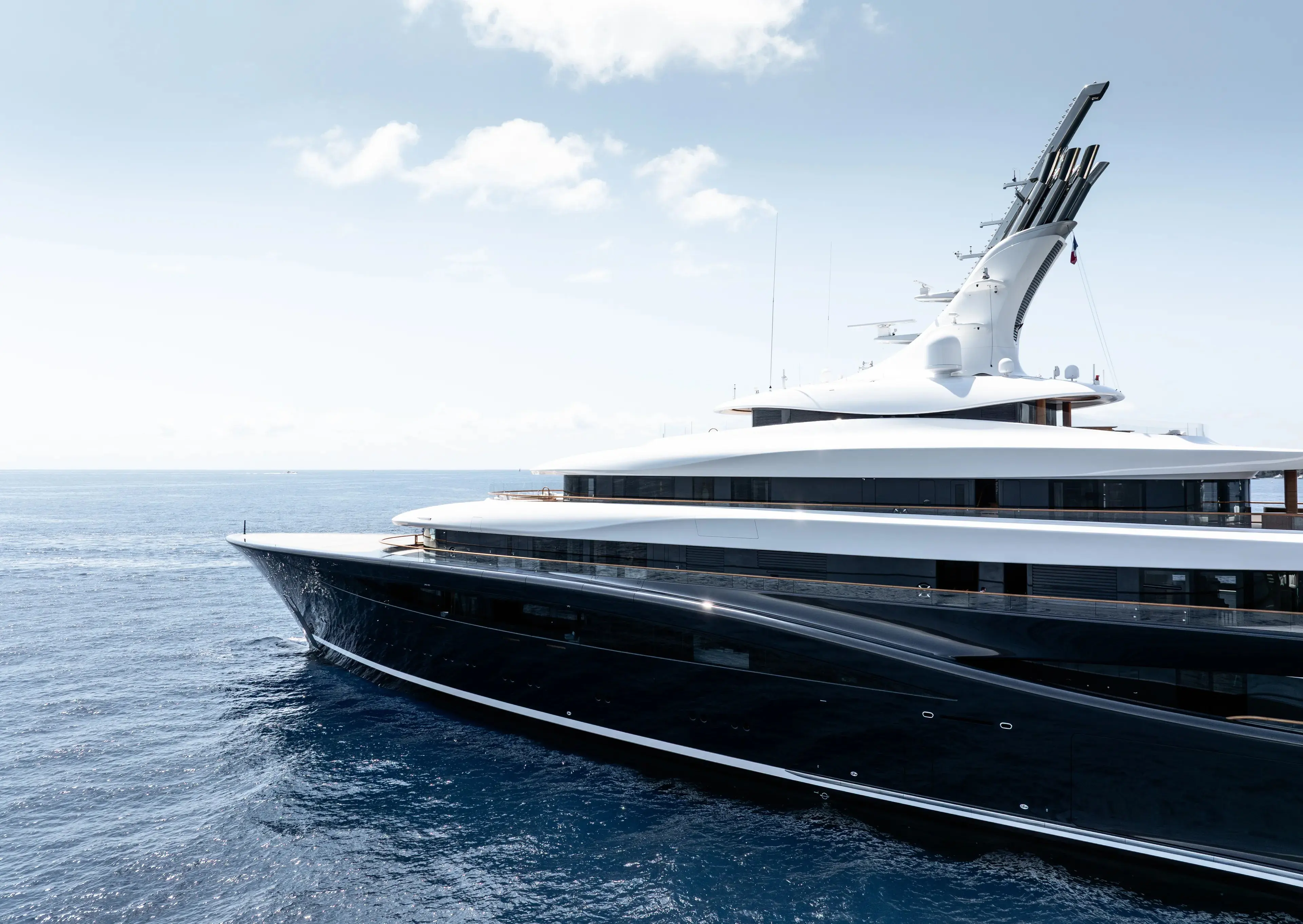
| 118,8 m LOA (390 ft), 7.247 GT | |
| Primo superyacht al mondo a celle a combustibile a idrogeno | |
| Sistema a celle a combustibile di circa 3,2 MW, idrogeno liquido a -253 C | |
| Circa 4 tonnellate di idrogeno, alimenta l'intero carico alberghiero | |
| Autonomia di circa 6.500 nm a 14 nodi, ibrido diesel elettrico | |
| Esterni e interni di RWD, 14 balconi | |
| Il più grande yacht mai costruito nei Paesi Bassi | |
| Varato ad Amsterdam nel 2024, prove in mare al largo di IJmuiden, rifornito di idrogeno nel 2025 |
Il primo della sua specie
Project 821, consegnato con il nome Breakthrough, è il primo superyacht al mondo a funzionare con celle a combustibile a idrogeno. Feadship ha impiegato quasi dieci anni per trasformare quella frase da ambizione di ricerca in uno yacht di 118,8 metri, uscito dal capannone di Amsterdam nel 2024. Nulla di tutto questo è un retrofit o un gesto simbolico. L'impianto a idrogeno è stato progettato per primo, e lo yacht è stato costruito per portarlo.
Il punto non è la novità, è la prova. Prima di Breakthrough un superyacht a emissioni zero era una slide in una relazione da convegno. Ora c'è uno scafo in acqua che può restare alla fonda per circa una settimana senza produrre alcuna emissione locale, alimentando luci, aria condizionata, cambusa e impianti interamente a idrogeno. È la parte più pesante in termini di carbonio nell'uso reale di un grande yacht, ed è la parte che Feadship ha scelto di risolvere per prima.
Come funziona l'idrogeno
Al centro dello yacht c'è un sistema a celle a combustibile di circa 3,2 megawatt, alimentato da idrogeno liquido conservato in un serbatoio criogenico a meno 253 gradi Celsius. Quella temperatura è la parte difficile. L'idrogeno diventa abbastanza denso da essere trasportato in quantità utile solo quando viene raffreddato vicino allo zero assoluto, e tenerlo lì in sicurezza a bordo di uno yacht in movimento era un problema che l'industria navale non aveva mai risolto a questa scala.
Il serbatoio contiene circa quattro tonnellate di idrogeno liquido, sufficienti a coprire il carico alberghiero, cioè il fabbisogno elettrico quotidiano che corre sia in navigazione sia da fermi. Quando le celle a combustibile convertono quell'idrogeno in elettricità l'unico sottoprodotto è acqua. Non c'è combustione, non c'è scarico e non c'è rumore di motore, ed è per questo che l'esperienza alla fonda somiglia al silenzio più di qualsiasi yacht convenzionale di queste dimensioni.
Un superyacht a emissioni zero era una slide da convegno. Breakthrough è lo scafo che l'ha reso reale.
Uno yacht costruito attorno a un serbatoio
Breakthrough è il più grande yacht mai costruito da Feadship e il più grande mai varato nei Paesi Bassi, con 118,8 metri e 7.247 GT. Parte di quella dimensione è una conseguenza diretta dell'ingegneria. L'impianto criogenico a idrogeno e le sue zone di sicurezza occupano volume reale, e l'architettura navale ha dovuto crescere per ospitarli senza rinunciare agli spazi interni che a questo livello un armatore si aspetta.
Esterni e interni sono opera di RWD, con Edmiston a rappresentare l'armatore per tutta la costruzione. Lo yacht porta quattordici balconi, il maggior numero di aperture nello scafo di qualsiasi Feadship finora, un dettaglio che dice quanto il progetto abbia spinto vetro e luce naturale dentro uno scafo che doveva anche ospitare una centrale di potenza mai realizzata prima. Il risultato si legge come un Feadship moderno, non come un esperimento scientifico travestito da yacht.
Potenza, autonomia e come naviga
Le celle a combustibile a idrogeno reggono il carico alberghiero. Il movimento è affidato a un impianto ibrido diesel elettrico, perché la densità energetica necessaria ad attraversare gli oceani con il solo idrogeno ancora non esiste. L'installazione affianca due generatori MTU da 900 kilowatt e tre da 2.500 kilowatt a sedici unità a idrogeno PowerCell da 185 kilowatt, uno schema che permette allo yacht di attingere alla fonte più adatta al momento.
Quella combinazione dà un'autonomia di circa 6.500 miglia nautiche a 14 nodi, capacità transoceanica vera. Breakthrough è stato varato nel bacino di Amsterdam nel maggio 2024 e ha completato le prime prove in mare al largo di IJmuiden nel novembre successivo, con il rifornimento di idrogeno arrivato nel 2025. Le fasi di messa in servizio raccontano quanto di tutto questo fosse nuovo, non solo per Feadship ma anche per i porti e i fornitori attorno allo yacht.
Che cosa segnala alla flotta
Il costo riferito si aggira sui 600 milioni di euro, e lo yacht è stato venduto internamente da Edmiston. Feadship non ha mai confermato chi ne sia l'armatore, e noi non trattiamo in nomi di armatori. Per una costruzione mai tentata prima la proprietà conta molto meno del fatto semplice che qualcuno sia stato disposto a finanziare il rischio.
È questa la vera storia di Project 821. Un cantiere, un armatore e una lunga catena di fornitori si sono assunti il costo e l'incertezza di dimostrare che l'idrogeno può funzionare a questa scala, e il resto del settore ha ora un riferimento che prima non esisteva. Che il prossimo Feadship a idrogeno arrivi fra tre anni o fra dieci, ognuno di essi risalirà a questo scafo.
What happened after delivery
Breakthrough did not stay with the family who commissioned her. Bill Gates never boarded the finished yacht, and Feadship's landmark hydrogen project was quietly remarketed within about a year of delivery. Canadian waste-management entrepreneur Patrick Dovigi bought her in a deal reported at more than USD 650 million, becoming the owner who has actually put the technology to work at sea.
Running her has proven expensive in ways a conventional yacht would not be. Her first annual class survey and maintenance program, carried out at the MB92 yard in La Ciotat over about a month in mid-2026, was reported at around USD 5 million, largely spent inspecting the cryogenic hydrogen installation alongside the five MTU generator sets and the twin ABB azimuth propulsion pods. And because the fuel cells cannot yet cover a transoceanic passage on their own, moving the yacht from Europe to Miami under her new owner meant loading roughly 605,000 litres of conventional fuel at a single stop, a bill reported at about USD 435,000. The zero-emission story holds up at anchor. Getting the yacht across an ocean still means a diesel bill like any other superyacht her size, which is the honest limit of where the technology stands today. That gap between the anchor-side promise and the open-ocean reality is exactly what the rest of the industry is watching Breakthrough to answer over the coming years.
Motori e impianti
| Hydrogen fuel-cell system | 16 PowerCell H2 fuel-cell modules producing about 3.2 MW combined, fed by liquid hydrogen stored at minus 253 C in a 92 cubic metre vacuum-insulated Type C tank supplied by MAN Cryo, holding about 4 tonnes (BOAT International, Luxurylaunches agree) |
|---|---|
| Backup and hybrid power | Three MTU 2,500 kW and two MTU 900 kW diesel generator sets, switching to conventional diesel-electric power when hydrogen is unavailable or for ocean crossings (BOAT International, Wikipedia) |
| Propulsion | Twin ABB 3,200 kW azimuth pods, top speed 17 knots, range about 6,500 nm at 14 knots (Wikipedia, Luxurylaunches) |
| Hull and naval architecture | De Voogt Naval Architects, steel hull with aluminium superstructure, 118.8 m LOA, 19.0 m beam, 7,247 GT (Wikipedia) |
| Accommodation | Reported inconsistently across the trade press: cabin counts of 12, 13 and 15 all appear for the same 30-guest capacity, and crew is reported as 43 or 44. Both ranges are given here rather than picked, per the two-source rule |
Cosa riferiscono armatori ed equipaggi
Commissioned by Bill Gates, delivered to a different owner
Project 821 was built to a brief shaped in part by Melinda French Gates, but Bill Gates never boarded the finished yacht. It was quietly remarketed after delivery and bought by Canadian waste-management entrepreneur Patrick Dovigi in a deal reported at more than USD 650 million.
Wikipedia and Luxurylaunches, corroborated by SuperYachtFan and Supercar BlondieFirst-year running cost
The new owner's first annual class survey and maintenance program, carried out at MB92 La Ciotat over about a month in mid-2026, was reported at around USD 5 million, covering the five MTU generator sets, the twin ABB azimuth pods and a full inspection of the cryogenic hydrogen installation.
LuxurylaunchesFuel bill for an ocean crossing
Moving the yacht from Europe to Miami under her new owner required about 605,000 litres of fuel at a single stop, reported to cost around USD 435,000, because the hydrogen system cannot cover a transoceanic passage on its own.
Supercar BlondieBroker's assessment
Jamie Edmiston, whose brokerage represented the seller, called Breakthrough "the most extraordinary yacht ever built, the one that will change it all."
Jamie Edmiston, Edmiston, quoted by BOAT International
Cosa convince e cosa va valutato
Punti di forza
- A working zero-emission system, not a conceptThe hydrogen fuel cells genuinely cover the hotel load, roughly 70 to 78 per cent of a yacht's annual energy use, letting Breakthrough sit at anchor for about a week producing only water as exhaust, the first time this has been proven at superyacht scale.
- Engineering that reshaped the hullFeadship grew the design specifically to house a 92 cubic metre cryogenic tank and its safety zones, and still delivered the largest yacht ever built in the Netherlands, at 118.8 m and 7,247 GT, with 14 balconies and seven fold-out platforms.
Da valutare
- Cannot yet cross an ocean on hydrogenThe fuel cells cannot power a transoceanic passage. Long-range cruising still means loading hundreds of thousands of litres of conventional or biofuel diesel, as the delivery run to Miami showed.
- Very expensive to keep runningA single early maintenance cycle was reported at about USD 5 million, and the first Atlantic refuelling stop alone cost roughly USD 435,000, costs a buyer of a pioneering system should expect to sit well above a conventional yacht of the same size.
Informazioni pratiche
| Reported price | Asking price reported at approximately EUR 600 million / USD 645 to 650 million; sold to Patrick Dovigi in a deal reported at over USD 650 million. Figures are press-reported, not an official Feadship price (BOAT International, Wikipedia, Supercar Blondie). |
|---|---|
| Reported running cost | First annual maintenance program reported at about USD 5 million in 2026, on top of normal crew, insurance and berthing for a roughly 44-crew, 118.8 m yacht (Luxurylaunches). |
| Fuel for long range | Hydrogen covers hotel load only. An Atlantic crossing under diesel or biofuel power was reported to need about 605,000 litres, costing roughly USD 435,000 at a single stop (Supercar Blondie). |
| Bunkering infrastructure | Received the first liquid-hydrogen bunkering ever supplied to a superyacht in the Netherlands, in June 2025, which required new regulatory sign-off (BOAT International). |
| Not publicly known | An official Feadship-confirmed sale price, the exact cabin count (reported variously as 12, 13 or 15), and independent third-party verification of the claimed one-week zero-emission endurance at anchor. |
Design
| Esterni | RWD (Redman Whiteley Dixon) |
|---|---|
| Architettura navale | Feadship - De Voogt Naval Architects |
A chi si rivolge: Un armatore disposto a finanziare una tecnologia mai realizzata prima e a mettere il proprio nome sulla road map del settore verso le emissioni zero.
Prezzo indicativo: Prezzo richiesto riferito di circa EUR 600 milioni / USD 645 milioni, venduto internamente da Edmiston. Le cifre sono riportate dalla stampa, non sono un prezzo ufficiale Feadship.