Galactica Star
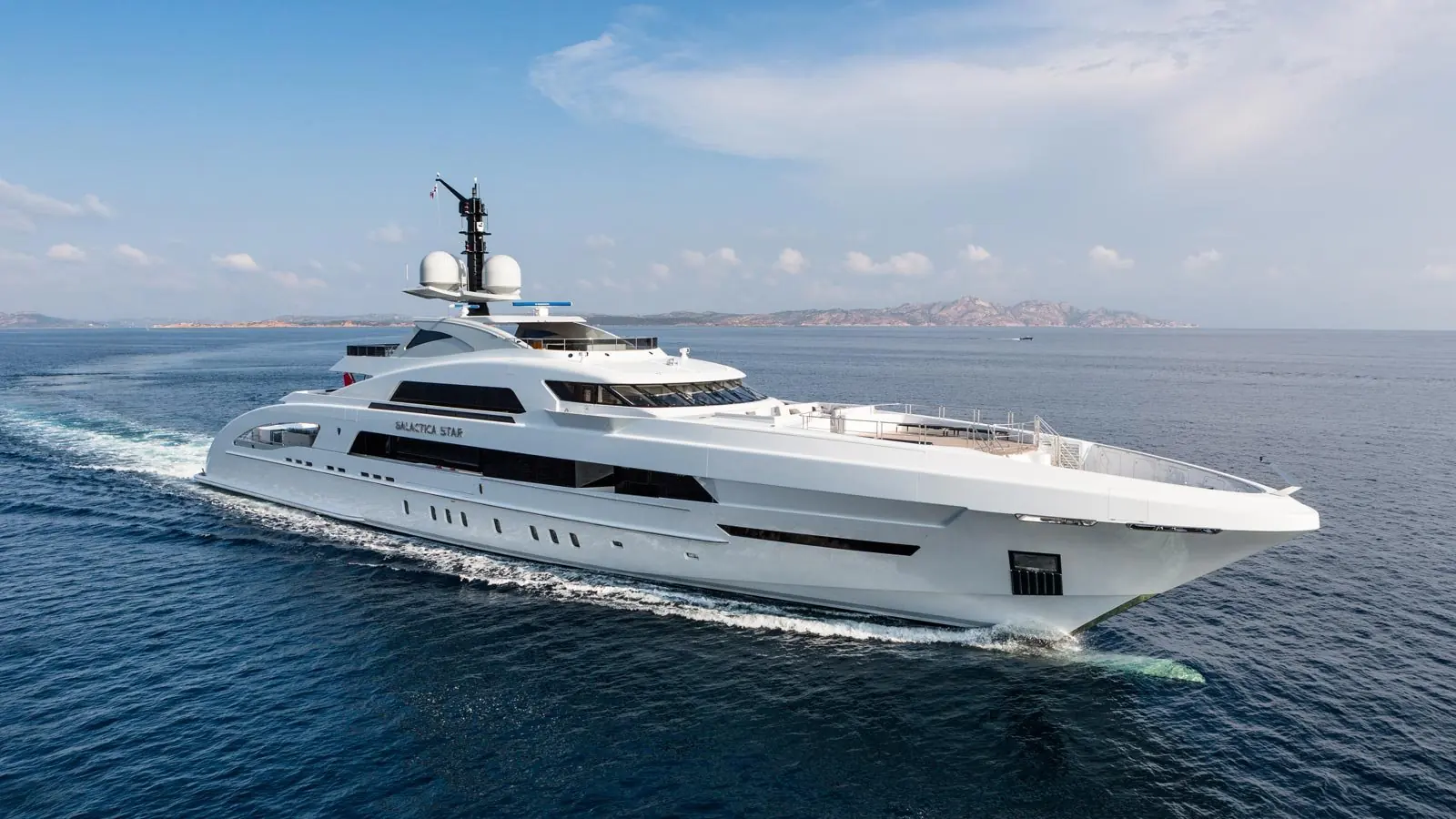
| LOA | 65 m |
|---|---|
| Consegna | 2013 |
| Architettura navale | FDHF Van Oossanen, prima applicazione completa |
| Esterni | Omega Architects |
| Interni | Bannenberg and Rowell |
| Sistemazioni | 12 ospiti, 13 di equipaggio |
| Velocità massima | 30 nodi in prova |
| Premio | World Superyacht Award 2014 |
Lo yacht che ha aperto un decennio
Quando Heesen ha consegnato Galactica Star nel maggio 2013, ha fatto più che varare un'ammiraglia di 65 metri. Noto in costruzione come Project Omnia, è stato la prima applicazione completa del Fast Displacement Hull Form sviluppato con Van Oossanen. Lo scafo prometteva la tenuta di mare di un dislocante con il passo di qualcosa di molto più corsaiolo, e le prove in mare hanno mantenuto. È poi andato a vincere ai World Superyacht Awards nel 2014. Quel riconoscimento ha confermato ciò che le prove in mare avevano già mostrato.
Per Heesen la barca è stata una prova di concetto che ha ridisegnato l'intera gamma. Quasi ogni yacht che il cantiere ha disegnato da allora fa risalire la propria efficienza a questo scafo. Per il suo armatore era un 65 metri davvero veloce con le maniere di una barca molto più tranquilla. Un decennio dopo è ancora un punto di riferimento in qualunque conversazione sui superyacht veloci. La sua influenza sulla gamma Heesen moderna è difficile da sopravvalutare.
Le linee veloci di Frank Laupman
Frank Laupman di Omega Architects ha disegnato un esterno che sembra rapido da fermo. Il profilo è lungo e asciutto, con prua verticale e sovrastruttura tesa che si accordano allo scafo sottostante. Oltre 267 metri quadrati di ponte si distribuiscono sui tre livelli superiori, così agli ospiti non manca mai spazio al sole o all'ombra. Lo stile è invecchiato con grazia inconsueta per una barca della sua epoca. Frank Laupman gli ha dato proporzioni che appaiono attuali ancora oggi.
Gli accorgimenti intelligenti sono strutturali quanto estetici. Un'elisuperficie sul ponte di prua funziona anche da terrazza solare, posta sopra portelli ad ala di gabbiano che si aprono a rivelare un garage tender a tutto baglio. A poppa, un beach club su due livelli si dispiega tra il ponte principale e quello inferiore per portare gli ospiti a filo d'acqua. Erano mosse audaci nel 2013 e impressionano ancora oggi a bordo. Il risultato è uno yacht che porta gli ospiti vicino all'acqua a ogni occasione.
Il primo Heesen a portare lo scafo Fast Displacement, e ancora un riferimento.
La mano libera di Bannenberg and Rowell
Dentro, a Bannenberg and Rowell è stato dato spazio per inventare. Il direttore creativo Simon Rowell ha descritto un linguaggio di design teso e disciplinato che scorre da ambiente ad ambiente senza un tema fisso. Il risultato appare coerente e attuale, un'unica idea portata per tutta la barca. Si legge come una sicurezza calma e ponderata. I materiali risultano misurati e costosi dappertutto. Gli ospiti percepiscono la qualità prima di saperla nominare.
Il layout ospita 12 ospiti, con una cabina armatoriale a tutto baglio, una VIP sul ponte superiore e altre quattro suite doppie. Un equipaggio di 13 mantiene il servizio impeccabile su tutti i ponti. I volumi sono generosi e il passaggio tra gli spazi conviviali è agevole. È un interno costruito per ricevere su scala seria. I soggiorni lunghi a bordo risultano naturali grazie alla fluidità tra gli spazi.
Trenta nodi, guadagnati onestamente
Il titolo ingegneristico è semplice. Galactica Star ha raggiunto 30 nodi in prova contro i 27 contrattuali, e lo fa bruciando circa il 30 per cento in meno di carburante rispetto a uno scafo convenzionale a sezione tonda della sua taglia. Quella combinazione era quasi inaudita a 65 metri nel 2013. Il Fast Displacement Hull Form ne era la ragione, e questa barca è stata la sua prima espressione completa. Quel primo successo ha ridisegnato ogni Heesen successivo. L'ingegneria si è dimostrata valida lungo un decennio di servizio.
Per un armatore ciò significa raggio e passo senza una bolletta punitiva del carburante. Può inseguire il bel tempo o una prenotazione a cena in velocità, e poi assestarsi su una traversata efficiente la mattina dopo. L'efficienza estende anche l'autonomia alle velocità di crociera. Poche barche hanno eguagliato la miscela di prestazioni ed economia che ha introdotto. Quell'equilibrio è ciò che lo ha reso un'ammiraglia così persuasiva ai suoi tempi.
L'armatore a cui si addice
Galactica Star si addice all'armatore che vuole un pezzo di storia dello yachting con le prestazioni a sostenere il racconto. È un 65 metri veloce e deciso con lo spazio sui ponti e il beach club per intrattenere una lista ospiti al completo. La sua provenienza come primo Heesen FDHF aggiunge uno strato che pochi rivali possono rivendicare. Per un acquirente che apprezza sia velocità sia pedigree, è un oggetto raro. Il suo posto nella storia del cantiere è saldo.
Ripaga anche un armatore che naviga attivamente e non ama aspettare. Il passo gli permette di coprire distanze che ammiraglie più lente trattano come un trasferimento. Il design premiato e il beach club su due livelli mantengono memorabile la vita a bordo alla fonda. Fa ancora girare la testa in qualunque porto tocchi. È uno yacht per un armatore a cui piace arrivare presto e con stile.
Motori e impianti
| Main engines | Twin MTU 20V 4000 M93L diesels, 4,300 kW each at 2,100 rpm (Romeo United Yachts, Yachts International) |
|---|---|
| Generators | Two Kohler Kilo-Pak sets, 175 kW each (Romeo United Yachts) |
| Stabilizers | Five Seakeeper M21000 gyro-stabilizers - an unusually high count, fitted to hold the fast-displacement hull steady at both speed and at anchor (Romeo United Yachts) |
| Fuel tankage | 90,000 litres / 23,770 US gallons (Romeo United Yachts) |
| Range and speed | Contracted for 27 knots, reached 30 knots on trials; range about 4,200 nm at 14 knots (Romeo United Yachts, Yachts International, the yard's own material) |
| Hull form | Van Oossanen Fast Displacement Hull Form, the first full application on an aluminium Heesen - the naval-architecture idea the boat exists to prove (Heesen, Offshore Energy) |
| Not publicly known | Bow and stern thruster make and output, watermaker capacity, and black/grey water tankage were not published in any source checked |
Cosa riferiscono armatori ed equipaggi
High-profile charter guests
Beyonce and Jay-Z chartered the yacht in the Mediterranean in 2016 to mark the singer's 32nd birthday, one of the few instances of independent, named guest use reported for this yacht.
Boss Hunting, reporting contemporary celebrity-press coverageOriginal ownership and seizure
The yacht was linked in US and Nigerian investigations to Kola Aluko and the wider Diezani Alison-Madueke corruption case before its 2017 seizure and 2019 court-ordered sale.
Wikipedia, SuperYacht Times and BOAT International, drawing on US Department of Justice and contemporary press reporting
Cosa convince e cosa va valutato
Punti di forza
- A genuine engineering landmark, not just a fast boatThe first full-scale application of Van Oossanen's Fast Displacement Hull Form on an aluminium Heesen, reaching 30 knots against a contracted 27 while burning roughly 30 per cent less fuel than a conventional round-bilge hull her size - a result the yard has built its modern range around (Heesen, Offshore Energy).
- Award-recognised design that has aged wellWon at the World Superyacht Awards in 2014, and the Omega Architects exterior and Bannenberg and Rowell interior are still cited as reference points a decade later.
Da valutare
- Her ownership history is a matter of public record, not marketingSeized in 2017 under the US Kleptocracy Asset Recovery Initiative over links to a Nigerian oil-corruption case involving former petroleum minister Diezani Alison-Madueke, then sold via a US court-ordered sealed-bid auction in 2019 and renamed Illusion (Wikipedia, SuperYacht Times, BOAT International). A prospective charter guest or student of the boat should know this is part of her record, not a rumour.
- No independent sea trial data beyond the yard's own figuresThe 30-knot trial result and the fuel-saving claim both trace back to Heesen and its naval architect; no third-party publication was found independently verifying the fuel-consumption comparison against a conventional hull.
Informazioni pratiche
| Original build price | Reported as EUR 65 million at her 2013 launch (Wikipedia, citing contemporary press) |
|---|---|
| 2019 auction sale | Sold via a US court-ordered judicial sealed-bid auction after seizure, reportedly for around USD 42 million against reserve, bought through Burgess representing an undisclosed buyer (Yacht Harbour, BOAT International, SuperYacht Times) |
| Charter rate (as ILLUSION) | Reported around USD 900,000 a week by YachtCharterFleet, though she was not a full-time commercial charter yacht in her original ownership - 'you had to know the owner to step aboard' per contemporary reporting |
| 2019 refit | Refitted after the ownership change, per YachtWorld's research write-up, before returning to service under the new name |
| Not publicly known | The identity of the buyer at the 2019 auction is not public - the vessel is held through the shell company Paxford Ltd and operated by Burgess Yachts (Wikipedia) |
A chi si rivolge: L'armatore che vuole un 65 metri veloce da pietra miliare con design premiato, un beach club su due livelli e 30 nodi veri.