Galactica Super Nova (70m)
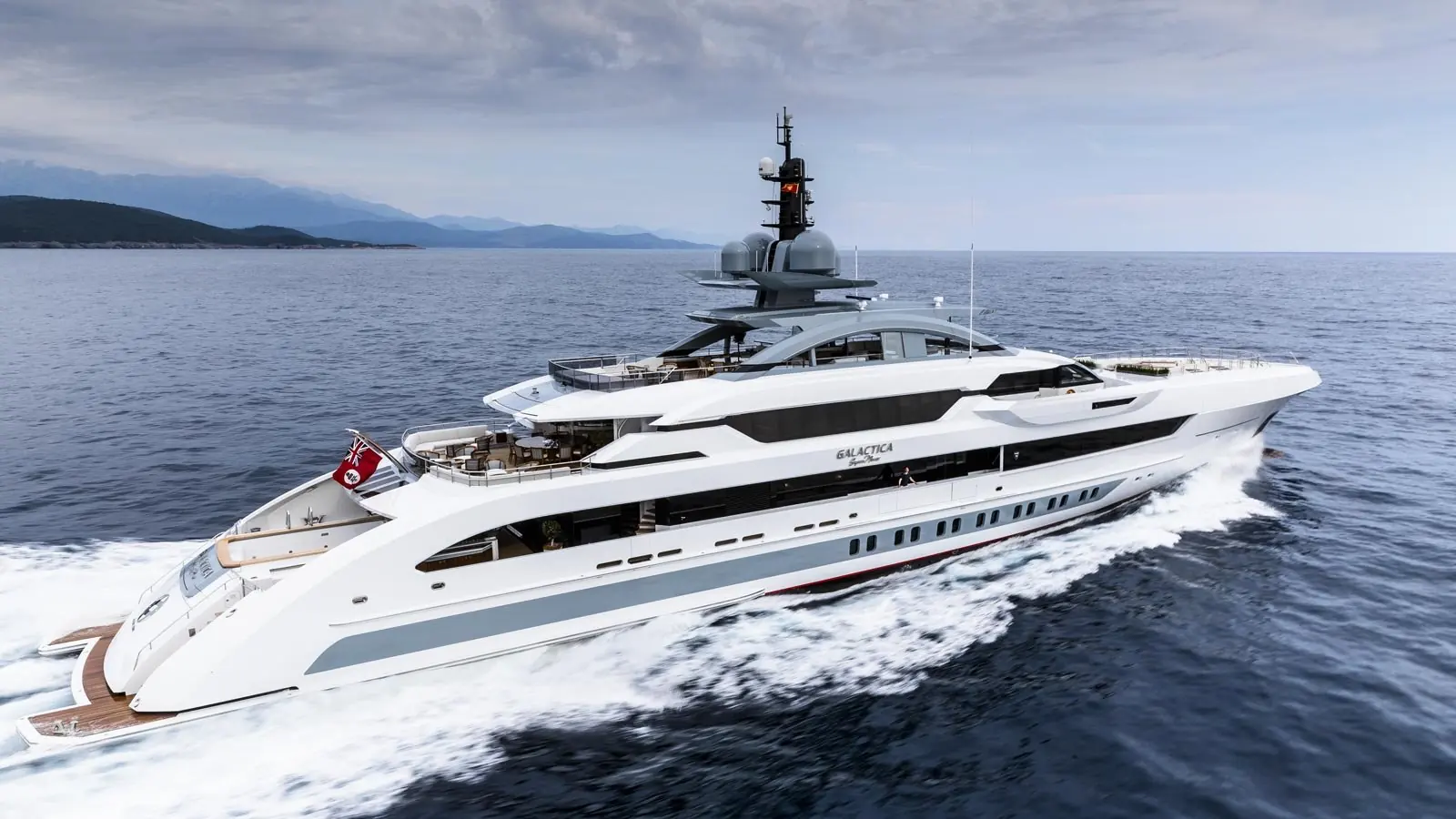
| LOA | 70,07 m |
|---|---|
| Baglio | 11,9 m |
| Stazza lorda | circa 1.200 GT |
| Velocità massima | 30 nodi |
| Autonomia | circa 4.000 nm a 12 nodi |
| Motori | due diesel MTU su eliche più un terzo MTU per l'idrogetto booster |
| Scafo | FDHF e sovrastruttura in alluminio |
| Design | esterni Espen Oeino, interni Sinot |
Un record per il cantiere nel 2016
Quando Galactica Super Nova è stato consegnato nel maggio 2016 era il più grande yacht che Heesen avesse mai costruito, con 70 metri. Ha anche dimostrato che il Fast Displacement Hull Form poteva crescere di scala senza perdere il proprio vantaggio. Una velocità massima di 30 nodi lo ha collocato tra i superyacht più veloci della sua classe in tutto il mondo. Per il cantiere è stato insieme una pietra miliare dimensionale e una dichiarazione prestazionale. Quella velocità massima lo mette ancora in testa al campo dei 70 metri un decennio dopo.
Il suo significato riguarda davvero il tetto che ha alzato. Raggiungere i trenta nodi su uno scafo in alluminio di 70 metri è un'impresa seria di architettura navale e di controllo del peso. Ha mostrato agli armatori che Heesen poteva portare l'idea dello scafo veloce in territorio da ammiraglia. Tutto quello che il cantiere ha fatto poi a 80 metri si costruisce su ciò che Super Nova ha dimostrato. La sua consegna ha dato a Heesen la fiducia per progettare scafi veloci ancora più grandi.
Trenta nodi da una linea di potenza inconsueta
Galactica Super Nova deve la propria velocità allo scafo FDHF Van Oossanen e a un'accorta disposizione della potenza. Due diesel MTU muovono eliche a passo fisso, e un terzo MTU alimenta un idrogetto booster per la punta massima. Quella configurazione gli permette di stare a una crociera economica sui motori principali e di chiamare l'idrogetto quando l'armatore vuole i 30 nodi pieni. I motori principali sono accreditati di circa 5.765 hp ciascuno. L'idrogetto resta fermo per gran parte della navigazione e si guadagna il proprio posto solo in cima alla gamma.
L'FDHF è ciò che rende utilizzabile quella velocità. Tiene bassa la resistenza su tutto l'arco, così è efficiente a una crociera di 12 nodi e resta comunque in grado di scattare. A quella crociera copre circa 4.000 miglia nautiche. Pochi yacht di 70 metri sanno passare da una traversata silenziosa ai trenta nodi con questa pulizia. Quel misto di raggio e passo è raro su uno yacht costruito così chiaramente per la velocità.
Uno dei 70 metri più veloci al mondo, con un idrogetto booster per 30 nodi veri.
Espen Oeino, scolpito per la velocità
Espen Oeino International ha firmato gli esterni, e il suo profilo rende evidente il passo da qualunque angolo. La sovrastruttura è lunga e bassa, scolpita per sembrare in movimento anche in banchina. Vetrate avvolgenti e linee tese gli danno una postura decisa e atletica. Il progetto è invecchiato bene, che è il segno di una mano disciplinata. Lo studio di Espen Oeino è noto proprio per questo tipo di linea sicura e sportiva.
Gli esterni offrono anche dotazioni vere su tutta la lunghezza. Ampi sun deck e un beach club come si deve vicino all'acqua danno agli ospiti spazio per distribuirsi. Lo stile non lascia mai che l'ingombro sui ponti rompa la corsa pulita del profilo. Forma e funzione stanno qui comodamente insieme. Un beach club apre la poppa sul mare per il bagno e per la gestione facile dei tender.
Sinot sottocoperta
Sinot Yacht Design ha creato gli interni per dodici ospiti tra una cabina armatoriale, una VIP e altre quattro suite. Lo stile è calmo e contemporaneo e usa materiali naturali per ammorbidire l'evidente potenza dello yacht. Il volume di uno scafo da 1.200 GT dà spazi conviviali generosi senza risultare cavernosi. È un contrappunto riposante alle prestazioni dello scafo. L'unica cabina armatoriale e una VIP stanno tra altre quattro suite ospiti a completare la dotazione.
La luce è un tema in tutte le aree ospiti. Grandi finestrature e piante aperte tengono il mare presente ovunque ci si sieda, e le finiture restano abbastanza discrete da lasciare guidare le vedute. Il layout si adatta sia a un uso familiare rilassato sia a riunioni più numerose. Il lavoro di Sinot si legge qui come senza tempo più che alla moda. Il ritegno mantiene il fuoco sull'acqua invece che sull'arredo.
Velocità seria per un armatore esigente
La storia ingegneristica è la linea combinata di diesel e idrogetto booster, una scelta inconsueta che offre insieme economia e una punta elevata. Tutto è costruito attorno alla difesa di quella cifra di trenta nodi mantenendo sensati i consumi in crociera. È uno yacht a propulsione convenzionale e non un ibrido, calibrato su un armatore che tiene al passo puro. I sistemi sono dimensionati per un'ammiraglia spinta con decisione. L'idrogetto booster è il pezzo che trasforma un veloce incrociatore in un autentico yacht da trenta nodi.
Galactica Super Nova si addice a un armatore che vuole davvero la velocità a 70 metri e non intende scendere a compromessi. Apprezza la possibilità di scappare al maltempo o semplicemente di arrivare per primo, sostenuta da volume e comfort da ammiraglia. Pochi yacht di questa lunghezza offrono questa miscela, il che lo mantiene desiderabile anni dopo la consegna. Per l'acquirente concentrato sulla velocità resta un riferimento. Per un decennio ha tenuto quella reputazione con pochissimo a insidiarla.
Motori e impianti
| Engines | Two MTU 20V 4000 M93L wing engines with fixed pitch propellers, each rated about 4,300 kW (5,766 hp), plus one central MTU 16V 4000 M93L engine driving a Rolls-Royce booster waterjet, rated about 3,440 kW (4,613 hp), combined over 16,000 hp. Consistent across Heesen's own spec page and Boat International. |
|---|---|
| Top speed | Conflict across sources: 30 knots per Heesen's current spec page and several directories, 30.3 knots per the widely cited Boat International sea trial report and an unofficial 32.7 knots at full load per Yachts International magazine. |
| Cruising speed | Conflict across sources: 12 knots per Heesen's own spec page and Yachts International, 14 knots per a Romeo United Yachts brokerage listing and 18 knots per a 2026 YachtCharterFleet listing under the name Gaja, which may reflect different operating profiles or a post refit figure. |
| Range | 4,000 nautical miles at 12 knots cruising, consistent across Heesen's own spec page, Boat International and Yachts International. |
| Hull form | Van Oossanen Fast Displacement Hull Form, aluminium hull and superstructure, credited with cutting resistance versus a conventional round bilge hull of similar size. |
| Fuel and water tankage | 89,000 litres fuel and 25,000 litres fresh water, consistent across Heesen's own spec page and the brokerage listing. |
| Stabilisers | Quantum extendable zero speed stabilisers, two fins, confirmed by Heesen's own spec page and the brokerage listing. |
| Tenders and toys | A forward tender garage houses tenders including an amphibious Quadski at delivery. A later charter inventory under the name Gaja lists a Boesch 750 Portofino de Luxe tender, a Narwhal SV-480 rescue boat, two Sea-Doo jet skis, a Yamaha WaveRunner, two Seabobs plus water skis and towables, describing a different point in time to the original build. |
| Notable features | A six metre swim jet infinity pool with glass panelling and hydro massage jets, a roughly 146 square metre beach club with 44 square metres of folding platforms, a nine metre foredeck cinema screen that converts to a nightclub setup, a Man Overboard Rapid Reaction System with automated buoys and a glass walled central elevator. |
| Gross tonnage, crew and guests | Conflict: 1,200 GT and 16 crew per most build era sources, 1,130 GT and 15 crew per Boat International's current directory entry under the name Gaja. Guest capacity is consistently reported as 12 guests in 6 cabins. |
Cosa riferiscono armatori ed equipaggi
Top speed came easily and the ride stayed smooth in a head sea
Captain Chris Guy described the delivery sea trial handling: "We did a speed run for the boss. On the main 20V MTUs alone we reached 26 knots." "We go from zero to top speed [30.3 knots] in 75 seconds." On a 1.5 metre head sea he said: "Last night we had a 1.5 metre sea against us and we were running at 15 knots. There was no slamming. None!"
Chris Guy, Captain of Galactica Super Nova, quoted in Boat InternationalInterceptors add a real knot of speed at full RPM
Confirmed through onboard testing that at full RPM the interceptors add roughly one additional knot of top speed.
Jan Kamstra, Yacht Engineer on Galactica Super Nova, quoted in Boat InternationalThe single jet, fixed prop layout hitting 30 knots is a genuine engineering achievement for this size
"Thirty knots is a great thing for a boat this size, especially with the simple fixed props and a single jet."
Perry van Oossanen, naval architect, Van Oossanen Naval Architects, quoted in Boat InternationalInterior design was kept consistent deck to deck with deliberate material shifts
On the interior scheme: "Every space is consistent. The detailing is the same, bridge to main to beach club, but there is a shift in materials and ceiling style to define each space."
Paul Costerus, Sinot Exclusive Yacht Design, quoted in Boat InternationalThe AV and entertainment system was engineered in from the start rather than added later
On the ten screen, multi zone audio visual system fitted across three decks: "We were able to work with the engineering team right from the start."
Ameet Sarvayia, Chief Technical Officer, VBH (AV integrator), quoted in Boat International
Cosa convince e cosa va valutato
Punti di forza
- A genuinely novel propulsion layout at deliveryTwo MTU wing engines with fixed pitch propellers plus a third central MTU engine driving a Rolls-Royce booster waterjet, a first time configuration for a yacht this size when she was built, paired with Van Oossanen's Fast Displacement Hull Form.
- Genuinely fast for her size classReached 30.3 knots on sea trial against a 30 knot contract, with zero to 30 knots in about 75 seconds. She was the largest and fastest yacht Heesen had built at the time, outrunning the yard's previous flagship Galactica Star at 28 knots.
- Peer recognised design and engineeringWon the Semi-Displacement or Planing Motor Yachts 50m and Above category at the 2017 World Superyacht Awards, with further recognition at the 2016 Monaco Yacht Show.
- Reported good sea keeping despite the speed focusThe captain describes running at 15 knots into a 1.5 metre head sea with no slamming, an unusual claim for a fast displacement hull this size, though it is a single first hand account rather than an independent test.
Da valutare
- Ownership history is a major diligence item, not a footnoteBuilt for Vagit Alekperov, president and CEO of Russia's Lukoil, who was placed under UK sanctions in April 2022. The yacht stopped transmitting AIS after leaving Tivat, Montenegro that March, required by law to run at all times for a vessel this size. Boat International's own current directory now lists her under a different name, Gaja. Independently verified reporting (The Daily Beast, Yahoo News, Wikipedia's list of yachts affected by Russia sanctions) confirms the sanctions date and the AIS blackout; a prospective buyer or charterer needs full, independently verified beneficial ownership and title history before proceeding, not marketing material.
- Published specs do not agree with each other, even among reputable sourcesTop speed is variously reported as 30 knots on the current builder spec page, 30.3 knots in the widely cited Boat International sea trial account and an unofficial 32.7 knots at full load in Yachts International magazine. Cruising speed is reported as 12, 14 or 18 knots depending on source. Gross tonnage appears as both 1,200 GT and 1,130 GT. No single number should be taken as authoritative without checking a current spec sheet.
- A specialised, non standard drivetrainThe mixed fixed pitch twin engine plus centreline waterjet booster arrangement is unusual for a yacht this size. A buyer should confirm parts availability, service history and refit costs for the Rolls-Royce booster jet specifically, since it is less common in the field than conventional shaftline or pod propulsion.
- Now approaching a decade old, under an unclear current name and registrationDelivered in 2016. A 2026 charter listing refers to her as Gaja, ex Galactica Super Nova and notes a 2026 refit; Boat International's directory records the same name change. A buyer or charterer should confirm which name, flag and management company currently apply and what the refit scope covered, rather than assume continuity with the original 2016 build.
Informazioni pratiche
| Charter rate | Reported at EUR 750,000 per week low season and EUR 800,000 per week high season plus expenses for the Mediterranean season, May to September, under the current charter name Gaja, per YachtCharterFleet. |
|---|---|
| Sale asking price | Listed for sale at EUR 75,000,000 jointly through Burgess and Arcon Yachts, also cross listed by Romeo United Yachts. Some value trackers estimate market value around USD 80,000,000. The original 2016 build cost was not found in any named source and should not be assumed. |
| Current name and status | Built and delivered as Galactica Super Nova in 2016. Boat International's directory now lists her under the name Gaja, with Galactica Super Nova recorded as a previous name. She appears simultaneously listed for sale and for charter in different trackers; a buyer should reconcile directly with the listing brokers before assuming availability. |
| Ownership and sanctions diligence | Original owner Vagit Alekperov of Lukoil was UK sanctioned in April 2022. The vessel went dark on AIS tracking off Montenegro shortly before. Any transaction should be preceded by independent legal and compliance due diligence on current title and beneficial ownership, which is not disclosed in brokerage marketing. |
| What is not published | No named source discloses the original 2016 build price. No independent, non owner, non yard sea trial or long term ownership review was found beyond the Boat International feature. Current mechanical condition, refit scope and maintenance history beyond the noted 2026 refit are not publicly detailed. |
| Booking and access | Charter and sale enquiries go through named brokerages: YachtCharterFleet listed agents for charter and the Burgess and Arcon Yachts network for sale. There is no public direct owner booking channel. |
Design
| Esterni | Espen Oeino (Espen Oeino International) |
|---|---|
| Interni | Sinot Yacht Architecture & Design (Sander Sinot) |
| Architettura navale | Van Oossanen Naval Architects / Heesen (aluminium Fast Displacement Hull Form) |
A chi si rivolge: Un armatore orientato alle prestazioni che vuole 30 nodi autentici a 70 metri con volume e comfort da ammiraglia, e che è contento di far girare una linea di potenza convenzionale ad alta potenza per ottenerli.