Galactica Star
| Longueur hors tout | 65 m |
|---|---|
| Livraison | 2013 |
| Architecture navale | FDHF Van Oossanen, première application complète |
| Extérieur | Omega Architects |
| Intérieur | Bannenberg and Rowell |
| Aménagement | 12 invités, 13 membres d'équipage |
| Vitesse de pointe | 30 noeuds aux essais |
| Récompense | World Superyacht Award 2014 |
Le yacht qui a ouvert une décennie
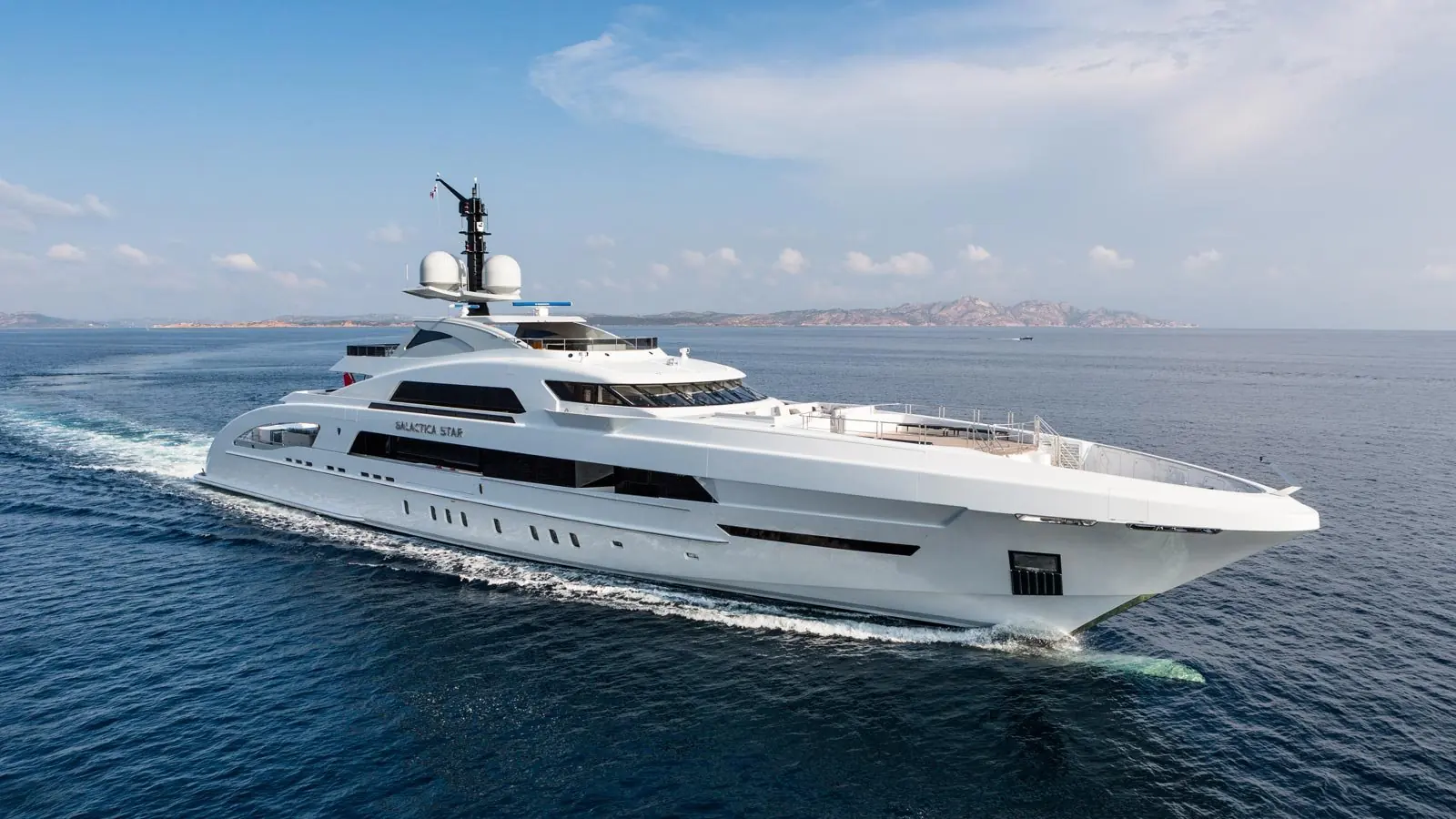
Quand Heesen a livré Galactica Star en mai 2013, il ne s'agissait pas seulement de lancer un vaisseau amiral de 65 mètres. Connu en construction sous le nom de Project Omnia, il était la première application complète de la Fast Displacement Hull Form mise au point avec Van Oossanen. La carène promettait la tenue à la mer d'un bateau à déplacement avec le rythme de quelque chose de bien plus racé, et les essais en mer ont tenu la promesse. Il a ensuite gagné aux World Superyacht Awards en 2014. Cette reconnaissance a confirmé ce que les essais avaient déjà montré.
Pour Heesen, le bateau était une preuve de concept qui a redessiné toute la gamme. Presque chaque yacht dessiné par le chantier depuis ramène son efficience à cette carène. Pour son propriétaire, c'était un 65 mètres réellement rapide avec les manières d'un bateau bien plus calme. Dix ans plus tard, il reste un point de référence dans toute conversation sur les superyachts rapides. Son influence sur la gamme Heesen moderne est difficile à surestimer.
Les lignes rapides de Frank Laupman
Frank Laupman, d'Omega Architects, a dessiné un extérieur qui paraît rapide à l'arrêt. Le profil est long et effilé, avec une étrave verticale et une superstructure tendue qui conviennent à la carène en dessous. Plus de 267 mètres carrés de pont se répartissent sur ses trois niveaux supérieurs, si bien que les invités ne manquent jamais de place au soleil ou à l'ombre. Le style a vieilli avec une grâce inhabituelle pour un bateau de son époque. Frank Laupman lui a donné des proportions qui paraissent encore actuelles aujourd'hui.
Les trouvailles sont structurelles autant qu'esthétiques. Un hélipont de pont avant fait aussi office de terrasse solarium, posé sur des portes en ailes de mouette qui s'ouvrent sur un garage à tender pleine largeur. À l'arrière, un beach club en duplex se déploie sur les ponts principal et inférieur pour amener les invités à la flottaison. C'étaient des gestes audacieux en 2013 et ils impressionnent encore à bord aujourd'hui. Le résultat est un yacht qui rapproche les invités de l'eau à chaque occasion.
Le premier Heesen à porter la carène Fast Displacement, et toujours une référence.
La main libre de Bannenberg and Rowell
À l'intérieur, Bannenberg and Rowell ont eu de la place pour inventer. Le directeur de création Simon Rowell a décrit un langage de design tendu et discipliné, qui circule d'un espace à l'autre sans thème imposé. Le résultat paraît cohérent et actuel, une seule idée portée dans tout le bateau. Cela se lit comme une confiance calme et réfléchie. Les matières paraissent retenues et coûteuses d'un bout à l'autre. Les invités sentent la qualité avant de pouvoir la nommer.
L'aménagement accueille 12 invités, avec une cabine propriétaire pleine largeur, une VIP sur le pont supérieur et quatre autres suites doubles. Un équipage de 13 personnes assure un service sans couture sur tous les ponts. Les volumes sont généreux et la circulation entre les espaces de réception est facile. C'est un intérieur bâti pour recevoir à une échelle sérieuse. Les longs séjours à bord se passent sans effort grâce à cette fluidité entre les espaces.
Trente noeuds, honnêtement gagnés
Le titre technique est simple. Galactica Star a atteint 30 noeuds aux essais contre 27 au contrat, et il le fait en brûlant environ 30 % de carburant en moins qu'une carène classique à bouchain arrondi de sa taille. Cette combinaison était quasiment inédite à 65 mètres en 2013. La Fast Displacement Hull Form en était la raison, et ce bateau en était la première expression complète. Ce premier succès a redessiné tous les Heesen qui ont suivi. L'ingénierie a fait ses preuves sur une décennie de service.
Pour un propriétaire, cela signifie de l'allonge et du rythme sans facture de carburant punitive. Il peut poursuivre le beau temps ou une réservation au restaurant à vive allure, puis se caler dans une traversée efficiente le lendemain matin. L'efficience allonge aussi son autonomie aux vitesses de croisière. Peu de bateaux ont égalé le mélange de performance et d'économie qu'il a introduit. Cet équilibre est ce qui en a fait un vaisseau amiral si convaincant à son époque.
Le propriétaire auquel il convient
Galactica Star convient au propriétaire qui veut un morceau d'histoire du yachting avec la performance pour appuyer le récit. C'est un 65 mètres rapide et marquant, avec l'espace de pont et le beach club pour recevoir un effectif complet d'invités. Sa provenance de premier Heesen FDHF ajoute une couche que peu de rivaux peuvent revendiquer. Pour un acheteur qui prise à la fois la vitesse et le pedigree, c'est un objet rare. Sa place dans l'histoire du chantier est acquise.
Il récompense aussi un propriétaire qui navigue activement et déteste attendre. Le rythme lui permet d'avaler des distances que des vaisseaux amiraux plus lents traitent comme un convoyage. Le design primé et le beach club en duplex gardent la vie à bord mémorable au mouillage. Il fait encore tourner les têtes dans chaque port qu'il visite. C'est un yacht pour un propriétaire qui aime arriver vite et avec allure.
Motorisation et systèmes
| Main engines | Twin MTU 20V 4000 M93L diesels, 4,300 kW each at 2,100 rpm (Romeo United Yachts, Yachts International) |
|---|---|
| Generators | Two Kohler Kilo-Pak sets, 175 kW each (Romeo United Yachts) |
| Stabilizers | Five Seakeeper M21000 gyro-stabilizers - an unusually high count, fitted to hold the fast-displacement hull steady at both speed and at anchor (Romeo United Yachts) |
| Fuel tankage | 90,000 litres / 23,770 US gallons (Romeo United Yachts) |
| Range and speed | Contracted for 27 knots, reached 30 knots on trials; range about 4,200 nm at 14 knots (Romeo United Yachts, Yachts International, the yard's own material) |
| Hull form | Van Oossanen Fast Displacement Hull Form, the first full application on an aluminium Heesen - the naval-architecture idea the boat exists to prove (Heesen, Offshore Energy) |
| Not publicly known | Bow and stern thruster make and output, watermaker capacity, and black/grey water tankage were not published in any source checked |
Ce que rapportent propriétaires et équipages
High-profile charter guests
Beyonce and Jay-Z chartered the yacht in the Mediterranean in 2016 to mark the singer's 32nd birthday, one of the few instances of independent, named guest use reported for this yacht.
Boss Hunting, reporting contemporary celebrity-press coverageOriginal ownership and seizure
The yacht was linked in US and Nigerian investigations to Kola Aluko and the wider Diezani Alison-Madueke corruption case before its 2017 seizure and 2019 court-ordered sale.
Wikipedia, SuperYacht Times and BOAT International, drawing on US Department of Justice and contemporary press reporting
Les points forts et les points de vigilance
Points forts
- A genuine engineering landmark, not just a fast boatThe first full-scale application of Van Oossanen's Fast Displacement Hull Form on an aluminium Heesen, reaching 30 knots against a contracted 27 while burning roughly 30 per cent less fuel than a conventional round-bilge hull her size - a result the yard has built its modern range around (Heesen, Offshore Energy).
- Award-recognised design that has aged wellWon at the World Superyacht Awards in 2014, and the Omega Architects exterior and Bannenberg and Rowell interior are still cited as reference points a decade later.
Points de vigilance
- Her ownership history is a matter of public record, not marketingSeized in 2017 under the US Kleptocracy Asset Recovery Initiative over links to a Nigerian oil-corruption case involving former petroleum minister Diezani Alison-Madueke, then sold via a US court-ordered sealed-bid auction in 2019 and renamed Illusion (Wikipedia, SuperYacht Times, BOAT International). A prospective charter guest or student of the boat should know this is part of her record, not a rumour.
- No independent sea trial data beyond the yard's own figuresThe 30-knot trial result and the fuel-saving claim both trace back to Heesen and its naval architect; no third-party publication was found independently verifying the fuel-consumption comparison against a conventional hull.
Informations pratiques
| Original build price | Reported as EUR 65 million at her 2013 launch (Wikipedia, citing contemporary press) |
|---|---|
| 2019 auction sale | Sold via a US court-ordered judicial sealed-bid auction after seizure, reportedly for around USD 42 million against reserve, bought through Burgess representing an undisclosed buyer (Yacht Harbour, BOAT International, SuperYacht Times) |
| Charter rate (as ILLUSION) | Reported around USD 900,000 a week by YachtCharterFleet, though she was not a full-time commercial charter yacht in her original ownership - 'you had to know the owner to step aboard' per contemporary reporting |
| 2019 refit | Refitted after the ownership change, per YachtWorld's research write-up, before returning to service under the new name |
| Not publicly known | The identity of the buyer at the 2019 auction is not public - the vessel is held through the shell company Paxford Ltd and operated by Burgess Yachts (Wikipedia) |
Pour qui: Le propriétaire qui veut un 65 mètres rapide et marquant, avec un design primé, un beach club en duplex et de vrais 30 noeuds.